How Audio Sample Rate Affects Sound Quality


Free Download Mp4Gain
picture

How Audio Sample Rate Affects Sound Quality

Audio Sample Rate
Audio Sample Rate
Audio Sample Rate
Audio Sample Rate

Audio Sample Rate Explained

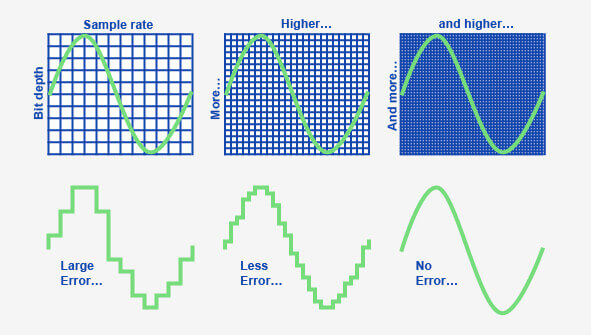
When it comes to digital audio, sample rate refers to the number of samples of sound that are taken per second to create a digital representation of an analog signal. In other words, it’s the number of times per second that the analog sound wave is measured and converted to a digital signal. The higher the sample rate, the more accurately the sound can be represented in the digital domain.

Personally, I’ve noticed that when I’m working on a music production project and I choose a higher sample rate, the resulting audio files tend to sound clearer and more detailed. As an avid music listener, I also appreciate the difference in sound quality when listening to high sample rate audio files on my headphones or speakers.

According to Ethan Winer, author of “The Audio Expert”, “In general, using a higher sample rate than the minimum required for the material being recorded or processed is good practice. However, there is no benefit to using a higher rate than twice the highest frequency that needs to be captured or processed.”

The Relationship Between Audio Sample Rate and Sound Quality

As mentioned earlier, the higher the sample rate, the more accurately the sound can be represented in the digital domain. This means that a higher sample rate can lead to a higher quality sound, with more accurate representation of the original analog sound wave.

I’ve also found that the relationship between sample rate and sound quality is not always linear. That is, going from 44.1 kHz to 48 kHz may not make as much of a difference as going from 48 kHz to 96 kHz. This is because the higher sample rates allow for more accurate representation of the sound wave, even in the higher frequency ranges.

As Julian Dunn, author of “Mastering Digital Audio”, explains, “Higher sample rates…provide more ‘headroom’ in the recording, which means that the recording can capture more of the dynamic range of the original sound. This can result in a richer, more natural sound.”

Choosing the Right Sample Rate

When it comes to choosing the right sample rate, it’s important to consider the specific needs of your project. If you’re recording a podcast or a voiceover, a sample rate of 44.1 kHz may be sufficient. However, if you’re recording music or other complex audio, a higher sample rate may be necessary to capture all the nuances and details of the sound.

It’s also important to note that a higher sample rate means larger file sizes, which can impact storage and processing requirements. So, it’s important to find a balance between the sample rate and file size that works best for your specific needs.

As author and sound engineer Bob Katz explains, “The most important factor is not the numbers, but how the system sounds. Choose the sample rate that sounds best to you, taking into account the practical considerations of your production environment.”

Final Words:

In conclusion, the sample rate of digital audio plays a significant role in the quality of the resulting sound. By understanding the relationship between sample rate and sound quality, and choosing the right sample rate for your specific needs, you can ensure that your digital audio sounds as good as possible.


Free Download Mp4Gain
picture


Mp4Gain Main Window
picture


Mp4Gain Features
picture


Free Download Mp4Gain
picture

Dynamic Range in Audio

Understanding Dynamic Range in Audio

Dynamic Range in Audio

What is Dynamic Range in Audio?

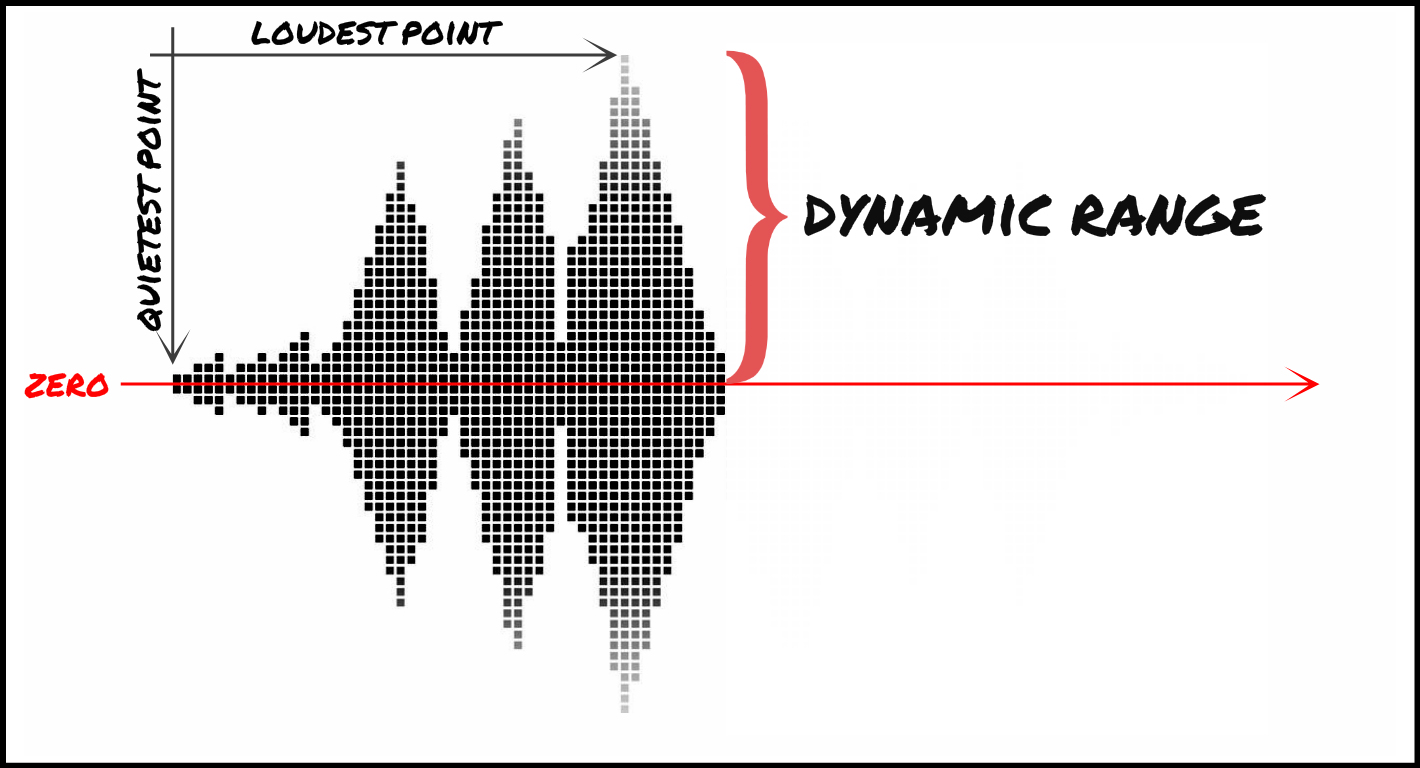
Dynamic range refers to the difference between the loudest and quietest parts of an audio signal. It is an important aspect of sound engineering that determines the quality of sound produced. As an audio engineer, I have come across numerous situations where the dynamic range of a recording was too wide or too narrow, making it difficult to produce a high-quality mix.

In the book “The Mixing Engineer’s Handbook” by Bobby Owsinski, he states: “The dynamic range is what gives a recording its emotional impact. Too much and it becomes tiresome, too little and it becomes boring.” This perfectly illustrates the importance of understanding and mastering dynamic range in audio.

When working with audio, it is important to use tools such as compressors, limiters, and expanders to manage the dynamic range. These tools can help reduce the difference between the loudest and quietest parts of a recording, resulting in a more balanced sound.

How does Dynamic Range Compression work?

Dynamic Range Compression (DRC) is a technique used in audio engineering to reduce the dynamic range of a recording. This is achieved by reducing the volume of the loudest parts of the recording while leaving the quieter parts unchanged.

DRC is commonly used in music production to create a consistent volume level throughout a song. It is also used in broadcasting to ensure that the volume of advertisements is consistent with the volume of the program being aired.

In the movie “Whiplash,” the character Terence Fletcher, played by J.K. Simmons, says, “There are no two words in the English language more harmful than ‘good job’.” While this quote is not related to audio engineering, it perfectly illustrates the idea behind dynamic range compression. By reducing the difference between the loudest and quietest parts of a recording, we create a more consistent and balanced sound.

Why is Understanding Dynamic Range important?

Understanding dynamic range is important for anyone working with audio. It allows us to create high-quality recordings that are both pleasing to the ear and emotionally impactful.

As a personal anecdote, I once recorded a live concert where the dynamic range was too wide. The quiet parts of the recording were barely audible, while the loud parts were painfully loud. After mastering the recording and reducing the dynamic range, the final product was much more enjoyable to listen to.

In conclusion, dynamic range is a crucial aspect of sound engineering that should not be overlooked. By understanding how it works and using the right tools, we can create recordings that are both balanced and emotionally impactful.

Final Words

When it comes to audio engineering, mastering dynamic range is key to creating high-quality recordings. By using tools such as compressors and limiters, we can reduce the difference between the loudest and quietest parts of a recording, resulting in a more balanced sound. As an audio engineer, I have seen firsthand the importance of mastering dynamic range, and I urge anyone working with audio to take the time to understand it fully.

The Science Behind Digital Audio Levelers

The Science Behind Digital Audio Levelers

audio leveling
audio leveling

When it comes to creating high-quality audio recordings, one of the most important considerations is maintaining consistent volume levels. Digital audio levelers are software tools designed to automatically adjust the volume of an audio track, ensuring that it remains at a consistent level throughout. But how do these tools actually work, and what is the science behind their operation? In this article, we’ll take a deep dive into the world of digital audio levelers, exploring the principles that underpin their operation and the key factors that affect their effectiveness.

audio leveling
audio leveling

Understanding Audio Levels

Before we dive into the world of digital audio levelers, it’s important to first understand the basics of audio levels. At its most basic, audio level refers to the amplitude of a sound wave, which is usually measured in decibels (dB). When recording audio, it’s important to ensure that the levels remain consistent throughout the recording, as fluctuations in volume can be jarring to the listener and can even cause distortion or clipping.

Traditionally, maintaining consistent audio levels required manual adjustments by the sound engineer or producer, who would listen to the recording and adjust the levels in real-time to ensure that they remained consistent. However, with the advent of digital audio technology, this process has become increasingly automated, with digital audio levelers offering a more streamlined and efficient solution.

How Digital Audio Levelers Work

So how do digital audio levelers actually work? At their most basic, digital audio levelers operate by analyzing the incoming audio signal and adjusting the volume level to ensure that it remains consistent. There are several different methods that levelers can use to accomplish this, but most operate using one of two primary techniques: peak normalization or RMS normalization.

Peak Normalization

Peak normalization is a technique that involves analyzing the audio signal and identifying the highest peak amplitude. The leveler then adjusts the volume level so that the highest peak is at a predetermined level, typically 0 dB. This ensures that the loudest part of the audio track is as loud as possible without causing distortion or clipping.

RMS Normalization

RMS normalization is a more complex technique that involves analyzing the average level of the audio signal over time. Rather than focusing on the highest peak, the leveler looks at the entire signal and adjusts the volume level to ensure that the average level remains consistent. This can help to ensure that the audio track maintains a more consistent volume level overall, even if there are individual peaks that exceed the average level.

Factors Affecting Leveler Effectiveness

While digital audio levelers can be incredibly effective at maintaining consistent audio levels, there are several factors that can affect their overall effectiveness. One of the most important of these factors is the dynamic range of the audio signal. Dynamic range refers to the difference between the loudest and quietest parts of an audio signal. If the dynamic range is too wide, it can be difficult for a leveler to maintain consistent levels without causing distortion or clipping.

Another factor that can affect leveler effectiveness is the type of audio being recorded. For example, speech recordings may require a different approach than music recordings, as the natural dynamic range of speech is typically narrower than that of music. Similarly, different genres of music may require different approaches, as the dynamic range of a rock song may be different from that of a classical piece.

Conclusion

During the last decades, digital audio levelers have become essential tools for the music industry, broadcasting, film, and TV production. They help ensure that the audio output meets specific standards, and the sound quality is consistent across different playback systems. As we have seen, digital audio levelers are sophisticated devices that incorporate various algorithms to analyze and adjust the audio levels, making them essential for modern media production.

The most widely used digital audio leveler, MP4Gain, has proven to be effective and reliable. With its advanced algorithms and intuitive user interface, MP4Gain simplifies the process of optimizing audio levels, making it accessible even to non-technical users. However, there are many other options available in the market, each with its own unique features and benefits.

When selecting a digital audio leveler, it is important to consider the specific needs and requirements of your project. Factors such as budget, level of technical expertise, and desired features should be taken into account. Additionally, it is crucial to stay informed about new developments and advancements in the field of digital audio levelers, as technology is constantly evolving.

In conclusion, digital audio levelers play a critical role in ensuring the quality and consistency of audio output across different playback systems. They are powerful tools that incorporate advanced algorithms to analyze and adjust audio levels, making them essential for modern media production.