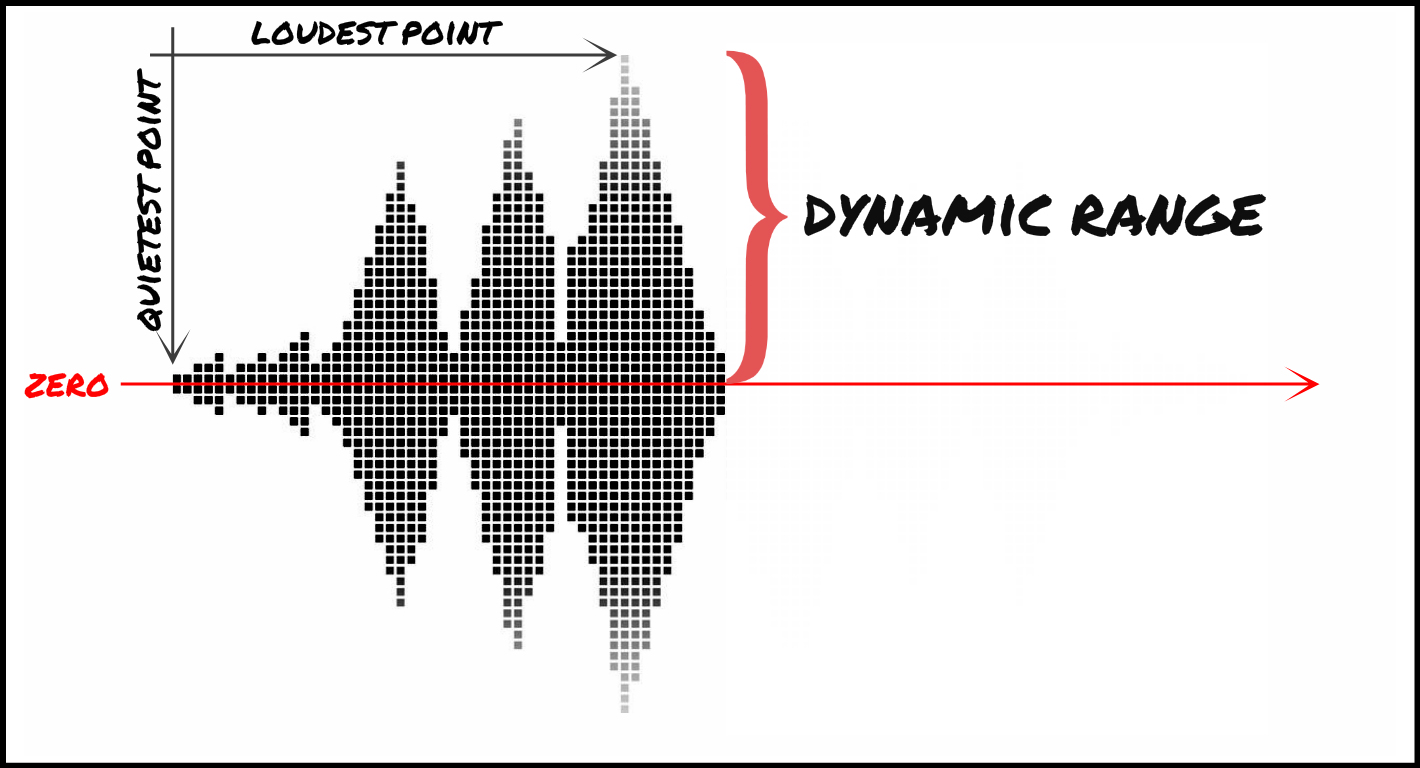
Dynamic range refers to the difference between the loudest and quietest parts of an audio signal. It is an important aspect of sound engineering that determines the quality of sound produced. As an audio engineer, I have come across numerous situations where the dynamic range of a recording was too wide or too narrow, making it difficult to produce a high-quality mix.
In the book “The Mixing Engineer’s Handbook” by Bobby Owsinski, he states: “The dynamic range is what gives a recording its emotional impact. Too much and it becomes tiresome, too little and it becomes boring.” This perfectly illustrates the importance of understanding and mastering dynamic range in audio.
When working with audio, it is important to use tools such as compressors, limiters, and expanders to manage the dynamic range. These tools can help reduce the difference between the loudest and quietest parts of a recording, resulting in a more balanced sound.
How does Dynamic Range Compression work?
Dynamic Range Compression (DRC) is a technique used in audio engineering to reduce the dynamic range of a recording. This is achieved by reducing the volume of the loudest parts of the recording while leaving the quieter parts unchanged.
DRC is commonly used in music production to create a consistent volume level throughout a song. It is also used in broadcasting to ensure that the volume of advertisements is consistent with the volume of the program being aired.
In the movie “Whiplash,” the character Terence Fletcher, played by J.K. Simmons, says, “There are no two words in the English language more harmful than ‘good job’.” While this quote is not related to audio engineering, it perfectly illustrates the idea behind dynamic range compression. By reducing the difference between the loudest and quietest parts of a recording, we create a more consistent and balanced sound.
Why is Understanding Dynamic Range important?
Understanding dynamic range is important for anyone working with audio. It allows us to create high-quality recordings that are both pleasing to the ear and emotionally impactful.
As a personal anecdote, I once recorded a live concert where the dynamic range was too wide. The quiet parts of the recording were barely audible, while the loud parts were painfully loud. After mastering the recording and reducing the dynamic range, the final product was much more enjoyable to listen to.
In conclusion, dynamic range is a crucial aspect of sound engineering that should not be overlooked. By understanding how it works and using the right tools, we can create recordings that are both balanced and emotionally impactful.
Final Words
When it comes to audio engineering, mastering dynamic range is key to creating high-quality recordings. By using tools such as compressors and limiters, we can reduce the difference between the loudest and quietest parts of a recording, resulting in a more balanced sound. As an audio engineer, I have seen firsthand the importance of mastering dynamic range, and I urge anyone working with audio to take the time to understand it fully.
Maximize Sound Quality: The Ultimate Mp3 Normalization Guide
Mp3 Normalizer
Let’s Learn About Mp3 Normalizer: An Overview
Mp3 Normalizer
Explanation of What Mp3 Normalization Is
Before diving into the specifics of Mp3 normalization, let’s take a moment to understand how sound works. Sound is a physical phenomenon that is created by vibrations that travel through a medium, such as air, and are picked up by our ears. Our ears then convert these vibrations into electrical signals that our brains interpret as sound.
When it comes to recording sound, we use microphones to capture these vibrations and convert them into an electrical signal that can be stored and played back. In the past, recordings were made on physical media, such as vinyl records or cassette tapes. Nowadays, however, most recordings are made digitally.
When sound is recorded digitally, it is captured as a series of numbers that represent the amplitude of the sound wave at different points in time. These numbers are then stored as a digital file, such as an Mp3. The amplitude of a sound wave determines its volume, with larger amplitudes producing louder sounds.
So, what is Mp3 normalization? In simple terms, Mp3 normalization is the process of adjusting the volume of an Mp3 file so that it plays at a consistent level. This can be achieved by adjusting the amplitude of the sound wave so that it does not exceed a certain level, known as the normalization level.
Importance of Normalizing Mp3 Files for Optimal Listening Experience
Now that we understand what Mp3 normalization is, let’s explore why it is important. Have you ever experienced the frustration of having to constantly adjust the volume while listening to music? Perhaps you turn up the volume to hear a quiet part of a song, only to be blasted by a loud part a few moments later.
By normalizing Mp3 files, we can avoid these volume fluctuations and ensure a consistent listening experience. Normalizing also helps to prevent distortion, which can occur when the volume of a sound wave is too high and clips the top or bottom of the waveform.
Brief Overview of the Benefits of Mp3 Normalization
Consistent volume levels for a better listening experience
Prevention of distortion
Ability to match the volume of different songs or recordings
In summary, Mp3 normalization is the process of adjusting the volume of an Mp3 file to ensure a consistent listening experience. It can help prevent volume fluctuations and distortion, and allows us to match the volume levels of different songs or recordings. In the following sections, we will explore Mp3 normalization in more detail and provide tips for achieving optimal results.
Before we dive into the different types of Mp3 normalization, it’s important to understand the basics of audio normalization. In essence, audio normalization refers to the process of adjusting the volume of an audio file to a standardized level, usually measured in decibels (dB).
One common method of measuring the level of an audio file is using root mean square (RMS) amplitude. RMS is a mathematical formula that calculates the average power of an audio signal. Essentially, RMS measures the amount of energy in an audio signal over a period of time, which helps determine the overall loudness of the audio file.
Decibels (dB) are another common unit of measurement for sound volume. Decibels are a logarithmic scale that measures the ratio between the sound pressure level of an audio signal and a reference level. This means that every 10 dB increase represents a tenfold increase in the sound pressure level. For example, an audio file with a volume level of 70 dB is ten times louder than an audio file with a volume level of 60 dB.
Another important unit of measurement for audio normalization is Loudness Units Relative to Full Scale (LUFS). Unlike decibels, which are based on the sound pressure level of an audio signal, LUFS measures the perceived loudness of an audio signal, taking into account the human ear’s sensitivity to different frequencies.
When it comes to normalizing audio, it’s important to measure the level of sound accurately. This is because different audio files can have different volume levels, and normalizing them to the same level ensures consistency and eliminates the need to adjust the volume manually when playing back a playlist of audio files.
Normalization is typically achieved through a process called gain adjustment, which involves increasing or decreasing the amplitude of an audio signal. This can be done manually or with the help of software. There are various types of normalization, such as peak normalization, RMS normalization, and true peak normalization, each with its own advantages and disadvantages.
Definition of Mp3 Normalization
Simply put, Mp3 normalization is the process of adjusting the volume of an Mp3 audio file to a standardized level. This is done to ensure consistency of volume levels across multiple audio files, particularly in cases where an Mp3 audio file has a different volume level than other files in a playlist or album.
How Mp3 Normalization Works
The process of Mp3 normalization typically involves analyzing the audio file to determine its peak level or RMS amplitude. This information is then used to adjust the volume of the audio file to a target level, usually measured in dB or LUFS.
One important thing to note is that Mp3 normalization is a lossy process. This means that the audio quality may be slightly reduced after normalization, particularly if the audio file is heavily compressed or if the normalization is performed at a high level. However, in most cases, the reduction in audio quality is negligible and the benefits of normalization outweigh the potential drawbacks.
Explanation of the Different Types of Normalization
There are several types of normalization that can be used for Mp3 audio files, each with its own advantages and disadvantages:
Peak normalization: This method adjusts the volume of an audio file so that its loudest peak is at a target level, usually 0 dB. However, this method doesn’t take into account the overall loudness of the file, so it may not be the most effective method for achieving consistency across multiple files.
RMS normalization: This method adjusts the volume of an audio file based on its RMS amplitude, which gives a more accurate measure of the file’s overall loudness. This method is generally considered to be more effective than peak normalization for achieving consistency across multiple files.
True peak normalization: This method takes into account inter-sample peaks, which can occur when digital audio is converted to an analog signal. By accounting for these peaks, true peak normalization can prevent clipping and distortion in the final output.
Advantages of Using Mp3 Normalization for Your Audio Files
Using Mp3 normalization has several advantages, including:
Consistency: Normalizing your audio files to a standardized level ensures that they will all have the same volume level, which can be particularly helpful when playing back a playlist or album.
Improved listening experience: When audio files are at a consistent volume level, listeners won’t need to constantly adjust the volume when switching between files.
Protection from clipping: Clipping occurs when an audio signal exceeds the maximum level that can be represented by the digital system. Mp3 normalization can help prevent clipping by reducing the overall volume of the audio file.
Better compression: Normalizing an audio file can improve its compression efficiency, resulting in a smaller file size without sacrificing quality.
Overall, Mp3 normalization is an effective way to ensure consistent volume levels across multiple audio files, resulting in a better listening experience for the audience. By understanding the different types of normalization and the units of measurement involved, audio professionals and enthusiasts can effectively optimize their audio files for various applications.
Normalization with Audio Compression
Normalization with audio compression is a method that combines normalization and audio compression to ensure that there are no passages of low volume. This method is commonly used in radio stations, television channels, and live concerts, where the aim is to make sure that all sounds, from the lead singer’s whisper to the sound of the drums, are clearly heard by the audience.
For example, let’s say you have an audio file of a live concert. The volume levels of the different instruments and vocals may vary throughout the recording. If you normalize the file without compression, the volume of the quieter parts may increase, but the louder parts may become too loud and distorted. However, by using audio compression, you can ensure that the volume of the entire recording is consistent and that no parts are too loud or too quiet.
Replay Gain
Replay Gain is a method of audio normalization that adjusts the volume levels of an audio file to a consistent level without altering the dynamic range. Unlike audio compression, Replay Gain does not compress or expand the audio’s dynamic range, which preserves the original sound quality of the recording.
Replay Gain analyzes the audio file’s volume levels and applies a gain adjustment to bring the overall volume to a specified target level. The adjustment is applied uniformly across the entire file, which helps to maintain the audio’s balance and clarity.
For example, if you have an audio file with a very quiet intro and a very loud chorus, Replay Gain will adjust the volume of the entire file to a target level, ensuring that the intro and chorus are both at an optimal volume level without distorting the dynamic range of the recording.
Replay Gain can be especially useful for creating consistent playback levels across different audio tracks in a playlist, as well as for reducing the need to constantly adjust the volume during playback.
Converting Audio and Video Formats
Mp4Gain can also be used as a format converter, allowing you to convert audio and video files from one format to another. This can be useful if you have a file that is not compatible with your media player or if you want to reduce the file size.
Extracting Audio from Video
If you have a video file with an audio track that you want to use separately, Mp4Gain can also extract the audio from the video file and save it as a separate audio file.
Common mistakes to avoid when normalizing audio files
When normalizing audio files, there are some common mistakes that you should avoid:
Normalization with too much audio compression: Too much audio compression can make your audio sound unnatural and distorted.
Normalization with too little audio compression: Too little audio compression may result in inconsistent volume levels and passages of low volume.
Normalization with incorrect settings: Make sure to choose the right normalization settings for your audio file to ensure optimal sound quality.
How to test your audio files after normalization to ensure optimal sound quality
After normalizing your audio files, it is important to test them to ensure optimal sound quality. You can do this by:
Listening to the file: Listen to the normalized filewith different audio devices, such as headphones, speakers, or car audio systems, to make sure it sounds good on all of them.
Checking the waveform: Use a waveform viewer to check the waveform of the normalized audio file. The waveform should be consistent and not have any clipping or distortion.
Comparing with the original file: Compare the normalized file with the original file to make sure that the changes made during normalization do not negatively affect the quality of the audio.
V. Conclusion
Mp4Gain is a versatile software that can help you improve the sound quality of your audio and video files. Whether you need to normalize the volume levels of your audio files, convert audio or video formats, or extract audio from video files, Mp4Gain has got you covered. With its user-friendly interface and powerful features, Mp4Gain is a great tool for anyone who wants to achieve optimal sound quality for their media files.
By using the tips and tricks mentioned in this article, you can ensure that your audio files are normalized correctly and sound great on any device. Remember to avoid common mistakes when normalizing
The Benefits of Mp3 Normalization: Final Thoughts
Overall, Mp3 normalization is an effective way to improve the quality of your audio files. By adjusting the volume levels to a consistent and optimal level, you can enhance the listening experience and avoid the need to constantly adjust the volume.
However, not all normalization software is created equal. While there are many options available, Mp4Gain is a modern normalizer that is designed to provide consistent, high-quality sound across a variety of devices and listening environments.
In today’s world, many people listen to music on their smartphones, tablets, and computers, often with headphones or earbuds. Additionally, many headphones have noise-cancelling features, while others do not. The headphones that cancel outside noise work by using a microphone to detect the sound waves and creating an opposite sound wave to cancel it out. This can affect the sound quality of the music and make it difficult to achieve consistent volume levels. Some headphones also have a frequency response curve that can make certain frequencies louder or quieter, which can also affect the sound quality of the music.
With Mp4Gain, you can rest assured that your music will sound great no matter where you listen to it. The software is designed to adjust the volume levels while maintaining the dynamic range of the original recording and taking into account the frequency response curve of the headphones, so that the music sounds just as good on a phone as it does on a high-end stereo system.
Whether you’re listening in a noisy environment or a quiet one, with or without noise-cancelling headphones, Mp4Gain’s normalization process will ensure that the sound is consistent and optimal. So why wait? Start normalizing your Mp3 files with Mp4Gain today and experience the difference in sound quality!
udio files, choose the right normalization settings, and test your files after normalization to ensure optimal sound quality.
Try out Mp4Gain today and experience the difference in sound quality for yourself!
The 90s were the stage of music transformation. The industry began a war based on the excessive increase in the volume of the songs so that they stood out in the listener over the competition. They had realized that people paid more attention to those songs that sounded louder. Why did this happen and happen? The human ear does not understand or perceive peak levels. Perceive loudness levels (the intensity with which a sound is perceived). The human ear receives better frequencies between 20Hz and 20Khz, the higher the frequency level, the better the sound will be perceived, since, apparently, a greater level of detail will be appreciated, but it does not imply that it is a better sound. The auditory system is not linear, so it requires a greater volume at high and low frequencies to give the same sense of loudness as in the media. With this pretext the record companies were increasingly increasing the sound of the records. Isophonic curves are curves that relate how the ear listens, depending on the pressure and frequency.
The average level of the CDs in 1990 was -12 dB. Then, in 1995 the level rose to -6 dB. In 2000, the CDs reached an average level of -3 dB. As the level of the CDs increased, the dynamic range was reduced to have a nuanced and distorted music, but this is not the only problem. Mixes with low dynamic range are counterproductive and can cause long-term problems and damage to hearing such as hearing fatigue or hearing loss.
What is dynamic range and why was it reduced?
As we have explained previously, the interest of the record companies focused on increasing the number of sales and to achieve this, they had to attract the attention of the listeners and the only way was to increase the volume. This fact was called the Loudness War. For the music to sound louder, at a higher volume, the songs had to be compressed and thereby eliminate the peaks of the highs creating distortion and misunderstanding of the music since it did not sound as originally been created The highs and lows are no longer so distant, the music is heard at a higher volume, but the nuances have ceased to be appreciated. Thus the dynamic range disappeared or, in other words, what gives music life and difference.
This phenomenon is much closer if we talk about the volume of television ads that appeared after a program. The sound increased excessively with respect to the volume of the program. The United States was the first country to realize and create an international LUFS scale (Loudness Units relative to Full Scale) to measure the volume of sound and avoid differentiation between the volume of programs and advertisements. LUFS is equivalent to decibel and an algorithm similar to our way of listening is used to calculate it.
Digital music has a factory volume cap, which experts have called a digital zero. If this volume is exceeded, distortion results. Distortion has been possible due to compressors and digital limiters that reduced the dynamic range in favor of increasing the volume.
The professionals of the sound began to see in this excessive increase of the volume a very serious problem that had to be solved, beyond mere technical questions, and associations like Pleasurize Music Foundation or the Turn me up! that fight against this type of practices to avoid continuing to increase the volume and compress the music indiscriminately.
The most famous streaming music platform with the largest number of subscribers is Spotify and seems to have realized that the rise in indiscriminate volume does not benefit anyone. This is why Spotify has lowered its sound level to -14LUFS, while previously playing to -12LUFS. Apple music is in -16 LUFS and Youtube and Tidal in -14. The AES (Audio Engineering Society) places the standard between -20 and -16 LUFS.
But what advantages does the sound have dynamic range if the volume is lower?
Well, once we have read the text we can almost take them out automatically:
– Clean sound
– Without saturation
– Reach the listener more effectively
– You can distinguish nuances and sound
– More beneficial to our ears.
The sound can always be improved and it is not necessary to compress the songs, this is known and understood by all those who mainly look for quality. Not being able to listen to a song because we are in a noisy environment such as the subway or the city center has an easy solution since we could connect a DAC to any device. This action will give more dynamism to the music and we can also increase the volume without fear