What is Audio Smoothing?


Free Download Mp4Gain
picture

What is Audio Smoothing?
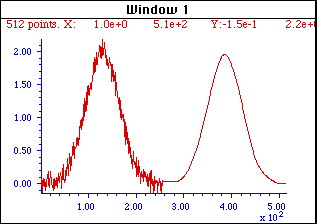
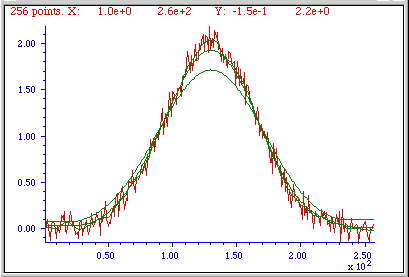
Audio Smoothing
Audio Smoothing
Audio Smoothing
Audio Smoothing


Audio smoothing is a process of reducing the noise and distortion in an audio signal. This is done by averaging the values of neighboring samples, which helps to smooth out any sharp changes in the signal.

Audio smoothing can be used to improve the quality of audio recordings, as it can help to reduce background noise and make the sound more natural. It can also be used to improve the sound of digital audio files, as it can help to reduce quantization noise and make the sound more smooth and even.

There are a number of different ways to perform audio smoothing. One common method is to use a moving average filter. A moving average filter averages the values of a window of neighboring samples, and then outputs the average value. The size of the window determines how much smoothing is applied.

Another common method for audio smoothing is to use a low-pass filter. A low-pass filter removes high-frequency components from the signal, which helps to reduce noise and distortion. The cutoff frequency of the filter determines which frequencies are removed.

Audio smoothing can be a useful tool for improving the quality of audio recordings and digital audio files. It can help to reduce noise and distortion, and make the sound more natural and smooth.

What are the benefits of audio smoothing?

There are a number of benefits to using audio smoothing. Some of the most common benefits include:

  • Reduced noise: Audio smoothing can help to reduce noise in an audio signal. This is because the averaging process helps to smooth out any sharp changes in the signal, which can make the noise less noticeable.
  • Improved sound quality: Audio smoothing can help to improve the sound quality of an audio signal. This is because the smoothing process can help to reduce distortion and make the sound more natural.
  • Increased clarity: Audio smoothing can help to increase the clarity of an audio signal. This is because the smoothing process can help to remove any unwanted noise or distortion, which can make the signal easier to understand.

How does audio smoothing work?

Audio smoothing works by averaging the values of neighboring samples in an audio signal. This helps to smooth out any sharp changes in the signal, which can make the noise less noticeable and improve the overall sound quality.

There are a number of different ways to perform audio smoothing. One common method is to use a moving average filter. A moving average filter averages the values of a window of neighboring samples, and then outputs the average value. The size of the window determines how much smoothing is applied.

Another common method for audio smoothing is to use a low-pass filter. A low-pass filter removes high-frequency components from the signal, which helps to reduce noise and distortion. The cutoff frequency of the filter determines which frequencies are removed.

How to use audio smoothing

Audio smoothing can be used in a variety of different ways. Some of the most common applications include:

  • Recording: Audio smoothing can be used to improve the sound quality of audio recordings. This is especially useful for recordings that are made in noisy environments.
  • Editing: Audio smoothing can be used to edit audio files. This can be used to remove noise or distortion, or to smooth out the sound of a recording.
  • Mastering: Audio smoothing can be used to master audio files. This can be used to improve the overall sound quality of a recording, or to make the sound more consistent.

Tips for using audio smoothing

When using audio smoothing, there are a few things to keep in mind:

  • Start with a low setting: When you first start using audio smoothing, it is best to start with a low setting. This will help you to get a feel for how the smoothing process affects the sound of the audio signal.
  • Experiment with different settings: Once you have a basic understanding of how audio smoothing works, you can experiment with different settings to see how they affect the sound of the audio signal.
  • Be careful not to over-smooth: It is important to be careful not to over-smooth the audio signal. This can result in a loss of detail and make the sound sound unnatural.

Conclusion

Audio smoothing is a useful tool that can be used to improve the quality of audio recordings and digital audio files. It can help to reduce noise and distortion, and make the sound more natural and smooth. When used correctly, audio smoothing can be a valuable part of your audio production workflow.


Free Download Mp4Gain
picture


Mp4Gain Main Window
picture


Mp4Gain Features
picture


Free Download Mp4Gain
picture

The Science Behind Digital Audio Levelers

The Science Behind Digital Audio Levelers

audio leveling
audio leveling

When it comes to creating high-quality audio recordings, one of the most important considerations is maintaining consistent volume levels. Digital audio levelers are software tools designed to automatically adjust the volume of an audio track, ensuring that it remains at a consistent level throughout. But how do these tools actually work, and what is the science behind their operation? In this article, we’ll take a deep dive into the world of digital audio levelers, exploring the principles that underpin their operation and the key factors that affect their effectiveness.

audio leveling
audio leveling

Understanding Audio Levels

Before we dive into the world of digital audio levelers, it’s important to first understand the basics of audio levels. At its most basic, audio level refers to the amplitude of a sound wave, which is usually measured in decibels (dB). When recording audio, it’s important to ensure that the levels remain consistent throughout the recording, as fluctuations in volume can be jarring to the listener and can even cause distortion or clipping.

Traditionally, maintaining consistent audio levels required manual adjustments by the sound engineer or producer, who would listen to the recording and adjust the levels in real-time to ensure that they remained consistent. However, with the advent of digital audio technology, this process has become increasingly automated, with digital audio levelers offering a more streamlined and efficient solution.

How Digital Audio Levelers Work

So how do digital audio levelers actually work? At their most basic, digital audio levelers operate by analyzing the incoming audio signal and adjusting the volume level to ensure that it remains consistent. There are several different methods that levelers can use to accomplish this, but most operate using one of two primary techniques: peak normalization or RMS normalization.

Peak Normalization

Peak normalization is a technique that involves analyzing the audio signal and identifying the highest peak amplitude. The leveler then adjusts the volume level so that the highest peak is at a predetermined level, typically 0 dB. This ensures that the loudest part of the audio track is as loud as possible without causing distortion or clipping.

RMS Normalization

RMS normalization is a more complex technique that involves analyzing the average level of the audio signal over time. Rather than focusing on the highest peak, the leveler looks at the entire signal and adjusts the volume level to ensure that the average level remains consistent. This can help to ensure that the audio track maintains a more consistent volume level overall, even if there are individual peaks that exceed the average level.

Factors Affecting Leveler Effectiveness

While digital audio levelers can be incredibly effective at maintaining consistent audio levels, there are several factors that can affect their overall effectiveness. One of the most important of these factors is the dynamic range of the audio signal. Dynamic range refers to the difference between the loudest and quietest parts of an audio signal. If the dynamic range is too wide, it can be difficult for a leveler to maintain consistent levels without causing distortion or clipping.

Another factor that can affect leveler effectiveness is the type of audio being recorded. For example, speech recordings may require a different approach than music recordings, as the natural dynamic range of speech is typically narrower than that of music. Similarly, different genres of music may require different approaches, as the dynamic range of a rock song may be different from that of a classical piece.

Conclusion

During the last decades, digital audio levelers have become essential tools for the music industry, broadcasting, film, and TV production. They help ensure that the audio output meets specific standards, and the sound quality is consistent across different playback systems. As we have seen, digital audio levelers are sophisticated devices that incorporate various algorithms to analyze and adjust the audio levels, making them essential for modern media production.

The most widely used digital audio leveler, MP4Gain, has proven to be effective and reliable. With its advanced algorithms and intuitive user interface, MP4Gain simplifies the process of optimizing audio levels, making it accessible even to non-technical users. However, there are many other options available in the market, each with its own unique features and benefits.

When selecting a digital audio leveler, it is important to consider the specific needs and requirements of your project. Factors such as budget, level of technical expertise, and desired features should be taken into account. Additionally, it is crucial to stay informed about new developments and advancements in the field of digital audio levelers, as technology is constantly evolving.

In conclusion, digital audio levelers play a critical role in ensuring the quality and consistency of audio output across different playback systems. They are powerful tools that incorporate advanced algorithms to analyze and adjust audio levels, making them essential for modern media production.