How Audio Sample Rate Affects Sound Quality


Free Download Mp4Gain
picture

How Audio Sample Rate Affects Sound Quality

Audio Sample Rate
Audio Sample Rate
Audio Sample Rate
Audio Sample Rate

Audio Sample Rate Explained

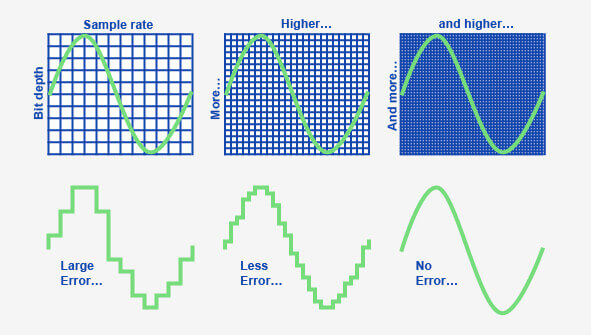
When it comes to digital audio, sample rate refers to the number of samples of sound that are taken per second to create a digital representation of an analog signal. In other words, it’s the number of times per second that the analog sound wave is measured and converted to a digital signal. The higher the sample rate, the more accurately the sound can be represented in the digital domain.

Personally, I’ve noticed that when I’m working on a music production project and I choose a higher sample rate, the resulting audio files tend to sound clearer and more detailed. As an avid music listener, I also appreciate the difference in sound quality when listening to high sample rate audio files on my headphones or speakers.

According to Ethan Winer, author of “The Audio Expert”, “In general, using a higher sample rate than the minimum required for the material being recorded or processed is good practice. However, there is no benefit to using a higher rate than twice the highest frequency that needs to be captured or processed.”

The Relationship Between Audio Sample Rate and Sound Quality

As mentioned earlier, the higher the sample rate, the more accurately the sound can be represented in the digital domain. This means that a higher sample rate can lead to a higher quality sound, with more accurate representation of the original analog sound wave.

I’ve also found that the relationship between sample rate and sound quality is not always linear. That is, going from 44.1 kHz to 48 kHz may not make as much of a difference as going from 48 kHz to 96 kHz. This is because the higher sample rates allow for more accurate representation of the sound wave, even in the higher frequency ranges.

As Julian Dunn, author of “Mastering Digital Audio”, explains, “Higher sample rates…provide more ‘headroom’ in the recording, which means that the recording can capture more of the dynamic range of the original sound. This can result in a richer, more natural sound.”

Choosing the Right Sample Rate

When it comes to choosing the right sample rate, it’s important to consider the specific needs of your project. If you’re recording a podcast or a voiceover, a sample rate of 44.1 kHz may be sufficient. However, if you’re recording music or other complex audio, a higher sample rate may be necessary to capture all the nuances and details of the sound.

It’s also important to note that a higher sample rate means larger file sizes, which can impact storage and processing requirements. So, it’s important to find a balance between the sample rate and file size that works best for your specific needs.

As author and sound engineer Bob Katz explains, “The most important factor is not the numbers, but how the system sounds. Choose the sample rate that sounds best to you, taking into account the practical considerations of your production environment.”

Final Words:

In conclusion, the sample rate of digital audio plays a significant role in the quality of the resulting sound. By understanding the relationship between sample rate and sound quality, and choosing the right sample rate for your specific needs, you can ensure that your digital audio sounds as good as possible.


Free Download Mp4Gain
picture


Mp4Gain Main Window
picture


Mp4Gain Features
picture


Free Download Mp4Gain
picture

The meanings of Hz and bit of sound sources

The meanings of Hz and bit of sound sources

Audio Frequency

The meanings of Hz and bit of high resolution sound sources are “how accurately a second was made” and “how accurately the pitch width and sound pressure of the sound were recorded.”

Audio Hz

We use Hz (hertz) and bit (bit) to represent music data.

When I started researching hi-res audio sources, I was wondering “what is Hz? What is bit?”, So I will write an article.

As I mentioned each time, this article was written by someone who is not familiar with audio as a memo.

Please be careful as you may have misunderstanding or misunderstanding.

In short, Hz is “whether to record the sound and how much a second” to represent the, bit is “What was finely recorded how much the width and pressure of the sound of the highs and lows of the sound” represents the increase.

What is Hz?
What is a bit?
High bit and high Hz sound sources are easier to deliver to consumers
abstract
Sponsorship

What is Hz?
Hz is a unit that expresses the sampling frequency (sampling frequency).

This is “how good a second is.”

If you make the digital clock display thinner, it will be “plugged in” and “smooth”.

If the digital display timer also shows up to 1/1000 of a second, it will display the time as if it were connected to the human eye.

Even if it can’t show the time between each number.

In the same way as this, when the “Hz = value of the precision with which the data is taken per second” becomes extremely fine, you can hear it as if you were connected and you can hear it with the so-called good sound.

The sampling frequency of CDs is 44.1 kHz, and many high-resolution audio sources are sold at 96 kHz or 192 kHz.

“K” is the same as kg, which means 1000, so 44.1 kHz means 44100 Hz.

In other words, a 44.1 kHz CD is significant because it is divided into 44,100 pieces to express the sound for one second.

Since the high-resolution sound source is 96 kHz or 192 kHz, it means that the original sound is expressed in more detail than the CD.
(One second is divided into 96000 and 192000)

Therefore, it seems that high-resolution sound sources usually sound good.

High resolution sound source distribution site: e-onkyo music

What is a bit?
A bit is the smallest unit that a computer handles.

It may be difficult to understand when it comes to the smallest unit, but in Japan today, 1 yen is the smallest unit, and it is the same feeling that the price is not expressed in intervals of 1 yen or less. (In the case of daily life. Without considering actions or changes.)

There is no 1.3 yen and it looks like there is no 0.9 yen.

You can express 1 yen, 2 yen, 1096 yen, etc., and all prices are expressed in 1 yen intervals.

Therefore, in everyday life, 1 yen is the minimum unit for expressing price.

In the case of a computer, that “1 yen” is “1 bit”.

In terms of sound, the bit seems to correspond to the width of the tone and the sound pressure of the sound.

The difference according to the number of bits is, for example, when the sound in the world can be expressed only with the three numbers 10, 15, 17 and 20, and when there are 10, 13, 15, 17 and 20, the sound is more precise. Which one can you express? It is so.
(I think it’s correct, but it may be wrong …)

How small must the bit be to express the sound? it is.

If you can only express with 10, 15 and 20, there are some parts where you have to change the sound you want to express with 16 and 17 to “15!” Or 8 and 9 to “10!” First of all, if 16 or 17, 8 and 9 can be expressed as they are, it will be more faithful to the original sound.

It is better to be able to express 13.22222 with 13 instead of 14, and firstly, if you divide the decimal point as 13.2 into small pieces so that they are expressed as they are, it will be more faithful to the original sound.

This is why sound recorded with high bits has more depth and breadth, isn’t it? It seems .

Specifically, it appears that 16 bits are expressed in the fineness of 2 to the 16th power, and 24 bits are expressed in the fineness of 2 to the 24th power.

High bit and high Hz sound sources are easier to deliver to consumers
In the case of PC audio, the original sound is converted to digital data and saved on the PC, and then converted to analog again for listening.

The stream is original sound → digital data → analog.
(The flow is the same for CDs, but CDs contain data on CD, but in the case of PC audio, it is stored on the PC’s HDD or SSD.)

Until now, when putting the recorded sound on a CD, it seems that the part that would have little effect on the sound quality, but because it can be sold free of charge due to the spread of the Internet, was somewhat omitted to some extent. I mean, it looks like I tried to sell it without skipping it.