How Audio Sample Rate Affects Sound Quality


Free Download Mp4Gain
picture

How Audio Sample Rate Affects Sound Quality

Audio Sample Rate
Audio Sample Rate
Audio Sample Rate
Audio Sample Rate

Audio Sample Rate Explained

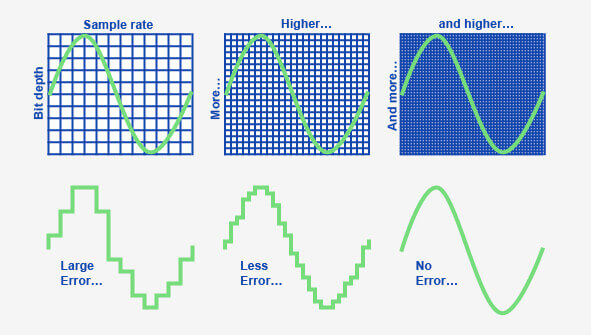
When it comes to digital audio, sample rate refers to the number of samples of sound that are taken per second to create a digital representation of an analog signal. In other words, it’s the number of times per second that the analog sound wave is measured and converted to a digital signal. The higher the sample rate, the more accurately the sound can be represented in the digital domain.

Personally, I’ve noticed that when I’m working on a music production project and I choose a higher sample rate, the resulting audio files tend to sound clearer and more detailed. As an avid music listener, I also appreciate the difference in sound quality when listening to high sample rate audio files on my headphones or speakers.

According to Ethan Winer, author of “The Audio Expert”, “In general, using a higher sample rate than the minimum required for the material being recorded or processed is good practice. However, there is no benefit to using a higher rate than twice the highest frequency that needs to be captured or processed.”

The Relationship Between Audio Sample Rate and Sound Quality

As mentioned earlier, the higher the sample rate, the more accurately the sound can be represented in the digital domain. This means that a higher sample rate can lead to a higher quality sound, with more accurate representation of the original analog sound wave.

I’ve also found that the relationship between sample rate and sound quality is not always linear. That is, going from 44.1 kHz to 48 kHz may not make as much of a difference as going from 48 kHz to 96 kHz. This is because the higher sample rates allow for more accurate representation of the sound wave, even in the higher frequency ranges.

As Julian Dunn, author of “Mastering Digital Audio”, explains, “Higher sample rates…provide more ‘headroom’ in the recording, which means that the recording can capture more of the dynamic range of the original sound. This can result in a richer, more natural sound.”

Choosing the Right Sample Rate

When it comes to choosing the right sample rate, it’s important to consider the specific needs of your project. If you’re recording a podcast or a voiceover, a sample rate of 44.1 kHz may be sufficient. However, if you’re recording music or other complex audio, a higher sample rate may be necessary to capture all the nuances and details of the sound.

It’s also important to note that a higher sample rate means larger file sizes, which can impact storage and processing requirements. So, it’s important to find a balance between the sample rate and file size that works best for your specific needs.

As author and sound engineer Bob Katz explains, “The most important factor is not the numbers, but how the system sounds. Choose the sample rate that sounds best to you, taking into account the practical considerations of your production environment.”

Final Words:

In conclusion, the sample rate of digital audio plays a significant role in the quality of the resulting sound. By understanding the relationship between sample rate and sound quality, and choosing the right sample rate for your specific needs, you can ensure that your digital audio sounds as good as possible.


Free Download Mp4Gain
picture


Mp4Gain Main Window
picture


Mp4Gain Features
picture


Free Download Mp4Gain
picture

What is the sample rate / sample rate?

What is the sample rate / sample rate?

Sample Rate

Sampling rate Sampling frequency is the number of sampling processes performed per second in an AD converter that converts an analog signal into a digital signal.

Sample Rate

The unit is “Hz”, and the higher the value, the faster the analog input signal can be converted to a digital value, resulting in higher sound quality. However, the amount of data grows proportionally, so you must choose the appropriate frequency for media and devices with limited storage capacity.

It is said that to accurately record and reproduce a certain sound, it is necessary to sample at a frequency that is approximately twice the frequency of that sound. The sampling frequency used for music CDs is 44.1 kHz. In this case, the voice waveform is shredded 44,100 times per second and the voice information at each moment is converted into digital information.

Humans generally have 20 Hz for individual differences, but they can perceive sounds around 15 kHz to 20 kHz as sound, and this frequency band is called the audible range.

Difference between sample rate and bit rate
Sample rate and bit rate are used to describe the sound quality before and after compression of the audio data.

The sampling rate is a value that represents “the number of sampling processes performed per second”.
For example, at the standard sample rate of 44.1 kHz, it means to sample 44100 times per second.
The higher this number, the softer the sound and the better the sound quality. In other words, the numerical value of the sample rate represents the quality of the sound.

On the other hand, the bit rate is a value that indicates “at how many levels the volume is represented”.
For example, in the case of 16 bits, which is the standard bit rate, the amount of information is divided by 2 to the 16th power (= 65536 steps). If the number of bits is low, the sound quality will be granular and, as with the sample rate, the higher the value of the bit rate, the more information that can be reproduced and the sound quality will be better.

Sampling rate bit rate
Divide the time axis A
44.1 kHz, divide 44100 per second Divide the amount of information vertically Into
In the 16-bit case, divide the amount of information by 2 to the 16th power.
LiveOn compatible sample rate
In LiveOn, when creating a conference room, you can select from 5 patterns of “8kHz, 11kHz, 16kHz, 22kHz, 32kHz”. LiveOn supports up to 32 kHz, so you can have a meeting with clear sound quality.

It is very easy to listen to because you can communicate with a voice close to the voice on the floor and you can use it comfortably without stress even in long meetings.

The sample rate set when creating the conference room can be changed from the change screen.

Main sampling frequencies
Live: 8kHz to 32kHz
Telephone (ISDN, etc.): 8kHz
YouTube video (standard): 22.05 kHz
FM stereo transmission relay: 32kHz
CD-DA: 44.1 kHz
DAT / miniDV video: 32kHz to 48kHz