What is the ideal decibel volume for a music file?


Free Download Mp4Gain
picture

Once upon a time there was an analog recording

Until at least the early 1980s, most recordings were made with analog material, and more specifically with magnetic tapes.

With these bands, it was necessary to maximize the signal / noise ratio. For this, recordings were often made as high as possible, close to “the red zone”.

VU analogic meter

This limit, specifically, corresponds to the 0 VU measurement that can be read on analog level meters.

If the signal exceeded this value and entered the red zone, a fairly hot saturation appeared and, in any case, progressive intensity. Undoubtedly, this contributed to giving the side that today we describe as “vintage” to the recordings of the time.

Cutout

Today, the situation is no longer the same because the operation of digital recording is quite different.

First, the digital signal is measured in dBFS, a unit that actually corresponds to the difference between the signal level and the highest signal that can exist. It has nothing to do with the 0 VU measurements we discussed earlier.

In other words :

As long as your signal remains below 0 dBFS, there will be no problem or coloration except for that of your preamp / processing chain

If the signal exceeds 0 dBFS, it cannot be played when listening (for example, with headphones or speakers, after digital> analog conversion has been performed).
Specifically, what will happen?

Well the sound will be trimmed.

The clipping phenomenon

That is, any signal that exceeds the 0 dBFS threshold will be truncated purely and simply. The consequence is a strong distortion devoid of any musicality, unlike the distortion that would be found in analog material.

Suddenly, if you record a sound whose signal exceeds this limit, it will be distorted by distortion and generally unusable.

An example will be clearer: an acoustic guitar recorded too loudly.

clipping audio

It sounds distorted and cropped. It’s horrible, isn’t it? 🙁

Furthermore, we can see that the shape of the signal is truncated at the peaks due to the phenomenon of What level to record then?
Perhaps while thinking about imitating analog recording, many people record their voice or guitar aiming at a level of 0 dBFS.

The problem is that doing this makes it very difficult to make sure that the signal is not clipped.

In fact, even if you don’t hear it during follow-up, it is highly likely that a peak or two will exceed the fatal threshold of 0 dBFS. And when you notice it during mixing, it will be too late …

Also, by trying to reach this level, you can overload your preamps a bit. If you are using entry-level or mid-range equipment, it will probably affect the sound quality.

In fact, if you record in 24-bit (which you should), the available dynamic range is wide. Therefore, it is not necessary to take sound at high volume.

Rather, it is much better practice than aligning yourself with an average RMS level between -15 and -22 dBFS.

When it comes to peaks, it is okay if some peaks drop to -12 or -10 dBFS. The main objective is to keep enough space to apply its effects during mixing.

On the other hand, once the mix is ​​finished, it is during mastering that it will raise the general level of your mix to reach, at will, the volume that can be found on commercial CDs. And it is only then that the maximum level will be close to 0 dBFS.


Free Download Mp4Gain
picture


Mp4Gain Main Window
picture


Mp4Gain Features
picture


Free Download Mp4Gain
picture

Sound qualities of vinyl

Now it is a reality, the vinyl record is experiencing a second youth. For an apparently growing number of fans, black pastel has become an essential complement to modern streaming and downloading uses. A number of reasons are invoked to explain this revival madness, but one in particular returns very regularly and never fails to cause much heated debate among enthusiasts: the “vinyl sound.” Without intending to end a debate that will undoubtedly be unleashed for many years, this dossier presents some elementary notions that allow a rational understanding of this sentiment.
Vinyl LP Record

A little history

First, let’s go back a few decades: The “33 laps” were born on June 18, 1948 during a press conference held by the American record company Columbia Records. At this time, the most common home audio medium is 78 rpm – a 25 or 30 cm diameter disc, covered with a natural polymer in which a spiral groove is recorded representing a monophonic sound wave. This groove is traversed by a reading needle as the disc rotates, as the name suggests, at a speed of 78 revolutions per minute. The 33 rpm record uses this same concept, but it takes advantage of the technological advances of its time to replace the natural polymer with a synthetic polymer, polyvinyl chloride (PVC).

Vinyl records

Armed with these arguments, vinyl is about to become a standard for home audio. Widely adopted by the general public since the mid-1950s, it will accompany the considerable advances made in the second half of the 20th century in the fields of sound recording and (re) production: improvement of electronic amplifiers; definition of a standardized equalization that guarantees the transparency of the frequency response in most of the audible spectrum (the famous RIAA curve) in 1954; appearance of the stereo in 1958 … All this will lead to the birth and development in the 1960s of the concept of “high fidelity”, of which vinyl will continue to be the exclusive medium for almost 20 years. It was not until 1982, the release date of a certain compact disc, that vinyl’s hegemony was finally questioned.

On paper, optical media designed by Sony and Philips feature a number of revolutionary improvements. Of course, its small size and immunity to mechanical wear are notable examples, but they are not the only ones: the transition to digital promises incredible sound transparency, happily surpassing that allowed by vinyl. But lovers of beautiful sound do not pretend to be satisfied with simple theoretical data and many of them, not ready to abandon a format they have appreciated for so long, reject this supposed superiority of the CD. Thirty years later, it is still his arguments that lead some purists to believe that vinyl would have this famous “grain” that would allow the medium to maintain its sound quality king throne, compared to digital media.

The arguments

The “heat” of vinyl

33 rpm is often said to be distinguished from CDs and other digital formats by its “warm” sound. To understand this qualifier, we will have to talk about bandwidth problems: the range of reproducible audio frequencies for each medium.

When it comes to vinyl, this bandwidth is absolute … unlimited. Since it is a purely analog device, there is no theoretical limit to how often a disc slot could vibrate the pen. Of course, the practice does not fit this ideal: among other reasons, when the master’s degree is carried out, the strong mechanical stresses suffered by both the recording head and the disc material cause noise, inaccuracies and attenuations at very high frequencies. . However, the fact remains that a very high quality vinyl record can effectively store sound information at frequencies up to around 50 kHz. On a more common quality disc, the frequency range generally reaches around 23 kHz.

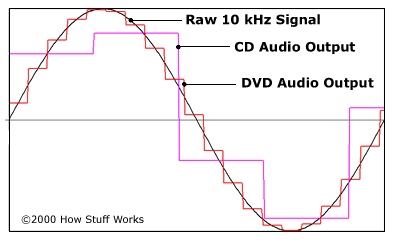
Things are different in the case of digital modulation: the famous Nyquist-Shannon theorem tells us that the maximum frequency reproducible by a digital signal is half the sampling frequency of that signal. Specifically, for a CD sampled at 44.1 kHz, the maximum playable frequency is 22.05 kHz. A really lower value than vinyl. Enough to talk about CD inferiority? No, because this value is still much higher than the hearing limit of the human ear (which is generally, optimistically, at 20 kHz for a young ear in full possession of its means).

But then where is the audible difference … if it really exists? This could have been, in the first days of the CD, in the filtering suffered by the signal upstream of its fixation in the support. In fact, the Nyquist criterion tells us that not only sampling at 44.1 kHz cannot allow frequencies to reproduce beyond 22 kHz, but that these frequencies must be completely removed from the sound signal before sampling, to avoid the aliasing phenomenon. A condition that was realized at the time only by low-performance analog filters, offering in particular a very imperfect phase response in the high spectrum. The result was a distortion that could be clearly heard and gave the sound a certain acidity, a metallic character. From there the bad reputation of the CD was born.

The “softness” of vinyl.

Vinyl’s reputation for producing a “softer” sound than digital is explained in part by the decrease in treble, which basically resembles the infidelity of sound in the original mix, but may also be associated with the theme of saturation. A form of distortion that is sought in this case to avoid as much as possible, saturation occurs when the signal to be recorded exceeds the maximum amplitude allowed by the recording medium. It can take different forms, which sound very clearly in the ear: they therefore oppose analog saturation and digital saturation.

In the case of digital recording, the value of this maximum amplitude is perfectly defined: it corresponds to the value of a sample “one by one”. If the input signal exceeds this value, it results in the sudden appearance of a plateau on the recorded waveform; This is called a hard cut.

In the case of a vinyl record, the amplitude not to be exceeded corresponds to that which causes the groove to oscillate by a distance equal to the pitch of the turns. Exceeding this limit can cause the slot to become tangled, and therefore the disc cannot be read. When recording the master, the signal is passed through a limiter responsible for restricting the slot to its authorized width. This limiter, if it works purely analogically, does not produce a clipping as strict as digital saturation; By gradually reducing the effect of an increase in the input signal until the limit is reached, it causes distortion that is much less unpleasant to hear than the strong clipping effect.

The “dynamic” of vinyl

The argument that is regularly heard today as justification for a supposed superiority of vinyl on CD, is the only one on our list that does not find its origins in the early years of digital support. It must be said that, at this precise point, neither theory nor practice seems to leave the slightest possibility that the analog disk will contest the victory of its adversary: ​​while the 16-bit quantization of the CD gives it a dynamics of 96 dB , the noise The background inherent in vinyl allows it to reach, at best, only about 70 dB; in the usual cases, we prefer to have 60, even 50 dB.

But then what are we talking about when we extol the superior dynamics of vinyl? We are really talking about a very real phenomenon, a consequence of the evil of the century of sound, the ignominious War of the Loudness. While all digital media still regularly suffer the ill effects of this relentless rush for volume, vinyl appears to be relatively safe. With its reputation for precisely being appreciated by audiophiles, it sometimes benefits from mastering at a lower level, guaranteeing you a significantly higher dynamic range.

Is listening to music on vinyl really better?

Vinyl / MP3 theme seems to be all the rage. Some vinyl purists believe that there is no debate. “You understand that when you listen to a vinyl, it is better, cpocomprésséblabla […] blabla”, we all live this type of conversation with an individual with the red label “with (ne) base”.


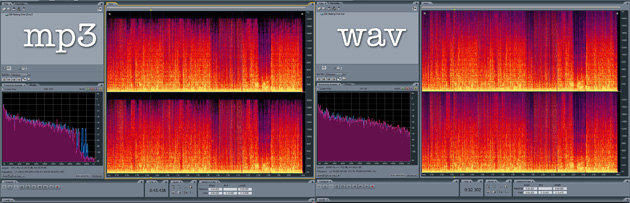
MP3 vs WAV vs VINYL

The “micro-groove” vinyl record was released on June 18, 1948 during a press conference organized by Columbia Records to announce the end of 78 rpm. Format adopted by the general public since the mid-1950s, vinyl will remain the exclusive medium of music for almost 20 years.

The Compact Disc arrives in 1982 and offers quality music transcription based on a sample of 44,100 Hz. Sound is collected 44,100 times per second. This rate gives it an accuracy close to that of vinyl.

Vinyl vs mp3

MP3 was released in the mid-90s. Wanting to reduce the weight of songs and fit on our “smartphones”, it compresses the audio data. This results in loss and degraded sound, provided you listen carefully on a high-quality sound system. Finally, everything also depends on the compression rate mentioned in bitrate per second. Corresponds to a bit rate of binary information (or bits) per second: a bit rate of 320 Kilo-Bits-per second corresponds to approximately 320,000 bits transmitted per second. This is the reason that the less the sound is compressed, the more information the file has and, consequently, the bigger it will be. To listen more or less faithful to the sound, above 256 Kbps, you go alone. It is always possible to choose the so-called “lossless” formats like FLAC,

Sound can be defined as a wave, a signal that vibrates the membrane of the inner ear at a certain frequency. To clarify things, we must quickly analyze the concept of bandwidth, which is the range of reproducible audio frequencies for each medium. The higher the frequency, the higher the note; the lower the frequency, the lower the sound (hence the bass name for bass, little genius). Your broken headphones or your Funktions One are just trying to transcribe this signal.

The vinyl bandwidth is, in principle, unlimited. MP3 seeks to reproduce this signal as faithfully as possible. An excellent quality vinyl record can store sound information at frequencies up to around 50,000 Hz. In lossless mp3, the frequency range generally reaches around 23,000 Hz.

FUN FACT: The human ear can hear frequencies ranging from 16Hz to 20,000Hz. We cannot capture the entire frequency spectrum of a vinyl or MP3.

It is often said (too?) About vinyl that is distinguished from MP3 by its warm sound, by its “grain”. In fact, there is a noticeable difference between listening to an MP3 and a vinyl because the recording techniques are different, hence the famous “grain” of the vinyl, but it is reproducible without problems in numerical format

From a technical point of view, vinyl is no better than an MP3 in the correct format. Surely there are many more emotional considerations to help understand the new vinyl spring.

ANALOGUE AND DIGITAL

The essential

Analog and digital are two methods of transporting and storing data. (audio, photo, video …). Analog was born with the onset of electricity, while digital appeared more recently in the computer age.

Analogue and Digital

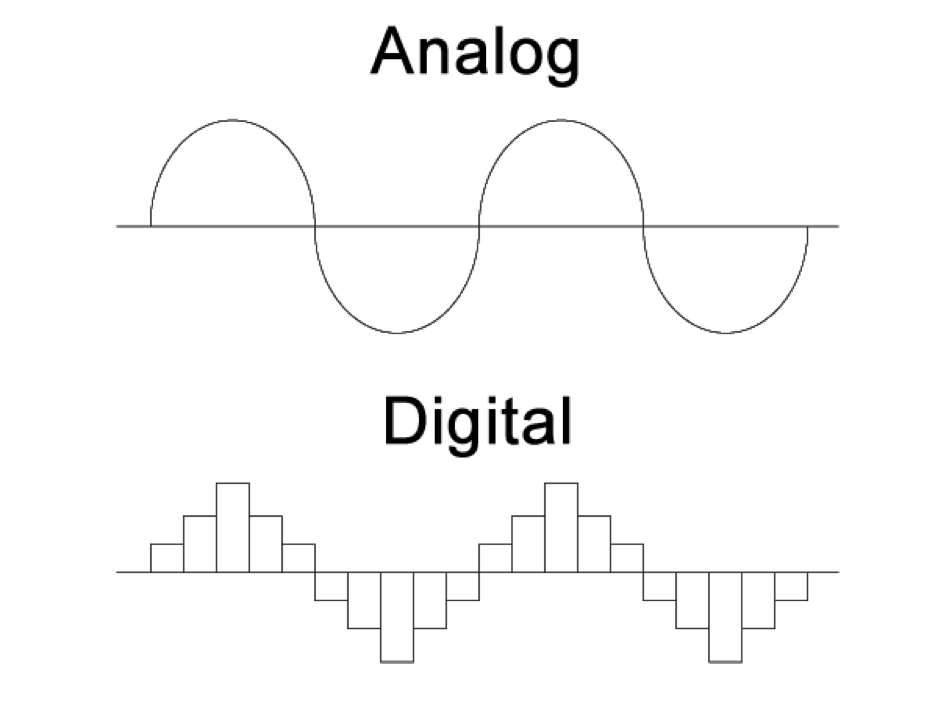
The analogical principle is to reproduce the signal to be recorded (audio, video …) in a similar way in a medium (magnetic in general). For example, when recording an audio signal in an analog system, the signal present on the tape will follow the same amplitudes (“the same curve”) as the sound wave (with more or less fidelity): the characteristic pressure variations of a sound wave will result in variations of an electrical signal. Therefore, the electrical amplitude of the analog signal will be the more or less faithful image of the signal to be recorded (audio, video, etc.)

analogue vs digital

In digital, the analog signal to record becomes digital thanks to an analog> digital converter. After this conversion, the signal is just a sequence of “0” and “1”, that is, a signal with two amplitudes instead of infinity in analog.

Once in this form, the signal can be copied and transmitted losslessly because instead of transporting a signal whose amplitude should faithfully vary from the original, it carries a signal consisting of only two amplitudes (for example, 0 = 0 volts and 1 = 5 volts). So when a parasite disturbs an analog signal, digitally this parasite will have no effect: for example, a parasite that adds 0.2v disturbance will deteriorate an analog signal, while this same parasite on a digital signal will have no effect because 0v + / – 0.2v will always be considered = “0”.

Therefore, the digital signal is an analog signal made up of two possible levels (for example, “0” = 0v and “1” = 5v) and when the analog signal moves away from these two voltages, it does not matter because all the signals close of 0v will be considered = “0” and any signal close to 5v will be = “1” with a voltage threshold between the two resulting in exceptional immunity against parasites and exemplary ease of making perfect copies (clones) of this signal type.

After digital transport and storage, any signal (video or audio) must return to its original analog form. For example, an audio signal will be converted from digital to analog and then amplified; in fact, our ears cannot hear digitally! ! !

It should be noted that digital is only used (in the case of an audio or video signal) for the transport and storage of data.

2 / Analog VS Digital and data compression.

So we have just seen that digital is not a commercial device, it is the support of all new technologies, but should we consider that digital is definitely better than analog?

I would try to answer yes, but it is necessary to moderate this judgment and that for two reasons: compression and sampling.

* / Digital compression:

Converting a signal to digital is not without problems: the bandwidth occupied by a signal once digitized is greater than its analog equivalent. When dealing with very bulky data, such as video, the processing is very cumbersome; Therefore, it is necessary to use a compression algorithm intended to reduce the amount of information by reducing the quality of the signal. All of the compressions used for video or audio rely on human perception to make this drop in quality little or not noticeable to humans. But the problem is that we often tend to want to compress the signal too much and the degradation becomes noticeable (case of GSM phones, MP3 <128kbit / s, mpeg-1 videos …)

For example, a high-quality audio signal recorded on a high-end cassette deck (analog) will be of better quality than a 112kbit / s mp3, because a large amount of information has been suppressed at 112kbit / s to satisfy the 112kbit / s imposed bit rate.

On the other hand, in an analogous way, the concept of copy generation intervenes: one copy will be less good than the original, one copy of the copy will lose a little more … After 10 or 20 copies of copies, the signal is totally deteriorated and cannot be used. In digital, a copy is often a clone of the original, so in theory you can make countless copies that are strictly the same quality as the original. I am talking about theory because errors can occur during a digital copy, often due to the state of the media. This is the case when copying an audio CD digitally (from your CD-ROM drive to your hard drive, for example): when a scratch or failure occurs, the information will not be copied and will be replaced by the correction system errors due to “extrapolated” data make this defect go unnoticed; In this case, the digital copy will no longer be identical to the original.

Which is better, analog or digital audio?

Which is better, analog or digital audio? Is there really a difference? Do you need very expensive audio equipment to make a difference? Really matters?

analog versus digital

Before we get to the heart of the matter, we should take a quick look at what makes a sound digital or analog. This is how a sound is recorded. A copy of an analog sound recording is a continuous electronic signal.

Today, advances in analog-to-digital conversion methods have improved the quality of digital recordings. Some say that there is no distinction between digital and analog mode. Others disagree, sometimes with passion. Music lovers, those who want the best possible quality in public address systems, insist that analog systems provide better sound.

What are the differences between analog and digital recordings? Read on to find out.

analog vs digital

History of digital sound.

Before the 1970s, music was recorded with analog recording equipment. The microphones they used recorded sound and generated an analog waveform that other devices could transfer directly to the appropriate medium, which was generally a magnetic tape. Assuming the musician wore reliable equipment, the recorded sound was a faithful representation of the original sound.

With digital recording, sound engineers can convert analog waveforms to digital signals. There are many different types of equipment that can be converted from analog to digital. Some studios record analog sound on the original master tape and then transfer it in digital format. Others use special equipment to record digitally directly.

The first digital recordings sacrificed fidelity, or sound quality, in favor of reliability. One of the disadvantages of the analog format is that analog media tends to wear out quickly. Vinyl records can become deformed or scratched, which can significantly affect sound quality. The magnetic tape eventually wears out and is vulnerable to magnets, which can erase or destroy the data stored on the tape. Digital media like CDs can be played indefinitely and are more durable.

Analog versus digital

Some music lovers believe that digital recordings are insufficient when it comes to accurately reproducing sound. They use complex language and jargon to describe the capabilities and flaws of an audio system. Most of his criticisms relate to the frequency of the sound.

Humans can hear sounds ranging from 20 hertz (Hz) to 20 kilohertz (kHz). The frequency of a sound wave corresponds to our perception of the tone of a sound. The higher the frequency, the higher the pitch we hear.

Audiophiles describe the sound quality of an audio system at different frequencies using terms like full, warm, and airy. A full or warm sound comes from a system that reproduces low frequencies well. An aerial sound means that the music played gives the listener the impression that the instruments are in a spacious environment and generally refers to sounds in the high frequency range.

Some music lovers say that vinyl albums are better at low frequencies, which means they provide warm sound. They claim that CDs are not as accurate in reproducing sounds in this range. Others insist that there is no detectable difference between a well-produced digital file and a vinyl in good condition.

If the artist uses an analog format to create the original recording, an analog copy is preferable. In fact, there would be no need to convert sound from analog to digital. The copy must be an exact representation of the original track. But if the artist uses digital recording, it is better to buy the album on CD.

The perception of musical quality is subjective. Two people listening to the same music, with the same equipment, may have different opinions on the quality of the recording.

Differences between analog and digital sound: analog and digital

Analog and digital signals
The sound is of course an analog signal and the analog signal is continuous. Therefore, there is no rest or interruption. Digital signals are not continuous. Specific values ​​are used to represent the information. In the case of sound, a sound wave is represented by a series of values ​​that represent pitch and volume for the duration of the recording.

FLAC, WAV, MP3, DSD, ALAC … What audio format should I use?

You probably know the famous MP3 audio format. There’s even a good chance that you only use it on a daily basis. But did you know that it is possible to take your music to the next level thanks to other audio formats? If the terms FLAC, DSD, sample rate, or even lossless don’t mean anything to you, then you’ve come to the right place. Designed specifically for newbies, this guide tells you everything you need to know about the basics of digital audio.

soundwave

FLAC, DSD, ALAC … Listening to a debate between audiophiles can seem difficult when you do not know this universe and the many acronyms that refer to it. But if you try the adventure, you will not regret it. Say goodbye to your boring and lifeless MP3s and hello to quality music. Trust us, your ears will thank you!

Sample Rate and Bit Depth: The Basics of Digital Music

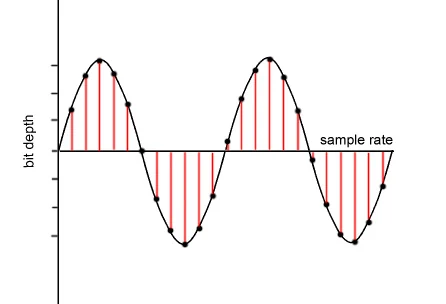
Before knocking you out (we promise we won’t hit too hard) with barbaric acronyms in every way, let’s first focus on two essential notions of modern audio, namely sampling rate and bit depth. These two elements give an idea of ​​the recording precision of a song.

but depth

As you know, computers run on bits, which are sets of 0 and 1. During a passage in the studio, music produced by an artist must be digitized, therefore transformed into 0 and 1 in order to be recorded on CD or transmitted to through transmission services. This is where the sampling rate and bit depth come into play.

Take the example of a CD. Our beloved empanadas are recorded in 16-bit / 44.1 kHz. The 44.1 kHz sampling rate means that the music produced by our musician is analyzed 44,100 times per second by studio recording devices. As for the bit depth, it gives an indication of the number of information recorded during this same period. The greater the depth, the more information will be encoded at the end.

However, CD quality is not the best in the world, even if it far exceeds MP3. Thus, we find 24-bit / 192 kHz recordings. The DSD goes even further with a frequency that rises to several MHz. But for simplicity, just remember that the higher the values ​​described above, the more accurate the recording will be in your sound reproduction.

Lossy formats: MP3, AAC, OGG

In general, there are two types of formats in the audio world: lossy, lossy in English, and lossy, or lossless. If you want the best audio quality, stay away from compressed formats.

The best known of all is MP3. True dinosaur in the audio world, this type of file was developed at a time when the capacities of our hard drives were determined in MB and not in TB. Therefore, we had to compress the recordings as much as possible, even if that meant putting quality aside.

It is true that MP3 encoded music weighs only a few megabytes. But the applied algorithm is very aggressive, it simply cuts the frequencies considered inaudible by the human ear. In fact, MP3 loses many audible parts. To get an idea, click the link below, you will hear these famous truncated parts. The pieces seem flat, devoid of life. Listening can even become unpleasant after several tens of minutes. Suffice it to say that, apart from its small size, MP3 is no longer really interesting in our time if we are looking for quality music.

To make things better, Apple, meanwhile, released another audio format, AAC, for advanced audio encoding. This is also a lossy format which therefore loses details during data compression. However, the algorithm used is more efficient, cutting fewer important frequencies, at least on paper. In absolute terms, the difference from MP3 is not necessarily stark and the debate has been raging for years in the audiophile environment to find out if the AAC format is really better than MP3.

Finally, there is also the OGG Vorbis, another lossy compressed format. Like AAC, it is supposed to work better than MP3. This is the type of file Spotify uses. Her interest is to enable efficient transmission while reducing quality. However, the songs encoded in this format are not fabulous. The ideal is really to become lossless.

Loudness: how do I know if I listen to my music too loudly?

10% of young people aged 15 to 30 never lower the volume of their music, at the risk of irreversible damage to their hearing. 10% of young people aged 15 to 30 never lower the volume of their music, with the risk of irreversible damage to your hearing.

Loudness

Hissing, tinnitus, hearing loss … The consequences of exposure to loud noise can be irreversible. But how do you know where to place the cursor? Sound and hearing specialists respond.

Hearing disability is no longer just for the elderly. The 15-30 year old generation, almost born with headphones on their ears, gets drunk on sound every day. To the point of creating more or less serious hearing problems. According to an Ipsos study, more than three-quarters have already experienced hearing problems, such as tinnitus (ringing or buzzing in the ears) or hearing loss after high exposure to noise. However, 10% of youngsters never turn down the volume. How to listen to music without risking being deaf early? Our tip as the twelfth edition of Sound Week started on Monday.

Edward Tufte forum: Public performances: music always too loud?

What is loud sound?

“Starting at 80 decibels, we begin to consider a sound to be loud or very loud,” says Dr. Jean-Michel Klein. For comparison, the average sound volume is 30 decibels (db) in quiet places, 40 to 60 db during a conversation, 70 to 80 in a bar or restaurant, and 105 and 120 during a concert, as the website recalls. from Inpes, Ecoute-ton-oreille.com.

By adjusting the volume of your music in a quiet place, this allows you to create references. And save them, resisting the temptation to turn up the sound at the same time as the background sound. “It is a matter of education,” adds Dr. Klein. As a child, children receive sound toys, which will accustom them to being in noise. Once they are teenagers, the risk is that they will listen to their music again. stronger.”

What noise level can be dangerous?

From this risk threshold of 80 decibels, depending on the situation and the person, the volume can cause hearing problems. “The perverse side is that there is no fixed rule or warning signal. It is like driving too fast on a small road. You can do it ten times and fall into the ditch only the eleventh,” says Dr. Klein, an ENT doctor in Paris. and president of the National Union of specialists in otorhinolaryngology. The same for sound: some will damage your hearing from the first hearing of a loud sound, others after a few hours. Some after five or six long exposures in a nightclub, for example. The tolerance threshold varies from person to person. Therefore, people who have had repeated ear infections in childhood may be more vulnerable.

“The problem is not just listening too loud, but also listening to music at a sustained level for a long time,” explains Christian Hugonnet, president and founder of Sound Week. This acoustic engineer recommends taking fifteen minute listening breaks. “You have to get used to listening too much and learning to put on headphones regularly.”

The ear can be damaged before pain is felt. The pain threshold is in fact 120 dB, well above the danger threshold. And in some cases, the damage is irreversible.

What signs should they alert?

Ear “cottony” that corresponds to an impression of hearing the sound surrounded by a veil, whistling, tinnitus are symptoms that should be concerned. But it can also be hyperacusis, which makes noise intolerant or even a loss of treble, the first affected. So many signs that the ear has suffered. “When you ask someone to rehearse, it’s not a good sign. Same thing when you start talking out loud,” adds Christian Hugonnet. Risks are irreversible damage to the audience. And inflict early hearing aging.

When should you consult? As soon as the “abnormal” signs do not go away a few hours after exposure or after a night’s sleep, go to your otolaryngologist or, if necessary, to the emergency room.

MP3 audio files and lossless files, which is the best?

For your music collection, better an mp3 audio file or a lossless file? Let’s see the differences together and what format to choose
In the transition from analog music (vinyl records, cassettes, and other similar media) to digital music (audio CDs, mp3 audio files, etc.) experienced a few decades ago, compression algorithms have played a critical role. To avoid taking up too much space on the data storage media (when the transition hit the core, each byte of available space was worth so much gold) it was necessary to develop algorithms that would help compress the file size without overly affecting the audio quality. .

Lossless Audio

It was during these years that names such as mp3 audio files, WMA files, WaV files, and OGG files began to circulate with some frequency in musical environments (and not) around the world.

Lossless vs. at a loss

Over the years, the panorama of audio formats expanded dramatically and there was the curious formation of two opposite blocks. On the one hand, in fact, the so-called lossless files (literally lossless) were to be ‘concentrated’, while on the other side of the musical ‘Iron Curtain’ were the lossy files (literally lossy). As the names suggest, the difference between one format and another is due to the possible loss of musical information.

comparision mp3 vs lossless

Phonometric comparison between lossless files and mp3 audio files

Lossless files guarantee (and guarantee) the same sound depth and quality as an audio CD, while lossy files (such as mp3 audio files) reduce the size of a music track in the order 10 times at a partial cost sound quality. For example, if a lossless file takes up 40 megabytes, an mp3 audio file of the same song will be just over 4 megabytes.

Bitrate issue

What makes the difference between the two audio file formats is the bit rate used in the analog to digital conversion process. When we talk about bit rate (sometimes also written bit rate) we mean the number of bits that can process in the unit of time. In music, the bit rate measures the amount of data contained in each second of the audio track: the higher the value of the bit rate, the better the quality of the music.

In an mp3 audio file, this value can range from 32 kbps (kilobits per second) to 320 kbps. However, in a lossless file, there is no compression, and with a bit rate of around 1,411 kbps, the audio quality is comparable to that of an audio CD. According to the numbers, therefore, lossless files are better than mp3 audio files, ensuring deeper, true-to-original sound. However, as experience teaches us, numbers are not always everything.

Slimming differences

The reality of events appears to be quite different. The human ear, in fact, would not be so sensitive as to notice differences between an excellent quality mp3 audio file (with 320kbps bit rates) of a lossless file.

To understand this, just run one or more ABX tests. Such a test consists of cross-comparing two known files (called A and B) and two unknown files (X and Y, which are the same as A and B but with a different bit rate). At the end of the test, two pairs of files must be formed, matching the originals with the relative modified files. If you are using an mp3 audio file with a high bit rate (320 kbps or slightly lower), even the ear with the most musical training will not be able to distinguish the differences.

Despite this, a music file made up of lossless files still guarantees a substantial advantage over a file made up of mp3 audio files. The first, in fact, can be converted to other audio formats without this leading to a loss of quality; Conversions of a lossy file, on the other hand, will cause further loss of music information and deterioration of audio quality.

WHEN MUSIC CAN BE HARMFUL

The number of children seeking help from hospitals’ otolaryngology department is increasing: whistling, ringing in the ears, partial hearing loss; The problem of excessive exposure to sound and noise sources continues to be underestimated.

decibels allowed

A single rock concert or a single game in the stadium could be enough to cause permanent hearing damage: a new line of studies supports it according to which a single exposure to loud, but not necessarily deafening, noises can kill some terminations nerve fibers that connect the inner ear to the brain.

This is the message of a new line of research: “A single exposure to loud but not deafening noise could be enough to cause irreparable damage to the nerves of the auditory system.”

noise decibels

Previously it was believed that the only undesirable effect of noise exposure, like those of a disco night, was the annoying but temporary sensation of having the ears covered.
The idea was that it would take years, if not decades, of trauma to the sensitive niches of the inner ear to kill the tiny hair cells, where the vibrations of the sound waves are converted into electrical signals and then processed within the brain. . Only the death of hair cells is believed to compromise the ability to hear clearly in the confusion of noise during the day.

The study in mice, guinea pigs and chinchillas has confirmed what has been said previously, that is, a single exposure to a loud sound can kill some endings of the nerve fibers that connect the inner ear to the brain.

According to an American investigation that already has 60 dB (decibels: the unit of measurement of sound pressure) can induce psychic consequences. At 85 dB the danger threshold begins, at 95 decibels you are at risk of damage if you listen to music for more than 4 hours, at 105 if you stand in front of the speakers for more than an hour, but if the decibels are 115, 15 minutes are enough, and 120 the immediate pain threshold is exceeded with permanent damage. Well, the decibels reach 110 in the disco. Rock, house or electronic music are the biggest killers of the ear. They cause the hole effect that, at high frequencies, weakens hearing.

In summary, the price to pay for listening to music at full volume can be really expensive.

Worse still, you can only make a long horn, a jackhammer that beats continuously, a firecracker that explodes at close range, an airplane engine taking off.

Ludwig Van Beethoven did not go to the disco, but because of the music he became completely deaf: it is the cells of the eyelashes, species of ultra-sensitive microphones, that face increasingly heavy injuries when the ear is besieged for a long time by vibrations too high and when the damage is done there is nothing you can do to regenerate your hearing.

Galeotta is not just the disco. Risk can also lurk in the headphones (if not padded) or in the headphones of an I-pod, which reach 105-110 decibels; p25er listening to music in the office through headphones: be careful!

HERE IS WHAT THE WHO RECOMMENDS:

To prevent a pleasant hobby, such as listening to music, from being dangerous to our health, it is sufficient to take simple precautions. The slogan is to keep the decibels under control. In fact, mp3 players and smartphones are often used at very high volumes for long periods of time, when instead they should not exceed 60 minutes a day. Listening to music with headphones at a volume of 95 decibels, even for half an hour a day, means irreparably damaging your hearing in a couple of years.
The higher the volume, the faster the damage will appear and its extension. So listening times considered safe vary with decibels:

– 8 hours at 85 decibels (noise in the passenger compartment of a car);

– 2 and a half hours at 90dB (meter);

– 47 minutes at 95dB, a quarter of an hour at 100dB (train in transit);

– 4 minutes at 105 dB (an mp3 player with the maximum volume);

– 28 seconds at 115dB (a rock concert);

– 9 seconds at 120 dB (a siren).

If facility managers don’t follow the limits set by the noise law, the advice is to stay away from cash registers.

Analog vs. Digital

Analog and digital signals are used to transmit information, generally through electrical signals. In these two technologies, information, such as audio or video, is transformed into electrical signals. The difference between analog and digital technologies is that in analog technology, information is translated into electrical pulses of varying amplitude. In digital technology, the translation of information is in binary format (zero or one), each bit represents two different amplitudes.

Analog vs Digital

Analog and digital signal definitions.

An analog signal is a continuous signal for which the variable characteristic of the signal (variable) is a representation of another quantity that varies in time, that is, analogous to another signal that varies in time. It differs from a digital signal in terms of small signal fluctuations that are significant.

A digital signal uses discrete (discontinuous) values. In contrast, non-digital (or analog) systems use a continuous range of values ​​to represent information. Although digital representations are discrete, the information represented can be discrete, such as numbers or letters, or continuous, such as sounds, images, and other measures of continuous systems.

Properties of digital and analog signals.

Digital information has certain properties that distinguish it from analog communication methods. These included

Synchronization: Digital communication uses specific synchronization sequences to determine synchronization.
Language: Digital communications require a language that must be the property of the sender and receiver and must specify the meaning of the symbol sequences.
Errors: disturbances in analog communication cause errors in actual planned communication, but disturbances in digital communication do not cause errors that allow error-free communication. Errors must be able to replace, insert or delete symbols to be expressed.
Copy: Analog communication copies are inferior to their originals, but due to error-free digital communication, copies can be made indefinitely.
Granularity: For a continuously variable analog value to be represented digitally, there is a quantization error that is the difference between the actual analog value and the digital representation, and this property of digital communication is called granularity.

Differences in use in equipment.

Many devices have built-in translation features ranging from analog to digital. Microphones and speakers are perfect examples of analog devices. Analog technology is cheaper, but the size of the data that can be transmitted at any given time is limited.

Digital technology has revolutionized the operation of most equipment. The data is converted into binary code and then reassembled in its original form at the point of reception. As they are easy to handle, they offer a wider range of options. Digital equipment is more expensive than analog equipment.

Analog and digital quality comparison.

Digital devices translate and reassemble data and are more likely to lose quality than analog devices. The advancement of the computer has allowed the use of error detection and correction techniques to eliminate artificial disturbances in digital signals and improve quality.

Differences in applications

Digital technology has been more effective in the cell phone industry. Analog phones became redundant despite good clarity and sound quality.

Analog technology includes natural signals like human speech. With digital technology, this human speech can be recorded and stored on a computer. Therefore, digital technology opens the way to infinite possible uses.