What does “bit rate” mean in a video?


Free Download Mp4Gain
picture

When downloading videos from the Internet or copying videos from disc to your computer, you may have the option of choosing a different bitrate. Even DVDs have specific bit rates. As technology has advanced, video media are able to achieve higher quality, such as high definition DVD, and this is achieved by increasing the video bit rate.
Bitrate

Definition

Bit rate, sometimes referred to as “bit rate”, is the term used to define compression of audio, video, or other multimedia compression in terms of the amount of data, measured in bits, per unit of time in the printed material. Bit rate is the ratio of quality to time. Bit rate is also often measured in kilobits or megabits per second.

Bitrate

Sense

Videos with a higher bit rate will have a larger file size. For example, it will take longer to download or stream from the Internet and upload to a device or computer, and you can burn fewer videos to DVD. However, a higher bit rate usually indicates a higher quality. In this way, your video can be clearer and sharper. When browsing for video or importing it to computer from DVD or camera, choose the highest bit rate for higher quality. However, if space is your main concern, choose the lowest bitrate when downloading or compressing video files.

bit rate factors

Programs will have different bit rates depending on different factors. For example, the output material may have more depth and quality, thus producing a higher bit rate. High definition movies have a higher bit rate than standard definition, for example. Different types of video files have different bit rates and you can also choose different bit rates for the same file. For example, iTunes allows you to compress audio files with a bit rate greater than 128 kilobytes per second to save space on your iPod.

Standard bit rates

Most standard definition DVDs have a maximum bit rate of 9.8 megabits. High definition television has a bit rate range between eight and 15 megabits per second, while the standard for 720p high definition video is approximately 19 megabits per second. At the time of publication, Blu-Ray DVDs have the highest bit rate of all consumer videos with a maximum of 40 megabits per second. This makes the content of Blu-Ray DVDs more than four times that of standard DVDs.


Free Download Mp4Gain
picture


Mp4Gain Main Window
picture


Mp4Gain Features
picture


Free Download Mp4Gain
picture

What is the difference between MP3, AAC, AIF, WAV and FLAC files?

Nowadays, thanks to the digitization of music, it is possible to store and reproduce a large number of music goats that are saved on a hard drive or on a player or even that you listen to through streaming.

MP3 WAVE FLAC AAC

As we said, this is thanks to what has been possible to digitize the audio.

Of course cal captures the original audio in its analog version. That is, as we hear it.
A large amount of information is captured, some of which is not even perceptible to our ears and This makes the files that store all the information very heavy.

WAV vs MP3 vs AAC vs AIFF

That is why different formats have had to be created that can have a much smaller size without sacrificing audio quality.

Let’s see the list of some of the most used audio files:

MP3.

This format is created in Germany in 1995.
And its ability to compress sometimes at a rate of 11 times less than the original genre, a true Boom What changed the way we listen to music forever.
From there they began to create a series of devices such as MP3 players or portable phones that were capable of playing MP3 files and I am sure that MP3 became the most popular format in the world.

Some audio purists have questioned that MP3 uses so-called masking in its algorithm for compressing audio. That is simply part of a principle of the human ear. What says that if at the same time two sounds are produced at close frequencies, the ear will only perceive that which sounded louder. For this reason, the MP3 discards those sounds that occur at similar frequencies but at a lower volume and also discards the sounds that are outside the range that the human ear can perceive. After all this the MP3 performs a compression to make it even smaller. That is, it first discards information and then compresses it. This type of format such as MP3 that discards information and then compresses it are known as lossy formats.

WAV.

You could say that this is the format that saves the audio as it arrives without making any adjustments or any kind of compression or discarding it eliminates any information.
The problem with the WAV format is that it takes up a lot of disk space and this has made it unpopular because it is not really manageable to use in phones or MP3 players and even to send it over the internet.

FLAC.

Unlike MP3, El Flaco only compresses the audio without doing any kind of discarding. It needs to eliminate any information. Even when it is redundant or is outside the auditory range of the human ear, that is why it is called a lossless format. Which means that it is much lighter than the WAV format because it has been compressed. But on the other hand, no information was taken away with which it did not lose any acoustic quality.

AAC.

In an attempt to compete with MP3, this format is created which manages to compress the audio enormously but without modifying the original frequencies. For this reason, it is assumed that although it is very similar to MP3 in its reduced size it has better audio quality.

AIFF.

This format is basically the same as WAV but WAV is for windows and AIFF is for Mac.


Bitrate

It is important to understand that bitrate is what the information rate is. What can pass per minute is decisive for the quality of, for example, an mp3.

An mp3 encoded with a 90 bits per minute bitrate will have a sound quality quite different from the original, whereas an mp3 encoded with a 320 bits per minute ticket will have audio of such high quality that 99% of people will not be able to distinguish what an original WAV file and some say that 100% of people will not be able to distinguish it.

All this of course has generated controversy from audio purists but for the average user who is already going to listen to their music, the sound equipment that is not absolutely professional is the same as an mp3 with a bitrate higher than 160 than a WAV

Should we fall in love with HD audio?

What is the advantage over MP3?

In the same title encoded in two formats, MP3 does not allow you to listen to sounds higher than 18 kHz
In the last ten years, the MP3 format has established itself as the preferred format for listening to dematerialized music. While it has come a long way, especially with compression rates that have gone from 96 kbps to 192, or even 320 kbps, it is a corrupt format.

HD Audio

In fact, the MP3 format is a lossy compression format, meaning that the sounds produced are not faithful to the initial recording. Therefore, some sounds disappear directly from the recording. For example, MP3 files cannot hear high-pitched sounds at a frequency higher than 16 kHz, while the human ear can hear up to 20 kHz.

High Definition Sound

Lexicon:

Bits: 16 to 32 for a lossless file, this is the amount of information present in a given sample. The higher the number, the more information is important and the more accurate the sound quality. The number of bits is used to set the dynamics of the recording sound.

kHz: This is the unit used to measure the sampling frequency. This frequency, associated with the number of bits, makes it possible to know how many times this number of bits is found in one second. Therefore, a 16-bit / 44.1 kHz CD-quality file will contain 705,600 bits in one second per channel, or a 1411-kbps quality file for a stereo file.

Audio compression: MP3, like WMA or AAC, is a compressed audio file. Specifically, this means that the file has been corrupted compared to the CD file to make it lighter and easier to transport. A lossy compressed file will have flatter sound levels, very high or very low sounds that disappear, and even compression artifacts that make some sounds disappear.

In audio formats, compression results in lighter files that are convenient to download quickly, but sometimes of lower quality. The lower the number displayed, the worse the quality. Therefore, an uncompressed or lossless compressed audio format will have more depth, will be less uniform between the weakest and strongest notes. Then an MP3 file compressed to 320 kbps will be of higher quality than an MP3 file compressed to 96 kbps. We can make an analogy between an audio file and a video file. Like video, a compressed audio file will be of lower quality, with less clear picture or sound and more or less visible or audible compression artifacts, but less weight than an HD file. This is the main difference between traditional audio formats and those that are compressed without loss, then called “lossless”.

What are the differences between CD and HD audio?

The human ear can hear perfectly up to the quality of coding in CD, that is to say in 16 Bits at 44.1 kHz. At a higher sample rate, it is much more difficult to detect quality differences between two identical sounds encoded at different frequencies. The Nyquist-Shannon sampling theorem indicates that it is particularly difficult to detect sounds at a sampling frequency greater than 40 kHz.

However, some people may listen to titles encoded at a higher frequency. This is the very principle of HD audio. These are titles encoded with a higher frequency and number of bits than the CD. Then we get closer to the audio quality of the master of an album, that is to say its most perfect studio version, directly from the studio recording, which can go up to 32 Bits at 192 kHz. There are many formats, physical or dematerialized, that allow you to listen to files in HD audio quality. Also, more and more services are beginning to differentiate themselves from MP3 and offer CD-quality files in a dematerialized version, allowing you to get the most out of an album as originally planned.

The reality, as studies have shown, is that people DO NOT distinguish between a normal CD and an HD one.
Many tests have been carried out and it has been shown that the common people, even musicians, do not distinguish one from the other.

So it seems more like marketing, rather than an audible reality.

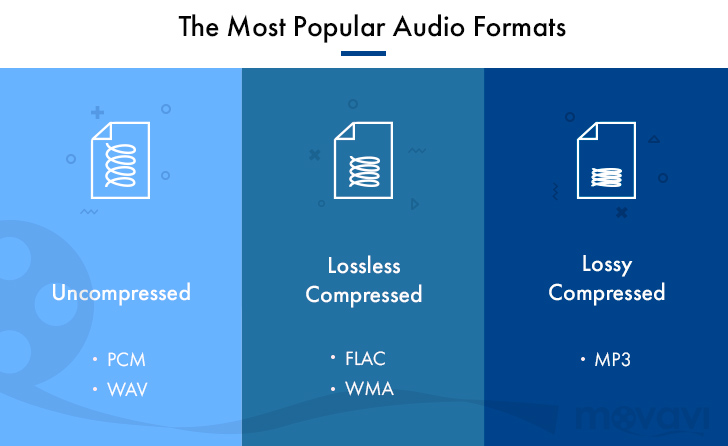
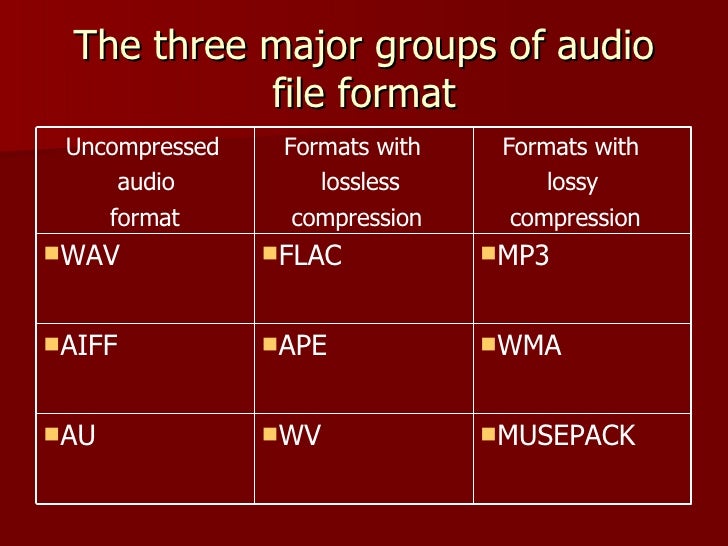
Uncompressed and compressed formats

Popular audio formats

Uncompressed formats

There are audio formats that do not have compression and are the best in terms of sound quality. On the other hand, they take up much more memory space and a lower transmission speed than compressed formats. With professional software such as Pro Tools, SuperCollider or Max, you generally work with files of this type. The two main formats are:

WAV (wave). Audio format developed by Microsoft and IBM for compatible IBM PCs. In this format, musical instruments feel the same regardless of the PC on which the file is played (with the same acoustic quality of the hardware components, of course).

AIFF (Audio Interchange File Format). The format developed by Apple is also called the Apple Interchange File Format.

Audio formats

Lossy compression

It allows for more compression, but at the expense of sound quality. Lossy compression methods generally tend to discard information considered useless, keeping only the essential ones and arise from the idea that not all frequencies contained in a sound spectrum are perceived by the human ear. Then the high frequencies are cut off, which are believed to be the least distinct in our hearing. Obviously, the more frequencies you cut, the more the space occupied by the audio track decreases and with this also the quality of the result as a reconversion process. It does not allow the complete restoration of the cut-off frequencies. Let’s see what are the main audio formats of this type:

MP3 (MPEG-1/2 Audio Layer 3). Audio compression algorithm capable of drastically reducing the amount of data required to reproduce a sound, compromising obtaining an almost faithful reproduction of the original uncompressed file. The best codec for compression is Lame. maximum achievable bit rate 320 Kbps.

WMA (Windows Media Audio). Audio file standard invented by Microsoft. Audio compression format very similar to an MP3.

OGG (Vorbis). It is an open source algorithm and with the same perceived quality, it allows greater compression than the MP3 format, obtained through advanced psychoacoustic research.

AAC (advanced audio coding). It is an audio compression format officially included in MPEG-4. Provides superior audio quality to MP3 format with more compact encoding. Currently it is used mainly by Apple, which in the variant that manages copyright has a compression of 128 Kbps (the standard of the iTunes Store) and corresponds to that of an MP3 at 192 Kbps at constant bitrate. Conversion times are a bit slower than other formats.

AC3 (Dolby Digital). Dolby Digital is a multi-channel audio coding system developed by Dolby Laboratories Inc and used in film, digital TV, laser discs, DVDs, and other digital audio streaming or playback media. It works from a minimum of 96 kbps to a maximum of 640 kbps. In cinema, Dolby Digital is used with only 320 kbps of bandwidth, as it prints in the limited space available between the slide holes of the films. Generally, in DVD it is used with a bit rate of 192 kbps to encode stereo signals (2.0, 2.1) or stereo surrounds, and with a bit rate between 384 and 448 kbps for 5.1 signals.

Lossless compression

These compression methods try to reduce the space occupied by the track without going to touch the sound. The compression rate is much lower than with lossy methods, but there is no loss of quality and the sound is identical to the original when converting. Let’s see what are the main audio formats of this type:

FLAC (Free Lossless Audio Codec). The widespread open source audio codec is currently well supported by various audio software. Unlike most lossless compression algorithms (like ZIP and gzip, for example) that only achieve 10-20% compression, it achieves significant compressions, on the order of 30-50%.

APE (Monkey’s Audio). No lossy format that allows us to reduce the space our music occupies by approximately 50% (in some cases even more). Currently it is no longer developed.

ALAC (AApple Lossless Audio Codec). The format developed by Apple stores data in an MPEG-4 container with the extension .m4a. It does not have Digital Rights Management (DRM) and is now deprecated.

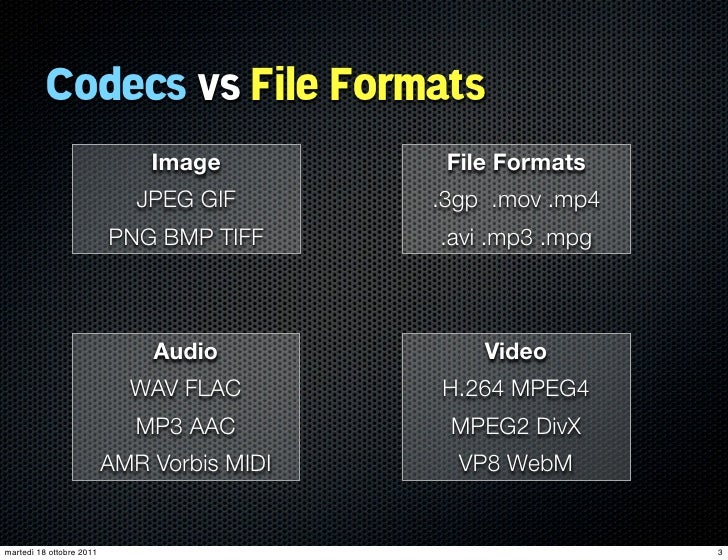
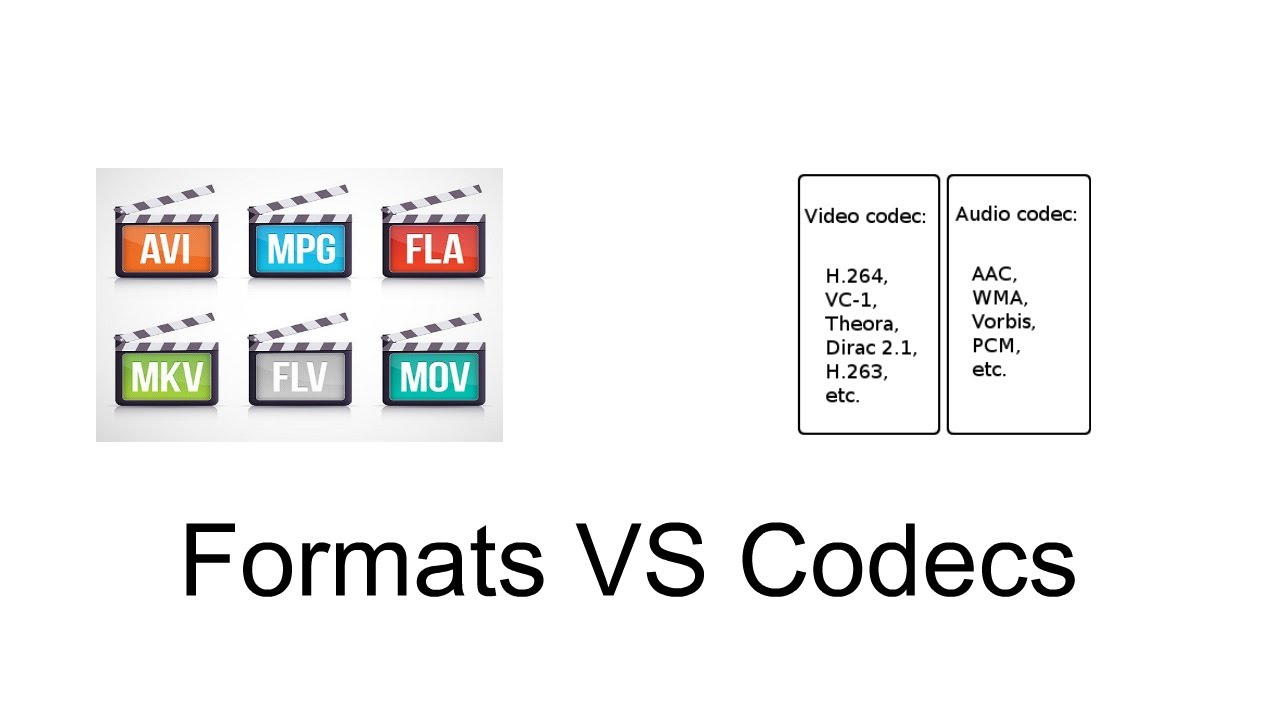
Formats and codecs

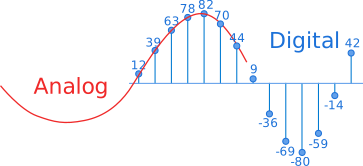
As a result of the process of sampling an analog audio signal we obtain a sequence of binary numbers (numerical streams) that can be written to particular types of files (audio files or sound files) stored on various types of digital media (CD, DVD, HD or other).

Codecs and formats

These files can have three different encoding formats:

Uncompressed – All data derived from the sampling process is written to the stored file.
Lossy: the information contained in the stored file is less than that contained in the source data (information loss).
Lossless – The information contained in the stored file is identical to that contained in the source data, but the data is still compressed.

Formats & Codecs
In fact, these different possibilities arise from the need that when we want to store all the information related to a signal in a digital medium, we may need to reduce the storage space occupied in order to benefit from the portability or transmissivity of the encoded stream. We must resort to compression of the information itself in such a way that it also allows the reverse operation.

This operation is performed using codecs that are programs (or devices) that deal with both the digitization of signals (typically audio or video) and their digital encoding and / or decoding.

There are several types of codecs, different from each other by the type of signal on which they must operate and by the encoding / compression algorithm implemented in them. Each encoding format can be derived from several different codecs. In fact, these allow you to listen to proprietary formats opened by any file reader, keeping the physical layer separate from the logical format of its representation.

The advantages of compression are:

takes up less space on the target media.
spend less time during data transfer (bit rate).
The cost (disadvantages) is the increase in read / write times linked to decompression / compression times and, in the case of audio files, also in terms of audio quality.

Bitrate

Before delving into the different types of audio formats, let’s focus on concepts related to data transmission speed, since audio files are intrinsically linked to the time that passes: each second is associated with a certain information content and therefore both to a certain subsequence of figures. binary. The number of binary digits that make up these subsequences is called the bit rate.

Bit rate is the number of binary digits used to store one second of information.

CDs, for example, have a sampling frequency equal to 44,100Hz as standard, which therefore generates 44,100 values ​​per second for each channel. In the case of a stereo file, they are multiplied by 2, and since sampling is done at 16 bits (exactly equal to 2 bytes), they must be multiplied by 2:

44,100 * 2 * 2 * 60 (seconds) = 10,584,000 bytes (~ 10MB) every minute

Bitrate is expressed in kilobits per second (kbps) and can range from 32 to 320 kbps. For example, if we wanted to calculate the bit rate of the previous file we would have to calculate:

44,100 * 2 * 2 * 8 (bytes to bit) = 1,411,200 bits / second (1,411 kbs)

The calculations we have just carried out refer to an uncompressed format, whereas in the case of compressed formats, as the total length of the file decreases, the average length of the subsequences also decreases, and consequently the bit rate. mean that will correspond to the compression factor.

In fact, if a file with a 1411 Kbps bit rate like the one in the previous example were compressed at an average bit rate of 320 Kbps, we would have reduced the original file size by a factor of approximately 4.5 (1411/320).

Currently in the most advanced codecs there are three types of bitrate implementation:

CBR (BitRate from Costant). The simplest, most used and now least effective method. The bit rate remains constant in each frame and this means that the encoder will always use the same number of bits to encode each musical passage. In practice, the more complex passages will have a lower quality than those with little dynamics or silence since they will be encoded with an always equal number of bits, while more would be needed for the former and less for the latter. A great advantage of this mode is that the size of the resulting file is always proportional to the length of the part and is easily evaluated.

ABR (Average Bit Rate). Average bit rate is a mode that outperforms CBR and consists of a kind of variable bit rate. The encoder encodes the regions that need it with more bits and the simpler ones with less.

Differences when displaying a 1080p and 720p video

What are the differences when displaying a 1080p and 720p version of the same medium on a 720p screen?

Suppose I have 1280×720 pixels on my screen and the current resolution is also set to 1280×720. What are the differences between the 1080p version and the 720p version of the same medium? Is it obvious to an end user (a video enthusiast or non-enthusiast)?

The Difference Between 720p and 1080i

Theory

Inexperienced eyes may not notice the differences in the video. 1080p videos still need to be resized. However, it will not be exactly the same because compression and scaling are applied in a different order.

File:Resolution chart

Suppose the original video was 1080p. In this case, the video was resized from 720p first and then compressed. On the other hand, the 1080p clip was initially compressed on the server side and then resized on the computer. The 1080p file will obviously be larger. (otherwise it offers a higher resolution, but in a lower quality, ruining the viewing experience and invalidating the highest resolution point of use 1)

Lossy compression usually causes visual artifacts that appear as square blocks with noticeable edges when video is paused, but are not visible when played at normal frame rates. The 1080p file will contain more square blocks (caused by compression) than the 720p video, but those blocks will be roughly the same size in both videos.

By doing simple calculations, we can calculate that 1080p video will contain 2.25 times more such blocks, so after resizing to 720p, those blocks will be 2.25 times smaller than actual 720p video. The smaller those blocks, the better the quality of the final video, so 1080p video will look better than 720p video, even on the 720p screen. 1080p upscaled video will appear slightly sharper than the current 720 clip.

Things get a bit more complicated if the source material is higher than 1080p. The 1080p clip is first resized to 1080p and compressed before playing, then resized once more during playback. The 720p clip is resized only once and then compressed. The intermediate scale step present in the case of 1080p video will degrade its quality slightly 2. Compression will make 720p even worse, so 1080p still wins.

One more thing: it is not only compressed video, but also audio. When people decide to use a higher 1 bit rate for video compression, they often do the same for audio. The 1080p version of the same video can offer better sound quality than 720p video.

1: Bitrate is the factor that decides how good compressed video is at the cost of file size. It is specified manually when the video is compressed. Specifies the amount of disk space that can be used for each frame (or unit of time) of compressed video. Higher bitrate = better quality and larger file. Using the same bitrate with the same frame rate will produce files of (roughly) the same size regardless of the video resolution, but the higher the resolution, the less disk space can be wasted on a single pixel, thus increasing the output resolution without increasing the bit rate can make compressed video worse than it would be with a lower output resolution.

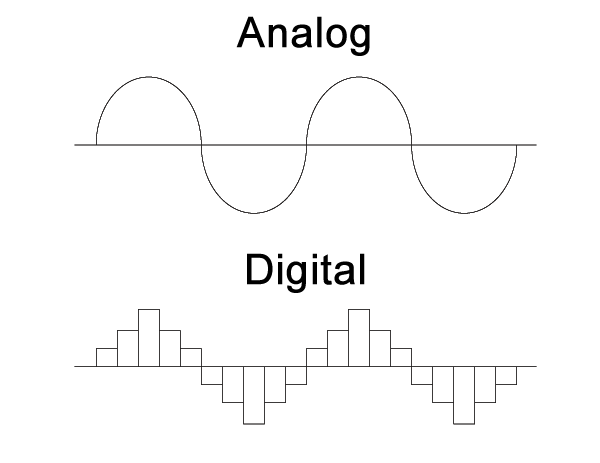
What is meant by analog and digital?

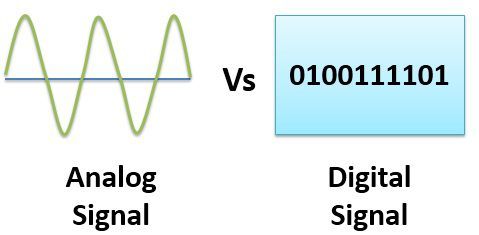
The terms “analog” and “digital” are used to distinguish two
large families of electronic circuits.

Analog and digital

Analog circuits are those that handle signals that vary
continuously and must be reproduced as accurately as possible
possible. For example, a vocal amplifier is a typical device
fully analog in which the signal produced by the microphone
is processed and amplified but should not be modified in its
essential components to ensure “fidelity” of reproduction.

Analog Music in a Digital World

Digital circuits (from the English word “digit” which can be translated as
digit or number, and therefore are also called “numeric”),
instead, they deal with signals that can only have two states, usually indicated
by the numerical values ​​0 and 1, which in within the circuits correspond
two clearly differentiable signal values:
for example, 0 may correspond to a voltage
between 0 and 0.2 volts, while the value 1 at a voltage between 4.5 and 5 volts.
An element that can assume only two states represents a “bit” of information.
Most of the components of a common personal computer are made
with digital circuits.

In reality, many of today’s electronic devices
They adopt mixed technologies, part analog and part digital.
Consider, for example, a compact disc player. The sign that
represents the engraved piece is stored in the form typically
digital: a succession of microscopic areas that can be opaque
or reflective, each area corresponds to a value of 0 or 1 depending on whether
it is opaque or reflective.
The sequence of values ​​0/1 constitutes a digital representation
the acoustic signal, so the first part of the reproduction circuit
uses digital techniques.

To play the original sound,
the sequence of bits must first be transformed into an analog signal and this step is done
a particular circuit called a “digital / analog converter” that has
the purpose of translating the sequence of bits into an electrical signal
which is “Analogous” to the acoustic signal originally produced by the instruments
that played the piece that is being recorded.

Then the analog signal can be amplified (by a circuit
analog, of course) and sent to the speakers for playback
acoustics.

Rather, consider a
fully analog recording and playback system: a magnetic recorder.
In this case, the magnetic tape in the cassette “stores” the signal
acoustics in the form of variations in the intensity of magnetization,
that is, the intensity of
magnetization along the magnetic tape is proportional to the signal
original acoustics. In this sense, the trend of
magnetization is “analogous” to the trend of the acoustic signal.

The player simply transforms the variation in the magnetic field
“read” on tape in a “similar” variation of an electrical signal
which is then amplified and reproduced as an acoustic signal.

Analog – Digital

Analog  Digital

When we talk about the Internet and the current technological “machines” (mobile phone, camera, tablet, computer) we always speak of “digital” and, sometimes, we contrast this term with “analog”. But what exactly these words mean and what they refer to, many times we ignore, perhaps also because it is not relevant for us and is based on being able to use “digital” for what we need without investigating it so much.

Analog Digital

“Analog” and “digital” are terms that are constantly encountered when talking about technologies (old and new). In common sense, “analog” is associated with a meaning of “old” or “past” or “low quality”; “Digital”, on the other hand, is synonymous with “new” or “innovative” or “quality”. This common sense distinction is not true.
One thing to keep in mind when addressing these issues is that the definitions of the two terms are one thing (what do they mean, where do they come from, …) and the operational implications they have (because we use one and not the other, as the consequences, implications, results …). As if to say, one thing is the universal law of gravity (with which the sun also has to do) and another is to stay in the sun to warm up and tan.
Another thing to keep in mind is that everything that is under the Digital / Analog issue is not something of our days, its essence was not born with the advent of “new” technologies; here it is one of the oldest problems in human thought and refers to philosophical disquisitions and to the issue of “continuous” and “discrete” variables. But we won’t dwell on these.

As for the definitions. ..
First of all, we must bear in mind that when we talk about Analogue and Digital we refer to ways of representing the measure of a quantity (they are “attributes of a quantity”), to ways in which the quantities we are considering vary (such as a audio signal, a video signal, color,….).

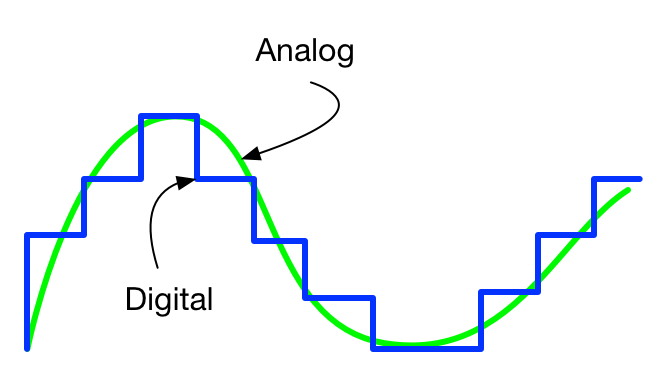
Analogous thing is a continuously varying quantity: an analog variable can take an infinite number of values ​​(for example, the distance between two points in space can take an infinite number of values).

Digital is a quantity that varies “step by step”: a digital variable can take only a finite number of values ​​(the duration of a day; for example, it can take only one of the 85,000 values ​​if we use the “second” unit, a of the 850 thousand values ​​if we use tenths of a second or one of the 8 million and 500 thousand if we use hundredths of a second; many possibilities but still finite, determined).

We can deduce that the concept of analog can be associated with a condition of continuity, that is, in a probable path something moves by changing its location through infinite positions and defining them as infinite we exclude the possibility of being able to number them.
With digital instead, the same path would be divided into stages (steps) and even if it is very small and numerous, it would always be possible to determine the amount.

Practice

Let us now turn to the practical implications of these two ways of representing physical quantities.
Until recently, all the data with which they organized audio or video recordings, static images, data transmissions such as radio, television, telephone were organized in the form of analog signals because the instruments that detected them “. The surfaces” on which they were recorded and the channels through which they were transported were mechanical and made specifically for that type of signal, in fact, they were the same as that signal.
Let’s think about color: the colors we see in a landscape are nothing more than a well-organized set of blue, red and green lights in their infinite shades; its representation through a photograph is based on the combination of blue, red and green pigments (therefore physical objects). We can say that the representation of a landscape through a photographic print is an analog representation of reality.

With the arrival of electronics (which has to do with physical quantities transformed and processed into electrical signals), physical quantities begin to be represented through electrical signals. Initially, these electrical signals were of the analog type (electronics that use continuous signals, signals that can assume an infinite range of possible values, that is, analog signals); later and a special type of signal has been used that can assume only some values ​​among the infinitely possible, in fact it can only assume two values: the presence or absence of the signal. If we look at the basic level of any computer application we will realize that we have a very long series of numbers “one” and “zero” where “one” is the presence of the signal and “zero” its absence.
This is “digital” electronics; digital because it uses signals that are not continuous but “in jumps”.

WMA Lossless vs FLAC

Lossless audio compression comes in a variety of forms. By definition, since all of these formats are lossless, technically there should be no difference in audio quality between them. The significant difference lies in the way they are compressed, which some say affects audio quality in different ways. WMA and FLAC files have some advantages and disadvantages, depending on the context.

WMA

WMA Lossless format

The Windows Media Audio format is one of several common lossless formats out there. It was originally designed to compete with the MP3 format, which lacks the full digital rights management capabilities of the WMA format. It is comparable to other proprietary lossless formats in its ability to support multi-channel audio and high-resolution recordings. WMA uses a unique compression algorithm that is sometimes claimed to provide better quality audio than other lossless formats. However, since “lossless” is by definition an identical reproduction of an original source, the superiority of the WMA format is questionable.

FLAC

FLAC format

The free lossless audio codec was originally created by Josh Coalson in 2000 and has since become a common format in lossless audio playback. Like the Apple Lossless format, the FLAC format is open source and can be used and expanded as desired. The tools for creating and editing FLAC files are freely available. A major limitation of the format is its lack of compatibility with many proprietary digital audio devices and applications. However, support for the FLAC format has grown considerably, especially in the area of ​​audio transmission.

Proprietary and open source

The most significant difference between the WMA and FLAC formats is their use, or lack thereof, of digital rights management technology. WMA is a proprietary format owned by Microsoft and requires a license to implement it. Despite this limitation, it is among the most popular codecs in use and can be played with a wide variety of devices and applications. The FLAC format has the advantage of being freely available for use, but the widespread presence of the WMA format is lacking. The preferred format will always depend on the context in which the file will be used.

Audio quality

Technically, all lossless audio codecs should offer identical audio qualities. However, it is occasionally argued that the different compression methods used result in subtle differences. The WMA codec uses two types of compression on a single file, depending on the complexity of the audio it contains. The result is less compression on complex passages and more compression on less complex regions, said to provide smoother quality than the other codecs. The FLAC compression algorithm is much simpler and compresses all audio files in the same way. If this results in a difference in the quality of the WMA codec, it is probably not detectable by the human ear.