What if the bit rate is high?


Free Download Mp4Gain
picture

What if the bit rate is high?

Bitrate

High bit rate = a lot of data can be transferred per second

bitrate
.

Sounds like a good thing.

The network cameras managed by my company send the captured video data to a personal computer for viewing over the network.

If you want to see the video, you want to see a beautiful video that moves sharply with high image quality, right?
However, the amount of data in a beautiful image is surprisingly large …

In such case, if the bit rate is high, a lot of data can be transferred per second, so you can deliver beautiful images to your computer. On the other hand, if the bit rate is low, the amount of data that can be transferred per second is small, resulting in choppy and poor quality moving images.

“Then the bitrate should be high anyway!”

… That is not the case.
In fact, in a surveillance camera system, there are the following disadvantages to increasing the bit rate.

Disadvantages of high bit rate!
Transferring a large amount of data increases the load on the network line and equipment.

There is an upper limit to the bit rate that can be transferred depending on the network environment. This depends on the LAN cable you are using, the performance of the hub, etc., but it will be difficult so I will skip it. Just think that there is an upper limit for the bit rate depending on the environment.

“So what happens if it exceeds the upper limit?”

In the case of video from a network camera, the connection often drops. If you exceed the upper limit, the line will be punctured and you will lose connection with the camera. The image may be interrupted for a moment, but if it is too bad, you will not be able to see the image from the camera at all.
If this happens, it will be very troublesome …

Also, if the bit rate is high, a large amount of data will reach the browsing computer and the recording NVR. When a lot of data arrives, the computer or NVR will not be able to process the data, which may cause abnormal operation (reboot, etc.).

Therefore, the System Kay NVR defines the maximum bit rate that can be supported as a specification. The bit rate that the entire NVR can process such as performance and bandwidth limit per channel are described in the specifications.


Free Download Mp4Gain
picture


Mp4Gain Main Window
picture


Mp4Gain Features
picture


Free Download Mp4Gain
picture

Video distribution Advantages and disadvantages of a high bit rate

Video distribution Advantages and disadvantages of a high bit rate

bit rate

The video bit rate is calculated separately for video and audio and added together.

Bit Rate

The sum of the video and audio bit rates is called the oval bit rate (total bit rate).

Expressed in the formula
Oval bit rate = video bit rate + audio bit rate

Will be.

High bit rate benefits
The higher the bit rate, the better the picture and sound quality, and the lower the bit rate, the worse the picture and sound quality.
However, note that if the video bit rate is high, there are cases where the video bit rate is high and the image quality is good, but the audio bit rate is low and the sound quality is poor. On the contrary, there may be cases where the image quality is poor and the sound quality is good.

High bit rate video basically has the advantage of improving image quality and sound quality, but you also need to understand the disadvantages.

Disadvantages of high bit rate
The higher the bitrate, the more net bandwidth is consumed and the more playback load is applied.
For example, increasing the bit rate from 500 Kbps to 1000 Kbps doubles the net bandwidth usage and doubles the playback load or more.

It is easy to increase the bit rate for high image quality, but if you increase the bit rate too much, the CPU will become overloaded and you may not be able to reproduce it well, so be careful.

Especially when the radio wave of the smartphone is bad or the band is limited, it may not play smoothly at a high bit rate.

Even if the bit rate is increased, the image quality and sound quality do not improve above a certain level.
In fact, increasing the bit rate does not mean that the image quality and sound quality will increase without an upper limit.

For example, if the image quality of the original video material shot by the camera is 100, even if it is converted at a high bit rate by video editing software or encoding software, a high-quality video with a quality of 100 or more image of the original video will be created. You can not.

No matter how high the bit rate is, if the quality of the original video material is poor, the quality will not be better.

Let’s think about the optimal bitrate for each video.
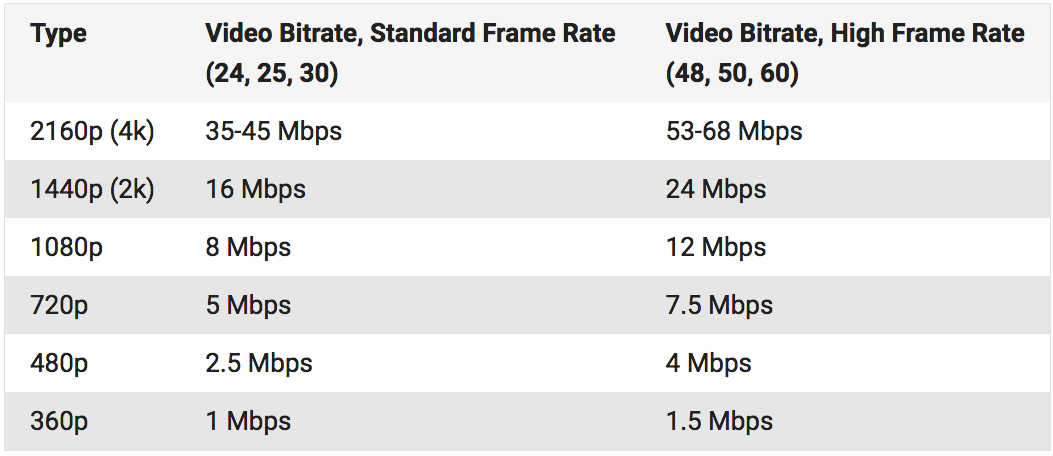
When creating a video, you need to think about how to set the optimal codec, resolution, frame rate, and bit rate yourself.

Then
The higher the bit rate, the better the picture and sound quality.
If the bit rate is high, the network and the playback terminal will be overloaded.
Even if the bit rate is increased, the picture quality and sound quality should not be higher than that of the original video material.
It is useful to remember that.

Also, almost all video editing software, encoding software, YouTube, and other free video publishing services commonly used when creating and publishing videos have preset settings with preset codecs, resolutions, frame rates, and bit rates.

However, the image quality of the presets is not always optimal, so use this bit rate knowledge when you need to make fine adjustments.

What does “bit rate” mean in a video?

When downloading videos from the Internet or copying videos from disc to your computer, you may have the option of choosing a different bitrate. Even DVDs have specific bit rates. As technology has advanced, video media are able to achieve higher quality, such as high definition DVD, and this is achieved by increasing the video bit rate.

Bitrate

Definition

Bit rate, sometimes referred to as “bit rate”, is the term used to define compression of audio, video, or other multimedia compression in terms of the amount of data, measured in bits, per unit of time in the printed material. Bit rate is the ratio of quality to time. Bit rate is also often measured in kilobits or megabits per second.

Bitrate

Sense

Videos with a higher bit rate will have a larger file size. For example, it will take longer to download or stream from the Internet and upload to a device or computer, and you can burn fewer videos to DVD. However, a higher bit rate usually indicates a higher quality. In this way, your video can be clearer and sharper. When browsing for video or importing it to computer from DVD or camera, choose the highest bit rate for higher quality. However, if space is your main concern, choose the lowest bitrate when downloading or compressing video files.

bit rate factors

Programs will have different bit rates depending on different factors. For example, the output material may have more depth and quality, thus producing a higher bit rate. High definition movies have a higher bit rate than standard definition, for example. Different types of video files have different bit rates and you can also choose different bit rates for the same file. For example, iTunes allows you to compress audio files with a bit rate greater than 128 kilobytes per second to save space on your iPod.

Standard bit rates

Most standard definition DVDs have a maximum bit rate of 9.8 megabits. High definition television has a bit rate range between eight and 15 megabits per second, while the standard for 720p high definition video is approximately 19 megabits per second. At the time of publication, Blu-Ray DVDs have the highest bit rate of all consumer videos with a maximum of 40 megabits per second. This makes the content of Blu-Ray DVDs more than four times that of standard DVDs.

What is the bit rate and how does it influence the quality of the videos?

Amid the pandemic we are facing and authorities increasingly asking people to stay home, the use of the Internet, especially broadcast services, is skyrocketing. Amazon Prime Video, Netflix, YouTube, Twitch and others have already announced measures to try to ensure everyone accesses their videos without gagging, but there are differences between the measures on some platforms.

bitrate

YouTube reduces standard video quality to SD worldwide

Netflix, for example, opted for a reduction in the data rate or bit rate without lowering the resolution of the video itself. YouTube is already one of the platforms that now forces you to load at a lower resolution while maintaining the data rate, that is, the final quality, and allows you to increase the image size manually by the user.

bitrate

Oops wait! So does reducing resolution not reduce the quality and quantity of data to transfer? Not quite. Resolution is not the only thing that defines the quality of a video image, or even a JPG image, audio and the like, there are a number of factors. Among them, in addition to the image size, the bit rate that will be transferred from a server to a device, for example.

Data rate versus bandwidth

Reducing the amount of data sent to each user can help guarantee the service for everyone (Photo: Pixabay)
To understand metering on Netflix, you first need to understand the difference between the data rate of a media file and the bandwidth of the connection. Both can be called bitrate and throughput, and whether those terms are correct or not matters little. What matters is that it confuses, so it is necessary to clarify it.

The data rate of a media file refers to the maximum size of a second of the video. A video, as you may already know, is divided into frames, the most common speed is 30 fps (30 frames per second). Each table has its own set of information, and the total of 30 (or 24, 60, 120, and the like) forms the bitrate.

The bandwidth of the connection is the speed of your internet. Brazilian 4G, for example, has an average of 20 Mbps. Some fixed broadband operators offer packages of 100 Mbps, 200 Mbps or even more. This rate is the maximum amount of data that your Internet can receive from a central server.

Data volume

YouTube chose to lower the standard resolution without decreasing the volume of data (Photo: Pixabay)
The bit rate of a media file, therefore, is the amount of data it has each second. Netflix reduced this rate to decrease the amount of information that its servers need to send to each user connected to the platform. This reduces the quality of the image because it is less data, which can slightly reduce sharpness and cause noise, which some call “pixelization”, especially in very dark areas of the frame.

The resolution is not the lowest: it is that this image has less information. When loaded onto a large screen such as a TV, details are missing to display. On smaller screens, you will hardly notice the difference.

Facebook and Instagram will reduce the quality of video in Brazil
Globoplay will reduce video quality to meet demand
In short, Netflix’s decision ensures resolution, keeping sharpness a little closer than the user is used to, but reducing the amount of data transferred, resulting in images with a lower level of detail and sometimes , even more noise, even.

By sending less information to each user, Netflix, as well as Facebook, Globoplay and other services with similar measures, the platform avoids what we call server bottlenecks. This could cause suffocation and connection failures. YouTube’s measure also alleviates traffic because not everyone will manually increase the resolution, which in itself already reduces the amount of information to be transferred.

What is a video bit rate? What is mp3

The bit rate is of two types:

internal: the number of bits transmitted per second;

external: data rate and its value for real-time transmission (to watch a movie or listen to music).

Bitrate

Let me remind you that high bitrate usually means better quality, however this may depend on the source file.

How to find out the bit rate of a specific file?

It can usually be found right inside

And what is the difference, let’s see?

There is said to be little difference. 🙂 In my opinion)) (hearing), it is necessary to listen to music not through the speakers for 100 rubles, and certainly not through a portable speaker. C and everything fits immediately: it does not sound, but cacophony, if the bit rate is less than 120 kbps.

Bitrate

Different bit rates for people who work with sound. Well, to listen at home, any bitrate, even the lowest bitrate, will. Here it is, as the saying goes, an amateur.

Incidentally, one of the “representatives” of music with a high bit rate is the .flac format. . , the bit rate weighs less than 800-1000 kbps, however it takes up more space, such a song can weigh 30mb, and the album less than 400.

I hope this explanation of “What is the bit rate in music” has helped me a little? Please leave the comments below so I can reply to you.
Don’t be afraid of me and add

With the concept of “bit rate” we are faced with the mention of files in audio and video format. To understand the essence of this term, you must master file compression and encoding. German scientists have established the general principle of compressing files with minimal loss. Using the MP3 encoding example, the source audio file is cut into chunks lasting 50 milliseconds, each of which is analyzed separately. In the analysis, the fragment is broken down into harmonics according to the Fourier method, of which, according to the theory of sound perception, the harmonics that the person perceives worse than the rest are expelled from the human ear. These are quieter harmonics in the context of the stronger ones. As a result, sounds masked by hearing inertia are ejected (for example, if a very short beep sounds at once, with a delay of a fraction of a second, some other short-term signal is heard, then it will not be heard. ) The remaining harmonic information after filtering is recorded in an MP3 file, which results in a much smaller size than the original WAV. The WAV file stores complete information about the original sound, digitized and quantized at a frequency of 44 kHz. This information is stored on normal audio CDs. During playback, a reverse transformation is performed, in which the remaining harmonics are converted back into a sound wave. Some information about the original signal has disappeared, therefore the sound is not the same as the original. But insignificant sounds have been thrown, so the human ear cannot distinguish the signal from the original, which it was before packaging in MP3.

Bit rate is the amount of information per unit of time. Its essence: how much information about each second of the registry can we spend. Of course, the smaller it is, the smaller the files are with the same duration over time, so they have to throw more “extra” harmonics. Bit rates have units of measure: kilobits per second (Kbps) and megabits per second (Mbps). The MP3 audio compression algorithm is often used with 128 kbps compression. They are of two types: fixed and variable. So with video compression, if a constant bit rate is applied, a fixed amount of data is used to encode a second of a movie. In the case of variable bitrate, the codec sets its own bitrate value based on the scene in the movie. For example, when encoding in MPEG, in practice, the compression gain is obtained by saving only the difference between adjacent frames. With a slow scene change, the difference between the frames is small, and therefore it is possible to reduce the bit rate required to reproduce these scenes.