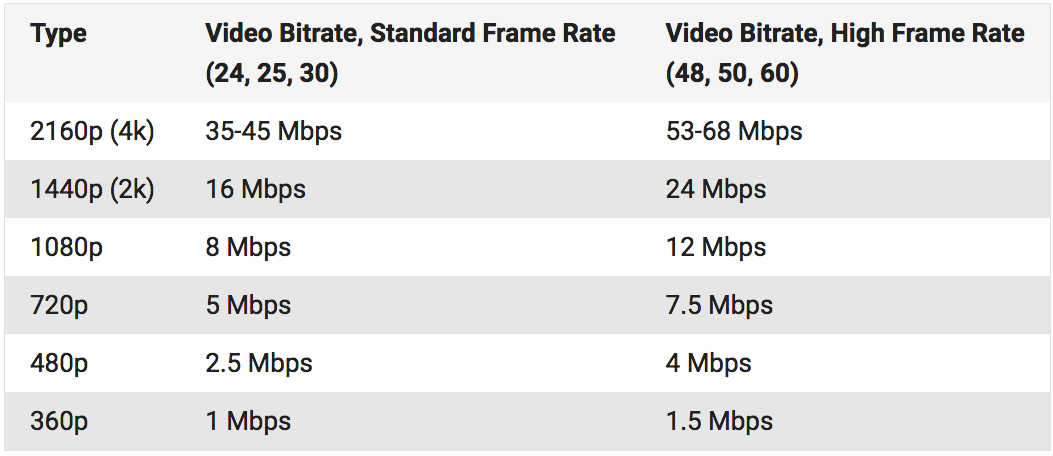
What if the bit rate is high?


Free Download Mp4Gain
picture

What if the bit rate is high?

Bitrate

High bit rate = a lot of data can be transferred per second

bitrate
.

Sounds like a good thing.

The network cameras managed by my company send the captured video data to a personal computer for viewing over the network.

If you want to see the video, you want to see a beautiful video that moves sharply with high image quality, right?
However, the amount of data in a beautiful image is surprisingly large …

In such case, if the bit rate is high, a lot of data can be transferred per second, so you can deliver beautiful images to your computer. On the other hand, if the bit rate is low, the amount of data that can be transferred per second is small, resulting in choppy and poor quality moving images.

“Then the bitrate should be high anyway!”

… That is not the case.
In fact, in a surveillance camera system, there are the following disadvantages to increasing the bit rate.

Disadvantages of high bit rate!
Transferring a large amount of data increases the load on the network line and equipment.

There is an upper limit to the bit rate that can be transferred depending on the network environment. This depends on the LAN cable you are using, the performance of the hub, etc., but it will be difficult so I will skip it. Just think that there is an upper limit for the bit rate depending on the environment.

“So what happens if it exceeds the upper limit?”

In the case of video from a network camera, the connection often drops. If you exceed the upper limit, the line will be punctured and you will lose connection with the camera. The image may be interrupted for a moment, but if it is too bad, you will not be able to see the image from the camera at all.
If this happens, it will be very troublesome …

Also, if the bit rate is high, a large amount of data will reach the browsing computer and the recording NVR. When a lot of data arrives, the computer or NVR will not be able to process the data, which may cause abnormal operation (reboot, etc.).

Therefore, the System Kay NVR defines the maximum bit rate that can be supported as a specification. The bit rate that the entire NVR can process such as performance and bandwidth limit per channel are described in the specifications.


Free Download Mp4Gain
picture


Mp4Gain Main Window
picture


Mp4Gain Features
picture


Free Download Mp4Gain
picture

Video distribution Advantages and disadvantages of a high bit rate

Video distribution Advantages and disadvantages of a high bit rate

bit rate

The video bit rate is calculated separately for video and audio and added together.

Bit Rate

The sum of the video and audio bit rates is called the oval bit rate (total bit rate).

Expressed in the formula
Oval bit rate = video bit rate + audio bit rate

Will be.

High bit rate benefits
The higher the bit rate, the better the picture and sound quality, and the lower the bit rate, the worse the picture and sound quality.
However, note that if the video bit rate is high, there are cases where the video bit rate is high and the image quality is good, but the audio bit rate is low and the sound quality is poor. On the contrary, there may be cases where the image quality is poor and the sound quality is good.

High bit rate video basically has the advantage of improving image quality and sound quality, but you also need to understand the disadvantages.

Disadvantages of high bit rate
The higher the bitrate, the more net bandwidth is consumed and the more playback load is applied.
For example, increasing the bit rate from 500 Kbps to 1000 Kbps doubles the net bandwidth usage and doubles the playback load or more.

It is easy to increase the bit rate for high image quality, but if you increase the bit rate too much, the CPU will become overloaded and you may not be able to reproduce it well, so be careful.

Especially when the radio wave of the smartphone is bad or the band is limited, it may not play smoothly at a high bit rate.

Even if the bit rate is increased, the image quality and sound quality do not improve above a certain level.
In fact, increasing the bit rate does not mean that the image quality and sound quality will increase without an upper limit.

For example, if the image quality of the original video material shot by the camera is 100, even if it is converted at a high bit rate by video editing software or encoding software, a high-quality video with a quality of 100 or more image of the original video will be created. You can not.

No matter how high the bit rate is, if the quality of the original video material is poor, the quality will not be better.

Let’s think about the optimal bitrate for each video.
When creating a video, you need to think about how to set the optimal codec, resolution, frame rate, and bit rate yourself.

Then
The higher the bit rate, the better the picture and sound quality.
If the bit rate is high, the network and the playback terminal will be overloaded.
Even if the bit rate is increased, the picture quality and sound quality should not be higher than that of the original video material.
It is useful to remember that.

Also, almost all video editing software, encoding software, YouTube, and other free video publishing services commonly used when creating and publishing videos have preset settings with preset codecs, resolutions, frame rates, and bit rates.

However, the image quality of the presets is not always optimal, so use this bit rate knowledge when you need to make fine adjustments.

Does it make sense to convert a file to a higher audio bit rate?

When a particular file (mp4, flv, etc.) has a 95 kbps audio bit rate, does it make sense to convert it to a higher bit rate when converting to mp3 or other format (lost or lost)?

Change bitrate

Would this result in higher audio quality or just a larger file?

I’m not talking about a higher quality of output than an input: this is obviously not possible. (Apart from switching from a lossless format to the original waveform.) I want to know if an output with a higher bit rate than the input will have a better quality than it would.

Note that conversion between lost formats is not recommended. Only in some cases, an original CD / wave may not be available. The question is more or less about the utility of possibly increasing the bit rate during conversion.

maybe a sub question is helpful: does the answer depend on the type of output file (lossless or lost)?

The top two answers below seem to be different, namely the latter indicating that the bit rates are not directly comparable, and if the original sound is in a more efficient format, the (less efficient) audio output should have a somewhat higher bit rate (same idea here and here), but if mp3 is the least effective, I’m not sure which formats are more effective. (Is it aac?) (- And in general, the answers seem to fall into one of the two attitudes represented by the most reconciled responses).

bitrate

Yes, it may make sense if you need to change the format.

If you have a 95 kbps file in a very efficient format to maintain the same quality, a relatively inefficient format like the mp3 format requires a higher bit rate.

Bitrate

Of course, you never recover anything that was lost in the first place. Conversely, MP3 encoding will further reduce the quality. Each lost format uses a different means to reduce the amount of stored data, eliminating “unnecessary” (unnecessary) portions of the data. Come and go through a bunch of different formats and there’s not much left …

Therefore, if you want to stay as close to the quality of your file as possible, choose a higher bit rate. Probably 320 kbps of space is wasted, but for mp3 format, a value between 128 and 192 is required to maintain, or at least get close to, the quality of a more efficient 95 kbps file.

Generally, this will usually not result in higher sound quality. The basic reason is that you cannot create sounds that are not in the original file.

Ideally, the only result that you suggest will be larger files.

At worst, the quality of the files may be even worse as the second lossy encoder tries to encode the output of a previous lossy encoder. It encodes noise and actual data.

Recording at a higher speed can have benefits if you have a lossless source and make it a lost output. This will minimize any loss of output lost.

If you can, it is much better to go back to the original source and re-code it at the highest bit rate you want.

By increasing the bit rate you will not get better sound quality.

Think of it this way: when it was converted from the original media (such as a CD), it was compressed to contain the “content” in a smaller “box”, thus losing a lot of data (read in loss-making and loss-free formats). If you then increase the speed, you simply expand the “box”, but the “content” is always the same.