Parameters that affect the quality of digital audio. (Part 2)


Free Download Mp4Gain
picture

Parameters that affect the quality of digital audio. (Part 2)

digital audio

The format is also called the number of channels in multichannel sound systems (5.1; 7.1). Initially such a system was developed for cinemas but later spread by Software Codec


DIGITAL SOUND

Software-level audio codec

§ G.723.1 – one of the basic codecs for IP telephony applications

§ G.729 – proprietary narrowband codec used for digital representation of speech

§ Internet Low Bit Rate Codec (iLBC) – a popular free codec for IP telephony (in particular for Skype and Google Talk)

Audio Codec (Audio Codec; Audio Encoder / Decoder) – A computer program or hardware designed to encode or decode audio data.

Software codec

A software-level audio codec is a specialized computer program, a codec that compresses (compresses) or decompresses (decompresses) digital audio data according to an audio file format or streaming audio format. The task of an audio codec as a compressor is to provide an audio signal with a certain quality / precision and the smallest possible size. Compression reduces the amount of space required to store audio data, and it is also possible to reduce the bandwidth of the channel through which the audio data is transmitted. Most audio codecs are implemented as software libraries that interact with one or more audio players such as QuickTime Player, XMMS, Winamp, VLC media player, MPlayer, or Windows Media Player.

Popular software audio codecs by application:

§ MPEG-1 Layer III (MP3) is a proprietary audio recording codec (music, audiobooks, etc.) for computer equipment and digital players

§ Ogg Vorbis (OGG) – the second most popular format, widely used in computer games and file-sharing networks to transfer music

§ GSM-FR is the first digital voice coding standard used in GSM phones

Adaptive Multispeed (AMR): human voice recording on mobile phones and other mobile devices

Dependence of the loudness, as well as the tone of the sound on the intensity and frequency of the sound wave.

Hertz (denoted by Hz or Hz) is a unit of measurement for the frequency of periodic processes (eg, oscillations).
1 Hz means an execution of said process in one second: 1 Hz = 1 / s.

If we have 10 Hz, this means that we have ten executions of said process in one second.

The human ear can perceive sound at frequencies ranging from 20 vibrations per second (20 Hertz, low sound) to 20,000 vibrations per second (20 KHz, high sound).

In addition, a person can perceive sound in a wide range of intensities, in which the maximum intensity is 1014 times greater than the minimum (one hundred thousand billion times).

To measure the volume of sound, a special unit of “decibels” (dB) was invented and used.

A decrease or increase in sound volume by 10 dB corresponds to a decrease or increase in sound intensity by 10 times.

Sound volume in decibels

In order for computer systems to process sound, a continuous audio signal must be converted to a discrete digital form by time sampling.

For this, a continuous sound wave is divided into separate small time sections, for each section a certain value of sound intensity is set.

Therefore, the continuous dependence of the loudness of the sound at time A (t) is replaced by a discrete sequence of loudness levels. On the graph, this appears to replace a smooth curve with a sequence of “steps.”

Sync Audio Sampling

A microphone connected to the sound card is used to record analog audio and convert it to digital format.

The denser the discrete fringes are located on the graph, the better it is ultimately possible to recreate the original sound.


Free Download Mp4Gain
picture


Mp4Gain Main Window
picture


Mp4Gain Features
picture


Free Download Mp4Gain
picture

Parameters that affect the quality of digital audio. (Part 1)

Parameters that affect the quality of digital audio. (Part 1)

digital audio

The best music formats for sound quality Minimum and maximum sound quality

DIGITAL AUDIO

The main parameters that affect the quality of digital audio recording are:

§ The capacity of the ADC and DAC.

§ Sampling frequency of ADC and DAC.

§ Jitter ADC and DAC

§ Resampling

In addition, the parameters of the analog path of digital sound recording and playback devices are still important:

§ Signal to noise ratio

§ Total harmonic distortion

§ Intermodulation distortion

§ Inequality of the amplitude-frequency response

Channel interpenetration

§ Dynamic range

Digital sound recording techniques

Digital sound recording is currently done in recording studios, under the control of high-quality, expensive personal computers and other equipment. In addition, the concept of “home studio” is quite developed, in which professional and semi-professional recording equipment is used, allowing you to create high-quality recordings at home.

Sound cards are used as part of the computers that perform processing on your ADCs and DACs; Most of the time at 24 bit and 96 kHz, a further increase in bit rate and sample rate hardly increases the recording quality.

There is a whole class of computer programs: sound editors that allow you to work with sound:

Record incoming audio stream

§ create (generate) sound

§ modify an existing recording (add samples, change timbre, speed of sound, cut parts, etc.)

§ rewrite from one format to another

Convert convert different audio codecs

Some simple programs only allow converting formats and codecs.

Varieties of digital audio formats.

There are several concepts of audio format.

The digital representation of the audio data depends on how the digital-to-analog converter (DAC) quantizes. In sound engineering, two types of quantization are currently the most common:

Pulse code modulation

Sigma-delta modulation

Quantization bit depth and sample rate are often specified for various audio recording and playback devices as a digital audio rendering format (24-bit / 192 kHz; 16-bit / 48 kHz).

The file format determines the structure and presentation characteristics of the audio data when stored on a PC storage device. To eliminate the redundancy of the audio data, audio codecs are used, with the help of which the audio data is compressed. There are three groups of audio file formats:

§ uncompressed audio formats like WAV, AIFF

Lossless audio formats (APE, FLAC)

Lossy compression audio formats (mp3, ogg)

Modular music file formats are highlighted. Created synthetically or from prerecorded live instrument samples, they are primarily used to create modern electronic music (MOD). Also, this can be attributed to the MIDI format, which is not a sound recording, but at the same time, using a sequencer, it allows you to record and play music using a certain set of commands in the form of text.

Digital audio media formats are used for both mass distribution of sound recordings (CD, SACD) and professional sound recording (DAT, minidisc).

For surround sound systems, sound formats can also be distinguished, which are mainly multi-channel sound accompaniments for movies. These systems have complete format families from two major competitors, Digital Theater Systems Inc. – DTS and Dolby Laboratories Inc. – Dolby Digital.

Lossless formats: flac, ape, wv, dts, and other digital audio formats

Lossless formats: flac, ape, wv, dts, and other digital audio formats

Free Lossless Audio Codec

Recently, in the open spaces of the Russian Internet, music in Lossless formats has been found more and more often, which can not fail to delight connoisseurs of free real quality. But sadly, files with the flac, ape, wv, dts permission cause a “RAM” stupor for a common user and he walks in search of his usual mp3. Well what can I say, Epic Fail, comrades?

lossless  audio

This guide provides a detailed description of lossless formats and describes in detail how to read and write such files …

Theory: lossless formats

Lossless data compression is an information compression method, whereby encoded information can be retrieved with bit precision. This fully recovers the original data from the compressed state. This type of compression is diametrically different from lossy data compression. As a general rule, each type of digital information has its own lossless compression algorithms.

FLAC and APE codecs are the main Lossless formats today

FLAC (English Free Lossless Audio Codec) is a popular free codec for audio compression. Unlike the lossy Ogg Vorbis, MP3 and AAC codecs, it does not remove any information from the audio stream and is suitable for both daily listening and archiving an audio collection. Today, the FLAC format is compatible with many audio applications.

Monkey’s Audio (APE) is a popular lossless digital audio encoding format. It is distributed free of charge along with open source code and a suite of encoding and playback software, as well as plugins for popular players. Monkey’s audio files use the following extensions: .ape to store audio and .apl to store metadata. Despite being open source, Monkey’s Audio is not free, as its license imposes significant restrictions on its use.

After downloading music on Lossless, you can burn it to CD in the future and listen to it with Hi-Fi (or other) class acoustics, while normal CD quality will be.

For comparison, bitrate:

-mp3 ~ 320 kb / s

-FLAC and APE ~ 1000 kb / s

Theory:

SACD, DVD-Audio, DTS-CD and others multi-channel music formats.

SACD stands for Super Audio Compact Disc, an optical disc format for storing music. It looks like a normal CD, some discs can be seen with the naked eye: their working side is yellow. The sound in SACD is recorded in a completely different format: DSD (Direct Stream Digital) and they are reproduced only in special players.

features:

– Multichannel: 6 channels of audio can be recorded

– A completely different type of recording (DSD), which provides better sound quality compared to a CD.

– Conditional compatibility with older players: there can be two layers to a disc: normal CD (stereo) and one or two SACD variants (stereo / multichannel).

That is, if the disk:

Single Layer (“Single Layer”) – Read-only on SACD players.

Double Layer or “Hybrid” (“Double Layer” or “Hybrid”): Read on both conventional CD players and SACD players.

All SACDs have CD text – text information about album, artist, and track.

What is high resolution audio?

What is high resolution audio?

Hi-Res Audio

When it comes to music, Hi-Res Audio, also called Hi-Res Audio, is harder to find. The main way most of us listen to music is by streaming to portable devices like smartphones. While very convenient, this trend has set us back in terms of what we consider a good music listening experience.

High-Res Audio

By this we mean that the file formats used by streaming services are of lower quality. Compared to CD format, MP3 files and music streaming from iTunes, Yandex.Music, Spotify and other services simply contain less data to create music. To put music in a format that can be easily streamed and give listeners the ability to store many songs on a portable music player or smartphone, 80% of the information present in the original recording can be removed.

What is Hi-Res Audio?

Due to the proliferation of the experience of listening to low-quality music, a strategy has been put in place to bring back high-quality two-channel audio by expanding the capabilities of downloadable and playable music to match or exceed CD quality. This initiative is called Hi-Res Audio, Hi-Res Music or HRA. For the purposes of this article, we are referring to the most common term: High Resolution Audio.

CD quality benchmark

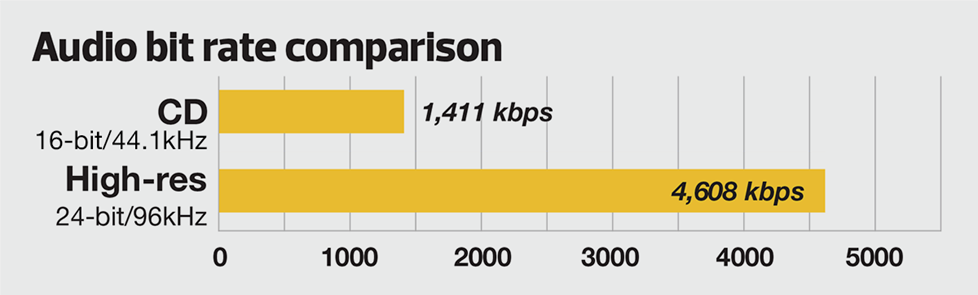
The CD format is considered the benchmark that separates low-resolution audio from high-resolution audio. Technically speaking, Audio CD is an uncompressed digital format that is represented by 16-bit PCM with a sample rate of 44.1 kHz.

Anything below the CD breakpoint, such as MP3, AAC, WMA, and other highly compressed formats, is considered low-resolution audio, and anything above is considered high-resolution audio.

Hi-Res Audio Formats

High-resolution audio is provided on physical media in HDCD, SACD, and DVD-Audio formats. However, with many no longer using physical media, a strategic step has been taken to provide listeners with the ability to access high-definition audio through downloads and streaming.

Non-physical high-resolution digital audio formats include ALAC, AIFF, FLAC, WAV, DSD (the same format used in SACDs), and PCM (with a higher sample rate and bits than CDs).

Is it true that vinyl record players have better sound quality? (Part 2)

Is it true that vinyl record players have better sound quality? (Part 2)

Vynil vs digital

Note 2: This is why you can immediately dismiss anyone who nonchalantly says “analog is better” on the grounds that digital music somehow has “gaps” or less information than analog signal: output from a properly designed digital music player. analog signal, and this signal is a complete and accurate version of the original signal (within the frequencies specified by Nyquist).

Analogue vs Digital


It is mathematical. Also note that almost every new record coming out on vinyl today (i.e., the hipster-preferred LP version of a new Decembrists set) went through many stages of recording and digital processing before getting into those vinyl beats. .

Note 3: I’m limiting my discussion here to CDs and I’m not trying to cover both the bottom of digital audio (i.e. low-bandwidth MP3) and the top (high-definition formats like SACD) that reduced rates of distribution. In fact, bad MP3s will have artifacts and sound worse than recordings; the higher formats are mostly gold, but at least as good as the CD technology I’m focusing on. High-performance MP3 (320kbps and above) and lossless digital formats have been shown to be indistinguishable from CD originals in double-blind studies, and therefore the discussion here applies to these cases as well.

Note 4: Many of the early CDs also had a number of other sins, including sources using the wrong types of master tapes (for example, 3rd and 4th generation dubbing masters optimized for cassette production) and mastering with very old equipment that does a poor job. digitization. These deficiencies, often described in terms of “hard”, “grainy” or “metallic” sound as opposed to the “warm” or “soft” sound of discs, were mostly corrected during the first 2 years of CD production. , but they damaged the reputation of the CD itself. carrier among many audiophiles, in some cases forever.

Note 5: There is an additional possibility that the recording player (the signal chain of the stylus, the cartridge and the audio pre-amplifier) ​​can change the sound in a pleasant way. This is an ironic possibility as the stated purpose of audiophile playback is to avoid any possibility of distortion or coloration of the original sound, but this may explain part of the preference for analog. Of course, to the extent that artists want their music to sound a certain way, they can align or colorize their work to make it sound the same on a CD.

Note 6: Of course, you can have an active and focused listening experience regardless of the media. This is why double-blind studies (where, by definition, listeners are fully engaged and unaffected by psychological biases) tend to disprove theories that analog formats are inherently better than digital.

Is it true that vinyl record players have better sound quality? (Part 1)

Is it true that vinyl record players have better sound quality? (Part 1)

Vinyl vs. Digital

The short answer is no.

Vinyl vs Digital

Human hearing ranges from 20 Hz to 20,000 Hz (Note 1); The sample rate of CDs is sufficient to fully capture audio in this range; Digital sampling allows you to fully restore the original analog signal with correct decoding (according to the Nyquist-Shannon sampling theorem) (Note 2); The dynamic range (the difference between high and low sounds) is greater than that of a record.

Thus, CDs can perfectly capture and restore sound beyond recording capabilities.

In other words, if an LP recording and a CD are created from the same primary source with no differences in configuration, and each is played on properly designed equipment, the CD will provide at least the same accurate representation of the original. as LP (and will be immune to transmitted mechanical noise, surface noise, and wear that can affect LP sound).

I mentioned earlier that CDs can handle a wide dynamic range; that’s true, but bigger isn’t always better in this case. The early CD engineers were determined to take advantage of this entire range. In this way, we ended up with recordings whose quiet parts could only be heard when listening carefully with the volume turned on in a very quiet room, while loud sounds, more than 90 decibels above the audible baseline, would damage your hearing and their relationships. These recordings are suitable for audiophile demonstrations, but are mostly useless in “normal” listening environments, such as cars or personal devices.

Over time, the trend in digital mastering has shifted towards lower and lower dynamic range and higher and higher average signal levels (a phenomenon known as loudness warfare). This also results in poor recordings, as some dynamic range is required to maintain the impact and realism of the music.

Interestingly, the dynamic range capability of analog LP recording (between 50-65dB depending on various factors chosen by the mastering engineer) seems to have chosen a good enough dynamics to be enjoyable, but not so dynamic as to require control constant volume. listen comfortably. Also, over the years, LP mastering trends have been much less volatile and more consistent. (Note 5).

As a result, the recordings on many CDs (for one reason or another) are worse than their records. But keep in mind that this is not a feature of technology, but rather a way to use (and abuse) it.

But there is another factor here. Digital music CDs or MP3s optimized for mobile use. Most of us listen to digital music on the go, through cheap headphones at the gym, or through our car stereo on a noisy highway, while traffic or other distractions compete for our attention. Playing a recording, on the other hand, requires much more dedication and concentration. By definition, you are in a place (where the player is). You actively select and initiate the experience, don’t “let it get mixed up.” You are most likely using the best equipment you own or have access to to listen to, and you are more likely to be distracted. You have a big sleeve with a cool pattern. Is to miss you?

In the end though, you can grab that same LP, use it to master a CD, clap, click and all, play it on a decent CD player through the same stereo, sit back and listen and get that. the same is audible. (Note 6). And if you sit down with a very well recorded and mastered CD and listen carefully, you will discover details and subtleties that can easily be lost on a worn, dirty or scratched LP.

But I don’t favor anyone’s preferences; This is what music is all about, and if the vinyl brings you closer to it, you will get more energy.

Note 1: LPs can contain signals with a frequency higher than 20 HKz; some recordings contain content up to 35 kHz. Most adults cannot hear at nearly 20 kHz, however some audiophiles agree with theories that these “supersonic” can be detected in other ways and / or may subtly interact with audible sounds to alter the nature of the feeling. Neither of these theories have been tested in double-blind studies.

Hi-Res Audio Files

Hi-Res Audio Files

Hi-Res Audio

Audio files 192 kHz / 24 bit, 176/24, 96/24, 9624, 24 bit / 96 kHz, 24/96, FLAC96, 192WAV, etc.

Hi-Res Audio

Lossless or uncompressed compressed digital files to accurately store and reproduce pulse code modulation (PCM) digitized sound. Audio files are generally considered High Definition (BP) files if they have a sample rate of 88.2 or 176.4 kHz (multiples of 44.1 kHz), 96 or 192 kHz (multiples of 48 kHz) or higher and 24 bits or higher.

For accurate sound reproduction, files must be in lossless formats. The most commonly used formats (codecs) are WAV, FLAC, WMA, AIFF and ALAC. WAV (Waveform Audio Format) is a format commonly used as a wrapper for uncompressed audio digitized using PCM. FLAC (Free Lossless Audio Codec – open lossless audio codec) is a popular audio compression format that does not remove any information from the audio stream and is suitable for both listening to music on high-quality audio equipment and for storing a collection audio on a hard drive. WMA (Windows Media Audio) is a compressed format developed by Microsoft (UNITED STATES). For accurate sound reproduction, the Lossless version is preferred. AIFF (Audio Interchange File Format) was developed by Apple Computer (USA) in two versions: with and without compression, and is most often used on Apple computers. ALAC (Apple Lossless Audio Codec) is an open source lossless audio codec also developed by Apple. There are also other formats for storing and playing audio files.

Audio files can be exact (“bitwise”) copies of studio master files, their variants with different sample rates and bit depths, or digital files obtained by digitizing analog audio recordings.

To put audio files on the hard drive of a computer or music server, you can download them from the Internet, transfer them from another PC, flash drive, or optical disc. An example of the latter is HRx discs

DXD (Digital eXtreme Definition) is a BP format that was initially used only for professional sound recording. The DXD format uses PCM to digitally encode audio data with a sample rate of 352.8 kHz and 24 or 32 bits. The DXD format was developed in 2004 by Digital Audio Denmark (Denmark) and was originally used to record and process sound in the production of super-audio discs.

However, it later began to be used as a standalone digital audio recording format. Since 2012, DXD music files are distributed on the Internet. The release of consumer DACs that support this format is expanding.

In addition to the aforementioned formats, in which the signal was digitized using PCM, since 2010 DSD audio files have been distributed on the Internet, in which another technology was used for encoding: Direct Stream Digital (direct digital stream), based on sigma-delta modulation. This is the same technology that is used in SACDs (see below). DSD audio files have the extension DFF or DSF.

Encoding with different sampling rates is used: 2.8224 MHz, such as SACD (often referred to as DSD64, as this frequency is 64 times higher than CD, or single DSD, DSD1), with a frequency twice as high high: 5.6448 MHz (designated DSD128, 2xDSD, DSD2, 5.6MHz DSD or Double-DSD), four times higher: 11.2896 MHz (DSD256, 4xDSD, DSD4, 11.2MHz DSD or Quad-DSD) and even eight times higher higher than 22.5792 MHz (DSD512, 8xDSD, DSD8, 22.5MHz DSD or Octuple-DSD). There are also DSD files in multiples of 48 kHz – 3.072 / 6.144 / 12.288 / 24.576 MHz.

With the appropriate software and DAC, DSD audio files can be played from a computer in their native format, or they can be converted to PCM files for playback using non-DSD digital-to-analog converters.

MQA is a compression technology proposed in December 2014 by the British company Meridian Audio, which previously developed the MLP method for DVD audio discs (see below). MQA (Master Quality Authenticated, Russia Confirmed Studio Quality) technology is based on the use of a special codec that allows you to significantly reduce (by an order of magnitude) the size of a digital audio file to simplify its transmission and storage , and then decode without degrading sound quality, according to the company. …

Analog-Digital Processing

Analog-Digital Processing

Digital vs Analog

A digital signal is obtained from analog or is directly synthesized into digital (in electric musical instruments).

DIGITAL ANALOG AUDIO

Converting from analog to digital involves two basic operations: sampling and quantizing. Discretization is the replacement of a continuous signal with a series of samples of its instantaneous values ​​taken at regular intervals. According to the Kotelnikov-Chenon theorem, a discrete signal can be completely restored later, as long as the sampling frequency is at least twice the upper frequency of the signal spectrum. The samples are then quantized according to level: each of them is assigned a discrete value closer to the real one. The precision of quantization is determined by the bit width of the binary representation. The higher the bit depth, the more quantization levels (2N,

The audio CD format has a sampling frequency of 44.1 kHz and 16 bits. This gives 44 thousand samples per second, each of which can take one of 216 = 65536 levels (for each of the stereo channels).

In addition to the 44.1 kHz / 16-bit format, others are used in digital recording. Studio recording is generally done in 20-24 bit, then the data is converted to audio CD by recalculation. The extra bits are then discarded or (better) rounded, sometimes pseudo-random noise is added to reduce quantization noise (dither).

The most advanced custom audio formats are DVD Audio and Super Audio CD (SACD). DVD Audio adopts the MLP lossless data compression algorithm developed by Meridian. And SACD, unlike other formats, does not use pulse code modulation (PCM or PCM), but one-bit encoding of the DSD (Discrete Pulse Width Modulation) stream. SACDs come in single or double layer (hybrid) discs with a normal CD layer.

The most popular audio medium today is compact disc, despite certain limitations in sound quality seen by audiophiles. The reason for them is in the low sample rate: for an accurate reconstruction of signals near the upper limit of the audio range, a filter that is not physically workable is needed (its impulse response covers the negative time area). This is compensated to some extent by digital filtering with higher sampling and bit depth. The data on the disc is redundantly encoded (Reed-Solomon code) to ensure smooth playback in real time.

Broadband communication is required for digital audio transmission, especially for uncompressed high definition multichannel transmissions.

Figure: 1. Digitizing an analog signal and obtaining digital samples on CD Audio and SACD (right)

DIGITAL AUDIO TRANSMISSION

The communication lines for digital audio transmission can be cables, optical lines, and overhead radio.

For the transmission of PCM signals over wired lines, AES / EBU (balanced, coaxial), S / PDIF (unbalanced coaxial) interfaces have been developed, which provide transmission of various signals (clock frequency, digital word rate, channel data) over a cable. Inside the devices, these signals are transmitted separately, at the output of the transport mechanism they are encoded and at the input of a digital-to-analog converter (in two-block systems) they are separated again in a digital receiver.

Typically, a high-quality coaxial cable is used for digital audio transmission. There are also S / PDIF converters for fiber optic lines: AT&T ST and Toslink (the latter is standard in consumer equipment). And also, for the use of twisted pairs in Ethernet cable networks. The medium of distribution for compressed audio in the form of archived files is the Internet.

Like any digital signal, digitized audio is distributed and switched by special devices: distribution amplifiers, matrix switches, and conventional.

There is one factor that negatively affects digital signals, and often negates almost all of the advantages of digital audio over analog, including the ability to repeatedly copy, stream, and archive programs without any loss of quality: we are talking about jitter. Jitter is jitter, or the uncertainty of a transition from 0 to 1 and vice versa.

Digital audio file formats wav, mp3, aiff, ogg, flac, m4a

Digital audio file formats wav, mp3, aiff, ogg, flac, m4a

digital audio formats

The last five years gave a great boost to the development of portable and stationary audio systems, and with this support for a variety of digital audio formats.

DIGITAL AUDIO FORMATS

Small pocket devices have a large internal memory and fixed audio equipment has become even smarter and more demanding. That is why, now, we can not save space on the player and download songs that weigh between 15 and 30 MB each, but at home, listen to digital music in a quality equal to the sound of an analog vinyl.

Description of popular digital audio formats
However, the most widespread audio formats still have their pros and cons, and even in an urgent matter like digital audio, a “panacea” has not yet been found. Classic digital audio formats are divided into “compressed” and “uncompressed” streams, as well as “lossless” formats, which exclude loss of sound.

Description of digital audio formats Description of digital audio formats

Wav audio format
The waveform audio file format (WAVE, WAV – “in waveform”) is a file format for storing a recording of an uncompressed digitized audio sequence. In general, this is the most common format for working in the studio and in broadcasting. allows you to get the most honest sound quality. For example, the standard audio CD format is an LPCM audio stream, with parameters: 2ch (stereo), 44-100Hz, 16bit.

Mp3 audio format
MPEG-1/2 Audio Layer 3: (MP3) is the most popular digital format for storing compressed audio. The MP3 format uses a special algorithm designed to greatly reduce the size of the original file. This format allows you to keep the audio close to the original sound, but thanks to a variety of settings, extremely small size.
Compared to the standard audio CD format, a file in MP3 format and a bit rate of 128 kbps will be approximately 1/11 the size of the original file.

FLAC audio format
FLAC (Free Lossless Audio Codec) is a popular free codec designed for lossless compression of audio data. What does that mean? Unlike lossy audio codecs such as MP3 or OGG, the FLAC audio codec does not remove any information from the audio stream. This format is ideal for audiophiles who create their own music collections and listen to music on high-quality equipment.

Ogg audio format
OGG is a format that has not gained great popularity, but is nonetheless used by a fairly large audience. The OGG format, similar to MP3, compresses audio with loss of quality, but is fundamentally different in practical conversions. This made it possible to get better quality with a smaller file size and to display this codec as absolutely independent. In addition to similar formats that convert lossy audio, OGG has the ability to adjust container properties.

Aiff audio format
The Audio Interchange File Format (AIFF) is a fairly universal audio file format developed by Apple, which is used to store audio data. Like its counterpart, the WAV format, it is uncompressed audio and is widely used in professional recordings and music production.
The .aiff and .aif files created by Apple Loops are used by GarageBand and Logic Audio music editors.

M4a audio format
Apple Losseles (also known as Apple Lossless Encoder, ALE or Apple Lossless Audio Codec, ALAC) (m4a) is another Apple development. This audio format refers to uncompressed audio, which provides lossless playback. It is a fairly specific format, which is mainly supported by products of the creator company, and in some cases, as in the iPhone system sounds, where it is possible to use exclusively the m4a format.

Sound via Bluetooth: versions and codecs, do they affect the sound quality?

Sound via Bluetooth: versions and codecs, do they affect the sound quality?

Bluetooth

Bluetooth is a wireless technology that allows, among other things, to connect headphones or portable speakers, stereo systems or sound bars to your smartphone or laptop.

Bluetooth 5 to double speed, quadruple range of wireless links - CNET

There are many devices on the market today with different versions of the Bluetooth protocol and with support for different codecs. What does all of this mean, which version is the latest, we need to understand all of this, and most importantly for us, does this somehow affect the sound quality? Let’s see.

One important thing to keep in mind up front is that the Bluetooth sound technology you hear has much less impact on sound quality than the design of the device itself. If you try to test multiple wireless headphones or speakers, you will hear the obvious differences between the devices. If you test the same device, but connected with different codecs or versions of Bluetooth, the difference may not be so obvious, maybe even subtle.

Simply put, you should not base your choice solely on the Bluetooth technologies and codecs supported by the device, this is neither the first nor the second most important criteria.

Bluetooth versions

Bluetooth has improved dramatically over the years since the turn of the century, and audio compression isn’t as brutal today as it was in the days of Bluetooth 1.1 or 2.0 (when wireless headphones and earphones first hit the market). ). Let’s highlight the main technical differences between the Bluetooth versions, devices with which they can be found for sale today.

Bluetooth 3.0: The data transfer rate has increased significantly (up to 24 Mbps vs. 2.1 Mbps in Bluetooth 2.0), but the power consumption has increased.

Bluetooth 4.0: reduced power consumption while maintaining a speed of 24 Mbps.

Bluetooth 4.1: added anti-crosstalk protection when working with LTE modules installed on all 4G smartphones.

Bluetooth 4.2: higher speed and improved data transmission security.

Bluetooth 5.0: range increased 4 times, speed increased 2 times.

Bluetooth 5.1: it was possible to determine the location and direction with the utmost precision.

As you can see, the new versions primarily address data rate and power efficiency issues, which rarely directly affect sound quality. However, newer versions can improve data transfer reliability, which can allow a heavier codec, such as aptX HD or LDAC, to run at higher data rates.

So to summarize:

The Bluetooth version generally does not directly affect the sound quality.

Both devices must support the Bluetooth version and specific codec.

The difference between different codecs on the same device can be subtle.

AAC is only meaningful to Apple, not of interest to Android.

aptX and other codecs, on the other hand, are not supported by Apple devices.

Wireless technology shouldn’t be an important consideration when choosing an audio device. Don’t automatically rule out headphones without the latest Bluetooth version or with SBC only, they may sound better or be more comfortable than their competitors.