What is high resolution audio?


Free Download Mp4Gain
picture

What is high resolution audio?

Hi-Res Audio

When it comes to music, Hi-Res Audio, also called Hi-Res Audio, is harder to find. The main way most of us listen to music is by streaming to portable devices like smartphones. While very convenient, this trend has set us back in terms of what we consider a good music listening experience.
High-Res Audio

By this we mean that the file formats used by streaming services are of lower quality. Compared to CD format, MP3 files and music streaming from iTunes, Yandex.Music, Spotify and other services simply contain less data to create music. To put music in a format that can be easily streamed and give listeners the ability to store many songs on a portable music player or smartphone, 80% of the information present in the original recording can be removed.

What is Hi-Res Audio?

Due to the proliferation of the experience of listening to low-quality music, a strategy has been put in place to bring back high-quality two-channel audio by expanding the capabilities of downloadable and playable music to match or exceed CD quality. This initiative is called Hi-Res Audio, Hi-Res Music or HRA. For the purposes of this article, we are referring to the most common term: High Resolution Audio.

CD quality benchmark

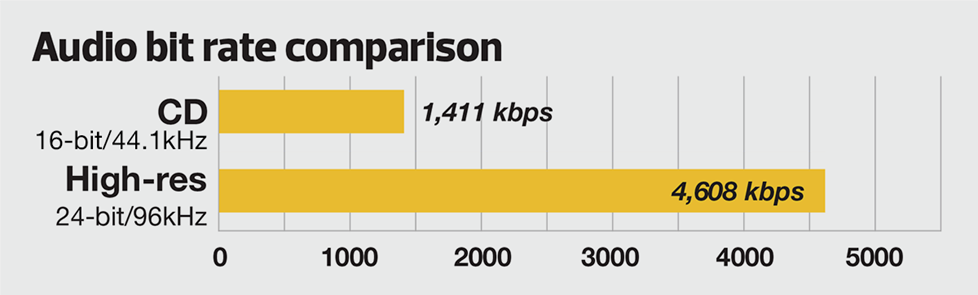
The CD format is considered the benchmark that separates low-resolution audio from high-resolution audio. Technically speaking, Audio CD is an uncompressed digital format that is represented by 16-bit PCM with a sample rate of 44.1 kHz.

Anything below the CD breakpoint, such as MP3, AAC, WMA, and other highly compressed formats, is considered low-resolution audio, and anything above is considered high-resolution audio.

Hi-Res Audio Formats

High-resolution audio is provided on physical media in HDCD, SACD, and DVD-Audio formats. However, with many no longer using physical media, a strategic step has been taken to provide listeners with the ability to access high-definition audio through downloads and streaming.

Non-physical high-resolution digital audio formats include ALAC, AIFF, FLAC, WAV, DSD (the same format used in SACDs), and PCM (with a higher sample rate and bits than CDs).


Free Download Mp4Gain
picture


Mp4Gain Main Window
picture


Mp4Gain Features
picture


Free Download Mp4Gain
picture

Hi-Res Audio Files

Hi-Res Audio Files

Hi-Res Audio

Audio files 192 kHz / 24 bit, 176/24, 96/24, 9624, 24 bit / 96 kHz, 24/96, FLAC96, 192WAV, etc.

Hi-Res Audio

Lossless or uncompressed compressed digital files to accurately store and reproduce pulse code modulation (PCM) digitized sound. Audio files are generally considered High Definition (BP) files if they have a sample rate of 88.2 or 176.4 kHz (multiples of 44.1 kHz), 96 or 192 kHz (multiples of 48 kHz) or higher and 24 bits or higher.

For accurate sound reproduction, files must be in lossless formats. The most commonly used formats (codecs) are WAV, FLAC, WMA, AIFF and ALAC. WAV (Waveform Audio Format) is a format commonly used as a wrapper for uncompressed audio digitized using PCM. FLAC (Free Lossless Audio Codec – open lossless audio codec) is a popular audio compression format that does not remove any information from the audio stream and is suitable for both listening to music on high-quality audio equipment and for storing a collection audio on a hard drive. WMA (Windows Media Audio) is a compressed format developed by Microsoft (UNITED STATES). For accurate sound reproduction, the Lossless version is preferred. AIFF (Audio Interchange File Format) was developed by Apple Computer (USA) in two versions: with and without compression, and is most often used on Apple computers. ALAC (Apple Lossless Audio Codec) is an open source lossless audio codec also developed by Apple. There are also other formats for storing and playing audio files.

Audio files can be exact (“bitwise”) copies of studio master files, their variants with different sample rates and bit depths, or digital files obtained by digitizing analog audio recordings.

To put audio files on the hard drive of a computer or music server, you can download them from the Internet, transfer them from another PC, flash drive, or optical disc. An example of the latter is HRx discs

DXD (Digital eXtreme Definition) is a BP format that was initially used only for professional sound recording. The DXD format uses PCM to digitally encode audio data with a sample rate of 352.8 kHz and 24 or 32 bits. The DXD format was developed in 2004 by Digital Audio Denmark (Denmark) and was originally used to record and process sound in the production of super-audio discs.

However, it later began to be used as a standalone digital audio recording format. Since 2012, DXD music files are distributed on the Internet. The release of consumer DACs that support this format is expanding.

In addition to the aforementioned formats, in which the signal was digitized using PCM, since 2010 DSD audio files have been distributed on the Internet, in which another technology was used for encoding: Direct Stream Digital (direct digital stream), based on sigma-delta modulation. This is the same technology that is used in SACDs (see below). DSD audio files have the extension DFF or DSF.

Encoding with different sampling rates is used: 2.8224 MHz, such as SACD (often referred to as DSD64, as this frequency is 64 times higher than CD, or single DSD, DSD1), with a frequency twice as high high: 5.6448 MHz (designated DSD128, 2xDSD, DSD2, 5.6MHz DSD or Double-DSD), four times higher: 11.2896 MHz (DSD256, 4xDSD, DSD4, 11.2MHz DSD or Quad-DSD) and even eight times higher higher than 22.5792 MHz (DSD512, 8xDSD, DSD8, 22.5MHz DSD or Octuple-DSD). There are also DSD files in multiples of 48 kHz – 3.072 / 6.144 / 12.288 / 24.576 MHz.

With the appropriate software and DAC, DSD audio files can be played from a computer in their native format, or they can be converted to PCM files for playback using non-DSD digital-to-analog converters.

MQA is a compression technology proposed in December 2014 by the British company Meridian Audio, which previously developed the MLP method for DVD audio discs (see below). MQA (Master Quality Authenticated, Russia Confirmed Studio Quality) technology is based on the use of a special codec that allows you to significantly reduce (by an order of magnitude) the size of a digital audio file to simplify its transmission and storage , and then decode without degrading sound quality, according to the company. …