What is the real benefit of Hi-Res Audio support?


Free Download Mp4Gain
picture

What is the real benefit of Hi-Res Audio support?

hi res

About the Hi-Res Audio Certificate

hi res

Today, many products carry the high resolution logo, which stands for high resolution support. For sources such as portable players, sound cards, and USB headphones, this means support for sample rates above 44/48 kHz.

But if you don’t use special audiophile recordings in high resolution formats and you don’t touch on the controversial issue of audibility of frequencies above 20 kHz, is there any benefit to this support for normal use? For example, when watching YouTube videos or sound in games?

As practice shows, there is also a very notable one.

Hi-Res Audio certification is awarded to devices capable of reproducing sound at frequencies above 20 kHz. For headphones with an analog connection, this certificate is advertising tinsel, because all headphones are capable of reproducing frequencies above 20 kHz; only some models play them silently, while others are very quiet. The criteria for the threshold of this “silence” does not have a Hi-Res Audio certificate (or supposedly exists, but is not subject to disclosure). Consequently, absolutely any headset can get it.

For digital sources, the reproduction of frequencies above 20 kHz is dependent on the sample rates supported by the DAC, and consequently all devices containing a modern DAC are Hi-Res Audio certified.

The system mixer is to blame.

The fact is that in modern devices, both on a computer and on a smartphone, all sound passes through the system mixer. He is in charge of mixing all the audio streams of different programs. All separate sounds from YouTube, video player, Skype, music player and other programs need to be converted to stereo broadcast.

The mixer always runs at a specific sample rate.

All incoming audio streams are converted to the frequency at which the system mixer operates. The higher the frequency, the less distortion will go into the audible frequency range.

Where does the distortion come from when the sample rate is increased?
It’s like taking a photo of a checkerboard and zooming in slightly from 8×8 pixels to 15×15 pixels. Obviously, with multiple magnifications, you can’t just double pixels to preserve the original image. And in a multiple magnification, there will be a question, the new pixels should simply double the adjacent ones or contain an intermediate color between the original pixels.

The best option will depend on the type of image. But the higher the resolution of the final image relative to the source, the less visible the artifacts of resizing will be.

In our case, as the pixel resolution increases, each pixel will be smaller. Those. By increasing the image in pixels, we are essentially increasing the pixel density for the same visual image size.

Similarly, with an increase in sample rate, from an increase in sample rate, we do not get fundamentally new sounds, tonality measurements, or playback speed. But at the same time, by changing the sample rate, we get additional distortions in the sound. The higher the sample rate of the system mixer, the more distortion will fall in the inaudible high-frequency range.

If there is only one sound reproduction source, then the system mixer is not needed in the signal path. But for the stability of the whole system, it processes the audio stream regardless of whether the sound is reproduced by only one program or ten.

For those who want to listen to high-quality music, it makes sense to use the sound output bypassing the system mixer.

This is compatible with some Windows and Android players (and professional sound processing software). This is not possible in games, browsers, or instant messaging. For the Android operating system, the RAA project conducts separate tests for software players, identifying players with optimal settings and smartphones on which it works.

In games on low-power systems, excessively high frequency can reduce overall performance; Here it is worth making a reasonable compromise between quality and performance (if possible).

Sound enhancement at high sample rates
Quality can significantly depend on the conversion algorithm.


Free Download Mp4Gain
picture


Mp4Gain Main Window
picture


Mp4Gain Features
picture


Free Download Mp4Gain
picture

Everything you need to know about high resolution

Everything you need to know about high resolution

Hi-Res Audio

High Definition Audio is the choice of the most dedicated digital music fans. What is it, where to get it, and what does it take to hear it?

HI RES AUDIO

If you’re a bit interested in digital music (whether it’s listening to CDs or streaming Spotify on your smartphone), you’ve probably come across the term “Hi-Res Audio” or “Hi-Res Audio.”

In recent years, the popularity of Hi-Res Audio is slowly but surely gaining momentum, fueled by the emergence of new components, streaming services, and even smartphones that support this standard. Until recently, it was a niche segment for a narrow circle of insiders, but today everyone wants to join it.

If you want to get the best possible music listening experience, or at least better sound quality, you should familiarize yourself with the concept of Hi-Res Audio.

This perspective is a bit overwhelming as it involves many factors. What is Hi-Res Audio? What do all these formats and numbers mean? Where can I get high-quality files and on what devices can I play them? Finally, where do you start?

Our guide to the world of Hi-Res Audio will help you understand the matter in depth. After reading this material to the end, you will be armed with all the necessary knowledge and take the first step on the way to the magical world of the best sound.

WHAT IS HI-RES-AUDIO?

Unlike HD video, there is still no universal standard for high definition audio. Digital Entertainment Group, Consumer Electronics Association and The Recording Academy, as well as the largest recording companies define it as follows: “An audio file in a lossless format that carries a soundtrack across the entire frequency range in which it was mastered using higher quality equipment than CD ”.

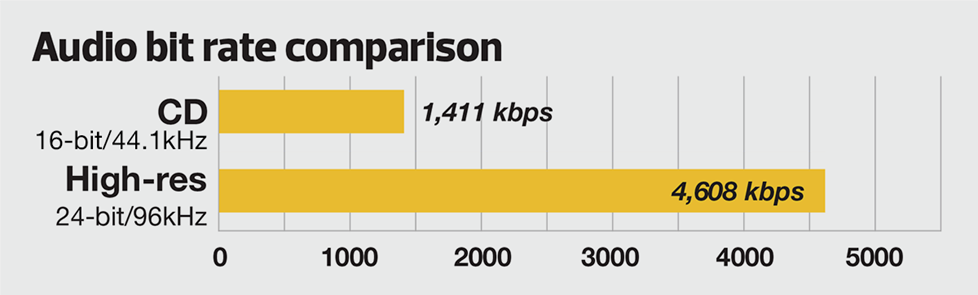
In simple terms, this term generally refers to recordings with a higher sample rate and / or bit depth than CDs (i.e. 16-bit / 44.1 kHz).

The sample rate indicates how many times per second a signal is sampled during its conversion from analog to digital. The higher the bit depth, the more accurate the signal measurement will be at the sampling point, so the 16-bit to 24-bit transition can significantly improve quality.

High-resolution audio formats typically have a sample rate of 96 or 192 kHz at 24 bits. Also, there are files with 44.1, 88.2 and 176.4 kHz.

A little loss

However, Hi-Res Audio has one major drawback: the size of the files. They are typically tens of megabytes in size, and a few songs can easily take up all of your device’s memory. Because of this, they are difficult to transfer over mobile networks and Wi-Fi.

And that’s not all: each of the Hi-Res Audio file formats has certain compatibility limitations. Examples include FLAC (Free Lossless Audio Codec) and ALAC (Apple Lossless Audio Codec); both theoretically provide lossless transmission of musical information. In addition, there are uncompressed formats: WAV and AIFF, DSD (the format used in Super Audio CD) and the recently developed MQA (Master Quality Authenticated).

You can discuss the relative advantages of each format, but first of all, you will have to consider their compatibility with audio system components and software solutions.

WHAT ARE GOOD HIGH-RESOLUTION AUDIO FORMATS?

The main advantage of high definition formats over tablets is the higher sound quality. Downloadable sites like Amazon and iTunes and streaming services like Spotify offer relatively low-bitrate compression formats like 256kbps AAC from Apple Music and Spotify’s 320kbps Ogg Vorbis.

During the compression encoding process, some information is lost; in other words, the signal resolution is reduced for convenience and file size reduction. This affects the sound quality: in these formats, your favorite songs will not be able to be fully revealed.

What is high resolution audio?

What is high resolution audio?

Hi-Res Audio

When it comes to music, Hi-Res Audio, also called Hi-Res Audio, is harder to find. The main way most of us listen to music is by streaming to portable devices like smartphones. While very convenient, this trend has set us back in terms of what we consider a good music listening experience.

High-Res Audio

By this we mean that the file formats used by streaming services are of lower quality. Compared to CD format, MP3 files and music streaming from iTunes, Yandex.Music, Spotify and other services simply contain less data to create music. To put music in a format that can be easily streamed and give listeners the ability to store many songs on a portable music player or smartphone, 80% of the information present in the original recording can be removed.

What is Hi-Res Audio?

Due to the proliferation of the experience of listening to low-quality music, a strategy has been put in place to bring back high-quality two-channel audio by expanding the capabilities of downloadable and playable music to match or exceed CD quality. This initiative is called Hi-Res Audio, Hi-Res Music or HRA. For the purposes of this article, we are referring to the most common term: High Resolution Audio.

CD quality benchmark

The CD format is considered the benchmark that separates low-resolution audio from high-resolution audio. Technically speaking, Audio CD is an uncompressed digital format that is represented by 16-bit PCM with a sample rate of 44.1 kHz.

Anything below the CD breakpoint, such as MP3, AAC, WMA, and other highly compressed formats, is considered low-resolution audio, and anything above is considered high-resolution audio.

Hi-Res Audio Formats

High-resolution audio is provided on physical media in HDCD, SACD, and DVD-Audio formats. However, with many no longer using physical media, a strategic step has been taken to provide listeners with the ability to access high-definition audio through downloads and streaming.

Non-physical high-resolution digital audio formats include ALAC, AIFF, FLAC, WAV, DSD (the same format used in SACDs), and PCM (with a higher sample rate and bits than CDs).

Everything you need to know about high resolution

Everything you need to know about high resolution

Hi-Res Audio

High Definition Audio is the choice of the most dedicated digital music fans. What is it, where to get it, and what does it take to hear it?

Hi-Res Audio

If you’re a bit interested in digital music (whether it’s listening to CDs or streaming from Spotify on your smartphone), you’ve probably come across the term “high-definition audio” or “high-resolution audio.”

In recent years, the popularity of Hi-Res Audio is slowly but surely gaining momentum, fueled by the emergence of new components, streaming services, and even smartphones that support this standard. Until recently, it was a niche segment for a narrow circle of insiders, but today everyone wants to join it.

If you want to get the best possible music listening experience, or at least better sound quality, you should familiarize yourself with the concept of Hi-Res Audio.

This perspective is a bit overwhelming as it involves many factors. What is Hi-Res Audio? What do all these formats and numbers mean? Where can I get high-quality files and on what devices can I play them? Finally, where do you start?

Our guide to the world of Hi-Res Audio will help you understand the matter in depth. After reading this material to the end, you will be armed with all the necessary knowledge and take the first step into the magical world of the best sound.

WHAT IS HI-RES-AUDIO?

Unlike HD video, there is still no universal standard for high definition audio. Digital Entertainment Group, Consumer Electronics Association and The Recording Academy, as well as the largest recording companies define it as follows: “An audio file in a lossless format that carries a soundtrack across the entire frequency range in which it was mastered using higher quality equipment than CD ”.

In simple terms, this term generally refers to recordings with a higher sample rate and / or bit depth than a CD (i.e. 16-bit / 44.1 kHz).

The sample rate indicates how many times per second the signal is sampled during its conversion from analog to digital. The higher the bit depth, the more accurately the signal is measured at the sample point, so the transition from 16-bit to 24-bit can significantly improve quality.

High-resolution audio formats typically have a sample rate of 96 or 192 kHz at 24 bits. Also, there are files with 44.1, 88.2 and 176.4 kHz.

Small loss

However, Hi-Res Audio has one major drawback: the size of the files. They are typically tens of megabytes in size, and a few songs can easily take up all of your device’s memory. Because of this, they are difficult to transfer over mobile networks and Wi-Fi.

And that’s not all: each of the Hi-Res Audio file formats has certain compatibility limitations. Examples include FLAC (Free Lossless Audio Codec) and ALAC (Apple Lossless Audio Codec); both theoretically provide lossless transmission of musical information. In addition, there are uncompressed formats: WAV and AIFF, DSD (the format used in Super Audio CD) and the recently developed MQA (Master Quality Authenticated).

The relative advantages of each format can be discussed, but the first thing to consider is their compatibility with audio components and software solutions.

WHAT IS GOOD FOR HIGH RESOLUTION AUDIO FORMATS?

The main advantage of high definition formats over tablets is the higher sound quality. Downloadable sites like Amazon and iTunes and streaming services like Spotify offer relatively low bitrate compression formats, such as 256kbps AAC from Apple Music and Spotify’s 320kbps Ogg Vorbis.

During the compression encoding process, some information is lost; in other words, the signal resolution is reduced for convenience and file size reduction. This affects the sound quality: in these formats, your favorite songs will not be fully revealed.

Master class

While you can put up with this when listening to Spotify playlists on the bus ride to work, true music fans won’t have enough. High definition audio comes to your aid.

To understand why it should sound better than MP3, let’s compare its bit rates. The highest possible bit rate for an MP3 is 320 kbps, while a 24-bit / 192 kHz file is 9216 kbps for streaming and 1411 kbps for a CD.

Therefore, 24/96 or 24/192 high-resolution audio files should more accurately recreate the sound that musicians and engineers worked on.