What is Dithering and Noise Shaping?


Free Download Mp4Gain
picture

What is Dithering and Noise Shaping?

dithering

These are some types of artificial methods for processing digital sound.

dithering

signal, intended to improve subjective sound quality
at the cost of an obvious deterioration of its objective characteristics (mainly
– the non-linear distortion coefficient and the signal-to-noise ratio).

Blurring is the addition of a small amount of
the amount of noise (pseudo-random digital signal) of different spectrum
(white, pink, etc.). In this case, the error correlation is noticeably weakened.
Useful signal quantization side (rounding errors “dissipate”)
and despite an increase in noise, the subjective sound quality
noticeably increases. The level of added noise is selected based on
of the task and goes from the middle of the least significant digit of the countdown to
various categories.

Noise Shaping is the transformation of
Noisy useful signal to displace purely noise components
nent in the supra-tonal region with a selection in the lower part of the spectrum of the main
useful signal energy. Basically, Noise Shaping is one
from the PWM view (Pulse width modulation – pulse width module-
tion, PWM) with discrete pulse width. The signal processed by this means
Therefore, it requires mandatory filtering with high frequency suppression:
this is done digitally or analog.

The main application of Noise Shaping is in the field of digital representation.
signals with lower bit depth counts more frequently
following. The delta-sigma DAC to increase the sample rate
the sampling rate increases tenfold, at which
initial multi-digit readings, a series of discharge readings are formed
ness 1..3. The low frequency part of the flow spectrum of these samples with high
how accurately the spectrum of the original signal is repeated, and the high frequency
it contains mainly pure noise.

In the case of converting a digital signal into lower resolution samples
row at the same sample rate Noise shaping is performed
along with the Dithering operation. Since in this case the hour increase
sampling is impossible, instead the added noise spectrum
is formed in such a way that its low and middle frequency part
repeated as accurately as possible the weak part of the signal enclosed in the
the least significant bits of the samples. Thanks to this, the main energy of noise
ma is shifted to the top of the operating frequency range, and in most
the audible area is still fairly legible traces of a weak signal,
otherwise it would be completely destroyed. Although
the objective distortion of the weak signal stored in this way is very
are large, your subjective perception is still quite acceptable, allows
listening to components, whose level is lower than junior
count of downloads.

Essentially, Dithering and Noise Shaping are special cases of one
technology – with the difference that in the first case, no
noise with a uniform spectrum, and in the second – noise with a spectrum, special
customized for a specific signal. This technology leads
to the “non-standard” use of digital format based on
characteristics of the human ear.


Free Download Mp4Gain
picture


Mp4Gain Main Window
picture


Mp4Gain Features
picture


Free Download Mp4Gain
picture

What is oversampling?

What is oversampling?

oversampling

It involves sampling a signal with a frequency higher than the fundamental frequency.

oversampling

sampling. Oversampling can be analog, by upsampling
sampling of the original or digital signal when
yes, between existing digital samples, additional
nal, calculated by interpolation. Another way to acquire knowledge
intermediate reads consists of inserting zeros, after which all
the sequence is digitally filtered. The ADC uses-
Xia analog oversampling, on the DAC – digital.

Oversampling is used to simplify ADC and DAC designs. By
trouble conditions at ADC input and DAC output must be set
logarithmic filter with frequency response, linear in the operating range and steeply descending
outside her. The implementation of an analog filter of this type is quite complex;
at the same time, with an increase in the sampling frequency, the reflection
the spectrum moves proportionally away from the main signal, and a
the log filter can have a much lower shear slope.

Another advantage of oversampling is that the amplitude errors
tight quantization (crushing noise) distributed across the entire spectrum
quantized signal, by increasing the sampling frequency, distribute
over a wider frequency band, so that the main sound’s share
the signal has less noise. Each frequency is doubled
reduces the quantization noise level by 3 dB; from a binary time
the range is equivalent to 6 dB of noise, each quadruple of frequency allows
to reduce the capacity of the converter by one.

Oversampling along with increasing sample bit depth, interpolation
more accurate readings and their output to the DAC
Bit depth allows you to slightly improve the quality of sound restoration.
signal. For this reason, even on 16-bit systems, it is not uncommon for
18 bit and 20 bit oversampling DACs are used.

ADC and DAC with oversampling due to a significant reduction in time
none of the transformations can do without a search and store scheme.

What is ADC and DAC?

What is ADC and DAC?

ADC DAC

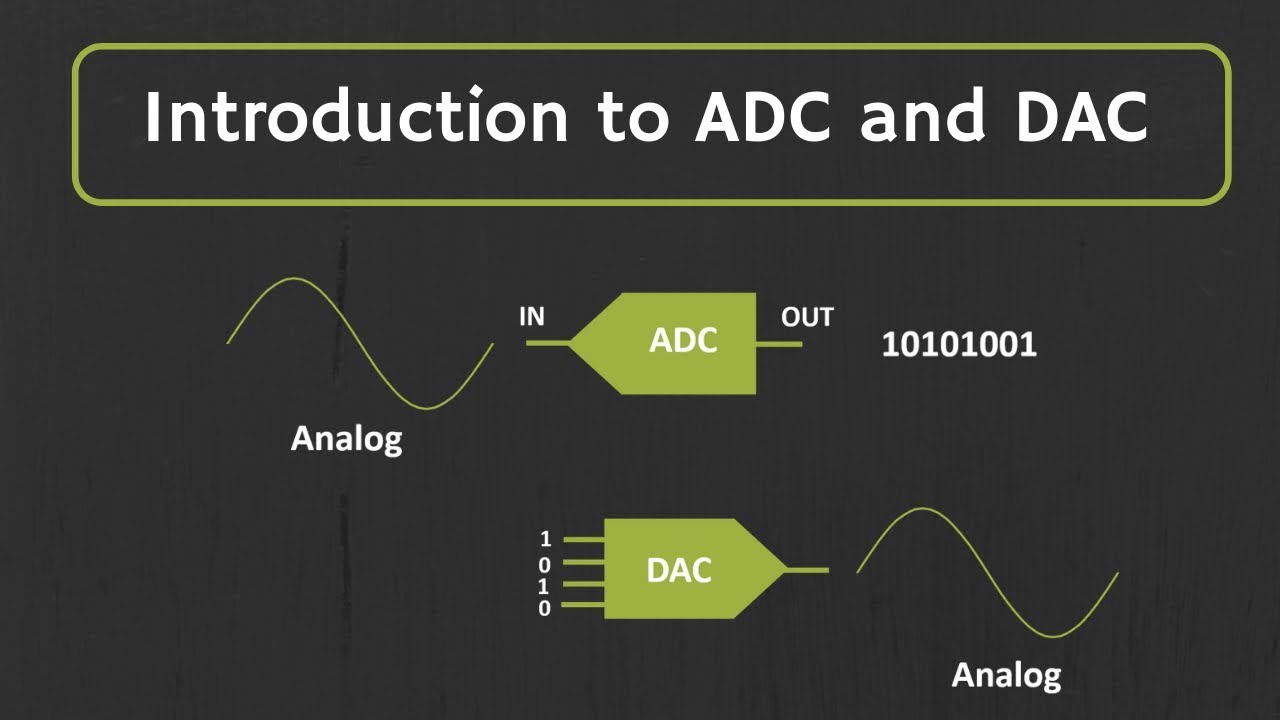
Analog-to-digital and digital-to-analog converters.

ADC DAC

The first conversion
converts an analog signal to a digital amplitude value, the second performs
inverse transformation. In English-language literature, the terms are used
ADC and DAC, and the combined converter is called codec
(codec).

The working principle of the ADC is to measure the level of the input signal and the output
The result in digital form. As a result of the ADC operation, a continuous
an analog signal is converted to a pulse, with simultaneous measurement
The amplitude of each pulse. The DAC receives a digital value at the input
amplitude and outputs voltage or current pulses of the required magnitude at the output
is located behind the integrator (analog filter)
it becomes a continuous analog signal.

For proper ADC operation, the input signal must not change during
conversion time, so your input is usually placed
a sample hold circuit that captures instantaneous signal level and stores
hurt him throughout the transformation time. DAC output
A similar circuit can also be installed, suppressing the influence of
execute processes inside the DAC to the parameters of the output signal.

With time sampling, the spectrum of the received pulse signal in
its lower part 0..Fa repeats the spectrum of the original signal, and above
contains a series of reflections (aka, specular spectra), which are found
they are placed around the sample rate Fd and its harmonics (sidebands).
In this case, the first reflection of the spectrum of the frequency Fd in the case of Fd = 2Fa is
is based directly behind the original signal bandwidth and requires
your anti-alias filter with a high
the thickness of the cut. In the ADC, this filter is installed at the input to exclude
overlapping spectra and their interference, and in the DAC – at the output, which
supra-tonal noise introduced by time in the output signal
resampling.

How is the digital representation of signals different from analog?

How is the digital representation of signals different from analog?

Digital Communication - Analog to Digital - Tutorialspoint

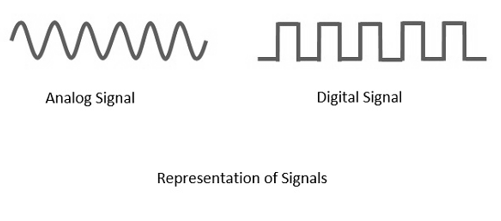
Traditional analog representation of signals is based on similarity
(similarity) electrical signals (changes in current and voltage)
the initial signals they present (sound pressure, temperature,
speed, etc.), as well as the similarity of the shapes of electrical signals in different
personal points along the amplification or transmission path. Electric way
which curve describes (also called transfer) the original signal,
as close as possible to the waveform of this signal.

What is the criteria for a signal to be a analog signal? - Quora

This representation is the most accurate, yet the slightest distortion of the shape
carrying an electrical signal will inevitably involve the same
distortion of the shape and signal carried. In terms of information theory,
the amount of information in the carrier signal is exactly equal to the amount
information in the original signal, and the electrical representation does not contain
there is redundancy which could protect the carried signal from being
storage, transmission and amplification.

The digital representation of electrical signals is designed to add
redundancy that protects against the effects of parasitic interference. For this-
Serious restrictions are placed on the carrier electrical signal.
– its amplitude can take only two limit values ​​- 0 and
1. The entire area of ​​possible amplitudes in this case is divided into three areas: the lower
ny represents zero values, the upper represents ones and the intermediate
naya is prohibited, only interference can enter.
Therefore, any interference whose amplitude is less than half the amplitude
where the carrier signal is, it does not affect the correct transmission
values ​​0 and 1. Interference with a higher amplitude also does not affect
if the duration of the interference pulse is noticeably shorter than the duration
information pulse, and a filter is installed at the input of the receiver.
pulse interference.

The digital signal formed in this way can carry any
useful information encoded as a sequence
bits: zeros and ones; special cases of such information are
electrical and sound signals. Here, the amount of information carried
digital signal is much more than encoded output
nom, so that the carrier signal has a certain redundancy with respect to
original, and any distortion of the waveform of the carrier signal, when
which still retains the receiver’s ability to correctly distinguish zeros
and the units do not affect the reliability of the information transmitted by this signal.
formations. However, in the case of significant interference, the waveform
may be distorted so that the accurate transmission of the information carried
becomes impossible: errors appear in it, which, with a simple
Encoding method, the receiver can not only correct, but also detect
to shoot.

To further enhance the immunity of the digital signal to interference and usage
It appears that redundant digital encoding of two types is used:
correct (EDC – Error Detection Code) and
correct (ECC – Error Correction Code)
codes. Digital encoding consists of a simple addition to the original.
formation of additional bits and / or transformation of the original bit
chains in a chain of greater length and different structure. EDC allows
just to detect the fact of the error – distortion or loss of utility or
the appearance of a false digit, however, the information transferred in this case
also distorted; ECC allows you to immediately correct detected errors –
ki, keeping the information that is transported unchanged. For convenience and reliability
the transmitted information is divided into blocks (frames), each of which
supplied with its own set of these codes.

Each type of EDC / ECC has its own capacity limit to detect and
correct errors, followed by undetected errors again and
distortion of the information that is transferred. The increase in EDC / ECC volume is related to
the amount of initial information in the general case increases detection
the ability to correct and correct these codes.

Like EDC, the popular cyclic redundancy code CRC (Cyclic
Redundancy check), the essence of which is the complex mix of
input information into the block and the formation of short binary words,
whose ranks are in strong cross-dependence on each
block bit. Changing even one bit in a block causes significant
the change in CRC calculated from it, and the probability of such a bi-
what the CRC does not change is extremely small, even for a short time
(units of percentage of the length of the block) CRC words. As an ECC, use
Hamming and Reed-Solomon codes are given, which
it also includes EDC functions.

Audio encoding.

Audio encoding.

AUDIO ENCODING

Digital audio is an analog audio signal represented by discrete numerical values ​​of its amplitude.

audio encodig

Sound digitization is a technology with a divided time step and subsequent recording of the values ​​obtained in numerical form.

Another name for digitizing audio is analog to digital audio conversion.

Sound digitization involves two processes:

sample (sample) a signal over time
amplitude quantification process.
Meanwhile, there is no need to worry about it. ”

Discretization of time.

Meanwhile, there is no need to worry about it. ”

The time sampling process is the process of obtaining the values ​​of the signal that is being converted, with a certain time step: the sampling step. The number of measurements of the magnitude of the signal, carried out in one second, is called the sampling frequency or the sampling rate, or sampling frequency (from the English “sampling” – “sampling”). The lower the sampling step, the higher the sampling frequency and the more accurate representation of the signal that we will obtain.

This is confirmed by Kotelnikov’s theorem (in foreign literature it is found as Shannon’s theorem, Shannon). According to him, an analog signal with a limited spectrum can be accurately described by a discrete sequence of values ​​of its amplitude, if these values ​​are taken with a frequency that is at least twice the highest frequency in the spectrum of the signal. That is, an analog signal in which the highest spectrum frequency is F m can be accurately represented by a sequence of discrete amplitude values ​​if F d> 2F m is satisfied for the sampling frequency F d.

In practice, this means that for the digitized signal to contain information on the full audible frequency range of the original analog signal (0 – 20 kHz), it is necessary that the selected sample rate be at least 40 kHz. The number of amplitude measurements per second is called the sampling rate (if the sampling step is constant).

The main difficulty of digitization is the inability to record the measured signal values ​​with perfect precision.

Analog to digital converters (ADC).

Meanwhile, there is no need to worry about it. ”

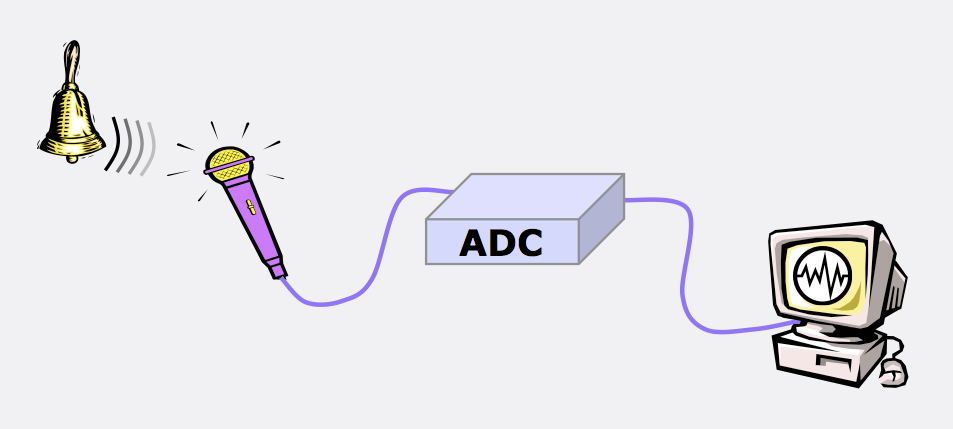
The above process of digitizing sound is done using analog-to-digital converters (ADCs).

This transformation includes the following operations:

Bandwidth limiting is done by a low pass filter to suppress spectral components that are more than half the sample rate.
Discretization in time, that is, substitution of a continuous analog signal with a sequence of its values ​​at discrete moments in time: samples. This problem is solved by using a special circuit at the input of the ADC – a sample and hold device.
Level quantization is the replacement of the signal’s reference value with the closest value of a set of fixed values: quantization levels.
Encoding or digitization, as a result of which the value of each quantized sample is represented as a number corresponding to the ordinal number of the quantization level.
This is done as follows: a continuous analog signal is “cut” into sections with a sample rate, a discrete digital signal is obtained, which goes through a quantization process with a certain bit depth, and is then encoded, that is, it is replaced by a sequence of code symbols. To record sound in a frequency band of 20-20,000 Hz, a sampling frequency of 44.1 and higher is required (today there are ADCs and DACs with a sampling frequency of 192 and even 384 kHz). To obtain a high-quality recording, 16 bits are sufficient, however, to expand the dynamic range and improve the quality of sound recording, 24 (less often 32) bits are used.

Meanwhile, there is no need to worry about it. ”

Encoding methods.

Frequency modulation.

Sound coding methods (of course we mean the electrical signal coming from the microphone) are based on the fact that, in theory, any complex sound can be broken down into a sequence of the simplest harmonic signals of different frequencies, each one of which is a sinusoid, called the original signal spectrum. The task of encoding sound, like any other analog signal, is to represent it in the form of another analog or digital signal, more convenient for its transmission or storage in each specific case.

How sound is encoded

How sound is encoded

How sound is encoded

Sound is a wave that travels more frequently in air, water, or other medium with a continuously changing intensity and frequency.

How sound is encoded

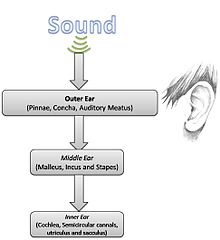
A person can perceive sound waves (air vibrations) with the help of hearing in the form of sound, while distinguishing between volume and pitch.

The higher the intensity of the sound wave, the louder the sound, the higher the frequency of the wave, the higher the pitch of the sound.

We previously wrote in more detail about the human perception of sound, you can read it here.

How audio is encoded (digital encoding and audio processing)
Dependence of the loudness, as well as the tone of the sound on the intensity and frequency of the sound wave.

Hertz (denoted by Hz or Hz) is a unit of measurement for the frequency of periodic processes (eg, oscillations).
1 Hz means an execution of said process in one second: 1 Hz = 1 / s.

If we have 10 Hz, this means that we have ten executions of said process in one second.

The human ear can perceive sound at frequencies ranging from 20 vibrations per second (20 Hertz, low sound) to 20,000 vibrations per second (20 KHz, high sound).

In addition, a person can perceive sound in a wide range of intensities, in which the maximum intensity is 1014 times greater than the minimum (one hundred thousand billion times).

To measure the volume of sound, a special unit of “decibels” (dB) was invented and used.

A decrease or increase in sound volume by 10 dB corresponds to a decrease or increase in sound intensity by 10 times.

Characteristic sound Loudness measured in decibels
Lower limit of human ear sensitivity 0
Leaf whisper ten
Conversation 60
Horn 90
Jet engine 120
Pain threshold 140

Sound volume in decibels

Sync Audio Sampling

In order for computer systems to process sound, a continuous audio signal must be converted to a discrete digital form by time sampling.

For this, a continuous sound wave is divided into separate small time sections, for each section a certain value of sound intensity is set.

Therefore, the continuous dependence of the loudness of the sound at time A (t) is replaced by a discrete sequence of loudness levels. On the graph, this appears to replace a smooth curve with a sequence of “steps.”

How audio is encoded (digital encoding and audio processing)
Sync Audio Sampling

A microphone connected to the sound card is used to record analog audio and convert it to digital format.

The denser the discrete strips are located on the graphic, the better it will be to ultimately recreate the original sound.

The resulting digital sound quality depends on the number of sound volume level measurements per unit time, that is, the sampling frequency.

Audio sample rate is the number of audio volume measurements in one second.

The more measurements that are made in one second (the higher the sampling frequency), the more accurately the “ladder” of the digital audio signal repeats the curve of the analog signal.

Each “step” of the graph is assigned a certain value for the sound volume level. Loudness levels can be thought of as a set of possible N states (gradations), which require a certain amount of I information to encode, which is called audio encoding depth.

Audio encoding depth is the amount of information required to encode the discrete volume levels of digital audio.

If the known encoding depth, the number of digital audio volume levels can be calculated by the general formula N = 2 I.

For example let the audio encoding depth be 16 bit, in this case the number of audio volume levels is:

N = 2I = 2 16 = 65 536.

During the encoding process, each sound volume level is assigned its own 16-bit binary code, the smallest sound level will correspond to the code 0000000000000000, and the highest – 1111111111111111.

Digitized audio quality

Therefore, the higher the sample rate and depth of audio encoding, the better the digitized sound will sound and the better you can bring the digitized sound closer to the original sound.

The lowest quality of digitized sound, corresponding to the quality of telephone communication, is obtained at a sampling rate of 8000 times per second, a sampling rate of 8 bits, and by recording an audio track (“mono” mode).
But it should be remembered that devices that resemble speech synthesizers and speech coders are used to improve this sound in telephony. About speech coders, this article also

Digital audio encoding

Digital audio encoding

Digital audio encoding

To represent the vibrations of sound in digital form, the amplitude of the sound signal is measured at each specific moment of the sound.

DIGITAL AUDIO ENCODING

Since the waveform of sound is inherently continuous, for its accurate digital display it is necessary to measure the amplitude an infinite number of times per second and divide the amplitude scale by an infinite number of gradations. In reality, the number of measurements per second (sample rate) typically ranges from 10,000 to 96,000. Currently, the most common sample rates are 44100 Hz (the standard for CD-audio) and 48000 Hz (the main standard for CD-audio). DAT). The number of amplitude gradations (resolution) is generally taken equal to 28, 216, or 224 (depending on the number of bits allocated for this information).

Of course, distortion is unavoidable when sampling a continuous signal. The lower the sample rate and / or resolution, the closer the output waveform will be to rectangular. In this case, high-frequency distortions arise, which are partially suppressed by filters installed at the DAC output.

Digitized audio requires a large amount of memory. In fact, at a standard 44100 Hz sample rate and 16-bit resolution, the audio material (stereo) for one minute would be 10,584,000 bytes (approximately 10.09 MB). Also, the sound files are very poorly compressed by standard archive programs (zip, arj, etc.). Therefore, there are special compression algorithms for them. For example, a WAV file compressed with ADPCM takes about four times less space. However, distortion may occur. Therefore, it is better not to use audio compression algorithms in professional work.

Encoding an mp3

Encoding an mp3

encoding mp3

What is masking

mp3 encoding

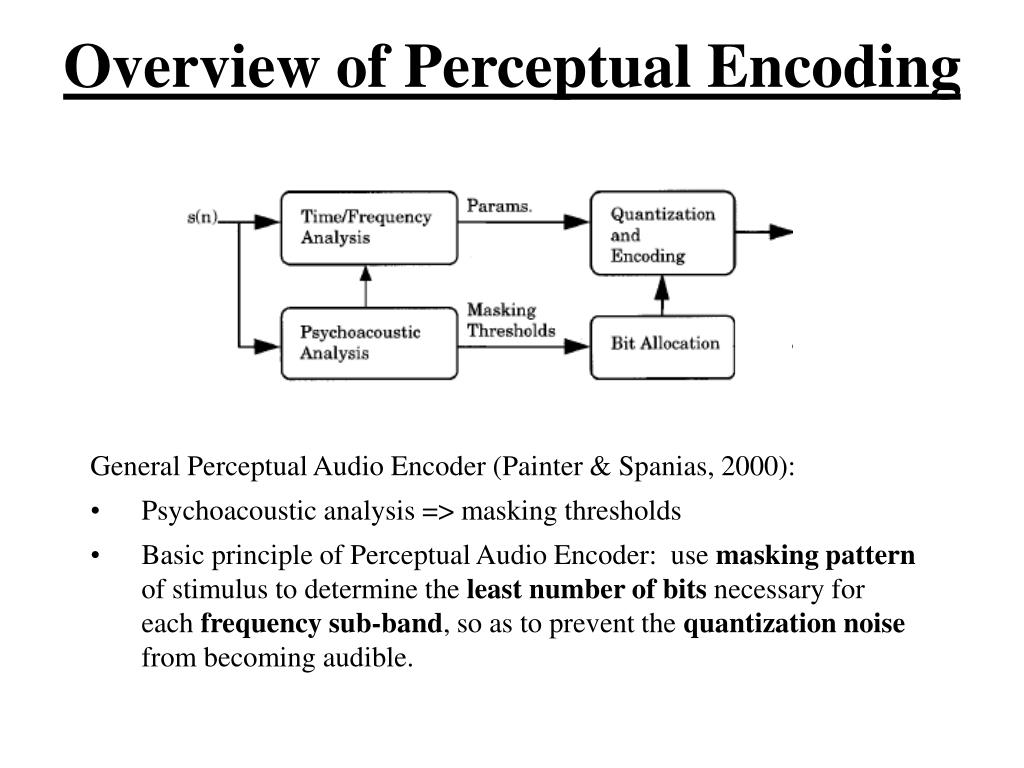
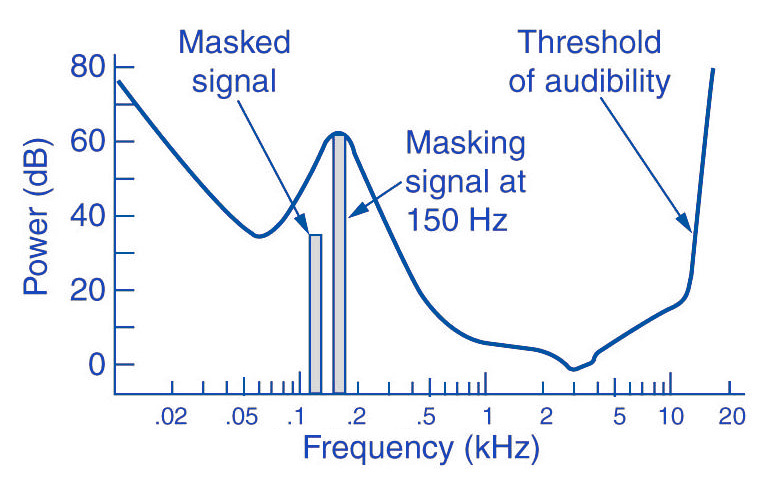
The lossy MP3 audio compression algorithm uses a limitation of human hearing perception called auditory masking. In 1894, the American physicist Alfred M. Mayer reported that a tone could be made inaudible by another tone of a lower frequency. In 1959, Richard Amer described a complete set of auditory curves related to this phenomenon. Between 1967 and 1974, Eberhard Zwicker worked on tuning and masking critical frequency bands, which in turn built on the fundamental research of Harvey Fletcher and his collaborators at Bell Labs in this area. Perceptual coding was first used to compress speech coding with Linear Prediction Coding (LPC), which has its origins in the works Fuminada Itakura (Nagoya University) and Shuji Saito (from Nippon Telegraph and Telephone) in 1966. In 1978, Bishnu S. Atal and Manfred R. Schroeder of Bell Labs proposed an LPC speech codec called adaptive predictive coding. , which used a psychoacoustic coding algorithm using the masking properties of the human ear. Schroeder and Atal’s further optimization with J.L. Hall was later described in a 1979 article. In the same year M.A. Krasner proposed a psychoacoustic masking codec, which published and produced hardware for speech (not used to compress musical bits), but the publication of its results in a relatively obscure technical report from the Lincoln Laboratory did not immediately influence the mainstream of the development of psychoacoustic codecs. The Discrete Cosine Transform (DCT), a type of transform coding for lossy compression, proposed by Nasir Ahmed in 1972, was developed by Ahmed with T. Natarajan and KR Rao in 1973; published their results in 1974. This led to the development of the Modified Discrete Cosine Transform (MDCT) proposed by JP Princen, AW Johnson, and AB Bradley in 1987 after earlier work by Princen and Bradley in 1986. MDCT later became the main body of the MP3 algorithm. Ernst Terhardt et al. Built an algorithm that describes auditory masking with high precision in 1982. This work adds to many reports by authors dating back to Fletcher, as well as work that originally defined critical ratios and critical bandwidth. In 1985, Atal and Schroeder introduced Code Excited Linear Prediction (CELP), an LPC-based perceptual speech coding auditory masking algorithm that achieved a significant degree of data compression for its time. IEEE peer-reviewed journal “Favorite Communications” reported on a wide variety of audio compression algorithms (mainly perceptual) in 1988. The February 1988 issue of Voice Coding for Communication reported on a wide range of audio compression algorithms bit-based established and operational. technologies, some of which use auditory masking as part of their core design, and some of which show real-time hardware implementations. – https://ru.qaz.wiki/wiki/MP3

Is Vinyl Sound Better Than Digital Audio Formats?

Is Vinyl Sound Better Than Digital Audio Formats?

Vinyl vs Digital

True music fans want the best sound quality for their favorite albums and recordings, and with the return of vinyl, the debate over which is better (CD versus vinyl, digital versus analog) has only sharpened.

Vinyl Vs. Digital


Many people value vinyl not only for its clean playability and the lack of digital sound processing during playback, but also for the very process of installing a record on a turntable and being able to hold the record in your hands.

Nowadays, it is possible to play tracks as often as musicians record them. They record music at frequencies above the standard 44.1 kHz (96 kHz or 192 kHz) CD recording rate for better sound quality. Many people in the audio industry say that they can see a noticeable improvement in quality with higher sample rates than CDs, which is why they prefer to listen to high-resolution music.

When turntables take priority over other formats

There’s a reason the vinyl revival has taken place. Yes, there is a certain appeal when you can hold a recording in your hands, which is different than choosing digital tracks on the screen. But there is also the argument that vinyl sounds better than digital recordings, exactly as the musician intended. The main difference between a vinyl record and a CD and MP3 is that the record on the record is analog. It is a physical recording, represented by a continuous electrical signal that reflects a change in the sound wave that is fully consistent with the original sound.

Unlike vinyl, most digital formats are compressed during recording and playback to minimize file size, making it ideal for various devices and can easily be streamed over the Internet. Most streaming services simply won’t be viable without audio compression technology.

When compressed, audio files lose not only size but also sound quality. This means that the listener loses the smallest sound details that the musician wanted to convey when he recorded this track. For the average listener this may not matter, but for music lovers, losing this depth of sound is completely unacceptable.

However, in both cases, analog or digital, good sound always begins with a good recording and how the sound engineer created it. If mistakes were made from the beginning, this cannot be corrected during playback.

Vinyl provides a warmer, livelier sound

Vinyl fans always talk about the “warmth” they get from classic records. This is not nostalgia, but a very real sonic phenomenon. According to sound engineer Adam Gonsalves, vinyl provides a more pleasant and warmer sound to your ears. This is especially noticeable when listening to classic rock artists like the Beatles, Led Zeppelin or Pink Floyd.

In the 1990s, record labels struggled to make their records stand out from the rest. To do this, the sound was processed and compressed with special programs for greater saturation. But this digital sound processing not only increased the volume, it also noticeably spoiled the sound quality. Compared to those processed tracks, vinyl is just so much cleaner and better.

When digital formats win

There is an important caveat that vinyl sounds better in certain but not all circumstances, especially when modern music is digitally recorded in the studio. In this case, albums released on vinyl and digital have little or no difference in sound quality between them. In addition, there are high definition digital audio formats and SACD (Super Audio CD) formats that surpass vinyl in sound quality.

In terms of convenience, digital formats outperform vinyl. Streaming music from your smartphone or mobile device is infinitely easier and more convenient than putting on a disc and flipping the disc every three to four songs.

Ultimately, it is up to each listener to decide what is most important to listen to: the high sound quality of vinyl records or the convenience of digital formats.

If you want to hear your favorite classical composers in exactly the way the musicians and sound engineer wanted to convey it, vinyl is made for you. Be sure to check out Denon turntables, amps, and other hi-fi components today to begin your journey to real sound.

What is digital audio and how does it work

What is digital audio and how does it work

Digital Audio

Regardless of the path chosen, after connecting the source, the sound from the source will be sent to a microprocessor called a digital audio converter (DAC for short), where there will be 2 stages:

Digital Audio

1) Conversion from analog to digital (a / d);

2) Conversion from digital to analog (d / a).

This processor is sometimes called an ad / da converter. Here, the analog audio signal is processed into digital, then redirected to the central processor and memory, and then to the storage medium. Stored digital recordings (often in .WAV format) are sent back to memory and the CPU, and then converted back to analog by the DAC.

The digital audio / MIDI sequencer allows you to record the sound of synthesizers, guitars, and microphones to files with the .wav extension. No matter how sound is transferred to the computer, it will still go to the DAC, computer memory, and hard drive. The resulting data type is called digital audio data. If you record in “CD quality” (among other things one of the lowest possible), every second of the sound is divided into 44,100 pieces. What is this data? Only numbers. But unlike the MIDI format that encodes the notes played, digital audio data is a digital representation of the actual sound wave. This is the same sound described in numbers. Can you guess that this format takes up thousands of times more space than midi data? This is true.

It is a graphical representation of digital audio data. For a computer, this is a sequence of numbers. With this data, you can perform various operations to change and improve. Outwardly, the signals appear to undergo a series of effects, but in reality what happens is a mathematical process.

How MIDI is converted to sound
You may be wondering how to convert MIDI to audio, is there a “convert” utility for that? Connect the output jacks of your synthesizer to your sound card (or audio interface, or mixer with firewire, etc.) and start recording. Analog waves go through a digital converter (DAC), are converted into numbers, and voila! you will receive digital audio data. The nice thing about a sequencer is that you first record a MIDI track and then refine it. in editors and translate it to digital audio for a perfect recording (well maybe not perfect, there is nothing perfect in the world). Yes; you are using synthesizer software, the process will be called slightly differently, but the gist is the same. The computer creates an audio track based on MIDI data and records it in audio format.

Time to process the resulting files perfectly in sync with plugins or effects. You can also save the finished tracks in MIDI format (then you can edit them at any time) and add the sound of vocals, guitars, or whatever else you want. The sequencer can work simultaneously with MIDI files and digital audio.

Effects types
One of the main and most used effects is VIBRATO.
Distinguish amplitude vibrato, when the amplitude of the signal changes periodically. The frequency of change should be small, from a few fractions of a hertz to 10-12 Hz. Tremolo is a type of amplitude vibrato. The frequency of vibration in the case of a tremolo is not less than 10-12 Hz, and the resulting signal is output in portions.

Frequency vibrato. In a non-electronic way, it was done with electric guitars. By changing the tension of the strings with a special lever, the musician changes the pitch (understand – frequency) and achieves the effect of frequency vibrato. The same can be done with synthesizers and midi keyboards using a special wheel or lever. In music editors, you can also adjust the frequency of the sound, change it within the specified or desired limits.

Ring vibrato. The signal passes through a filter, the settings of which are periodically changed. An interesting and beautiful sound is obtained due to periodic changes in the coloration of the timbre.

Effects: Reverb, Chorus, Flanger, Phaser, Delay: effects based on the delay of the signal.

Reverberation: the effect is created by mixing the main signal with copies lagged for different periods of time, obtained as a result of the reflection of various obstacles (walls, objects, etc.) The number of copies can be infinite, the reflected signal can return to reflected from another obstacle (the delay increases naturally) and again summarized with the main one. With a short delay, the effect results in an immersive and booming sound experience. .