What is Dithering and How Does It Work?


Free Download Mp4Gain
picture

What is Dithering and How Does It Work?
Dithering
Dithering
Dithering
Dithering

Dithering Technique

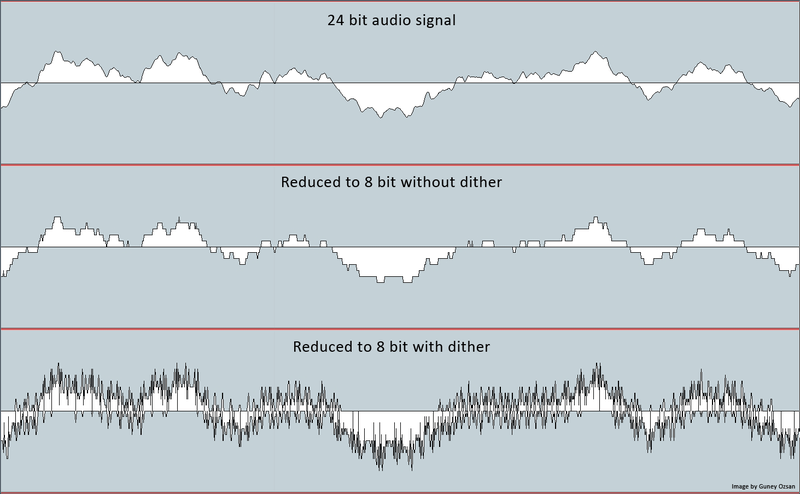
Dithering is a technique used to reduce banding and other artifacts in digital images and audio. It works by adding a small amount of noise to the signal, which can mask the unwanted artifacts and create a more natural, organic look or sound.

What is Dithering?

Dithering is the process of adding random noise to a signal in order to improve its quality. This can be used to reduce quantization error in digital audio, or to create a more natural-looking gradient in digital images.

Dithering Algorithm

There are many different algorithms used for dithering, each with their own strengths and weaknesses. Some of the most popular include ordered dithering, error diffusion dithering, and random noise dithering.

Dithering Images

In digital imaging, dithering can be used to reduce banding and other artifacts that can occur when the number of available colors is limited. By adding noise to the image, dithering can create the illusion of more colors and a smoother gradient.

Dithering Audio

In digital audio, dithering can be used to reduce quantization error and improve the overall sound quality. By adding a small amount of noise to the signal, dithering can create a more natural, analog sound that is easier on the ears.

At MP4Gain.com, we understand the importance of high-quality audio and video. That’s why we offer a range of powerful tools, including our flagship product, MP4Gain. With MP4Gain, you can easily normalize and convert your audio and video files to a wide range of formats, all with the click of a button.

Whether you’re a professional audio engineer or just looking to improve the quality of your home recordings, MP4Gain is the solution you’ve been looking for. So why wait? Try MP4Gain today and experience the power of dithering for yourself.


Free Download Mp4Gain
picture


Mp4Gain Main Window
picture


Mp4Gain Features
picture


Free Download Mp4Gain
picture

What is Dithering and Noise Shaping?

What is Dithering and Noise Shaping?

dithering

These are some types of artificial methods for processing digital sound.

dithering

signal, intended to improve subjective sound quality
at the cost of an obvious deterioration of its objective characteristics (mainly
– the non-linear distortion coefficient and the signal-to-noise ratio).

Blurring is the addition of a small amount of
the amount of noise (pseudo-random digital signal) of different spectrum
(white, pink, etc.). In this case, the error correlation is noticeably weakened.
Useful signal quantization side (rounding errors “dissipate”)
and despite an increase in noise, the subjective sound quality
noticeably increases. The level of added noise is selected based on
of the task and goes from the middle of the least significant digit of the countdown to
various categories.

Noise Shaping is the transformation of
Noisy useful signal to displace purely noise components
nent in the supra-tonal region with a selection in the lower part of the spectrum of the main
useful signal energy. Basically, Noise Shaping is one
from the PWM view (Pulse width modulation – pulse width module-
tion, PWM) with discrete pulse width. The signal processed by this means
Therefore, it requires mandatory filtering with high frequency suppression:
this is done digitally or analog.

The main application of Noise Shaping is in the field of digital representation.
signals with lower bit depth counts more frequently
following. The delta-sigma DAC to increase the sample rate
the sampling rate increases tenfold, at which
initial multi-digit readings, a series of discharge readings are formed
ness 1..3. The low frequency part of the flow spectrum of these samples with high
how accurately the spectrum of the original signal is repeated, and the high frequency
it contains mainly pure noise.

In the case of converting a digital signal into lower resolution samples
row at the same sample rate Noise shaping is performed
along with the Dithering operation. Since in this case the hour increase
sampling is impossible, instead the added noise spectrum
is formed in such a way that its low and middle frequency part
repeated as accurately as possible the weak part of the signal enclosed in the
the least significant bits of the samples. Thanks to this, the main energy of noise
ma is shifted to the top of the operating frequency range, and in most
the audible area is still fairly legible traces of a weak signal,
otherwise it would be completely destroyed. Although
the objective distortion of the weak signal stored in this way is very
are large, your subjective perception is still quite acceptable, allows
listening to components, whose level is lower than junior
count of downloads.

Essentially, Dithering and Noise Shaping are special cases of one
technology – with the difference that in the first case, no
noise with a uniform spectrum, and in the second – noise with a spectrum, special
customized for a specific signal. This technology leads
to the “non-standard” use of digital format based on
characteristics of the human ear.