How do ADCs and DACs work and function?
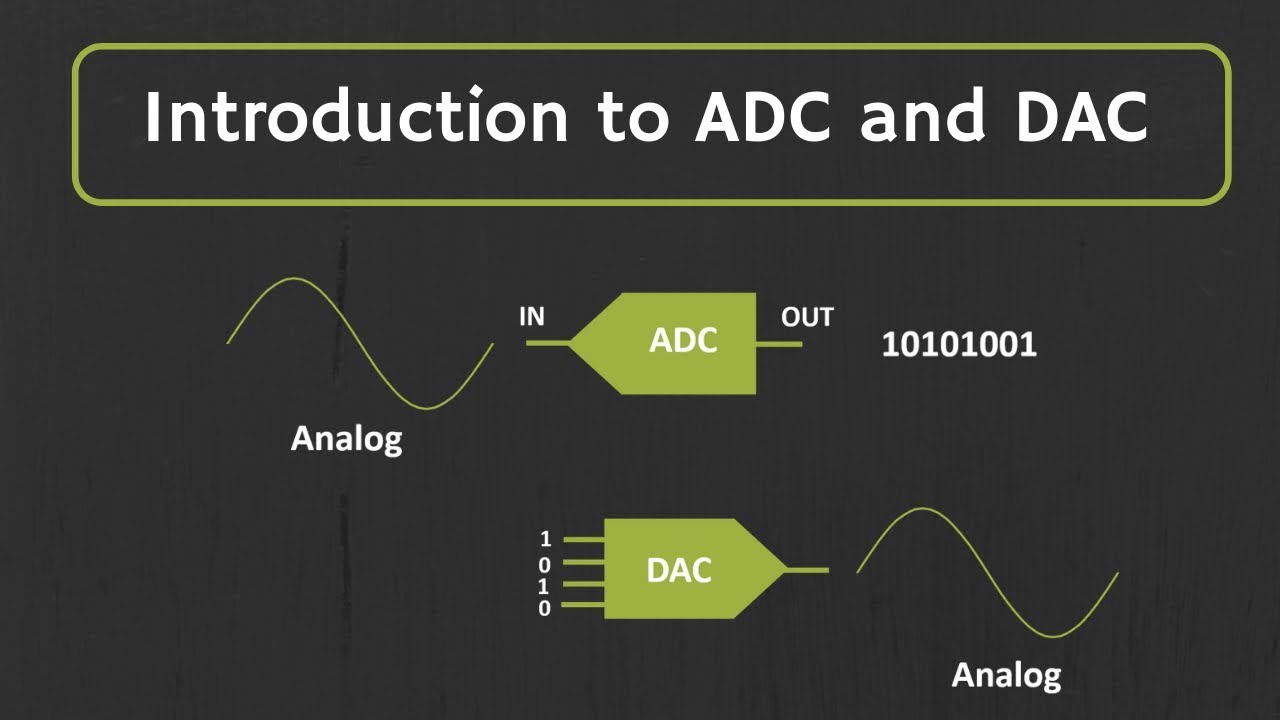
There are mainly three ADC designs:

Parallel – The input signal is simultaneously compared to the reference levels by a set of comparison circuits (comparators), which form a binary value at the output. In such ADC, the number of comparators is equal to (2 to the power N) – 1, where N is the digit capacity of the digital code (for an eight-bit code – 255), which does not allow to increase the capacity of digits above 10-12.
Successive approximation: The converter using an auxiliary DAC generates a reference signal that is compared to the input signal. The reference signal is changed sequentially according to the principle of mean division (dichotomy), which is used in many convergent search methods in applied mathematics. This makes it possible to complete the conversion in a number of clock cycles equal to the length of the word, regardless of the size of the input signal.
with time interval measurement: a large group of ADCs that use various principles of converting levels into proportional time intervals to measure the input signal, the duration of which is measured by a high frequency clock generator. This is sometimes called ADC counting.
Among ADCs with time interval measurement, the following three types prevail:
Sequential Count or Single Slope – In each conversion cycle, a linearly increasing voltage generator is started, which is compared to the input voltage. Typically this voltage is obtained from an auxiliary DAC, similar to a successive approximation ADC.
Dual Slope: In each conversion cycle, the input signal charges a capacitor, which is then discharged to a reference voltage with the duration of discharge measured.
tracking – A variant of the sequential counting ADC, in which the reference voltage generator does not reset on each cycle, but instead changes it from the previous value to the current one.
The most popular version of the tracking ADC is sigma-delta, which operates at a frequency Fs, which is significantly (64 times or more) higher than the sampling frequency Fd of the digital output signal. The comparator of such an ADC produces values of reduced bit depth (generally a bit – 0/1), the sum of which in the sampling interval Fd is proportional to the value of the sample. A sequence of low bit values is digitally filtered and decimated, resulting in a series of samples with a given bit depth and sample rate Fd.
To improve the signal-to-noise ratio and reduce the effect of quantization errors, which in the case of a one-bit converter turns out to be quite high, a noise shaping method is used through digital filtering and feedback circuits. error. As a result of applying this method, the shape of the noise spectrum changes so that the main noise energy is shifted to the region above the middle of the frequency Fs, a small part remains in the lower half, and almost all the noise it is removed from the original analog signal band.
DACs are based primarily on three principles:
weighting: with the sum of the weighted currents or voltages, when each bit of the input word makes a contribution corresponding to its binary weight to the total value of the received analog signal; These DACs are also called parallel or multibit (multibit).
sigma-delta, with preliminary digital oversampling and delivery of low-bit (usually one-bit) values to the reference charge-shaping circuit, which are added to the output signal with the same high frequency. These DACs are also called bit streams.
Pulse Width Modulation (PWM), when pulses of constant amplitude and variable duration are sent to the analog sample and hold signal, controlling the dosage of the load discharged at the output. Matsushita’s MASH (Multi-stAge Noise Shaping) converters work with this principle. These DACs got their name due to the use of various sequential noise shapers in them.
When using oversampling by a factor of tens (typically – 64x..512x), it is possible to reduce the DAC capacity without noticeable loss of signal quality; DACs with fewer bits also have better linearity. At the limit, the number of downloads can be reduced to one. The output waveform of such DACs is a useful signal surrounded by a significant amount of high frequency noise, which, however, is effectively suppressed by a uniform medium quality analog filter.
DACs are “straightforward” devices where conversion is easier and faster than ADCs, which are mostly slower and serial devices.


