Why are AV hard drives used in digital recording?


Free Download Mp4Gain
picture

Why are AV hard drives used in digital recording?
AV Hard drives


AV HARD DRIVE

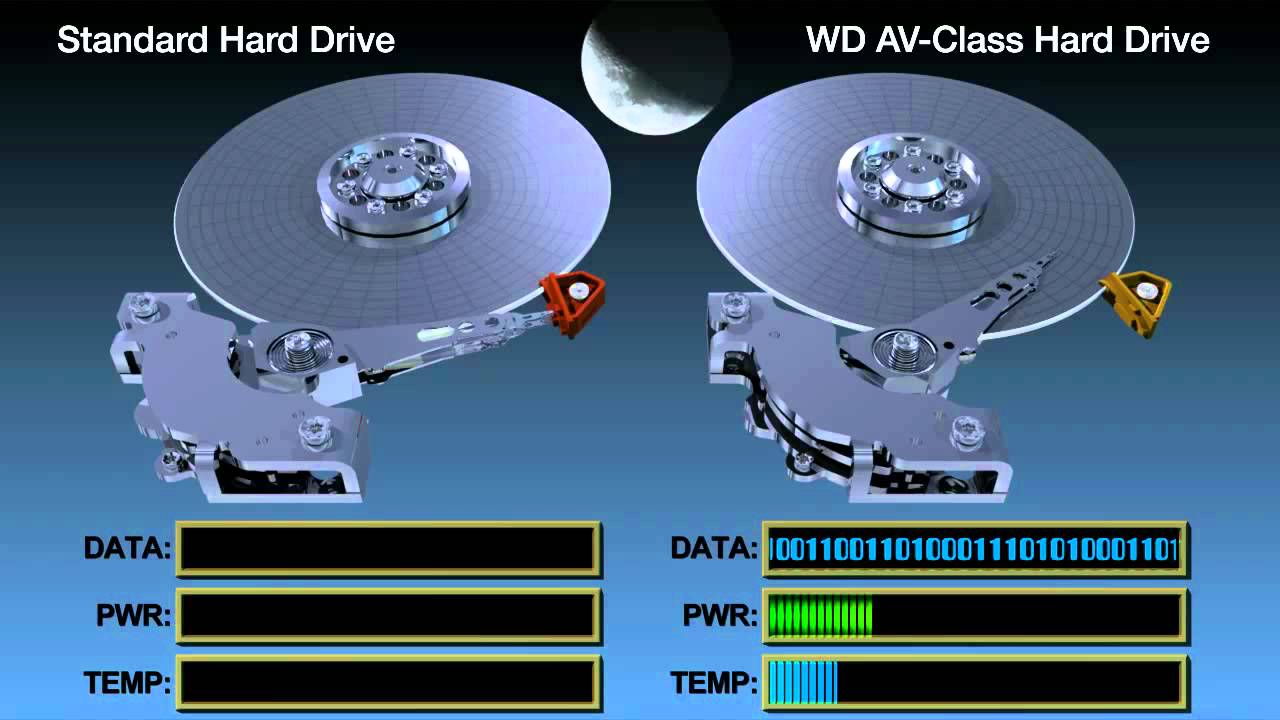
The class of AV (audio / video) hard drives means their ability to
read and write streams of data efficiently and smoothly, without pauses. Reserve Army-
some disks ship with a larger internal buffer and are not interrupted
They read / write the process thermal calibration positioning system.
For digital recording systems with insufficient performance and
amounts of RAM to smooth out possible irregularities in the operation of the
discs, AV discs are the only possible output.

Note that the presence of the abbreviation AV in the designation of the disc
it does not mean that it belongs to the Audio / Video class; must be
It must be explicitly mentioned in the passport of the disc.

However, the specified feature is generally necessary only when working
bot with high-quality video information, whose speed
it is approximately 10 megabytes per second per channel. In the case of sound
systems output the rate of a single 16-bit channel stream with a frequency
The 48 kHz sample rate is two orders of magnitude lower and is only 94 kilograms.
bytes per second. At the same time, almost no workstation
to ensure simultaneous operation with hundreds of channels, as well as
the disk cannot process so much data in parallel,
located in different parts of it. In real applications, multichannel
burning disc to disc, most of the overall disc costs
The howling subsystem relies on head movement between recording areas,
and nothing in the data transfer itself. The low speed of sound flows.
kov makes it more convenient and reliable to store them in the computer’s RAM,
disc thermal calibration compensation within 0.5 – 1 s, instead of
use of expensive and rare AV class discs. Also, it is far from
All conventional discs, thermal calibration has a remarkable effect on the
data stream number.

“Broken” data transmission can also occur when using “unintentional”
correct “operating system (DOS, Windows without 32-bit driver
faith on disk, etc.), insufficient number and size of file buffers
get rid of the operating system and the burning program, the use of low-class discs with
transfer rate of the order of 1-2 megabytes per second and lower, incorrect
connect a disc, etc. In any case, these situations are usually
talk about misconfiguration and hardware and software configuration
parts of the system.


Free Download Mp4Gain
picture


Mp4Gain Main Window
picture


Mp4Gain Features
picture


Free Download Mp4Gain
picture

What methods are used to compress digital audio effectively?

What methods are used to compress digital audio effectively?

Compress Digital Audio

COMPRESS DIGITAL AUDIO

Currently, the most famous are Audio MPEG, PASC and ATRAC. All of them
use the so-called “perceptual
encoding) in which information is removed from the sound signal,
perceptible to the ear. As a result, despite the change in shape and spectrum
signal, your hearing perception is practically unchanged, and the degree
Compression accounts for the slight reduction in quality. Such encoding
refers to lossy compression methods, when
it is no longer possible to accurately reconstruct the original waveform from the compressed signal
shape.


The techniques to eliminate part of the information are based on the characteristics of the human being.
who to listen to, called masking: if there is a high
strong peaks (dominant harmonics) weaker frequency content
hear in the immediate vicinity of them practically no
accepted (masked). When encoding, the entire audio stream is divided
is divided into small squares, each of which becomes a spectral
presentation and is divided into several frequency bands. Within the stripes there are
performs the definition and removal of masked sounds, after which each frame
it undergoes adaptive coding directly in spectral form. All
these operations can significantly reduce (several times) the volume
data while maintaining acceptable quality for most listeners
I read.

Each of the encoding methods described is characterized by a bit rate
the bitrate with which the compressed information should come
on the cable box when the audio signal is restored. Decoder converts
a series of instantaneous signal spectra compressed into a conventional digital waveform
shape.

MPEG Audio – A group of MPEG standardized audio compression methods
(Moving Pictures Experts Group – a group of experts to process motion
images). MPEG audio methods exist in various
types – MPEG-1, MPEG-2, etc .; currently the most common
not MPEG-1 type.

There are three layers of MPEG-1 audio for stereo compression.
your signals:

1 – 1: 4 compression ratio with a data stream of 384 kbps;
2-1: 6..1: 8 at 256..192 kbps;
3 – 1: 10..1: 12 at 128..112 kbps.

The minimum data rate in each layer is defined as 32
kbps; specified bit rates maintain signal quality
roughly at the level of a CD.

All three levels use the input split spectral transformation
changing the frame in 32 frequency bands. The most optimal in relation
data volume and sound quality recognized as level 3 with bit rate
128 kbps and a data density of approximately 1 Mb / min. When compressed from a bottom
at what speeds the forced limiting of the frequency band starts to
15-16 kHz, and channel phase distortions also occur (effects such as
phaser or flanger).

MPEG audio is used in computer sound systems, CD-i / DVD,
CD-ROM “audio”, digital radio / television and other systems
massive sound transmission.

PASC (Precision Adaptive Subband Coding – Precise Adaptive Intraband
coding) – a special case of Audio MPEG-1 Layer 1 with a speed
Stream 384 kbps (1: 4 compression). Used in the DCC system.

ATRAC (Adaptive TRansform Acoustic Coding – acoustic coding
adaptive transformation) is based on stereophonic sound
16-bit quantized format with a 44.1 kHz sample rate.
When compressed, each frame is divided into 52 frequency bands, resulting in
transmission speed: 292 kbps (1: 5 compression). Applied in the system

What interfaces are used for digital audio transmission?

What interfaces are used for digital audio transmission?

Digital Interfaces

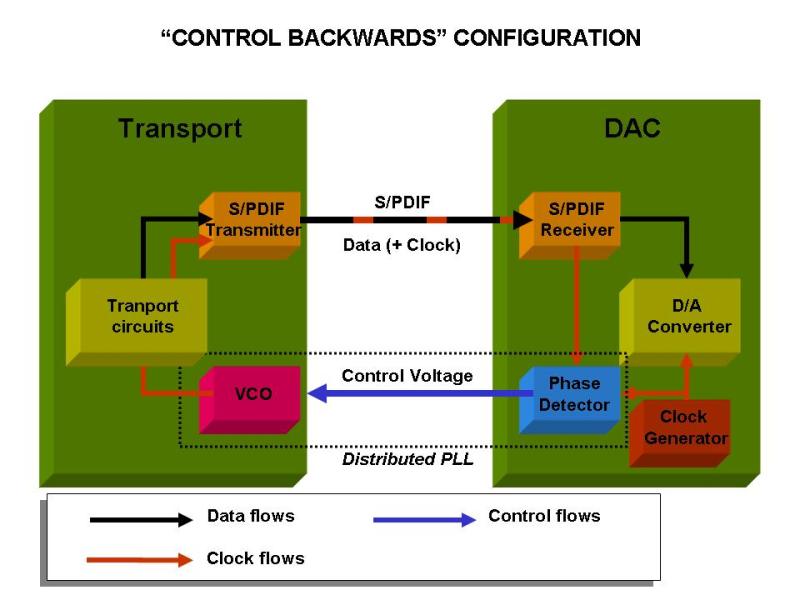
S / PDIF (Sony / Phillips Digital Interface Format – digital information format
terface from Sony and Philiрs) – digital interface for home radio
team.

Digital Audio Interfaces

AES / EBU (Society of Audio Engineers / European Broadcasting Union – Society
sound engineers / European Broadcasting Association) – digital engineering
terface for studio radio equipment.

Both interfaces are serial and use the same form
marking mat and coding system: BMC code with automatic synchronization
(Biphasic brand code: code with a double change representation of a unit
phase) and can transmit signals in PCM format of up to 24 bits
at sample rates up to 48 kHz.

Each signal sample is transmitted as a 32-bit word (frame), in which
rum 20 digits are used to transmit the count, and 12 – to form
synchronization preamble, transmission of additional information and
parity bit. 4 bits of the service group can be used to
extension of the sample format to 24 bits.

192 consecutive frames form a block, the beginning of which is marked
special preamble code of the first frame.

In addition to the parity bit, the service part of the word contains a validity bit
(Validity), which must be zero for each valid answer
accounts. If a word is received with a single bit of Validity or with a violation
parity in the word, the receiver interprets the entire sample as wrong and
you can choose to replace it with the old value or interpolate
based on multiple adjacent valid reads. Counts
marked invalid can transmit CD players that
DAT recorders and other devices, yes, when reading information from
the media could not be corrected during read errors
Ki.

The service part of the word also includes the C bits (Channel Status – Status
channel) and U (user bit). Constant price
kidney of each of these bits, taken one at a time from each block frame,
forms a 192-bit word of block service bits, where information is transmitted
information about the title of the work, track number,
device, CD subcodes, etc. S / PDIF transmits
copy protection settings (SCMS).

The standard encoding format is designed to transmit one and two
channel signal, however, when service bits are used to
By encoding the channel number, a multi-channel signal can be transmitted.

On the electrical side, S / PDIF provides a coaxial connection
cable with characteristic impedance of 75 ohms and RCA connectors (“tulle
pan “), signal amplitude – 0.5 V. AES / EBU provides connection
2-wire shielded symmetrical cable with transformer
decoupling via RS-422 interface with signal amplitude 3-10 V, connectors –
Cannon XLR 3-pin. There are also optical options
transceivers: TosLink (plastic fiber) and AT&T Link
(fiberglass).

How sound is encoded

How sound is encoded

How sound is encoded

Sound is a wave that travels more frequently in air, water, or other medium with a continuously changing intensity and frequency.

How sound is encoded

A person can perceive sound waves (air vibrations) with the help of hearing in the form of sound, while distinguishing between volume and pitch.

The higher the intensity of the sound wave, the louder the sound, the higher the frequency of the wave, the higher the pitch of the sound.

We previously wrote in more detail about the human perception of sound, you can read it here.

How audio is encoded (digital encoding and audio processing)
Dependence of the loudness, as well as the tone of the sound on the intensity and frequency of the sound wave.

Hertz (denoted by Hz or Hz) is a unit of measurement for the frequency of periodic processes (eg, oscillations).
1 Hz means an execution of said process in one second: 1 Hz = 1 / s.

If we have 10 Hz, this means that we have ten executions of said process in one second.

The human ear can perceive sound at frequencies ranging from 20 vibrations per second (20 Hertz, low sound) to 20,000 vibrations per second (20 KHz, high sound).

In addition, a person can perceive sound in a wide range of intensities, in which the maximum intensity is 1014 times greater than the minimum (one hundred thousand billion times).

To measure the volume of sound, a special unit of “decibels” (dB) was invented and used.

A decrease or increase in sound volume by 10 dB corresponds to a decrease or increase in sound intensity by 10 times.

Characteristic sound Loudness measured in decibels
Lower limit of human ear sensitivity 0
Leaf whisper ten
Conversation 60
Horn 90
Jet engine 120
Pain threshold 140

Sound volume in decibels

Sync Audio Sampling

In order for computer systems to process sound, a continuous audio signal must be converted to a discrete digital form by time sampling.

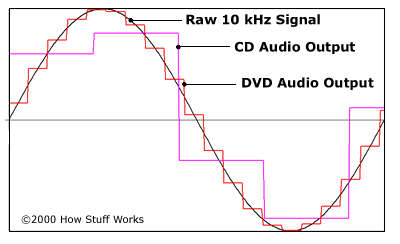
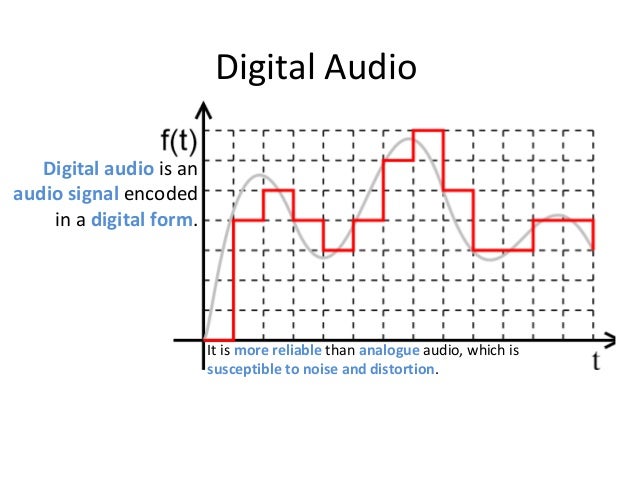
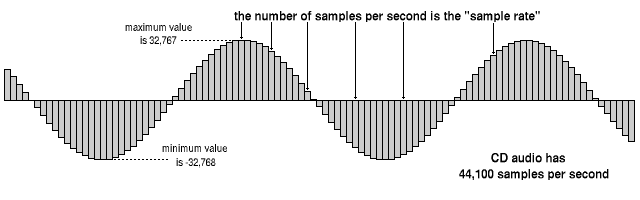
For this, a continuous sound wave is divided into separate small time sections, for each section a certain value of sound intensity is set.

Therefore, the continuous dependence of the loudness of the sound at time A (t) is replaced by a discrete sequence of loudness levels. On the graph, this appears to replace a smooth curve with a sequence of “steps.”

How audio is encoded (digital encoding and audio processing)
Sync Audio Sampling

A microphone connected to the sound card is used to record analog audio and convert it to digital format.

The denser the discrete strips are located on the graphic, the better it will be to ultimately recreate the original sound.

The resulting digital sound quality depends on the number of sound volume level measurements per unit time, that is, the sampling frequency.

Audio sample rate is the number of audio volume measurements in one second.

The more measurements that are made in one second (the higher the sampling frequency), the more accurately the “ladder” of the digital audio signal repeats the curve of the analog signal.

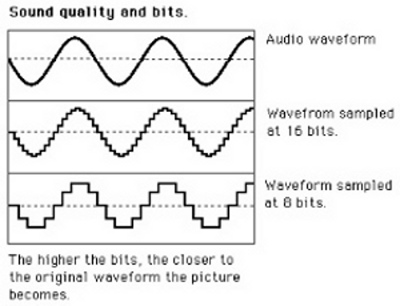
Each “step” of the graph is assigned a certain value for the sound volume level. Loudness levels can be thought of as a set of possible N states (gradations), which require a certain amount of I information to encode, which is called audio encoding depth.

Audio encoding depth is the amount of information required to encode the discrete volume levels of digital audio.

If the known encoding depth, the number of digital audio volume levels can be calculated by the general formula N = 2 I.

For example let the audio encoding depth be 16 bit, in this case the number of audio volume levels is:

N = 2I = 2 16 = 65 536.

During the encoding process, each sound volume level is assigned its own 16-bit binary code, the smallest sound level will correspond to the code 0000000000000000, and the highest – 1111111111111111.

Digitized audio quality

Therefore, the higher the sample rate and depth of audio encoding, the better the digitized sound will sound and the better you can bring the digitized sound closer to the original sound.

The lowest quality of digitized sound, corresponding to the quality of telephone communication, is obtained at a sampling rate of 8000 times per second, a sampling rate of 8 bits, and by recording an audio track (“mono” mode).
But it should be remembered that devices that resemble speech synthesizers and speech coders are used to improve this sound in telephony. About speech coders, this article also

Digital audio encoding

Digital audio encoding

Digital audio encoding

To represent the vibrations of sound in digital form, the amplitude of the sound signal is measured at each specific moment of the sound.

DIGITAL AUDIO ENCODING

Since the waveform of sound is inherently continuous, for its accurate digital display it is necessary to measure the amplitude an infinite number of times per second and divide the amplitude scale by an infinite number of gradations. In reality, the number of measurements per second (sample rate) typically ranges from 10,000 to 96,000. Currently, the most common sample rates are 44100 Hz (the standard for CD-audio) and 48000 Hz (the main standard for CD-audio). DAT). The number of amplitude gradations (resolution) is generally taken equal to 28, 216, or 224 (depending on the number of bits allocated for this information).

Of course, distortion is unavoidable when sampling a continuous signal. The lower the sample rate and / or resolution, the closer the output waveform will be to rectangular. In this case, high-frequency distortions arise, which are partially suppressed by filters installed at the DAC output.

Digitized audio requires a large amount of memory. In fact, at a standard 44100 Hz sample rate and 16-bit resolution, the audio material (stereo) for one minute would be 10,584,000 bytes (approximately 10.09 MB). Also, the sound files are very poorly compressed by standard archive programs (zip, arj, etc.). Therefore, there are special compression algorithms for them. For example, a WAV file compressed with ADPCM takes about four times less space. However, distortion may occur. Therefore, it is better not to use audio compression algorithms in professional work.

What is digital audio?

What is digital audio?

DIGITAL AUDIO

In fact, there can be several types of “digital sound”, more precisely, the types of its representation on a computer.

Digital Audio

The now familiar “digitized sound” is an analog of a photograph, an exact digital copy of sounds input from outside. It can be a microphone recording of your voice, a copy of audio tracks from a CD, or other sources. Like photography, this sound takes up a lot of space … however, the appetite for photography compared to sound is simply negligible! One minute of digital audio recorded at the highest quality requires approximately 10 megabytes. It is true that there are special compression methods that reduce the volume of computer sound ten times. But more on that later.

Besides “digital”, there is also “synthesized” sound – more precisely, music in MIDI format. Well, you are probably familiar with synthesizers. Briefly, the essence of MIDI technology can be summed up as follows: the computer not only plays the melody you need, but synthesizes it using a sound card. MIDI melodies are just command systems that control a sound card, note codes that it should “display” (indicating instruments, duration and some other parameters of this note). This technology is ideal for computer composers, as it allows you to easily change any parameter of the melody created on the computer: replace instruments, add or remove them, change the tempo and even the style of the song. And files with MIDI music are small, only a few tens of kilobytes. But MIDI has drawbacks too: you can’t record a voice to a MIDI file, and music sounds good only on a very high-quality sound card. Transfer the file you created to a neighbor’s computer equipped with a $ 10 card, and you will long think where all the charm and beauty of the melody has evaporated. It is true that MIDI can be relatively easily converted to digital sound format; reverse conversion, unfortunately, is impossible at the current level of computer technology development.

Finally, there is a third type of sound you can work with at home: “tracker” or “sampler” technology, a kind of love that comes from digital and synthesized sound. When you work with programs of this type, you will “build” a musical composition from small “pieces” of digital or synthesized sound that are repeated periodically: loops or samples. It is on this principle that compositions are created in the current popular style of “house”, “trance”, “techno” …

In short, all simple dance (not to say grosser, primitive), rhythmic music. This type of music, a cross between digital and synthesized, is called “tracker” and has a limited but loyal audience of fans.

What is digital audio?

What is digital audio?

Digital audio

Today we hear everywhere: high-quality digital sound, digital photography, digital video.

Digital Audio

What does this buzzword mean: digital? The key lies in modern methods of recording, processing and storing a wide variety of information, which appeared simultaneously with the advent of personal computers. The first PCs were designed only for settlement operations, but later they discovered that they can operate with texts, images, sounds and videos. You just need to translate everything into the computer language.

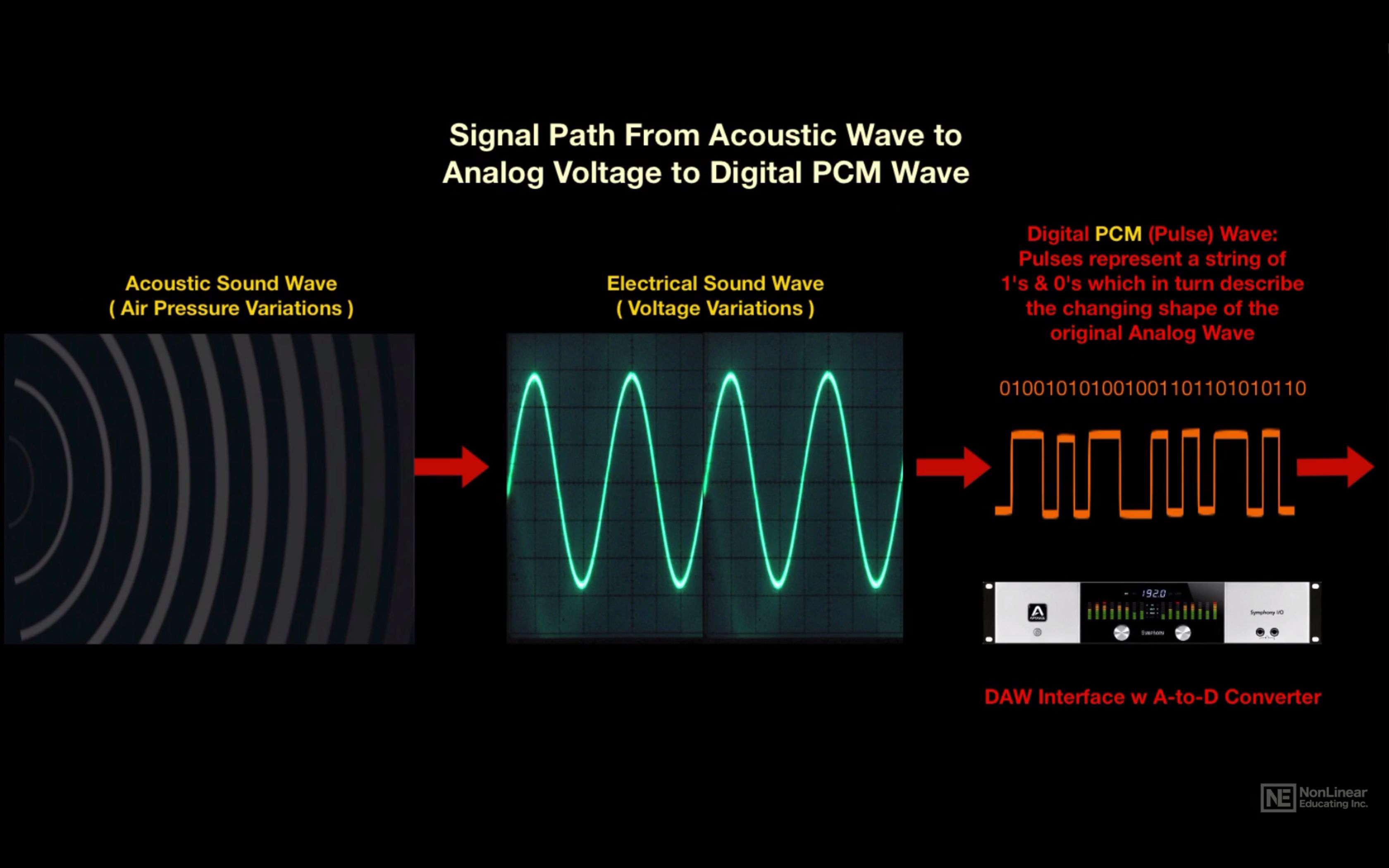
Let’s take a look at how you can record and play sound with a PC. First, the sound vibrations are converted to an alternating voltage using a microphone. This voltage is fed into the input of a special computing device – a sound card. The computer cannot register voltage. Like any electronic device, it can only record the voltage value of two levels: “there is voltage” (we should say a logical unit) or “there is no voltage” – logical zero.

It is in the form of combinations of logical zeros and ones that the PC records numbers, letters, words, or formulas. It is clear that recording a large amount of information requires many memory cells, because only one binary number can be written in a cell: 1 or 0. To write a digit or letter, 8 memory cells are needed. The number 3 is written as 00000011, the number 5 is 00000101, the letter k is 01101001, and the like.

How to record sound?
PC audio processing device control panel Very simple! The alternating voltage that reaches the sound card receives multiple measurements, the results of which are carefully recorded by the PC in memory. The computer measures the voltage approximately 44,000 times per second at any given time and records its value in memory. This is similar to how students keep a weather calendar: every day, at the same time, they record the readings of a thermometer, a barometer. The PC also records voltage values, but it does so much more frequently. How do you manage? Easy! Modern computers can do more than a billion simple operations per second, so the 44 or even 98,000 measurements required to record high-quality audio are not a problem for a computer. At the same time, the PC has to do a lot of work: drawing on the screen, writing the measurement results to disk, keeping an eye on which key you pressed, where the mouse moved, measured new voltage values, etc. Despite the fact that a voltage measurement consists of several dozen simple operations, the speed of modern processors is sufficient for it.

Large amounts of memory are required to store digital audio. One second of sound takes up the same space as 88,000 letters! This is how sound is recorded: voltage measurements are recorded on a large CD. Compare: You can record in text format a small library of 4-5 thousand books for several hundred pages or … 76 minutes of quality music.

Modern computers have learned to “cheat.” They record very quiet sounds with less precision, the ear will not yet hear them clearly. Sounds that are masked as loud sounds are also digitized less precisely. Why record in detail how smooth the violin sounds when the drum is struck hard? Therefore, the amount of memory occupied by sounds can be reduced ten times. This (and not only this) is done in the popular MP3 computer audio formats, which are common on the Internet, and in portable MP3 players, and Atrac, which is used in minidisc players.

How do I play the sound?
How is digital sound recreated? Even easier than typing it! In math lessons, you probably had to graph a function by points, and in physics lab work, you had to draw a graph based on measurements. During playback, the PC reads the voltage value from memory at all times and, using a sound card, resumes almost the same alternating voltage that was digitized.

These methods of recording and reproducing sound are used not only by computers, but also by various CD, MD and MP3 players, which, in fact, are also microcomputers, albeit without the usual keyboards, mice and monitors.

It is convenient not only to record and store digital sound, but also to transmit it remotely. The convenience lies in conserving airtime and battery life. During a conversation on a mobile phone, the voice is converted into digital form and memorized. When, say, 1/5 of a second of sound has accumulated, the phone’s transmitter turns on and the sound is transmitted for 1/100 of a second.

Fundamentals of digital audio

Fundamentals of digital audio

Digital Audio

Digital audio is based on the mathematical representation of the sound wave.

digital audio

The digital world is evolving very rapidly and it is no wonder that many people find digital technology complex. The purpose of this article is to explain what digital audio is without going into complicated mathematical details. To understand what digital sound is, you must first understand that there are no sounds inside a computer and there is only one math.

What is sound
Sound is the vibration of molecules. Mathematically, sound can be accurately described as a “wave.” It has a maximum peak value (wave hump) and a minimum value (deflection). If you have ever seen a graphical representation of a sound wave, you will notice that sound is always represented by a curve that constantly crosses the X-axis. This means that the nature of sound is “periodic”. Any sound has a crest and deflection, a positive and a negative period. This is called a loop. So the basic concept is that all sounds have at least one cycle.

The next important idea is that any periodic function can be represented mathematically as a series of sinusoids. In other words, even the most complex sound is just a collection of sine waves. A voice can constantly change its volume and pitch, but anytime it sounds, the voice is just a set of sine waves.

And finally, third: people do not hear sounds with a frequency higher than 22 kHz. Therefore, it is not necessary to record everything above 22 kHz.

So once again, the fundamentals of sound are as follows:

Sound waves are periodic and therefore can be described as a collection of sine waves.
We are not interested in waves with a frequency higher than 22 kHz, because we cannot physically hear them.
Analog to digital transition
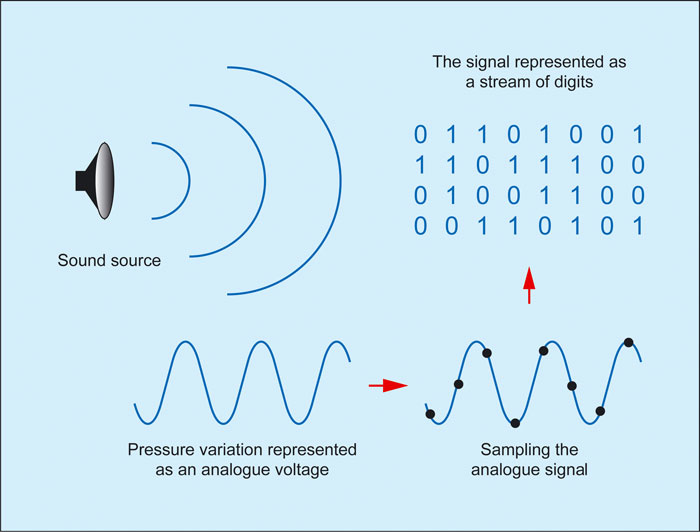
Let’s say I’m speaking into a microphone. The microphone turns my voice into a continuous electrical current. This electrical current passes through a wire through an amplifier of some kind and eventually enters an analog-digital converter (ADC). Remember that the computer does not store sounds, but mathematical values, so we need something that converts the analog stream into a sequence of ones and zeros. This is what the ADC is doing. In simple terms, the converter takes quick snapshots of the sound wave, called samples, and assigns an amplitude value to each sample. And here we come to two basic concepts that will help explain the nature of digital sound. These concepts are time and breadth.

Sound bitness
Sound bitness
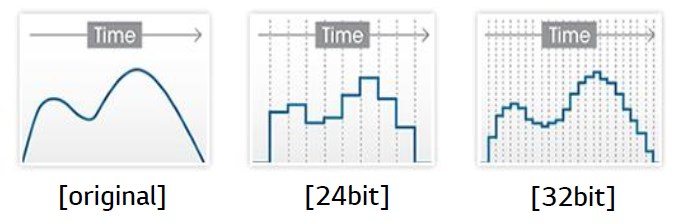
In the digital world, nothing is continuous, everything has a certain mathematical meaning. In the analog world, the sound wave will reach its peak and all values ​​from 0 dB to the peak will exist. And in a digital signal, there are a limited number of possible amplitude values. Think of analog audio as someone who gently walks up an escalator, while digital audio is someone who walks up a staircase and, over time, is on one rung or the other. Or let’s say there are values ​​50 and 51. So in analog sound there may be some intermediate value of 50.46, but in digital sound this value will be rounded to 50. This means that in fact the sound wave is distorted as it passes through the ADC … And since the analog signal is continuous, then this rounding of values ​​occurs constantly during the conversion process. This is called a quantization error and it sounds like a strange noise. But imagine a ladder with more steps that are less high. Now we have the values ​​50, followed by 50.2, followed by 50.4, and then 50.6, etc. An analog signal with an amplitude value of 50.46 will now be rounded to 50.4 instead of 50. This is a major improvement that does not completely eliminate quantization errors, but significantly reduces their impact. An increase in bitness is essentially an increase in the number of steps on a stair with a decrease in their height. As the quantization error decreases, the noise level decreases. Now we have the values ​​50, followed by 50.2, followed by 50.4, and then 50.6, etc. An analog signal with an amplitude value of 50.46 will now be rounded to 50.4 instead of 50. This is a major improvement that does not completely eliminate quantization errors, but significantly reduces their impact. An increase in bitness is essentially an increase in the number of steps on a stair with a decrease in their height. As the quantization error decreases, the noise level decreases.

What is digital audio

What is digital audio

digital audio

Digital audio is a numerical representation of sound.

Digital Audio

Recording sound as digital sound is similar to recording sound on a tape recorder. Let’s say you have a microphone connected to your computer. Whenever a sound is heard (speaking, singing, playing a musical instrument or just any noise), the microphone “hears” it and converts the sound into an electrical signal. The microphone then sends the signal to the computer’s sound card, which converts the signal into numbers. These numbers are called samples.

A sound card is a device that is inserted into a computer that allows it to understand the electrical signals from any sound device. You can think of a sound card as a “translator”. When an audio device (such as a microphone, electronic musical instrument, CD player, or other device capable of outputting an audio signal) sends signals to the computer, the sound card receives the signals and converts them into numbers that computer can understand.

The samples contain information that tells the computer what the recorded signal sounded like at specific times. The more samples that are used to represent the signal, the higher the quality of the recorded signal. For example, to create a digital sound recording that has the same quality as a CD recording, the computer must receive 44,100 samples per second. The number of samples taken per second is called the sample rate.

The size of each individual sample also affects the quality of the recorded sound. This size is called the bit depth. The higher the bit depth, the higher the sound quality. For example, to create CD-quality digital audio, each sample must be 16-bit.

Computers use the binary form to represent numbers. The place of a binary number is called a bit, each bit represents one of two numbers: 1 or 0. By combining bits, computers can display any number. For example, any number between 0 and 255 is represented as an eight-bit number. With 16 bits, it can represent numbers in the range 0 to 65,535.

Your computer can save all submitted samples. The temporal characteristics of the sample are also saved. Later, the computer can send samples to the sound card at the same intervals, so you hear the sound exactly the same as what was recorded. The basic concept is as follows: a sound card records an electrical signal from an audio device (such as a microphone or a CD player). The sound card converts the signals into sets of numbers, called samples, that are stored on your computer. During playback, the samples are sent back to the sound card, which converts them into an electrical signal. The signal is sent to the speakers (or other audio device) and you hear the sound exactly as you recorded it.

So what is the difference?
After reading the description of MIDI and digital audio, you may still be confused about the difference between the two. After all, both processes record the signals sent to the computer and then reproduce them, right? The point is, when you record MIDI data, you are not recording actual sound. Just record the instructions for playback. It is like a musician playing notes, where the notes are MIDI data and the musician is the computer. The musician (or computer) reads the notes (or MIDI data) and then stores them in memory. The musician then plays a melody on a musical instrument. What if the musician takes another instrument to play? The game will remain the same, but the sound will change. The same is true for MIDI data.

A keyboard synthesizer can produce any sound, but playing the same MIDI data using the keyboard will be exactly the same.

When you record digital audio, you are recording real audio. If you record a performance of a piece of music as digital sound, you cannot change the sound of that performance as described above. Due to these differences, MIDI and digital sound have their own advantages and disadvantages. Since MIDI is recorded as data for playback, rather than actual sound, you have much more freedom to manipulate the sound than with digital sound. For example, you can easily correct the error by changing the pitch. MIDI data can be converted to standard music notation, which is not possible with digital sound.

The benefits of digital audio

The benefits of digital audio

Digital Audio

The basics of “numbers”

DIGITAL AUDIO

Each of the multimedia devices on sale today, be it a CD player, a voice recorder or a flash memory player, uses many different types of presentation of data streams, which are then converted into sound. And even more sound formats used for professional purposes have been invented. An inexperienced buyer is forced to gather information on designations on boxes and devices from a variety of sources, often receiving incorrect information or even more confusion.

Almost all devices in the “Portable Audio” section of the ZOOM.CNews.ru catalog support multiple sound formats at the same time, and many devices that do not belong in this category are also tagged with support for playing sound files. To help our reader, we decided to create a short glossary of abbreviations and talk about the most common formats. We plan to leave it open for updates and modifications, adding new formats and describing in more detail the advantages and disadvantages of the already common or forgotten ones.

A little theory

To begin with, remember that digital sound is nothing more than a collection of numbers. The determining factor is the system by which sound as air pressure is converted into data streams and encoded for further processing and reproduction. Consequently, digital sound is usually included in computer files with various extensions, which more often (but not always) can determine their format. And the same concept of format can have, paradoxically, two meanings. First, the format may exist as a general characteristic, including both the type and the physical characteristics of the medium (disc or cassette), method of recording, principles of encoding, and protection against errors. Second, the format can only be understood as the method of encoding and compressing sound, as standard means are used for transfer, for example a computer.

Analog sound, unlike digital, is reproduced on analog devices and has several significant differences. While not a data stream, analog sound is represented as a continuous electrical signal that represents the change in sound wave. To translate it into digital format, the sound is “digitized”, that is, it is divided into certain segments, in which the numerical value of the amplitude is fixed at that moment. We will not delve into the principles of digital sound creation, but it is absolutely necessary to note that the more often a sound segment is divided and its characteristics described, the clearer and more complete the sound image itself is created.

This process generates an enormous flow of data that describes the sound, and it is clear that each digital audio format is nothing more than a compromise between the need to present the sound as loud as possible and the limitations of the memory of the computer or device. Of reproduction.

A little more theory. In most cases, the human ear perceives sound with a frequency no higher than 22,000 Hz and, to describe it fully in digital form, a sampling frequency of at least 44.1 kHz is required. Since it is absolutely impossible to determine the value of the signal at any given time, during digitization quantization occurs, that is, the replacement of the actual values ​​of the signal by approximate values. The more levels of audio quantization, the more accurately the signal level is described. As a result, each standard CD carries an audio signal with a sampling frequency of the same 44.1 kHz and a 16-bit quantization level,