Encoding an mp3


Free Download Mp4Gain
picture

Encoding an mp3

encoding mp3

What is masking

mp3 encoding

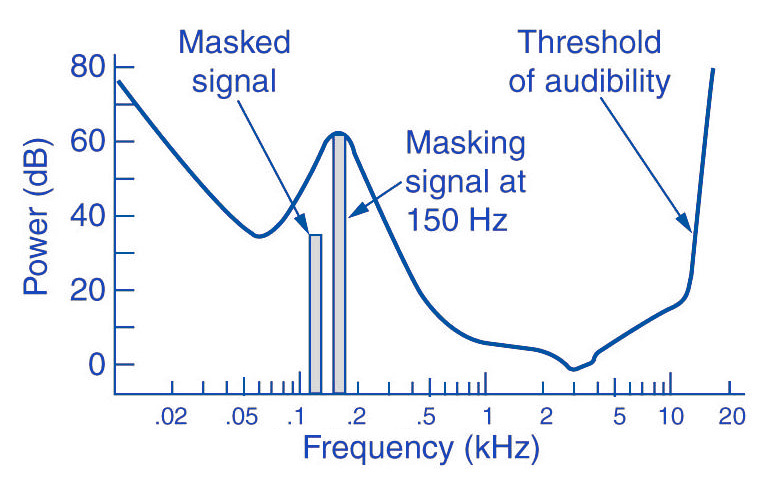
The lossy MP3 audio compression algorithm uses a limitation of human hearing perception called auditory masking. In 1894, the American physicist Alfred M. Mayer reported that a tone could be made inaudible by another tone of a lower frequency. In 1959, Richard Amer described a complete set of auditory curves related to this phenomenon. Between 1967 and 1974, Eberhard Zwicker worked on tuning and masking critical frequency bands, which in turn built on the fundamental research of Harvey Fletcher and his collaborators at Bell Labs in this area. Perceptual coding was first used to compress speech coding with Linear Prediction Coding (LPC), which has its origins in the works Fuminada Itakura (Nagoya University) and Shuji Saito (from Nippon Telegraph and Telephone) in 1966. In 1978, Bishnu S. Atal and Manfred R. Schroeder of Bell Labs proposed an LPC speech codec called adaptive predictive coding. , which used a psychoacoustic coding algorithm using the masking properties of the human ear. Schroeder and Atal’s further optimization with J.L. Hall was later described in a 1979 article. In the same year M.A. Krasner proposed a psychoacoustic masking codec, which published and produced hardware for speech (not used to compress musical bits), but the publication of its results in a relatively obscure technical report from the Lincoln Laboratory did not immediately influence the mainstream of the development of psychoacoustic codecs. The Discrete Cosine Transform (DCT), a type of transform coding for lossy compression, proposed by Nasir Ahmed in 1972, was developed by Ahmed with T. Natarajan and KR Rao in 1973; published their results in 1974. This led to the development of the Modified Discrete Cosine Transform (MDCT) proposed by JP Princen, AW Johnson, and AB Bradley in 1987 after earlier work by Princen and Bradley in 1986. MDCT later became the main body of the MP3 algorithm. Ernst Terhardt et al. Built an algorithm that describes auditory masking with high precision in 1982. This work adds to many reports by authors dating back to Fletcher, as well as work that originally defined critical ratios and critical bandwidth. In 1985, Atal and Schroeder introduced Code Excited Linear Prediction (CELP), an LPC-based perceptual speech coding auditory masking algorithm that achieved a significant degree of data compression for its time. IEEE peer-reviewed journal “Favorite Communications” reported on a wide variety of audio compression algorithms (mainly perceptual) in 1988. The February 1988 issue of Voice Coding for Communication reported on a wide range of audio compression algorithms bit-based established and operational. technologies, some of which use auditory masking as part of their core design, and some of which show real-time hardware implementations. – https://ru.qaz.wiki/wiki/MP3


Free Download Mp4Gain
picture


Mp4Gain Main Window
picture


Mp4Gain Features
picture


Free Download Mp4Gain
picture

ENCODING PRINCIPLES OF THE MP3 FORMAT.

ENCODING PRINCIPLES OF THE MP3 FORMAT.

Mp3 Encoding

Mp3, or fully MPEG-1, 2 and 2.5 Layer 3, is one of the most popular and widespread standards for storing audio data.

MP3 ENCODING

In this article, we will not delve into the history of creation and further development, but will consider the basic principles of the standard and examples of its implementation.

The mp3 standard does not establish a specific compression algorithm to “encode” the source data, but rather describes the essence of the possible methods.

The quality of the result obtained depends on the modification of the algorithm used, embedded in any encoding program of the “codec”, and on the quality of the original audio data.

There are 3 most common modifications of the mp3 format, which differ in the compression ratio parameters of the original audio data.

Name
Modification of the rule
Data rate per second (bit rate) Possible sample rates
MPEG-1 layer 3
32 – 320 kbps 32000 Hz
44100 Hz
48000 Hz
MPEG-2 Layer 3 16 – 160 kbps 16000 Hz
22050 Hz
24000 Hz
MPEG-2.5 Layer 3 8 – up to 160 kbps 8000 Hz
11025 Hz

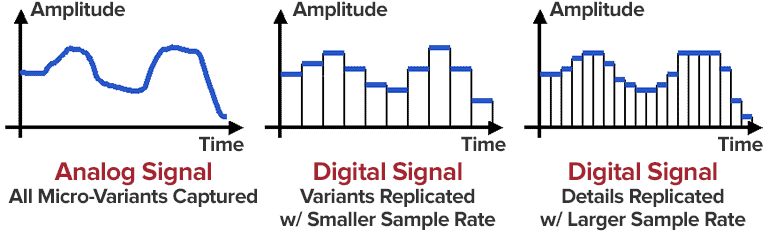
Processing begins with dividing the original audio signal into equal time intervals: equal frames, for example 0.05 or 0.26 seconds, after which each frame is analyzed and compressed according to general or individual parameters based on the data of the previous and next frames.

Most of the compression algorithms used are based on the perceptual characteristics of the human ear. Let’s consider the main options, which, as a rule, are applied in a complex way.

It is worth starting with the fact that, by ear, the average person is capable of perceiving a frequency range of approximately 10 Hz to 20,000 Hz. With growth, changes occur in the hearing aid and, for most, the sensitivity the higher frequency range decreases, as a result of which, in some mp3 modifications, during compression, all frequencies above 16000 hertz are cut off, which can significantly reduce the amount of information.

Audio recordings can be encoded in stereo (a surround sound effect that uses separate channels for the left and right speakers) or mono (the opposite of stereo). In mp3 format, different tracks are not recorded for each of your speakers, but information about the differences between the left and right channels.

In acoustics, there is a concept like “harmonics”, these are the frequencies of the “sounds” that sound together with the main and most prominent tone. For example, when hitting a drum, the loudest sound will be the tone and the minor, weaker, will be the harmonics.

After such a loud sound, the so-called “period of deafness” occurs, during a period of duration in which a person’s hearing practically does not respond to changes.

If in the intervals of the “deafness period”, remove all frequencies, then the errors of perception, will practically not allow to notice their absence, because of this, during compression, the weakest harmonics are cut off, located close to the most sounds. strong: tones.

A method is used to replace the near peak values ​​of the signal “peaks” (in terms of volume) with an average value.

There is a concept as bit rate: this is a value that characterizes the number of transmitted bits of information “units” during a period of time, usually one second.
The higher the bit rate, the better the audio detail will be, as long as the original, uncompressed audio data is of high quality.

As you can guess, digital formats consist of certain code sequences, in other words of sequences 0 and 1.
To save space, frequent joins within a file are assigned unique identifiers that replace long sequences.

Thanks to such complex influences, it is possible to compress the original audio signal into one of the popular formats with loss of quality – the mp3 format.

Various experiments have been carried out many times in order to reveal how significant the differences are before and after compression in mp3. As tests have shown, differences, some similar moments were not always possible, quickly and to distinguish, even when reproduced on equipment with higher fidelity.

For those who have never had the opportunity to directly compare the original and compressed audio recording, in most cases it will take some time or even find obvious differences.