What is the difference between MP3 and Wav format?


Free Download Mp4Gain
picture

What is the difference between MP3 and Wav format?

WAV vs. MP3

To start with, let’s understand a little what Mp3 is and what Wav is.
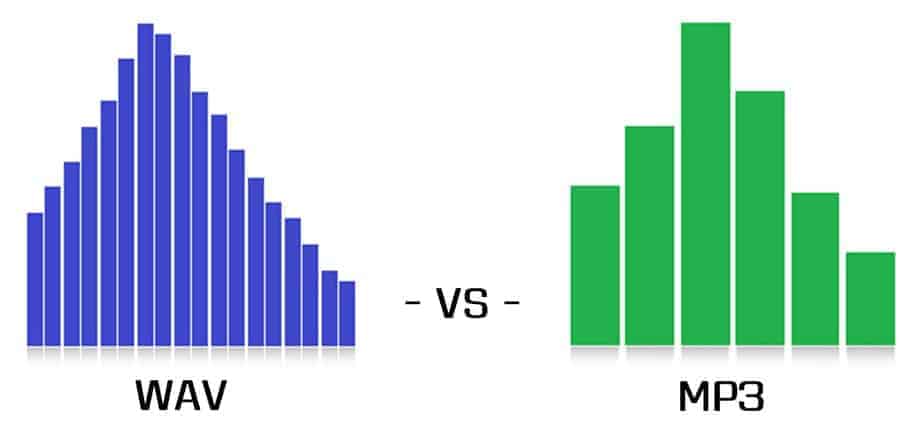
WAV vs MP3

Mp3 is one of the formats and options to store / save your audio file (audio recording).

This format is compressed. In simple words: it is designed to occupy the minimum amount of memory on your device.

Optimal bit rate for this format = 320 kbit / s.

Wav is an uncompressed version of your audio recording.

Consequently, the size of this file is much larger than that of the Mp3 format.

The optimal bit rate for this format is 1140 kbit / s.

From this we can conclude: what is the Wav format better than MP3?

Since the bitrate range of Wav is almost 3 times that of Mp3, the quality of the Wav format is much higher, which greatly affects the size of each of the formats.
The higher the quality of the original track, the higher the quality of the final result of your track. For better mixing, most people use the Wav format and this is the right choice. Now it is 2020, currently most studios work with Wav formats, but it is possible that you can make a high quality track by recording in Mp3 format. Admittedly, a mixing engineer will not be so impressed (probably).
The Wav format preserves a more accurate wave pattern that was created in the program when the instrument was written. Its accuracy is also reflected by loading your Wav file into the show’s playlist, where the mixer engineer combines your vocal and backing tracks into one track with the instrumental. The Mp3 format was created for listening to music at home, on a player (with headphones), on portable speakers, etc., where the inaudible frequencies of the audio recording are not important, as there is in fact no way to produce a sound of the highest quality while listening to this equipment.
Naked eye bit rate difference: Wav = 1140 kbit / s, Mp3 = 320 kbit / s.
To summarize, the main difference between Mp3 and Wav is that:

Wav is an incredibly detailed, uncompressed version of audio recording designed for studio use.

Mp3 is an incredibly compressed and less detailed version of audio recording designed for listening to music at home, in the car, etc.

Examples:

High-end equipment: Similar to expensive studio monitors, they produce the highest quality sound carried by the audio track. It is in this case that the Wav format is needed, since the possibility of eliminating inaudible frequencies, + high detail from the audio file is excluded.
Inexpensive equipment, such as a mobile phone, vacuum headphones, a radio in the car, etc., emits a good sound and audio signal, but not a high-quality one, allowing you to hear all the inaudible frequencies. Consequently, the Mp3 format is suitable for them, which does not give the maximum range of all frequencies and takes up minimal space on your device.


Free Download Mp4Gain
picture


Mp4Gain Main Window
picture


Mp4Gain Features
picture


Free Download Mp4Gain
picture

Head to Head Bet: OGG vs LAME

Head to Head Bet: OGG vs LAME

Ogg

You probably won’t surprise anyone with the sound capabilities of modern computers. Keeping a music library on a computer, along with audio cassettes and CDs, has become commonplace for many. Today, even schoolchildren know the magic password that unites many people, in one way or another connected to computers. This password consists of only three characters: “M” “P” “3”. Consider how many memories you have with them.

OGG

Many people know what audio CDs are in terms of simplicity and ease of use. “Why?” – you ask. Yes, because the CD, as they say, is “and in Africa” ​​the CD. If some characteristics of the reading are not taken into account, it is always and everywhere the same as it was created, that is, the same. It has the same rigidly defined format, and the sound quality is primarily dependent on the recording studio and is generally the best. Conveniently? I don’t argue!

What about the music on your computer? The PCM (Pulse Code Modulation) recording format used on CD-DA discs is not compact enough to store music on your computer, and completely unsuitable for sharing music over the Internet. Therefore, mathematically extremely complex algorithms for compressing audio data and its storage formats are constantly being developed and improved. These algorithms sometimes differ greatly from each other in sound quality. Many users are faced with a constant problem of choice: which program, with what algorithm and with what parameters to encode their favorite music?

Even though many different algorithms and formats have been created, only one of them is the absolute leader today. This is the MPEG 1.0 Audio Layer III compression format, popularly known as “MP3”. There are many encoding programs available to record music in this format. Each of these programs has its pros and cons; On the web you can find a large number of tests and comparisons of various MP3 encoders. The generally recognized leader today is LAME, a free open source project with no license restrictions.

We are used to thinking that MP3 is the best, MP3 is forever. However, it hasn’t been long since the prevailing audio compression format and encoder had a serious competitor: the all-new format and the Ogg Vorbis algorithm. After the beta 3 version of this encoder was released in late summer 2000, the public began to look closely at it and it became very difficult to choose the “best”. And at the beginning of 2001 two new versions were released at the same time: LAME 3.88 and Ogg Vorbis 1.0 Beta 4. Both versions differ significantly from the previous ones, so it is necessary to compare them, to make, so to speak, a “showdown” between both formats. That it was done. The result is in front of you.

MP3 and FLAC: who wins?

MP3 and FLAC: who wins?

Mp3 & FLAC

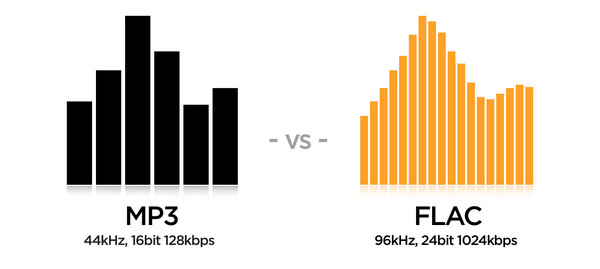
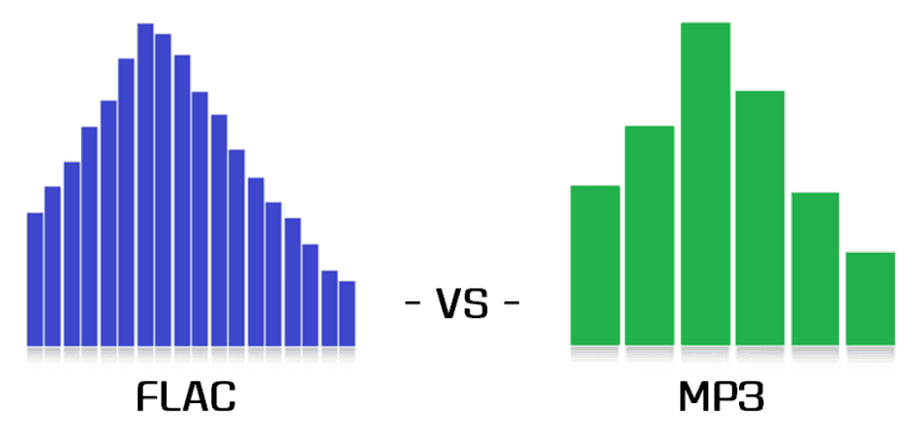
Music lovers from all countries have been arguing for many years: is it possible to distinguish a high-quality MP3 from a lossless one in a blind test (FLAC, APE, etc.)? How much does compression loss affect the perception of music? Should you give up MP3? Let’s try to answer these questions.

FLAC vs MP3

A little history
In the early 1990s, experts understood that the future of music was digital. However, hard drives were expensive then and fans preferred to store their music collections on cassettes and CDs. The researchers faced a problem: they needed a suitable format to store records on computers. At the same time, every hundred kilobytes were counted – you can slightly sacrifice quality compared to CDs, but save precious hard drive space.

In the late 1980s, the first functional prototypes of a new lossy compressed audio storage format, MP3, were created. The first publicly available MP3 encoder appeared in 1994, and the first playback software soon followed. The first encoding algorithms made it possible to obtain files with slightly “chopped” high frequencies. The sound quality was not comparable to that of a CD, but the output file sizes were quite acceptable.

In the early 2000s, volumes on hard drives were growing rapidly and other audio formats that provide lossless compression began to appear. Relatively speaking, an audio track of this format can be restored to the original WAV from a lossless CD. Perhaps the most popular lossless compression format was FLAC, introduced in 2001. It is suitable for both storing home audio collections and playing music on professional computers. However, a FLAC file can be 6-10 times heavier than a good quality MP3 (256 or 320 kbps). But does file size and losslessness mean consistently high sound quality?

find 10 differences
Compare, for example, two spectrograms of the same song (DAT ADAM – Hydra 3D): it is easy to see that MP3 “cuts” high frequencies compared to lossless compression (left – MP3 320 kbps, right – FLAC spectrogram, obtained by digitizing CD). But the question is different: will you hear the difference?

A bit of anatomy: The human ear is theoretically capable of hearing sounds from 16 Hz to 20 kHz. However, much depends on the age and individual characteristics of the listener. The author of this article can hear sound with a frequency of 16 kHz, but not 17 kHz and above, but there are adults (25 years and older) who can still perceive 18 kHz. All of these frequencies are quite successfully supported by the MP3 format. If you are exceptionally clear, you will be able to hear some difference in the high frequencies, but the difference is almost subtle for most people.

Flac vs mp3

Flac vs mp3

FLAC vs MP3

Recently, FLAC-compatible players, which are highly appreciated by most audiophiles, have developed rapidly. What is the secret of the format? Why is the popular mp3 format not suitable for music lovers?

Mp3 vs Flac

The birth of mp3

In the early days of digital audio, the first music format was Wave, which was widely used on CD-Audio discs. There were no large hard drives at the time and the 700MB album seemed very large. With the advent of high-performance microcircuits, the mp3 format was invented, allowing music to take up 10 times less disk space (~ 70MB vs. 700MB). This made it possible to significantly increase the number of musical compositions stored by listeners at home on a computer and early Flash players. Due to its high weight, the original format was replaced by the mp3 boom.

Many people remember the incredibly popular iriver players that support mp3 and ogg, but the time for those players has passed and iriver has released Astel & Kern players that support FLAC in high resolution.

Compression of information in mp3 and quality How does mp3 take up less space? It is based on two technologies: archiving and psychoacoustic compression. The conventional file is not very efficient and is only used in lossless formats like flac, ape, and wavepack. Psychoacoustic compression is added to mp3 and this format belongs to the Lossy group (lossy compression).

Psychoacoustic compression dilutes data according to a simple principle: anything that the listener potentially does not hear (for example, quiet sounds against the background of loud sounds) is mercilessly discarded. There are many parallels with the video and the photos. For example, in the jpg format, pixels with similar colors are grouped into large squares of the same color and when forming an image, we usually do not notice that various hues have disappeared. But if we want to take a closer look, we will definitely see it!

The quality of the same mp3 bit rate is different

There are a large number of mp3 encoders, and each has its own priority level in the algorithm, what is least important in music and what to remove first with low compression and last with high. The higher the compression, the more meaningful information is removed and the easier it is to listen to on simple audio equipment.

Unfortunately, the sound quality of mp3 depends not only on the degree of compression expressed in bitrate, but also on the codec with which it was compressed and with what settings. Very often, a high bit rate on the order of 320 kB / s is used, but with the fast and less resource consuming encoding mode. The file encodes very quickly, but as a result, it subjectively sounds worse than encoded at 128 kB / s in long, resource-intensive mode.

Almost all “mp3 producers” in the form of websites and CD compilations use fast algorithms. They believe that most will not hear the difference on their phones anyway, and will be guided by the purchase only by the bitrate. Why spend the extra effort if they buy well?

The differences between the 320 kB / s mp3 encoded in high quality and resource intensive mode and the original Wave are actually very small and sometimes difficult to distinguish even with good audio equipment, but these mp3s are usually very few and far between. they just make them enthusiastic. Most of the mp3 leaves a depressing impression.

Much also depends on the decoder, which determines the quality of the final sound. There are still battles on the forums, which software or hardware player sounds better with which decoder.

At the height of mp3 development, the quality of players and sound cards left much to be desired, especially considering that the main mp3 users were those who could not afford to listen to music on a good hi-fi system. . Quality issues were hardly noticed, similar to JPG compression issues when viewed through a cell phone screen. But on a good audio route, it was obvious. Recently, technology has advanced and the quality of most fonts has increased and consequently the disadvantages of mp3 have become more obvious. What are the main disadvantages of mp3 sound?

The absence or unnaturalness of the high frequencies (due to the strong decimation of the high frequencies, which most supposedly cannot hear)
Wheezing and distortion in vocals, unnatural timbres of instruments
Violation of the location of sources in space.
But most importantly, you never know how high quality an mp3 will sound, how much information is actually lost on it.

Why are AV hard drives used in digital recording?

Why are AV hard drives used in digital recording?

AV Hard drives


AV HARD DRIVE

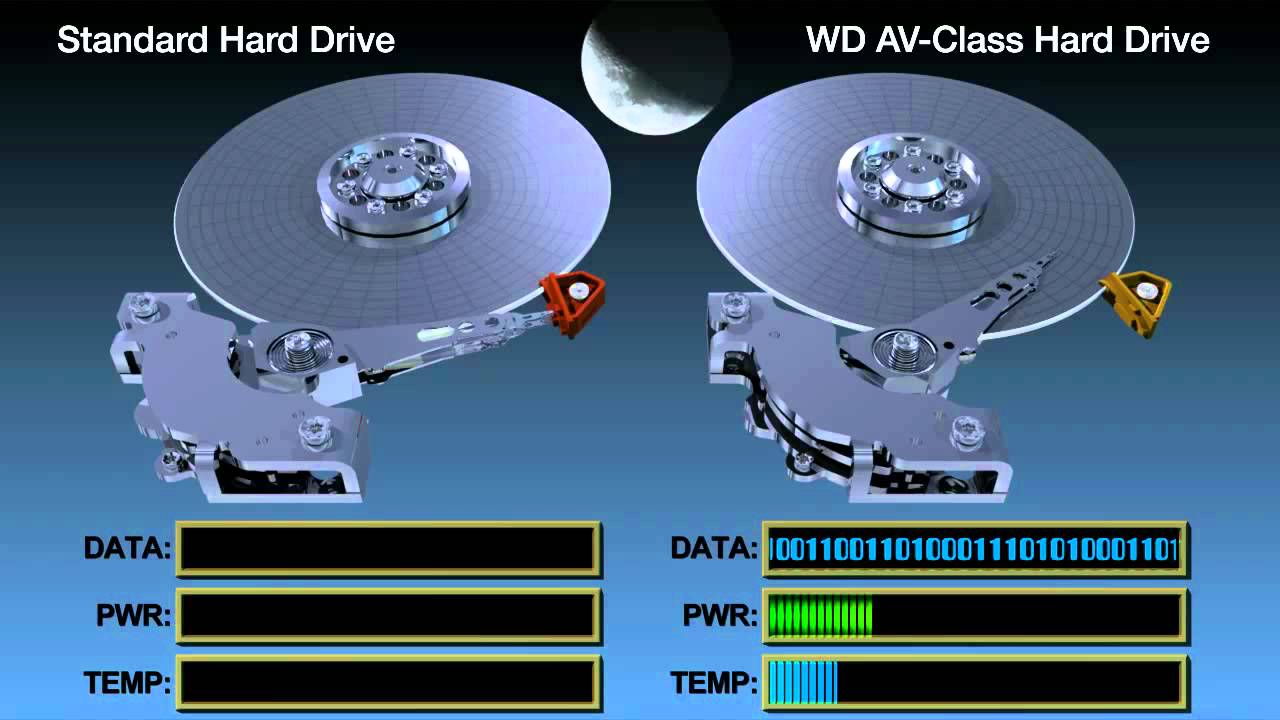
The class of AV (audio / video) hard drives means their ability to
read and write streams of data efficiently and smoothly, without pauses. Reserve Army-
some disks ship with a larger internal buffer and are not interrupted
They read / write the process thermal calibration positioning system.
For digital recording systems with insufficient performance and
amounts of RAM to smooth out possible irregularities in the operation of the
discs, AV discs are the only possible output.

Note that the presence of the abbreviation AV in the designation of the disc
it does not mean that it belongs to the Audio / Video class; must be
It must be explicitly mentioned in the passport of the disc.

However, the specified feature is generally necessary only when working
bot with high-quality video information, whose speed
it is approximately 10 megabytes per second per channel. In the case of sound
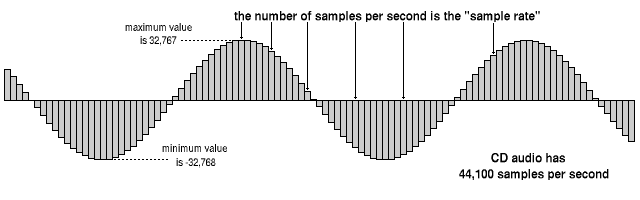
systems output the rate of a single 16-bit channel stream with a frequency
The 48 kHz sample rate is two orders of magnitude lower and is only 94 kilograms.
bytes per second. At the same time, almost no workstation
to ensure simultaneous operation with hundreds of channels, as well as
the disk cannot process so much data in parallel,
located in different parts of it. In real applications, multichannel
burning disc to disc, most of the overall disc costs
The howling subsystem relies on head movement between recording areas,
and nothing in the data transfer itself. The low speed of sound flows.
kov makes it more convenient and reliable to store them in the computer’s RAM,
disc thermal calibration compensation within 0.5 – 1 s, instead of
use of expensive and rare AV class discs. Also, it is far from
All conventional discs, thermal calibration has a remarkable effect on the
data stream number.

“Broken” data transmission can also occur when using “unintentional”
correct “operating system (DOS, Windows without 32-bit driver
faith on disk, etc.), insufficient number and size of file buffers
get rid of the operating system and the burning program, the use of low-class discs with
transfer rate of the order of 1-2 megabytes per second and lower, incorrect
connect a disc, etc. In any case, these situations are usually
talk about misconfiguration and hardware and software configuration
parts of the system.

What methods are used to compress digital audio effectively?

What methods are used to compress digital audio effectively?

Compress Digital Audio

COMPRESS DIGITAL AUDIO

Currently, the most famous are Audio MPEG, PASC and ATRAC. All of them
use the so-called “perceptual
encoding) in which information is removed from the sound signal,
perceptible to the ear. As a result, despite the change in shape and spectrum
signal, your hearing perception is practically unchanged, and the degree
Compression accounts for the slight reduction in quality. Such encoding
refers to lossy compression methods, when
it is no longer possible to accurately reconstruct the original waveform from the compressed signal
shape.


The techniques to eliminate part of the information are based on the characteristics of the human being.
who to listen to, called masking: if there is a high
strong peaks (dominant harmonics) weaker frequency content
hear in the immediate vicinity of them practically no
accepted (masked). When encoding, the entire audio stream is divided
is divided into small squares, each of which becomes a spectral
presentation and is divided into several frequency bands. Within the stripes there are
performs the definition and removal of masked sounds, after which each frame
it undergoes adaptive coding directly in spectral form. All
these operations can significantly reduce (several times) the volume
data while maintaining acceptable quality for most listeners
I read.

Each of the encoding methods described is characterized by a bit rate
the bitrate with which the compressed information should come
on the cable box when the audio signal is restored. Decoder converts
a series of instantaneous signal spectra compressed into a conventional digital waveform
shape.

MPEG Audio – A group of MPEG standardized audio compression methods
(Moving Pictures Experts Group – a group of experts to process motion
images). MPEG audio methods exist in various
types – MPEG-1, MPEG-2, etc .; currently the most common
not MPEG-1 type.

There are three layers of MPEG-1 audio for stereo compression.
your signals:

1 – 1: 4 compression ratio with a data stream of 384 kbps;
2-1: 6..1: 8 at 256..192 kbps;
3 – 1: 10..1: 12 at 128..112 kbps.

The minimum data rate in each layer is defined as 32
kbps; specified bit rates maintain signal quality
roughly at the level of a CD.

All three levels use the input split spectral transformation
changing the frame in 32 frequency bands. The most optimal in relation
data volume and sound quality recognized as level 3 with bit rate
128 kbps and a data density of approximately 1 Mb / min. When compressed from a bottom
at what speeds the forced limiting of the frequency band starts to
15-16 kHz, and channel phase distortions also occur (effects such as
phaser or flanger).

MPEG audio is used in computer sound systems, CD-i / DVD,
CD-ROM “audio”, digital radio / television and other systems
massive sound transmission.

PASC (Precision Adaptive Subband Coding – Precise Adaptive Intraband
coding) – a special case of Audio MPEG-1 Layer 1 with a speed
Stream 384 kbps (1: 4 compression). Used in the DCC system.

ATRAC (Adaptive TRansform Acoustic Coding – acoustic coding
adaptive transformation) is based on stereophonic sound
16-bit quantized format with a 44.1 kHz sample rate.
When compressed, each frame is divided into 52 frequency bands, resulting in
transmission speed: 292 kbps (1: 5 compression). Applied in the system

What interfaces are used for digital audio transmission?

What interfaces are used for digital audio transmission?

Digital Interfaces

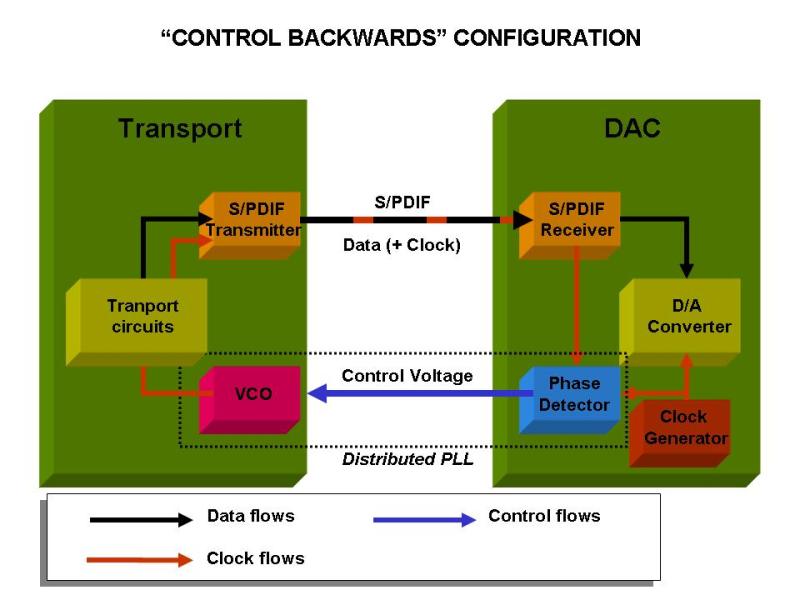
S / PDIF (Sony / Phillips Digital Interface Format – digital information format
terface from Sony and Philiрs) – digital interface for home radio
team.

Digital Audio Interfaces

AES / EBU (Society of Audio Engineers / European Broadcasting Union – Society
sound engineers / European Broadcasting Association) – digital engineering
terface for studio radio equipment.

Both interfaces are serial and use the same form
marking mat and coding system: BMC code with automatic synchronization
(Biphasic brand code: code with a double change representation of a unit
phase) and can transmit signals in PCM format of up to 24 bits
at sample rates up to 48 kHz.

Each signal sample is transmitted as a 32-bit word (frame), in which
rum 20 digits are used to transmit the count, and 12 – to form
synchronization preamble, transmission of additional information and
parity bit. 4 bits of the service group can be used to
extension of the sample format to 24 bits.

192 consecutive frames form a block, the beginning of which is marked
special preamble code of the first frame.

In addition to the parity bit, the service part of the word contains a validity bit
(Validity), which must be zero for each valid answer
accounts. If a word is received with a single bit of Validity or with a violation
parity in the word, the receiver interprets the entire sample as wrong and
you can choose to replace it with the old value or interpolate
based on multiple adjacent valid reads. Counts
marked invalid can transmit CD players that
DAT recorders and other devices, yes, when reading information from
the media could not be corrected during read errors
Ki.

The service part of the word also includes the C bits (Channel Status – Status
channel) and U (user bit). Constant price
kidney of each of these bits, taken one at a time from each block frame,
forms a 192-bit word of block service bits, where information is transmitted
information about the title of the work, track number,
device, CD subcodes, etc. S / PDIF transmits
copy protection settings (SCMS).

The standard encoding format is designed to transmit one and two
channel signal, however, when service bits are used to
By encoding the channel number, a multi-channel signal can be transmitted.

On the electrical side, S / PDIF provides a coaxial connection
cable with characteristic impedance of 75 ohms and RCA connectors (“tulle
pan “), signal amplitude – 0.5 V. AES / EBU provides connection
2-wire shielded symmetrical cable with transformer
decoupling via RS-422 interface with signal amplitude 3-10 V, connectors –
Cannon XLR 3-pin. There are also optical options
transceivers: TosLink (plastic fiber) and AT&T Link
(fiberglass).

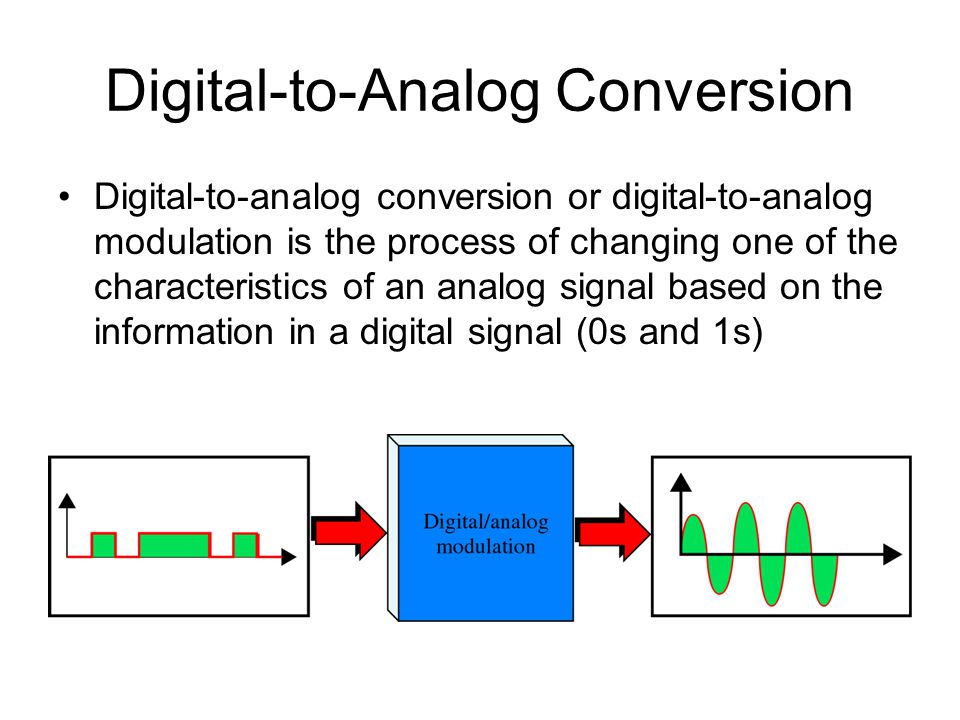
How are ADC and DAC organized and operated? Part 2

How are ADC and DAC organized and operated? Part 2

Digital to Analog Converter

The main difference between PDM and PWM DAC is that the maximum
pulse width in PWM is not equal to a power of two (e.g. for MASH it is
equals 11).

DAC - Digital to Analog Converter

DACs with oversampling and a small number of real bits have
significantly better linearity than parallel DACs with the same
tiva bit depth. The output waveform of these DACs is
fight a useful signal, framed by a significant amount of high frequency
total noise, the main energy of which is far enough away from
the higher frequency of the useful signal and thus effectively suppresses even
the simplest analog filter.

The effective bit width of a Delta-Sigma DAC is generally determined from a pair of
output signal meters – noise level and non-linear distortion factor
zheniya characteristic of a parallel DAC of a certain bit depth. When
the effective bit capacity of the Delta-Sigma DAC can significantly exceed
shake the bit width of your input signal, for example a DAC for a 16 bit
The digital signal can have an effective bit width of 18, 20 and
moreover, smoothing the original signal, reducing the influence of quantum errors on it.
and thus make it more comfortable to listen.

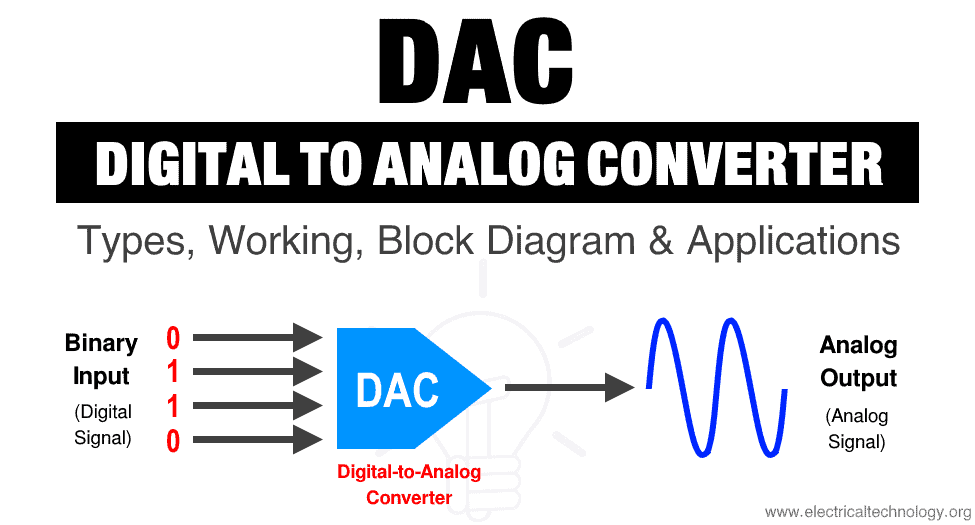
DACs are “straightforward” devices that convert to
it is easier and faster than ADCs, which are mostly later
and slower devices.

How are ADC and DAC organized and operated? Part 1

How are ADC and DAC organized and operated? Part 1

DAC

There are mainly three ADC designs:

DAC


– parallel: the input signal is compared simultaneously with the reference
levels by a set of comparison circuits (comparators), which are formed in
the output is a binary value. In such ADC, the number of comparators is (2
raised to the power of N) – 1, where N is the digit capacity of the digital code (by eight times
inline – 255), which does not allow increasing the bit depth above 10-12.

– successive approximation – the converter using the auxiliary
The digital DAC generates a reference signal that is compared to the input signal.
The reference signal is changed sequentially by half
division (dichotomy), used in many convergence methods
Xia seeks applied mathematics. This allows you to complete the conversion.
for the number of clock cycles equal to the width of the word, regardless of size
input sign masks.

– with time interval measurement – a large group of ADCs using
to measure the input signal various level conversion principles
in proportional time intervals, whose duration is
It is controlled by a high frequency clock generator. Sometimes called
They are also counting ADC.

Among ADCs with time interval measurement, the following three prevail
type:

– sequential counting or simple integration
(single slope): the generator starts on every conversion cycle
Linearly increasing voltage, which is compared to the input.
Typically this voltage is obtained from an auxiliary DAC, such as an ADC.
successive approximations.

– double integration (double slope) – in each conversion cycle
the input signal charges the capacitor, which is then discharged to discharge
Reference voltage point with measurement of discharge duration.

– tracking: a variant of the sequential counting ADC, in which the generator
the reference voltage torus does not reset every cycle, but changes
changes it from the previous value to the current one.

The most popular version of the Tracking ADC is Sigma-Delta, which is
operating at a frequency Fs, significantly (64 or more times) higher
the sampling frequency Fd of the digital output signal. The comparator is
th ADC produces reduced bit depth values ​​(usually one bit –
0/1), whose sum in the sampling interval Fd is proportional to the
face countdown. The sequence of low bit values ​​is subject to
digital filtering and frequency reduction (decimated), in
resulting in a series of reads with a given bit depth and time
the same sampling Fd.

To improve the signal-to-noise ratio and reduce the influence of quantum errors
vaniya, which in the case of a one-bit converter gives
arbitrarily high, the noise shaping method is applied through
error feedback and digital filtering circuits. As a result
applying this method, the shape of the noise spectrum changes so that the main
noise energy is shifted to the region above half the frequency Fs, inadvertently
most of it remains in the lower half, and most of the noise
removed from the original analog signal band.

DACs are mainly based on two principles:

– weighing – with the sum of weighted currents or voltages, when
yes, each bit of the input word introduces a corresponding binary
weight contribution to the total value of the received analog signal; such
DACs are also called parallel or multibit (multibit).

– Sigma-Delta, according to the operating principle, reverse ADCs of the same type. Entry-
digital signal undergoes significant retransmission (64x or more)
cretization and fed to the modulator, which forms low bits (usually
single bit values) processed by the Noise Shaping method (usually
implemented using a digital filter and error feedback).
Resulting low bit counts drive the dispensing circuit
reference loads, which are added with the same high frequency to
exit sign.

The types of DACs that produce a true 1-bit stream are called a bit stream.
(bit stream) or PDM (pulse density modulation)
pulses). A slightly different type is a pulse width DAC
modulation (PWM, pulse width modulation, PWM), when the circuit is selected
ki-storage of an analog signal, pulses of constant amplitude are emitted
and variable duration, controlling the dosage of the output
load. MASH converters (Multi-stAge
Noise modeling: Matsushita’s multi-stage noise modeling). In them
a feedback signal is received by several training schemes at the same time by mistake
noise, which controls the width of the output pulse.