Audio conversion from digital to analog


Free Download Mp4Gain
picture

Audio conversion from digital to analog
Digital-to-Analog

How to listen to the sound after digitizing? I mean, how do you convert back from digital to analog?
Digital to Analog

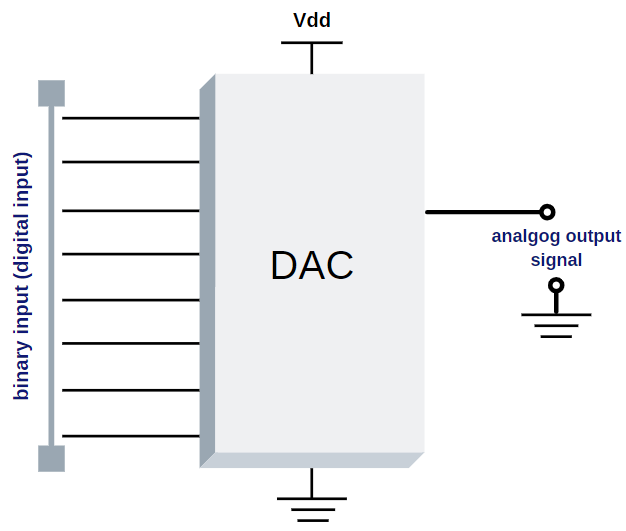
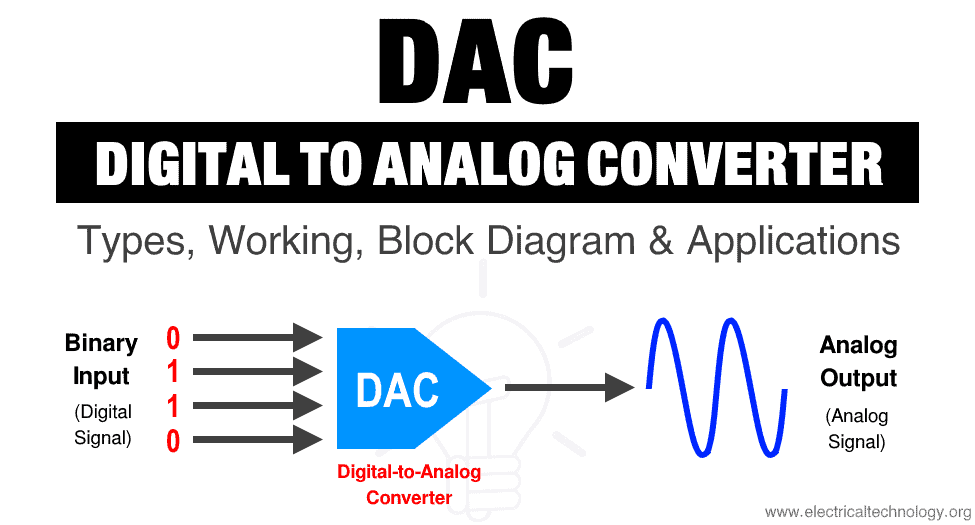
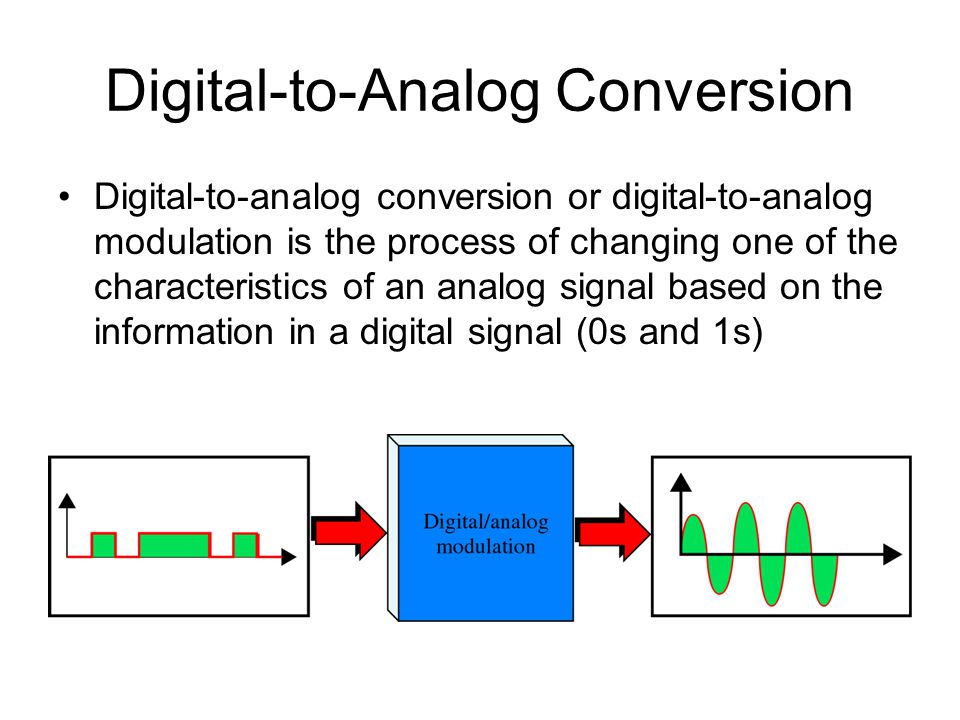
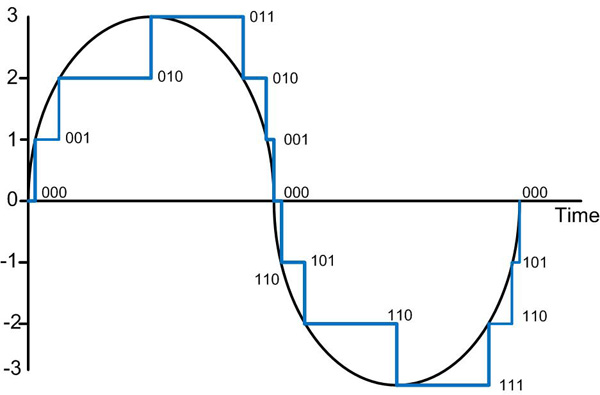
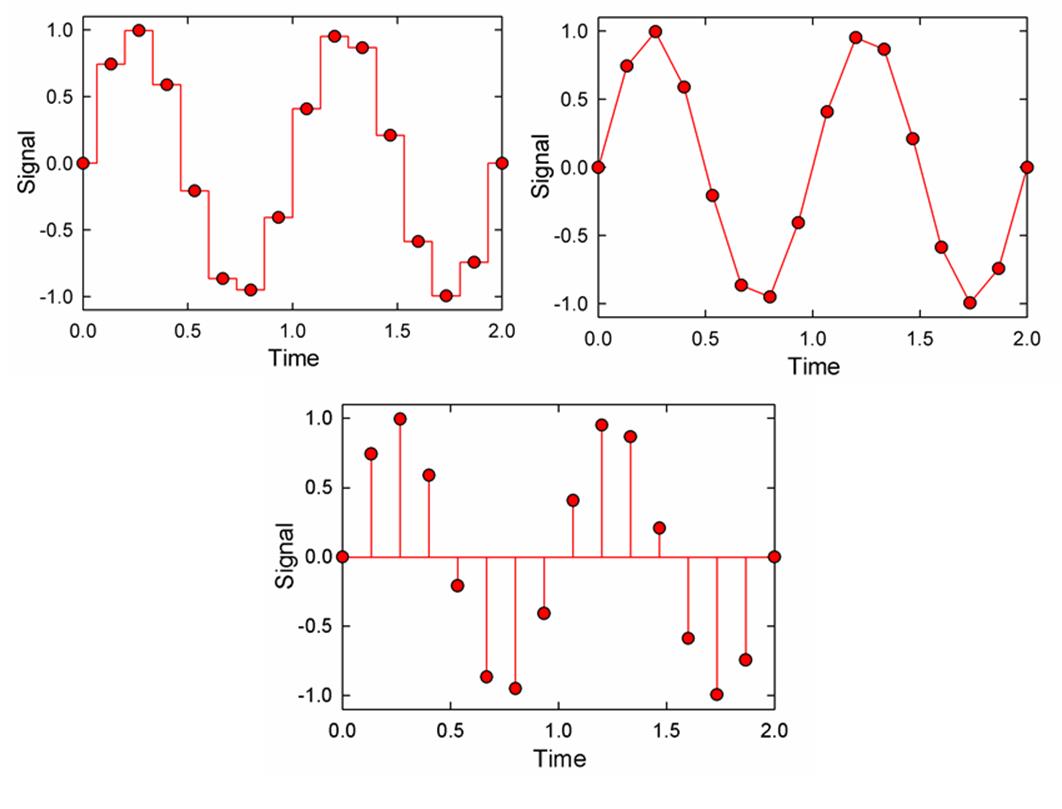
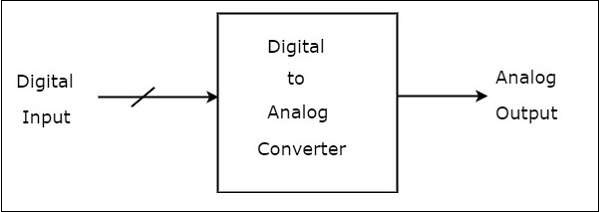
A digital-to-analog converter (DAC) is used to convert a sampled signal into an analog form suitable for processing by analog devices (amplifiers and filters) and later reproduced through acoustic systems. The conversion process is the reverse of sampling: having information about the value of the samples (signal amplitude) and taking a certain number of samples per unit of time, the original signal is restored by interpolation (Fig. 4).

More recently, sound reproduction on home computers was a problem, as computers were not equipped with special DACs. At first, the built-in PC speaker was used as the simplest sound device in the computer. Generally speaking, this speaker is still present in almost every PC, but no one remembers how to “rock” it to get it to start playing. In short, this speaker is connected to a port on the motherboard, which has two positions: 1 and 0. So if this port turns on and off quickly, then more or less credible sounds can be extracted from the speaker. The reproduction of different frequencies is achieved due to the fact that the speaker cone has a finite response and cannot instantly jump from one place to another. therefore, it “rocks smoothly” due to a sudden change in voltage across it. And if you vibrate it at different speeds, you can get air vibrations at different frequencies. The so-called Covox has become a natural alternative to dynamics: this is the simplest DAC, made on several selected resistors (or a ready-to-use microcircuit), which provides the translation of the digital representation of the signal into analog, it is that is, in actual amplitude values. The Covox is easy to make and has been a hit with hobbyists until a sound card was available to everyone. performed on several selected resistors (or a ready-to-use microcircuit), which provide the translation of the digital representation of the signal into analog, that is, into real amplitude values. The Covox is easy to make and has been a hit with hobbyists until a sound card was available to everyone. made in several selected resistors (or a ready-to-use microcircuit), which ensure the translation of the digital representation of the signal into analog, that is, into real amplitude values. The Covox is easy to make and has been a hit with hobbyists until a sound card was available to everyone.

In a modern computer, sound is reproduced and recorded using a sound card that is connected or integrated into the motherboard of the computer. The job of a sound card in a computer is audio input and output. In practice, this means that the sound card is the converter that converts analog audio to digital and vice versa. In a simplified way, the operation of a sound card can be explained as follows. Suppose an analog signal is applied to the input of the sound card and the card is turned on (by software) in record mode. First, the analog input signal goes to an analog mixer, which mixes the signals and adjusts the volume and balance. A mixer is needed, in particular, to allow the user to control the recording levels. Then the adjusted and balanced signal goes to the analog-to-digital converter, where the signal is sampled and quantized, as a result of which a stream of bits is sent to the computer via the data bus, which is the audio signal. digitized. The audio output is almost the same as the input, only in the opposite direction. The data flow directed to the sound card is overcome by a digital-to-analog converter, which forms an electrical signal from the numbers that describe the amplitude of the signal; the received analog signal can be passed through any analog path for further transformations, including playback. It should be noted that if the sound card is equipped with an interface for exchanging digital data, when working with digital audio, no analog blocks from the card are used. where the signal is sampled and quantized, as a result of which a stream of bits is sent to the computer via the data bus, which is the digitized audio signal. The audio output is almost the same as the input, only in the opposite direction.


Free Download Mp4Gain
picture


Mp4Gain Main Window
picture


Mp4Gain Features
picture


Free Download Mp4Gain
picture

How are ADC and DAC organized and operated? Part 2

How are ADC and DAC organized and operated? Part 2

Digital to Analog Converter

The main difference between PDM and PWM DAC is that the maximum
pulse width in PWM is not equal to a power of two (e.g. for MASH it is
equals 11).

DAC - Digital to Analog Converter

DACs with oversampling and a small number of real bits have
significantly better linearity than parallel DACs with the same
tiva bit depth. The output waveform of these DACs is
fight a useful signal, framed by a significant amount of high frequency
total noise, the main energy of which is far enough away from
the higher frequency of the useful signal and thus effectively suppresses even
the simplest analog filter.

The effective bit width of a Delta-Sigma DAC is generally determined from a pair of
output signal meters – noise level and non-linear distortion factor
zheniya characteristic of a parallel DAC of a certain bit depth. When
the effective bit capacity of the Delta-Sigma DAC can significantly exceed
shake the bit width of your input signal, for example a DAC for a 16 bit
The digital signal can have an effective bit width of 18, 20 and
moreover, smoothing the original signal, reducing the influence of quantum errors on it.
and thus make it more comfortable to listen.

DACs are “straightforward” devices that convert to
it is easier and faster than ADCs, which are mostly later
and slower devices.

How are ADC and DAC organized and operated? Part 1

How are ADC and DAC organized and operated? Part 1

DAC

There are mainly three ADC designs:

DAC


– parallel: the input signal is compared simultaneously with the reference
levels by a set of comparison circuits (comparators), which are formed in
the output is a binary value. In such ADC, the number of comparators is (2
raised to the power of N) – 1, where N is the digit capacity of the digital code (by eight times
inline – 255), which does not allow increasing the bit depth above 10-12.

– successive approximation – the converter using the auxiliary
The digital DAC generates a reference signal that is compared to the input signal.
The reference signal is changed sequentially by half
division (dichotomy), used in many convergence methods
Xia seeks applied mathematics. This allows you to complete the conversion.
for the number of clock cycles equal to the width of the word, regardless of size
input sign masks.

– with time interval measurement – a large group of ADCs using
to measure the input signal various level conversion principles
in proportional time intervals, whose duration is
It is controlled by a high frequency clock generator. Sometimes called
They are also counting ADC.

Among ADCs with time interval measurement, the following three prevail
type:

– sequential counting or simple integration
(single slope): the generator starts on every conversion cycle
Linearly increasing voltage, which is compared to the input.
Typically this voltage is obtained from an auxiliary DAC, such as an ADC.
successive approximations.

– double integration (double slope) – in each conversion cycle
the input signal charges the capacitor, which is then discharged to discharge
Reference voltage point with measurement of discharge duration.

– tracking: a variant of the sequential counting ADC, in which the generator
the reference voltage torus does not reset every cycle, but changes
changes it from the previous value to the current one.

The most popular version of the Tracking ADC is Sigma-Delta, which is
operating at a frequency Fs, significantly (64 or more times) higher
the sampling frequency Fd of the digital output signal. The comparator is
th ADC produces reduced bit depth values ​​(usually one bit –
0/1), whose sum in the sampling interval Fd is proportional to the
face countdown. The sequence of low bit values ​​is subject to
digital filtering and frequency reduction (decimated), in
resulting in a series of reads with a given bit depth and time
the same sampling Fd.

To improve the signal-to-noise ratio and reduce the influence of quantum errors
vaniya, which in the case of a one-bit converter gives
arbitrarily high, the noise shaping method is applied through
error feedback and digital filtering circuits. As a result
applying this method, the shape of the noise spectrum changes so that the main
noise energy is shifted to the region above half the frequency Fs, inadvertently
most of it remains in the lower half, and most of the noise
removed from the original analog signal band.

DACs are mainly based on two principles:

– weighing – with the sum of weighted currents or voltages, when
yes, each bit of the input word introduces a corresponding binary
weight contribution to the total value of the received analog signal; such
DACs are also called parallel or multibit (multibit).

– Sigma-Delta, according to the operating principle, reverse ADCs of the same type. Entry-
digital signal undergoes significant retransmission (64x or more)
cretization and fed to the modulator, which forms low bits (usually
single bit values) processed by the Noise Shaping method (usually
implemented using a digital filter and error feedback).
Resulting low bit counts drive the dispensing circuit
reference loads, which are added with the same high frequency to
exit sign.

The types of DACs that produce a true 1-bit stream are called a bit stream.
(bit stream) or PDM (pulse density modulation)
pulses). A slightly different type is a pulse width DAC
modulation (PWM, pulse width modulation, PWM), when the circuit is selected
ki-storage of an analog signal, pulses of constant amplitude are emitted
and variable duration, controlling the dosage of the output
load. MASH converters (Multi-stAge
Noise modeling: Matsushita’s multi-stage noise modeling). In them
a feedback signal is received by several training schemes at the same time by mistake
noise, which controls the width of the output pulse.

How is the digital representation of signals different from analog?

How is the digital representation of signals different from analog?

analog and digital

The traditional analog representation of signals is based on the similarity (similarity) of electrical signals (changes in current and voltage) with the original signals represented by them (sound pressure, temperature, speed, etc.).

Analog vs Digital

As well as in the similarity of the forms of the electrical signals in various points of the amplification or transmission path. The shape of the electrical curve that describes (also called transfer) the original signal is as close as possible to the shape of the curve of this signal.

Such a representation is the most accurate, however, the slightest distortion of the shape of the electrical carrier signal will inevitably involve the same distortion of the shape and signal of the carrier. In terms of information theory, the amount of information in the carrier signal is exactly equal to the amount of information in the original signal, and the electrical representation does not contain redundancy that could protect the carried signal from distortion during storage, transmission. and amplification.

The digital representation of electrical signals is designed to add redundancy to avoid unwanted interference. For this, serious restrictions are imposed on the carrier electrical signal: its amplitude can take only two limit values: 0 and 1. In this case, the entire zone of possible amplitudes is divided into three zones: the lower one represents zero values, the upper , unique, and the intermediate is prohibited, inward. only interference can get in. Therefore, any interference whose amplitude is less than half the amplitude of the carrier signal does not affect the correct transmission of values ​​0 and 1. Interference with a higher amplitude also does not affect whether the duration of the interference pulse is significantly less than the duration of the information pulse.

The digital signal formed in this way can carry any useful information that is encoded in the form of a sequence of bits: zeros and ones; electrical and sound signals are a particular case of such information. Here, the amount of information in the digital carrier signal is much higher than in the original encoded signal, so the carrier signal has a certain redundancy with respect to the original, and any distortion of the waveform of the carrier signal, which still retains the receiver’s ability to correctly distinguish between zeros and ones, does not affect the reliability of the transmitted signal. by this information signal. However, in the case of exposure to significant interference, the shape of the signal can be distorted to such an extent that the precise transmission of the information being transferred becomes impossible: errors appear in it, which, with a simple coding method , the receiver can not only correct, but also detect. To further increase the resistance of a digital signal to interference and distortion, two types of digital redundancy coding are used: verification codes (EDC – Error Detection Code) and correction (ECC – Error Correction Code). ). Digital encoding is simply adding extra bits to the original information and / or converting the original bit string into a longer string and other structure. EDC allows you to simply detect the fact of an error: a distortion or loss of a useful one or the appearance of a false digit, but the information that is transferred in this case is also distorted; ECC allows you to immediately correct detected errors, keeping the information that is transferred unchanged.

Each type of EDC / ECC has its own capacity limit to detect and correct errors, after which undetected errors and distortions of the transferred information begin again. An increase in the volume of EDC / ECC relative to the volume of the original information generally increases the detection and correction capabilities of these codes.

Like EDC, the popular cyclic redundancy code CRC (Cyclic Redundancy Check), whose essence is the complex mixing of the initial information in the block and the formation of short binary words, whose bits have a strong cross-dependence on each bit of the block. Changing even one bit in a block causes a significant change in the CRC calculated from it, and the probability of such a bit distortion where the CRC does not change is extremely small even with short CRC words (a small percentage of the length of the block). The ECC uses the Hamming and Reed-Solomon codes, which also include EDC functions.

The information redundancy of the digital carrier signal leads to a significant expansion (by an order of magnitude or more) of the frequency band required for its successful transmission.

How to store good sound in your computer?

How to store good sound in your computer?

digital to analog converter DAC

To record and store digital audio information, digital audio formats are used. The audio format is understood as a set of requirements for the digital representation of audio data.

Digital Audio to Analog Converter

When it comes to sound quality, digital formats are divided into 3 categories:

Formats without additional compression (CDDA, DSD, WAV, AIFF, etc.);
Lossless compressed formats (FLAC, WavPack, ADX, etc.);
Lossy compression formats (MP3, AAC, RealAudio, etc.).
High-quality sound is obtained when playing music saved in formats of the first and second category. In the formats of the third category, to reduce the amount of data, certain information is deliberately excluded. For example, information about hidden frequencies.

Latent frequencies are those that are outside the range of perception of the average person: 20 Hz – 22 kHz. For audiophiles, this range is wider due to individual psychophysiological characteristics.

To complete your home audio library, you must select records saved in files with the following extensions:

* .wav, * .dff, * .dsf, * .aif, * .aiff are uncompressed sound files;
* .mp4, * .flac, * .ape, * .wma are the most common lossless compressed audio files.
From history. They say that the first experiments on the preservation of sound were carried out by the ancient Greeks. They tried to keep the sound in amphorae. It looked something like this: they spoke words into the amphora and quickly sealed it. Unfortunately, none of those records have survived to this day.

The record player: finding a win-win solution

Choosing a player should start with an understanding of how the home audio library will be formed. You can buy CDs the old fashioned way or go shopping for your favorite music on the internet. The last option has two important advantages. It is compact and ecological:

There is no doubt about the place in the apartment to keep the CDs.
No need to throw faulty drives in the trash.
Have you decided how to buy music? Excellent! If you buy discs, you need a CD player. If you prefer to shop online, look for a player on a hard drive or flash memory. Undecided? Excellent! Look for a versatile player. In this, you can listen to both the discs and the files purchased through the network.

Naturally, it can be turned into a player and a personal computer. But this option is convenient when the computer is truly personal. The prospect of competition for keyboard space and potential conflicts will significantly reduce the enjoyment of listening to good quality music.

When choosing a turntable, pay particular attention to the connectors available. The more connector options, the easier it is to select other items in the Music Center.

DAC! And the figure turns … into an analog signal

The player reads a sequence from a CD or a file. Now comes the most mathematical moment of digital audio playback. The digital signal becomes analog. This math occurs in the DAC or digital-to-analog converter.

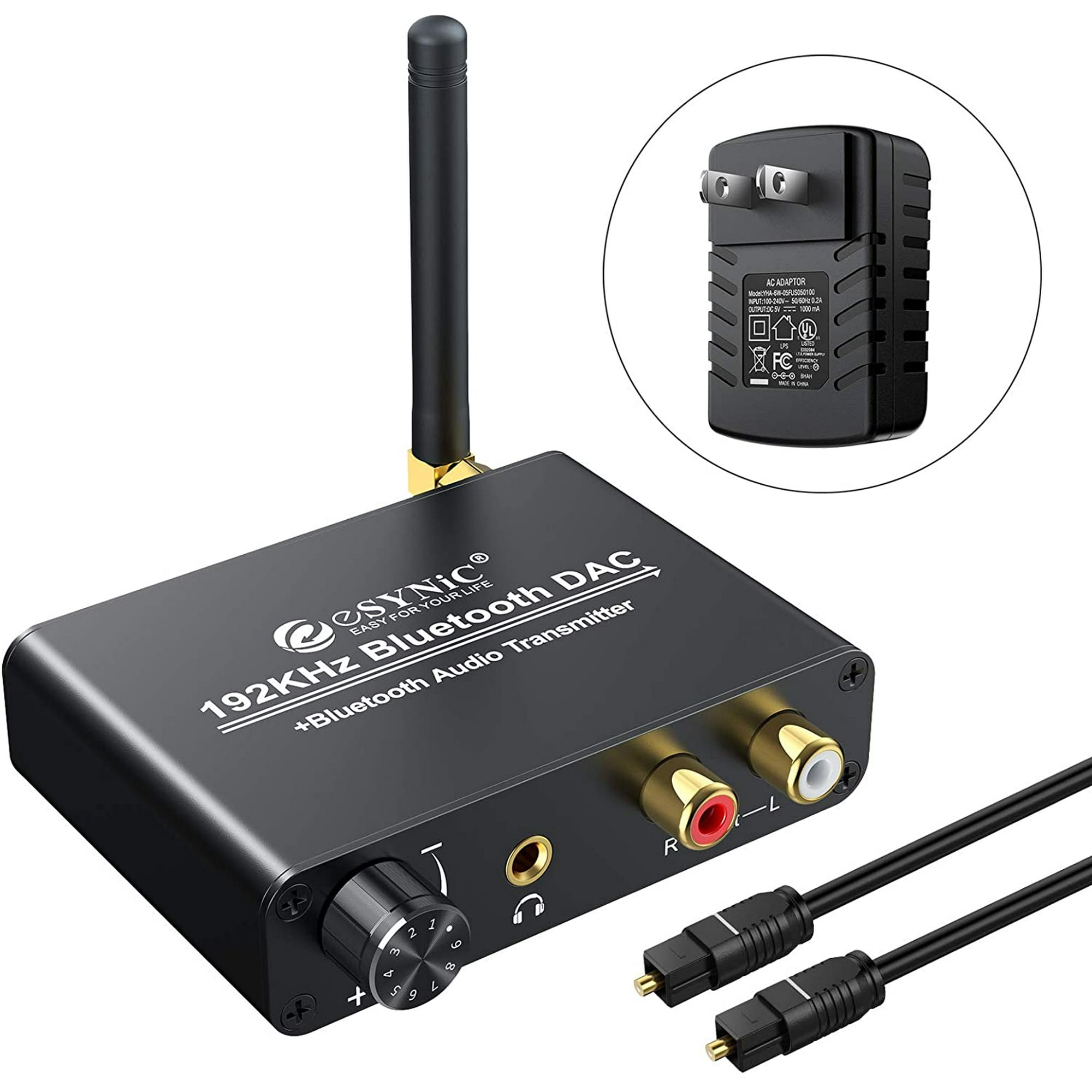
The DAC can be integrated into the player or implemented as a separate unit. To get high-quality sound, you should go for the second option. The built-in converter is usually of lower quality than the independent one. The external DAC has its own, built-in power supply powered from a common source with the player. When using an external DAC, it is almost unaffected by turntable and amplifier interference.

An external DAC for circuit solutions is implemented in 4 main versions:

Pulse width modulator;
Oversampling scheme;
Type of weighing;
R-2R ladder or chain scheme.
With so many options for high-quality sound, the R-2R option is indisputable. Due to a special circuit implemented in precision resistors, a ladder type DAC achieves very high conversion precision.

When choosing an external digital-to-analog converter, you should pay attention to two main features:

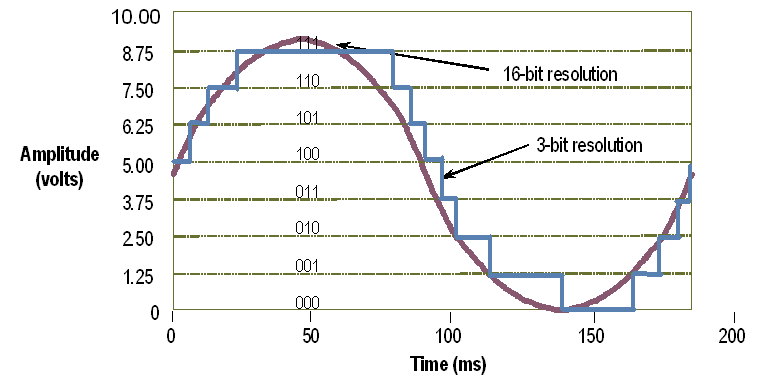
Bit depth. It is good if the selected model has 24 bits.
Maximum sample rate. Very good 96 kHz, great 192 kHz.

How a digital to analog converter affects the sound quality of your audio system

How a digital to analog converter affects the sound quality of your audio system

Digital to Analog Converter

Digital music formats are ubiquitous – even the most loyal vinyl supporter has to admit that it is extremely attractive to keep your entire music collection in the palm of your hand or put it on a server. Music lovers will have to accept a significant reduction in sound quality when listening to your favorite songs, albums and artists. And if you are serious about music, maintaining the original quality is undeniable.

Digital to Analog Converter

How Digital-to-Analog Conversion (DAC) Technology Works

In simple terms, a DAC converts digital data into sound that can be heard and enjoyed. When you break down digital files and music streams into their basic components, you end up with a lot of binary code. A DAC converts this data into an analog signal, which is then sent to the input of an amplifier and finally delivered through headphones or speakers to the listener’s ears. Aside from vinyl records, virtually all current music formats rely on this sound creation process: streaming services, digital music files, CDs, etc. Not all DACs are created equal, or by design, for that matter. Your smartphone’s DAC doesn’t need to convert data streams with the same precision and quality as a high-end component, for example. No one expects that their smartphone will provide 100 percent fidelity, high resolution audio reproduction. If you want the best sound quality from a variety of digital audio formats, a DAC that can handle the task of providing the best possible audio fidelity is absolutely necessary.

Choose the right DAC for your audio system

There are a few things to keep in mind when considering DAC options. First, does it support a wide variety of data file transfer speeds? If the timing of the bitstream conversion is not quite accurate, you will experience so-called jitter (clock jitter), which probably means poor sound quality. Second, with what skill level is this device designed? Poor quality circuitry can create unwanted noise and interference that degrade sound quality. There are also separate external DACs on the market available to act as intermediaries between your music source and your speakers or headphones, but you can eliminate this with audio gear that already has a high-quality built-in DAC inside.

For example, there are computers that are equipped with a high-resolution conversion function and are compatible with many audio formats, including FLAC, WAV, and ALAC. Its high-quality construction isolates noise to prevent it from adversely affecting overall sound quality. It also features a dedicated headphone amp block, so music lovers can fully immerse themselves in their favorite albums. As a general rule, the best equipment will allow you to create the best audio system. Explore the entire line of modern AV receivers, wireless music systems and hi-fi components to lay the foundation for your audio system.