Audio conversion from digital to analog


Free Download Mp4Gain
picture

Audio conversion from digital to analog
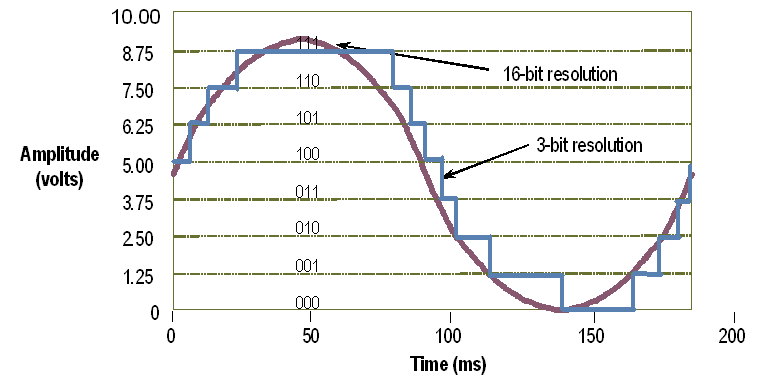
Digital-to-Analog

How to listen to the sound after digitizing? I mean, how do you convert back from digital to analog?
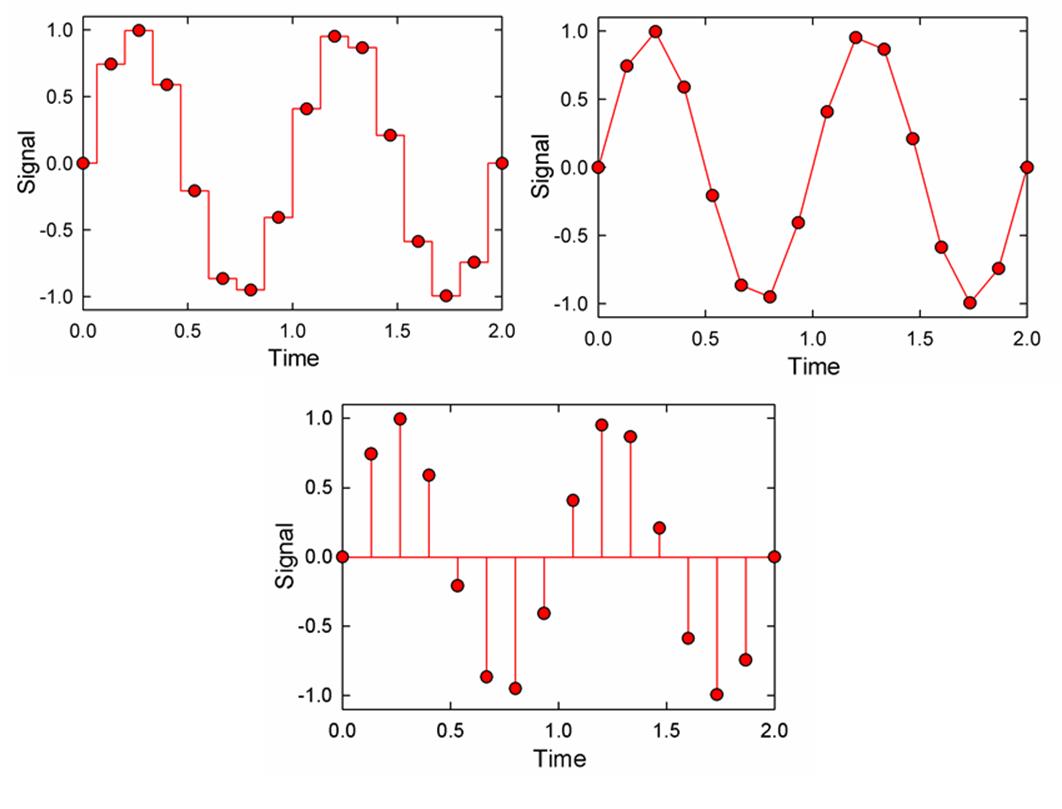
Digital to Analog

A digital-to-analog converter (DAC) is used to convert a sampled signal into an analog form suitable for processing by analog devices (amplifiers and filters) and later reproduced through acoustic systems. The conversion process is the reverse of sampling: having information about the value of the samples (signal amplitude) and taking a certain number of samples per unit of time, the original signal is restored by interpolation (Fig. 4).

More recently, sound reproduction on home computers was a problem, as computers were not equipped with special DACs. At first, the built-in PC speaker was used as the simplest sound device in the computer. Generally speaking, this speaker is still present in almost every PC, but no one remembers how to “rock” it to get it to start playing. In short, this speaker is connected to a port on the motherboard, which has two positions: 1 and 0. So if this port turns on and off quickly, then more or less credible sounds can be extracted from the speaker. The reproduction of different frequencies is achieved due to the fact that the speaker cone has a finite response and cannot instantly jump from one place to another. therefore, it “rocks smoothly” due to a sudden change in voltage across it. And if you vibrate it at different speeds, you can get air vibrations at different frequencies. The so-called Covox has become a natural alternative to dynamics: this is the simplest DAC, made on several selected resistors (or a ready-to-use microcircuit), which provides the translation of the digital representation of the signal into analog, it is that is, in actual amplitude values. The Covox is easy to make and has been a hit with hobbyists until a sound card was available to everyone. performed on several selected resistors (or a ready-to-use microcircuit), which provide the translation of the digital representation of the signal into analog, that is, into real amplitude values. The Covox is easy to make and has been a hit with hobbyists until a sound card was available to everyone. made in several selected resistors (or a ready-to-use microcircuit), which ensure the translation of the digital representation of the signal into analog, that is, into real amplitude values. The Covox is easy to make and has been a hit with hobbyists until a sound card was available to everyone.

In a modern computer, sound is reproduced and recorded using a sound card that is connected or integrated into the motherboard of the computer. The job of a sound card in a computer is audio input and output. In practice, this means that the sound card is the converter that converts analog audio to digital and vice versa. In a simplified way, the operation of a sound card can be explained as follows. Suppose an analog signal is applied to the input of the sound card and the card is turned on (by software) in record mode. First, the analog input signal goes to an analog mixer, which mixes the signals and adjusts the volume and balance. A mixer is needed, in particular, to allow the user to control the recording levels. Then the adjusted and balanced signal goes to the analog-to-digital converter, where the signal is sampled and quantized, as a result of which a stream of bits is sent to the computer via the data bus, which is the audio signal. digitized. The audio output is almost the same as the input, only in the opposite direction. The data flow directed to the sound card is overcome by a digital-to-analog converter, which forms an electrical signal from the numbers that describe the amplitude of the signal; the received analog signal can be passed through any analog path for further transformations, including playback. It should be noted that if the sound card is equipped with an interface for exchanging digital data, when working with digital audio, no analog blocks from the card are used. where the signal is sampled and quantized, as a result of which a stream of bits is sent to the computer via the data bus, which is the digitized audio signal. The audio output is almost the same as the input, only in the opposite direction.


Free Download Mp4Gain
picture


Mp4Gain Main Window
picture


Mp4Gain Features
picture


Free Download Mp4Gain
picture

Digital video: an overview of formats

Digital video: an overview of formats

Digital Video

Recently, home users have the opportunity to create digital videos with their own hands. It goes without saying how convenient it is to store family video files in this way. Digitized records do not deteriorate over time, do not lose quality when copied, and can be easily edited. Video compression technologies, which continue to improve even now, played an important role in its distribution.

Digital Video

First, let’s find out why compress video. To understand this, let’s move on to the basic principles of digitizing moving images.

The video sequence is formed from consecutive 720 x 576 pixel frames, which are changed 25 times per second (according to the PAL standard). If you scan them with 16-bit color depth, each frame will take up about 1.2MB, which means that to store 1 second of video, you’ll need about 30MB of disk space, and about 150GB will go to one movie. 1.5 hours. This is at least five times the capacity of hard drives found in modern home computers. Try to figure out how many 650MB CDs you need to burn one of these movies. To reduce the size of files containing digitized video, various data compression algorithms are used. There are two types of algorithms that work, respectively, without loss of information and provided.

Lossless compression (with virtually no degradation of image quality) in digital video is done using methods similar to those used in archivers such as WinZIP or WinRAR. However, due to some peculiarities of the video information, such algorithms in this case are not efficient enough (the minimum size of a compressed file is 1/3 of the original) and therefore it is practically not used.

Lossy compression is the main method of reducing the size of video files. These algorithms allow us to determine that part of the information that the viewer, most likely, will not notice when watching a movie, and remove it from the file. The main digital video formats using lossy compression today are Apple QuickTime, Intel Indeo, MPEG-1, MPEG-2, MJPEG, and MPEG-4. The specifications of the MPEG-7 standard are also under development, but it is still too early to talk about it.

Apple QuickTime

The MOV file format was developed by Apple for Macintosh computers and later ported to the PC platform. From 1993 to 1995, this format was dominant. Its latest version, number 4.1, allows you to transfer data in streaming mode. This means that you don’t need to fully download the file to start watching the video. However, with the advent of MPEG specifications, this format is gradually losing popularity. Its main problem is that the QuickTime standard is closed. Apple keeps secret the methods by which video is encoded. Consequently, third-party programmers cannot write programs that compress video in this format.

Intel Indeo

This format was developed by Intel Corporation to compress video data using the new capabilities of the Intel Pentium MMX processor. In addition to supporting streaming and copyright protection features, this standard implements several features that were innovative at the time of its introduction. It allows you to apply various effects to a video sequence (for example, change the brightness or contrast) in real time, decode not the whole frame, but, for example, the central fragment, make part of the frame of a video transparent and superimpose two videos one on top of the other. The latter effect is often used in television news programs, when a commentator is depicted in front of a video report of the scene.

However, the Indeo format is not widely used. And with the release of MPEG-4, which also contains all these features, this standard generally doesn’t work.

MPEG-1

The MPEG-1 video compression format was developed by the Motion Picture Expert Group, an international organization that creates video compression standards. It supports a maximum frame resolution of 4095 x 4095 pixels at a frame rate of up to 60 times per second.