Audio conversion from digital to analog
How to listen to the sound after digitizing? I mean, how do you convert back from digital to analog?
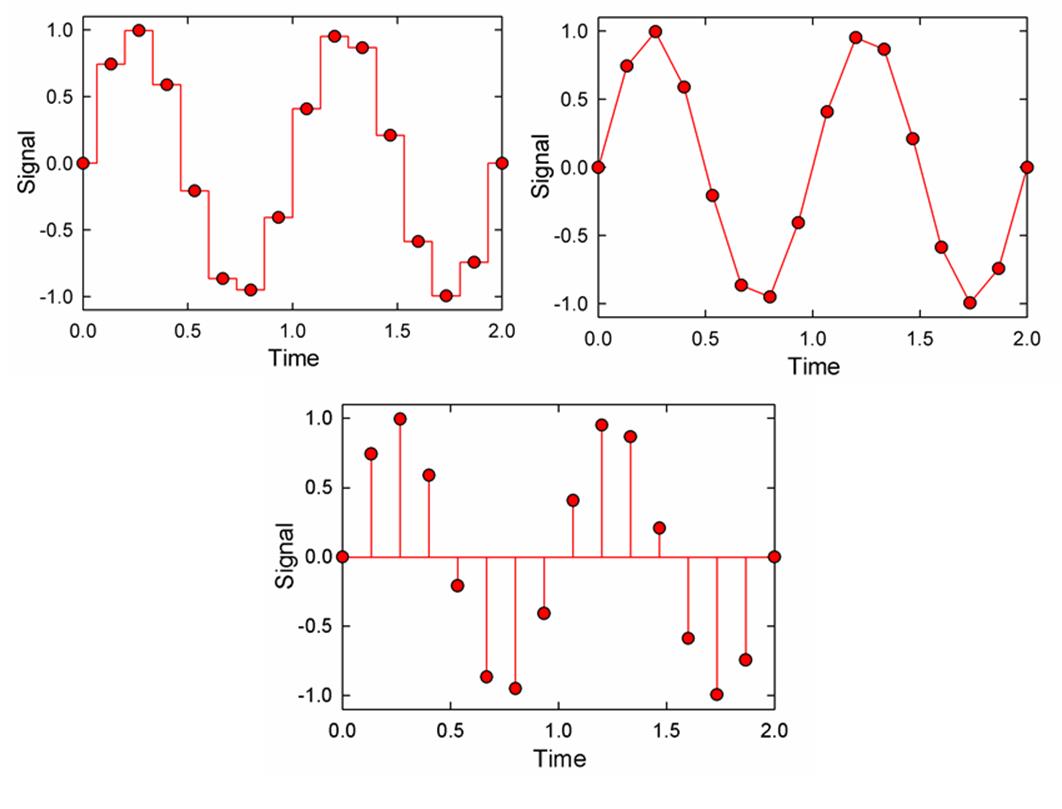
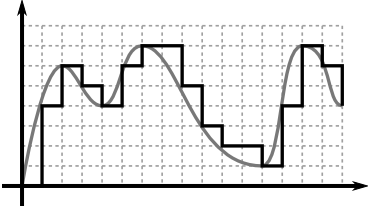
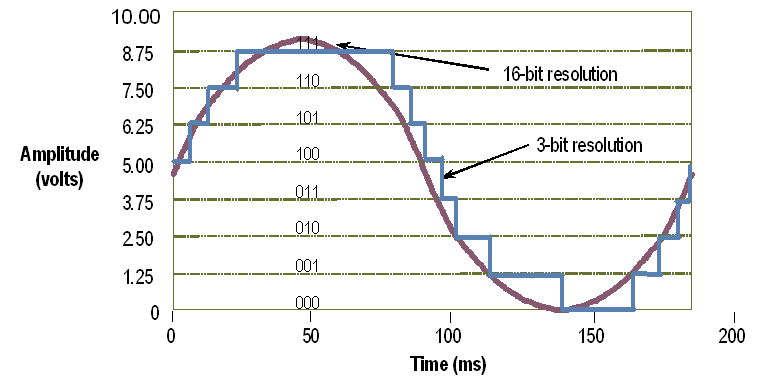
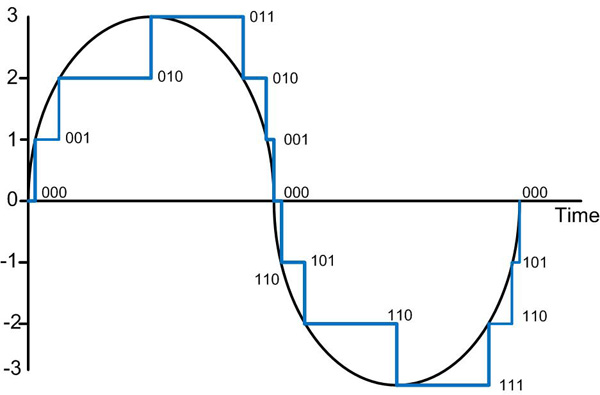
A digital-to-analog converter (DAC) is used to convert a sampled signal into an analog form suitable for processing by analog devices (amplifiers and filters) and later reproduced through acoustic systems. The conversion process is the reverse of sampling: having information about the value of the samples (signal amplitude) and taking a certain number of samples per unit of time, the original signal is restored by interpolation (Fig. 4).
More recently, sound reproduction on home computers was a problem, as computers were not equipped with special DACs. At first, the built-in PC speaker was used as the simplest sound device in the computer. Generally speaking, this speaker is still present in almost every PC, but no one remembers how to “rock” it to get it to start playing. In short, this speaker is connected to a port on the motherboard, which has two positions: 1 and 0. So if this port turns on and off quickly, then more or less credible sounds can be extracted from the speaker. The reproduction of different frequencies is achieved due to the fact that the speaker cone has a finite response and cannot instantly jump from one place to another. therefore, it “rocks smoothly” due to a sudden change in voltage across it. And if you vibrate it at different speeds, you can get air vibrations at different frequencies. The so-called Covox has become a natural alternative to dynamics: this is the simplest DAC, made on several selected resistors (or a ready-to-use microcircuit), which provides the translation of the digital representation of the signal into analog, it is that is, in actual amplitude values. The Covox is easy to make and has been a hit with hobbyists until a sound card was available to everyone. performed on several selected resistors (or a ready-to-use microcircuit), which provide the translation of the digital representation of the signal into analog, that is, into real amplitude values. The Covox is easy to make and has been a hit with hobbyists until a sound card was available to everyone. made in several selected resistors (or a ready-to-use microcircuit), which ensure the translation of the digital representation of the signal into analog, that is, into real amplitude values. The Covox is easy to make and has been a hit with hobbyists until a sound card was available to everyone.
In a modern computer, sound is reproduced and recorded using a sound card that is connected or integrated into the motherboard of the computer. The job of a sound card in a computer is audio input and output. In practice, this means that the sound card is the converter that converts analog audio to digital and vice versa. In a simplified way, the operation of a sound card can be explained as follows. Suppose an analog signal is applied to the input of the sound card and the card is turned on (by software) in record mode. First, the analog input signal goes to an analog mixer, which mixes the signals and adjusts the volume and balance. A mixer is needed, in particular, to allow the user to control the recording levels. Then the adjusted and balanced signal goes to the analog-to-digital converter, where the signal is sampled and quantized, as a result of which a stream of bits is sent to the computer via the data bus, which is the audio signal. digitized. The audio output is almost the same as the input, only in the opposite direction. The data flow directed to the sound card is overcome by a digital-to-analog converter, which forms an electrical signal from the numbers that describe the amplitude of the signal; the received analog signal can be passed through any analog path for further transformations, including playback. It should be noted that if the sound card is equipped with an interface for exchanging digital data, when working with digital audio, no analog blocks from the card are used. where the signal is sampled and quantized, as a result of which a stream of bits is sent to the computer via the data bus, which is the digitized audio signal. The audio output is almost the same as the input, only in the opposite direction.


.png)