
How a digital signal is transmitted over the air.
.png)
Any signal, analog or digital, are electromagnetic oscillations that propagate at a certain frequency, depending on what signal is transmitted, the device that receives this signal translates it into text, graphic or sound information that is convenient for the user or himself. device. For example, a television or radio signal, a tower or a radio station can transmit both analog and, for the moment, digital signals. The receiving device, upon receiving this signal, converts it into image or sound, supplementing it with text information (modern radio receivers).
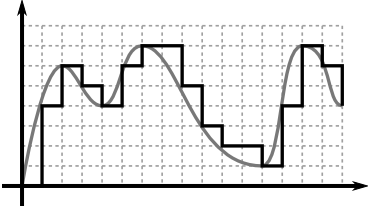
The sound is transmitted in analog form and already through the receiving device it is converted into electromagnetic oscillations, and as already mentioned, the oscillations propagate at a certain frequency. The higher the frequency of the sound, the higher the vibration, which means that the output sound will be louder. Generally speaking, the analog signal propagates continuously, the digital signal discontinuously (discretely).
Since the analog signal is constantly propagating, the oscillations add up and a carrier frequency appears at the output, which in this case is the main one and the receiver is tuned. In the receiver itself, this frequency is separated from other vibrations, which are already converted into sound. The obvious disadvantages of transmitting using an analog signal include a large amount of interference, low security of the transmitted signal, as well as a large amount of transmitted information, some of which is unnecessary.
If we talk about a digital signal, where data is transmitted discreetly, its obvious advantages should be highlighted:
–high level of protection of the transmitted information due to its encryption;
– ease of reception of digital signals;
– lack of strange “noise”;
– digital broadcasting is capable of providing a large number of channels;
–high transmission quality: the digital signal provides filtering of the received data;
To convert an analog signal to digital and vice versa, special devices are used: an analog-to-digital converter (ADC) and a digital-to-analog converter (DAC). The ADC is installed in the transmitter, the DAC is installed in the receiver and converts the discrete signal to analog.
In terms of security, why is the digital signal more secure than the analog? The digital signal is transmitted encrypted and the device that receives the signal must have a code to decode the signal. It is also worth noting that the ADC can also transmit the digital address of the receiver, if the signal is intercepted, it will be impossible to fully decipher it, since part of the code is missing; This approach is widely used in mobile communications.
In short, the main difference between analog and digital signal is the structure of the transmitted signal. Analog signals are a continuous flow of oscillations with variable amplitude and frequency. The digital signal is a discrete oscillation, the values of which depend on the transmission medium.
Digital signal
A digital signal is a data signal in which each of the representative parameters is described by a function of discrete time and a finite set of possible values.
The signals are discrete light or electrical pulses. With this method, the full capacity of the communication channel is used to transmit a signal. The digital signal uses the entire bandwidth of the cable. Bandwidth is the difference between the maximum and minimum frequency that can be transmitted through the cable. Every device on such networks sends data in both directions, and some can receive and transmit simultaneously. Baseband systems transmit data as a single frequency digital signal.
A discrete digital signal is more difficult to transmit over long distances than an analog signal, therefore it is premodulated on the transmitter side and demodulated on the information receiver side. The use of algorithms to verify and restore digital information in digital systems can significantly increase the reliability of information transmission.
Commentary. Keep in mind that a real digital signal is analog by its physical nature. Due to noise and changes in the parameters of the transmission lines, it has fluctuations in amplitude, phase / frequency (jitter), polarization. But this analog signal (pulse and discrete) is endowed with the properties of a number. As a result, it is possible to use numerical methods for its processing (computer processing).

