24/192 digital audio format and why it doesn’t make sense. Part 3
192 kHz is considered harmful
192 kHz digital music files offer no benefit, but still have some impact. In practice, it turns out that its playback quality is slightly worse, and ultrasonic waves appear during playback.
Both audio converters and power amplifiers are susceptible to distortion, and distortion tends to build up quickly in the high and low frequencies. If the same speaker reproduces the ultrasound along with the frequencies of the audible range, any non-linear characteristics will change part of the ultrasonic range to the audible spectrum in the form of uncontrolled random non-linear distortions that cover the entire range of audible audio. Non-linearity in a power amplifier will have the same effect. These effects are difficult to notice, but testing has confirmed that both types of distortion can be heard.
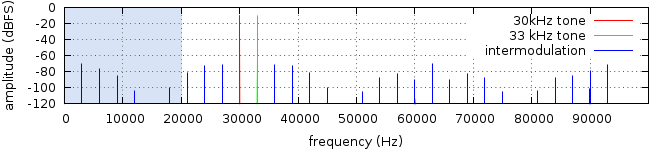
The graph above shows the distortion resulting from intermodulation of 30 kHz and 33 kHz audio in a theoretical amplifier with a constant harmonic distortion (THD) of approximately 0.09%. Distortion is visible across the spectrum, even at the lowest frequencies.
Inaudible ultrasonic waves contribute to intermodulation distortion in the audible range (light blue area). Systems that are not designed to reproduce ultrasound often have higher levels of distortion, around 20 kHz, which further contributes to intermodulation. Expanding the frequency range to include ultrasound requires compromises that reduce noise and distortion activity within the audible spectrum, but in any case, unnecessary reproduction of the ultrasonic component will degrade reproduction quality.
There are several ways to avoid additional distortion:
An ultrasound-only speaker, amplifier, and signal spectrum splitter to independently separate and reproduce ultrasound you can’t hear so it doesn’t affect other sounds.
Amplifiers and transducers designed to reproduce a wider spectrum of frequencies so that ultrasound does not cause audible harmonic distortion. Due to the additional cost and complexity of the performance, the additional frequency range will reduce the quality of reproduction in the audible spectrum.
Well-designed speakers and amplifiers that do not reproduce any ultrasound.
For starters, you don’t need to encode such a wide frequency range. You cannot (and should not) hear ultrasonic harmonic distortion in the audible frequency band if there is no ultrasonic component.
All of these methods are meant to solve a problem, but only 4 ways make sense.
If you are interested in the capabilities of your own system, the following samples contain: 30 kHz and 33 kHz audio in WAV 24/96 format, a longer FLAC version, some melodies, and a cut of normal songs at 24 kHz to make them drop fully in the ultrasonic range of 24 kHz to 46 kHz.
Tests to measure harmonic distortion:
30 kHz audio + 33 kHz audio (24 bit / 96 kHz) [5 second WAV] [30 second FLAC]
Tunes 26 kHz – 48 kHz (24 bit / 96 kHz) [10 second WAV]
Tunes 26 kHz – 96 kHz (24 bit / 192 kHz) [10 second WAV]
Cutting songs down to 24 kHz (24-bit / 96 kHz WAV) [10-second WAV] (original cut version) (16-bit / 44.1 kHz WAV)
Suppose your system is capable of playing all formats with sample rates of 96 kHz [6]. When playing the files above, you shouldn’t hear anything, no noise, hiss, clicks, or other sounds. If you hear something, then your system has a non-linear response and causes audible non-linear distortion of the ultrasound. Be careful when turning up the volume, if you enter the digital or analog clipping area, even a soft clipping can cause strong intermodulation noise.
In general, it is not a fact that harmonic distortion of ultrasound is audible in a particular system. The distortion introduced can be negligible and quite noticeable. In any case, the ultrasonic component is never a merit, and in many audio systems it will lead to a sharp decrease in the quality of sound reproduction. In systems where it does not damage, the ability to process ultrasound can be preserved or instead, resources can be used to improve the sound quality of the audible range.
Misunderstand the sampling process
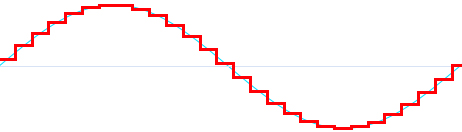
Sampling theory is often incomprehensible without the context of signal processing. And it’s no wonder that most people, even brilliant doctors in other fields, don’t get it. It’s also not surprising that many people don’t even realize that they are making a mistake.



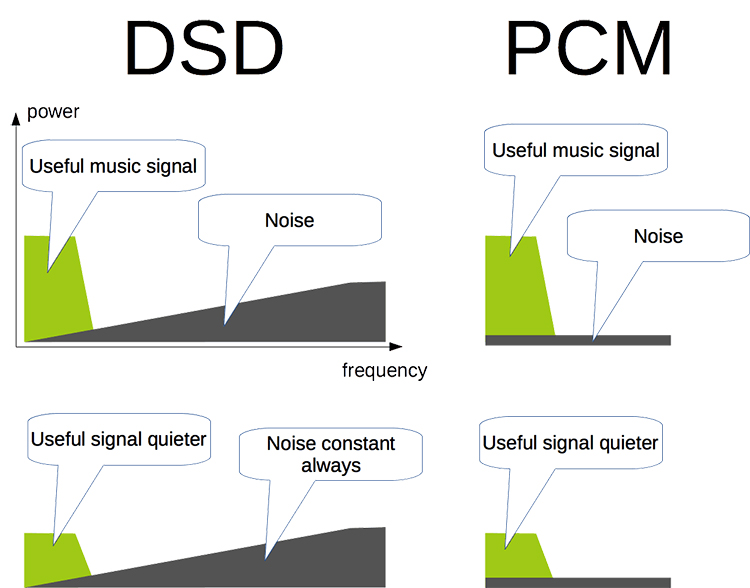
![What is DSD Audio? [Sound Quality, DSD vs PCM]](https://samplerateconverter.com/sites/default/files/u1/what-dsd/pcm-dsd-difference.png)