What is a WMA file?


Free Download Mp4Gain
picture

What is a WMA file?

WMA

How to open, edit and convert WMA files

WMA

A file with the WMA file extension is a Windows Media Audio file. Microsoft created this lossy format to compete with MP3.

There are several sub-formats of the WMA format, including WMA Pro, a lossy codec that supports High-Resolution Audio; WMA Lossless, a lossless codec that compresses audio without loss of quality; and WMA Voice, a lossy voice codec for applications that supports voice playback.

Microsoft also developed the Windows Media Video file format, which uses the WMV extension.

How to open WMA files
Windows Media Player is the best program for opening WMA files because it is included with most versions of Windows. However, you can use third party software like VLC, MPC-HC, AllPlayer, MPlayer and Winamp to play WMA files on other operating systems.

If you don’t have any of these programs installed on your computer, TwistedWave Online Audio Editor provides a quick way to play WMA files in your browser.

If you need to play the file on a program or device that doesn’t natively support the WMA format, such as an iPhone, you can convert it to another compatible format using one of the WMA converters described below.

Tip: If you find that an application on your computer is trying to open the WMA file but it’s the wrong application, or you’d rather have another program installed to open WMA files, see my How to Change the Default Program for a Specific File Extension Used to Perform changes in Windows.

Still can’t open the file?
File formats sometimes use the same or similar file extensions and can be confusing. You may think your file is a WMA file, but it may look like a .WMA file extension.

For example, WMF (Windows Metafile), WMZ (Windows Media Player Compressed Skins), and WML (Wireless Markup Language) files share some of the same letters as WMA, but aren’t actually used for the same purpose as WMA. audio file format.

Some other examples include Windows Media Photo files and WAM (Worms Armageddon Mission) files with the .WMP file extension. The GarageBand MagicMentor template file format for .MWAND files also uses some of the same letters.

Other types of WMA file formats
In addition to Windows Media Audio, there are three sub-formats that WMA files can exist in:

Windows Media Audio Professional – This lossy codec is similar to WMA in that it contains most of the same encoding features. However, it also supports better entropy encoding and more efficient stereo encoding.
Windows Media Audio Lossless – This subformat is designed for archiving WMA files as it compresses audio data without loss of quality. Once uncompressed, the audio is the same as the original. Typical compression levels are between 1.7:1 and 3:1.
Windows Media Audio Speech – This codec uses a higher compression rate than standard WMA and competes with other players such as Speex and ACELP. WMA voice is used for low bandwidth voice programs.



Free Download Mp4Gain
picture


Mp4Gain Main Window
picture


Mp4Gain Features
picture


Free Download Mp4Gain
picture

What is a WMA (Windows Media Audio) file

What is a WMA (Windows Media Audio) file

WMA

WMA (Windows Media Audio) files are a type of compressed audio file, just like MP3s. It is said that the size can be reduced to about 1/20th compared to uncompressed files while maintaining the audible sound quality of a music CD.

WMA

WMA Features

compression performance
WMA is an audio compression format developed by Microsoft. In addition to the lossy compression format, a lossless compression format called WMA Lossless has been born in recent years.

When comparing WMA with the same file size in MP3, it seems that WMA can be played with better audible sound. It also supports VBR (Variable Bit Rate) format and can be compressed with a certain quality. For VBR, please see What is the difference between CBR/VBR/ABR in audio/video conversion?

various functions
WMA also supports digital rights management (DRM) as a standard, and may have a copyright protection feature. For this reason, many companies have adopted WMA when delivering paid audio content, and WMA has become widespread.

WMA can also be streamed and the files can be downloaded and played.

Compatible with portable players
WMA can be played on many portable audio players along with MP3. Examples of WMA compatible players include Sony Walkman and Panasonic D-Snap.

WMA cannot be played on Apple iPod, but WMA can be converted to MP3 or AAC in iTunes 4.5 or higher for Windows.

Other lossy compression formats
Lossy compression formats other than Ogg Vorbis include:

MP3 (MPEG 1 Audio Layer 3)
AAC (Advanced Audio Coding)
Ogg Vorbis
ATRAC (Adaptive Transformation Acoustic Coding)

What music file format is recommended? List of types and extensions

What music file format is recommended? List of types and extensions

Audio File Formats Exstensions

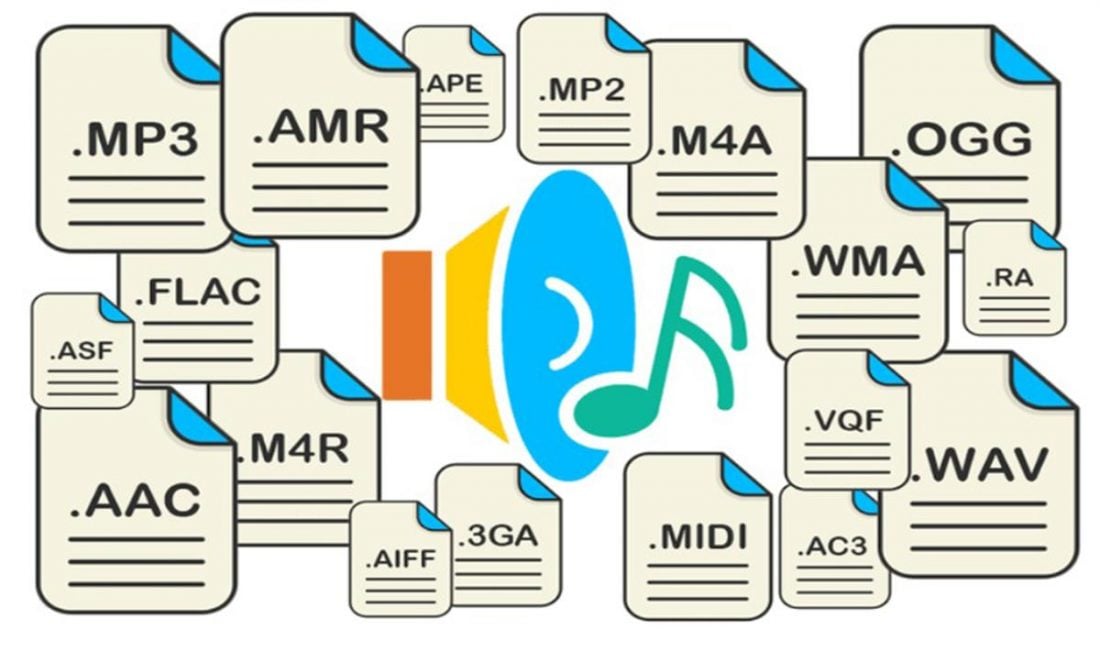
There are many types of music file formats, so it’s hard to know which one is recommended.

audio extensions

I have only used MP3 and WAV because it is difficult to understand, so I don’t know much about the new music file formats that are increasing year after year. Therefore, I had a quick look at the existing music file formats based on the information on the internet. Let’s make a list of types and extensions so that you can easily understand them later.

* The destination is a music file format that can be converted from a CD (linear PCM).

List of music file format types and extensions
format extension Compression method Compression rate Sound quality correspondence
CAA .aac Lossy compression Approximately 15% Some deterioration ○ ○
ATRAC .omg, oma, aa3 △
HE-AAC .aac ○ ○
MP3 .mp3 ◎
Opus .opus ×
Vorbis .ogg, oga △
WMA .wma, asf About 20% ▲
AAL .omg, oma, aa3 Lossless compression About 70% Equivalent to a CD △
apple lossless .m4a, mov, alac ○ ○
FLAC .flac ○ ○
mono audio .mono About 60% △
TAK .tak ×
TTA .tta About 70% ×
WMA lossless .wma, asf ▲
AIFF .aiff, aif, aifc uncompressed 100% ○ ○
WAV .wav, wave ○ ○
* The format is replaced with the term codec and the extension is replaced with the term file format. In a nutshell, a codec is a device or software that can bidirectionally encode (encode) and decode (decode) data using an encoding method. A file format is an information device, such as a computer. It is the storage format of the file. used in.

* The bit rate for lossy compression is 192 kbps.

* Supported items indicate the amount of hardware and software that support the music file format. ◎ Very many, ○ Many, ▲ Normal, △ Less, × Very few.

Currently, lossless compression is emerging as a compression format in addition to lossy compression. Irreversible compression (lossy compression) is a data compression method in which the data before compression and the data after compression do not completely match, and reversible compression (lossless compression) is the data before and after of compression. exactly matches the data.

In other words, lossy compression is a poor-sounding compression method because it adds a reduction in the amount of data, and lossless compression is a good-sounding compression method because it does not reduce the amount of data. . They are all the same in that they seek high sound quality in the smallest possible size.

Now, I think there are music file formats that you already know, but let me briefly explain each one.

blender image
AAC is a music file format standardized in 1997 (approved in 1999). Standardized for the purpose of high sound quality and high compression superior to MP3. If the bit rate is 160 kbps or less, it exceeds the upper limit frequency of MP3.

ATRAC is an audio data compression technology developed by Sony since 1992. If the bit rate is less than 128 kbps, it is above the upper limit of MP3 frequency.

HE-AAC is a music file format standardized in 2003. By incorporating SBR technology into the AAC mentioned above, the playback band is expanded and the sound quality and compression efficiency at low bit rates (128 kbps or less) improve considerably.

* SBR (Spectral Band Mirroring) is a technology for audio compression and encoding, which aims to strengthen the conventional encoding method and increase the compression rate.

MP3 is the oldest music file format standardized in 1991 (approved in 1993). Since it is old, it has a high penetration rate and there is a lot of hardware and software to support it.

Opus is a new audio compression format developed by the IETF and standardized by RFC6716 in 2012. There is very little hardware and software that supports it, but at low bit rates of 128kbps or less, it seems to be the best sound quality with compression. at a loss.

Vorbis is a free audio file format developed by Xiph.org. It seems that it is also adopted on Youtube. Since the standard bit rate is 112 kbps, the sound quality at the low bit rate appears to be good.

WMA is a Windows standard audio compression method developed by Microsoft. If the bit rate is 160 kbps or less, it exceeds the upper limit frequency of MP3. However, the size will be a little bigger

What is the best way to properly use compressed sound sources such as MP3, AAC and WMA?

What is the best way to properly use compressed sound sources such as MP3, AAC and WMA?

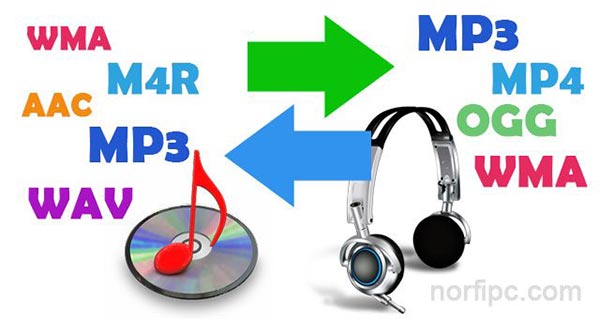
MP3, MP4, WMA, AAC y OGG

When you listen to music on a smartphone or iPod, what you seem to know but don’t understand are digital compressed sound sources like MP3, AAC, and WMA. Let’s think again about “what format” and “what bitrate is good”.

MP3, OGG, WAV, MP4, M4A, AAC

◆ World standard MP3, Apple standard AAC, Windows standard WMA
You all know that there are various formats of “digital sound sources”.

The most familiar is the WAV format, which is also used for CDs. Being an uncompressed format, there is no deterioration in sound quality and it is very versatile, but the capacity is not small, just over 50 MB in 5 minutes.

Therefore, when used with a portable music player such as a smartphone, iPod, or Walkman, it is common to convert (= encode) WAV to compressed sound sources such as MP3, AAC (M4A/M4P), and WMA.

By the way, compressed sound sources are used from the beginning for download distribution, like iTunes. AAC for iTunes, MP3 for Amazon, and WMA for major national distribution sites are the main ones.

・ MP3 …… The oldest compression format established in 1995. There are many compatible products, and it is the de facto standard that can be used in any case. “MP4” is a video standard, so don’t confuse it.

・ AAC (M4A / M4P) …… A standard established after MP3, which is a standard format for Apple products such as iPod and iPhone. M4P is a copyright protected file. AAC is also used for audio on digital terrestrial broadcasts and digital BS on television.

・ WMA …… A format advocated by Microsoft. It has a strong affinity with Windows and many products are also used in voice recorders.

Based on these characteristics, let us consider the compression format depending on the device used.

WMA file [Windows Media Audio].wma

WMA file [Windows Media Audio].wma

WMA

WMA is a compression coding method for voice data developed by Microsoft Corporation in the United States. The standard file extension when saving as a single file is “.wma”, and it can be saved to a video file as audio that accompanies the video. The company’s Windows, etc. are supported as standard.

WMA

General description
Related terms
Explanation of other dictionaries
cheep
WMA

It employs a lossy compression method that dramatically increases the compression efficiency by slightly modifying or reducing the data so that it is difficult for the human ear to notice, and adopts the user’s desired combination of sound quality and compression ratio in the time of encoding. It can be selected step by step. If the sound quality is high, the compression rate is low (the data after compression is large), and if the sound quality is low, the compression rate is high.

It was often compared to MP3 (MPEG Audio Layer-3), which was the standard format for audio compression at the time of the announcement, but in the same company, WMA requires about half the amount of data as MP3 (quality sound comparable to CD ) Can be recorded at 64 kbps ). As the version goes up, the algorithm is improved and the compression efficiency is improved.

Initially, only the constant bit rate (CBR) method was supported, which always records the same number of bits per unit of time, but as of version 9, a variable bit rate that allocates a large number of bits to places with drastic changes. also supports ( VBR : variable bit rate) and average bit rate ( ABR : average bit rate) which adjusts the average amount of VBR data to be constant.

The first version was released in 1999, and new versions have been announced with the Windows Media Player update. As derived specifications, “WMA Lossless” with lossless compression, “WMA Voice” specialized for voice recording, and “WMA Pro” with higher sound quality and multi-channel support (up to 7.1 channels) have been added. Unlike these, normal WMA is sometimes referred to as “standard WMA”, but even if not specified, WMA is almost always referred to as this.

Comparison of common audio formats: which one to use?

Comparison of common audio formats: which one to use?

WMA

Audio files come in all types and sizes. And although we are all familiar with MP3, how about AAC, FLAC, OGG or WMA? Why are there so many standards? Which ones should you care about and which ones can you ignore?

WMA

It’s actually pretty simple once you understand that all audio formats fall into three main categories. Once you know which category you want, all you have to do is choose the format in that category that best suits your needs.

Uncompressed audio formats
Uncompressed audio is exactly what it sounds like: real sound waves that have been captured and digitized without any additional processing. As a result, uncompressed audio files tend to be the most accurate, but they take up A LOT of disk space, around 34MB per minute for 96kHz 24-bit stereo.

PCM
PCM stands for Pulse-Code Modulation, the digital representation of raw analog audio signals. Analog sounds exist as signals, and to convert a signal into digital bits, the sound must be sampled and recorded at specific intervals (or pulses).

Therefore, this digital audio format has a “sample rate” (how often a sample is taken) and a “bit depth” (how many bits are used to represent each sample). There is no compression. Digital recording is a nearly accurate representation of analog audio.

PCM is the most common audio format used on CDs and DVDs. There is a subtype of PCM called linear pulse code modulation, where samples are taken at linear intervals. LPCM is the most common form of PCM, so at this stage the two terms are almost interchangeable.

Wav
WAV stands for Waveform Audio File Format (also called Audio for Windows at one point, but not anymore). It is a standard developed by Microsoft and IBM in 1991.

Many people assume that all WAV files are uncompressed audio files, but this is not entirely true. WAV is actually a Windows container for audio formats. This means that a WAV file can contain compressed audio, but it is rarely used for this.

Most WAV files contain uncompressed PCM audio. The WAV file is just a wrapper for PCM encoding, which makes it more suitable for use on Windows systems. However, Mac systems can generally open WAV files without any problem.

AIFF
AIFF stands for Audio Interchange File Format. Like Microsoft and IBM developed WAV for Windows, AIFF is a format that Apple developed for Mac systems in 1988.

Like WAV files, AIFF files can contain various types of audio. For example, there is a compressed version called AIFF-C and another version called Apple Loops that use GarageBand and Logic Audio, and they all use the same AIFF extension.

Most AIFF files contain uncompressed PCM audio. The AIFF file is simply a wrapper for PCM encoding, which makes it more suitable for use on Mac systems. However, Windows systems can generally open AIFF files without any problem.

audio file signal format

Lossy compressed audio formats
Lossy compression is a form of compression that loses data during the compression process. In the context of audio, this means that we sacrifice quality and fidelity for file size. The good news is that most of the time you won’t be able to tell the difference.

,

However, if the audio is compressed too much or too often, you will start to hear artifacts and other oddities that become more and more noticeable.

See also: Digital Photo Editing? Choose the right monitor and configure it correctly
MP3
MP3 stands for MPEG-1 Audio Layer 3. It was released in 1993 and quickly gained popularity, eventually becoming the world’s most popular audio format for music files. There’s a reason we have “MP3 players” and not “OGG players” …

The main pursuit of MP3 is to remove all audio data that exists outside the audible range of most normal people and reduce the quality of sounds that are not easy to hear, and then compress all other audio data from the as efficiently as possible.

Almost every digital audio capable device in the world can read and play MP3 files, whether we are talking about PC, Mac, Android, iPhone, Smart TV or anything else. When you need versatility, MP3 will never let you down.

Please note that MP3 is not the same as MP4

although their similar names may indicate otherwise.

ACC
AAC stands for Advanced Audio Coding. It was developed in 1997 as the successor to MP3.