
What music file format is recommended? List of types and extensions
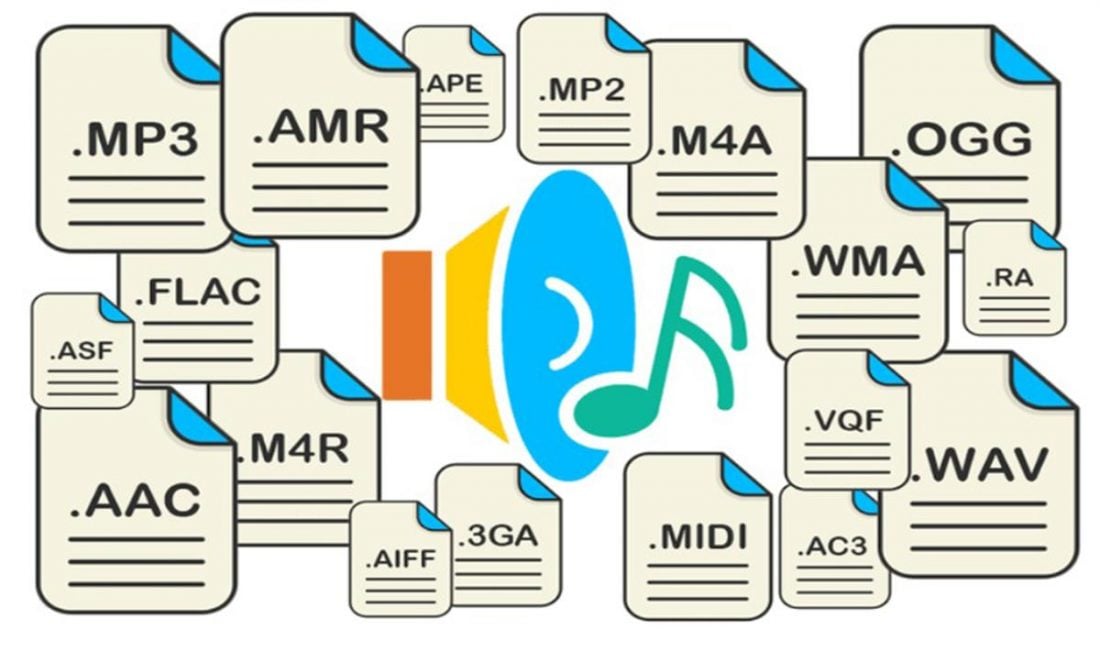
There are many types of music file formats, so it’s hard to know which one is recommended.

I have only used MP3 and WAV because it is difficult to understand, so I don’t know much about the new music file formats that are increasing year after year. Therefore, I had a quick look at the existing music file formats based on the information on the internet. Let’s make a list of types and extensions so that you can easily understand them later.
* The destination is a music file format that can be converted from a CD (linear PCM).
List of music file format types and extensions
format extension Compression method Compression rate Sound quality correspondence
CAA .aac Lossy compression Approximately 15% Some deterioration ○ ○
ATRAC .omg, oma, aa3 △
HE-AAC .aac ○ ○
MP3 .mp3 ◎
Opus .opus ×
Vorbis .ogg, oga △
WMA .wma, asf About 20% ▲
AAL .omg, oma, aa3 Lossless compression About 70% Equivalent to a CD △
apple lossless .m4a, mov, alac ○ ○
FLAC .flac ○ ○
mono audio .mono About 60% △
TAK .tak ×
TTA .tta About 70% ×
WMA lossless .wma, asf ▲
AIFF .aiff, aif, aifc uncompressed 100% ○ ○
WAV .wav, wave ○ ○
* The format is replaced with the term codec and the extension is replaced with the term file format. In a nutshell, a codec is a device or software that can bidirectionally encode (encode) and decode (decode) data using an encoding method. A file format is an information device, such as a computer. It is the storage format of the file. used in.
* The bit rate for lossy compression is 192 kbps.
* Supported items indicate the amount of hardware and software that support the music file format. ◎ Very many, ○ Many, ▲ Normal, △ Less, × Very few.
Currently, lossless compression is emerging as a compression format in addition to lossy compression. Irreversible compression (lossy compression) is a data compression method in which the data before compression and the data after compression do not completely match, and reversible compression (lossless compression) is the data before and after of compression. exactly matches the data.
In other words, lossy compression is a poor-sounding compression method because it adds a reduction in the amount of data, and lossless compression is a good-sounding compression method because it does not reduce the amount of data. . They are all the same in that they seek high sound quality in the smallest possible size.
Now, I think there are music file formats that you already know, but let me briefly explain each one.
blender image
AAC is a music file format standardized in 1997 (approved in 1999). Standardized for the purpose of high sound quality and high compression superior to MP3. If the bit rate is 160 kbps or less, it exceeds the upper limit frequency of MP3.
ATRAC is an audio data compression technology developed by Sony since 1992. If the bit rate is less than 128 kbps, it is above the upper limit of MP3 frequency.
HE-AAC is a music file format standardized in 2003. By incorporating SBR technology into the AAC mentioned above, the playback band is expanded and the sound quality and compression efficiency at low bit rates (128 kbps or less) improve considerably.
* SBR (Spectral Band Mirroring) is a technology for audio compression and encoding, which aims to strengthen the conventional encoding method and increase the compression rate.
MP3 is the oldest music file format standardized in 1991 (approved in 1993). Since it is old, it has a high penetration rate and there is a lot of hardware and software to support it.
Opus is a new audio compression format developed by the IETF and standardized by RFC6716 in 2012. There is very little hardware and software that supports it, but at low bit rates of 128kbps or less, it seems to be the best sound quality with compression. at a loss.
Vorbis is a free audio file format developed by Xiph.org. It seems that it is also adopted on Youtube. Since the standard bit rate is 112 kbps, the sound quality at the low bit rate appears to be good.
WMA is a Windows standard audio compression method developed by Microsoft. If the bit rate is 160 kbps or less, it exceeds the upper limit frequency of MP3. However, the size will be a little bigger


