Audio pcm what. Digital sound: DSD vs PCM Part 3
![What is DSD Audio? [Sound Quality, DSD vs PCM]](https://samplerateconverter.com/sites/default/files/u1/what-dsd/pcm-dsd-difference.png)
Retrieve a “digit” analog signal
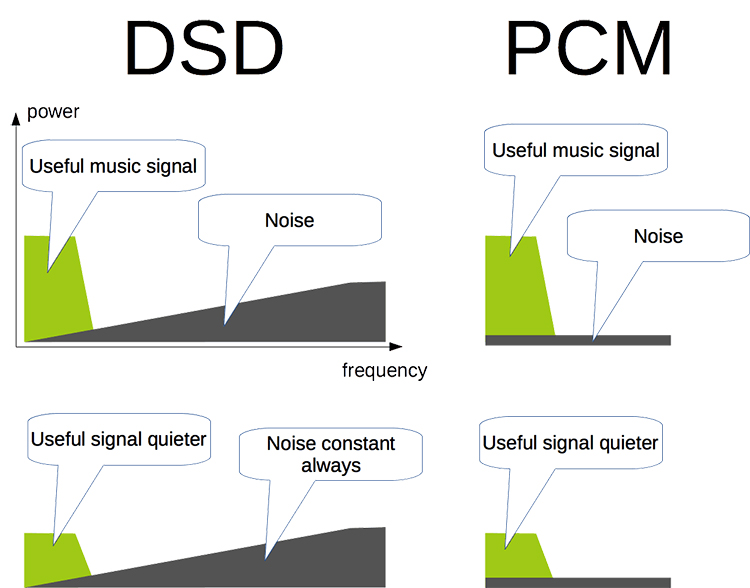
But digitizing an analog signal is half the battle. To listen to digital music, you must reverse convert. First, let’s see how to convert a digital DSD broadcast to sound. As we already know, this stream is a high frequency bi-level signal (2.8 MHz or more), the average value of this signal changes with the audio frequency. That is, if the approach to solving the problem is as simple as possible, you need to filter out all the high-frequency components of the DSD stream, leaving only a useful sound signal (frequencies up to 20 … 22 kHz). This is done using an analog low pass filter (LPF). The simplest LPF is an RC chain.
As you can see, the resulting graph only vaguely looks like the original sinusoid. But let’s not forget that we “applied” the simplest filter, improving the filter circuit can achieve an almost total absence of high frequency noise and obtain an analog sound with good quality indicators.
To restore an analog signal from a digital PCM, just an analog low-pass filter is not enough, you must first decrypt the digital data, for this, digital-to-analog converters (DACs) are used. They are of different types, but it is beyond the scope of this article to describe them all. Let’s dwell on the 2 most common types of sound technology. First of all, this is the so called ladder type DAC (also called multibit). As you probably guessed, such a DAC converts a PCM digital data stream into a stream of audio signal values that look like a ladder on the graph (Figure 6). As with DSD, it is imperative to use an analog filter to smooth out the jogging.
Often these converters use intermediate oversampling of the digital PCM signal at higher frequencies (eg 192 kHz): this reduces the “steps”, allowing for simplification of the analog filter circuit.
The second type of DAC, delta-sigma, uses oversampling at even higher frequency values with a simultaneous reduction of the bit depth to one bit. Doesn’t it look like anything? This is a familiar DSD signal! We have already discussed how to further process such a signal and convert it to analog.
PCM and DSD application, advantages / disadvantages
Where can we find each of the encoding methods? PCM format is very common: CDDA discs, DVD audio, MP3 files, FLAC, ALAC, AAC, sound in movies, and so on, it is easier to say when it is not PCM. Super Audio CD, DSD, DSF, DFF files are in DSD format. What is better? What format will we get a better sound from?
The articles dedicated to the DSD format describe many advantages over PCM, but are all the advantages described true, or are they myths invented for laymen who do not understand the technical component to recover the market densely occupied by the PCM format? Let’s briefly review the list.
conclusions
So should you choose DSD or PCM? There is no single answer and it cannot be: PCM 24 bit 92 kHz and DSD128, for example, are very similar in quality characteristics, and these characteristics are better than the equipment on which these formats will be played, which means a further increase in the quality of digital formats for playback at this stage is not practical. When evaluating the quality of sound in different high definition formats, subjective sensations come to the fore, because the human brain is not eaten by the same quality: the design of the equipment, its cost and, most importantly, the well-being and the The listener’s moods have a much greater effect on the sensation of listening to music. Therefore, choose what you like personally and do not impose your opinion on others. Happy listening everyone!
You can help and transfer some funds for the development of the site.