What is MP4? Basic knowledge of MP4


Free Download Mp4Gain
picture

What is MP4? Basic knowledge of MP4

MP4

What is MP4? When we play a video on a portable device like iPhone / iPad / iPod / Apple TV / PSP, we check the video file format and it turns out to be .mp4

MP4

What exactly is MP4? Next, we will explain the meaning, codec, characteristics, versatility, use, etc. of MP4.

What is MP4? .MP4 file: meaning / definition of MP4 explained in detail

MP4 is part of the MPEG-4 standard and is a digital multimedia container file format. Specifically, MP4 is a derivative format of ISO / IEC 14496 Part 12 developed based on Apple’s QuickTime media technology file format, and has a structure that follows many of the conventional QuickTime formats. The extension is .mp4, but the extension is different in some cases. That is, .m4v only for video and .m4a only for audio. It is used quite often in combination with the H.264 codec.

MP4 Features | What are the advantages and disadvantages of MP4?

MP4 has more functions than AVI, it is smaller than MKV, it has greater compatibility than FLV, and it can be compressed to the same image quality at a lower bit rate than MPEG-1 and MPEG-2, which is currently the most important. it will be said that it is a form.

The most important feature is its high convenience, which means that it is compatible with various operating systems, browsers, smartphones, tablets, mobile phones, and household appliances. It can be used on both Mac and Windows, and you can play videos without installing MP4 playback software. Speaking of the merits of MP4, it is easy to edit and has a high compression rate. Speaking of downsides, I think technically not suitable for oversized high-quality videos.

Explains MP4 codec and MP4 compatible devices
MP4 is a codec that further compresses MPEG-2. MP4 can be used by storing and using a combination of multimedia data from the following video and audio codecs.


Free Download Mp4Gain
picture


Mp4Gain Main Window
picture


Mp4Gain Features
picture


Free Download Mp4Gain
picture

What is MP3?

What is MP3?

MP3

“MP3” widely used in audio players. The official name is “MPEG-1 Audio Layer III”, which is the audio format for MPEG-1. The MP3 format itself is being standardized in parallel with MPEG as the video format, and in 1992 it will be standardized as “ISO / IEC IS 11172-3 (MPEG-1 Audio)”.

MP3

After that, MP3s will be distributed “as is” among enthusiasts, but this has not been a major advance since the introduction of the portable “mpman” audio player launched by SAEHAN International in South Korea in 1998. By combining this player, which can download and play music data over the Internet, with Napster, which appeared in 1999, the scene of portable audio players that used to carry cassettes, CDs, MDs, etc. it will change completely.

MP3s can also reduce the original data to less than one tenth. For example, it has become possible to compress a one-hour music CD to about 40MB and, using Napster, etc., we have established a new need for music sharing between users. After that, despite various “RIAA (Recording Industry Association of America)” procedures and the emergence of successor formats formulated by many manufacturers, MP3s remain a widely used audio. It is still used as a format.

■ MPEG

To understand the working principle of MP3, let’s first explain about “MPEG Audio” itself. A feature of MPEG Audio is that it uses auditory psychology, the lower audible limit of hearing, and the masking effect.

Let’s start with this minimum audible limit. In general, it is considered that humans can hear sounds in the range of 20 Hz to 20 kHz. Of course, this is an average value, and some people can hear a wider range, while others can only hear a narrower range, but this time I’ll drop it.

So if you can hear any sound in the 20Hz to 20KHz range, that’s not the case. The lower audible limit curve is shown in Fig. 1, and it is possible to hear even a fairly low sound around 2KHz, but at frequencies above or below it, it is heard that it is not considerably loud. .

You may have heard the term “volume curve”, which is the curve shown in Figure 1. Therefore, even if there is a sound source that sounds in a wide range from bass to treble (Fig. 2 ), the human ear has the characteristic that it can only be heard with both ends drooping (Fig. 3). By taking advantage of this and omitting all inaudible frequency data, a great deal of compression is made possible.

Masking effect

The masking effect is another phenomenon. For example, when a very loud sound is generated at a certain frequency, a specific area called “Critical Band” is created before and after that. And you won’t hear any of the other sounds included in this critical band.

When sound A is generated, the sloping area that extends to the before and after frequencies is the Critical Band. I can hear the part of the B sound that sticks out of the Critical Band without any problem, but I can’t hear the C sound that completely fits into the Critical Band.

In MPEG Audio, compression efficiency is further improved by omitting sound data that cannot be heard due to this critical band as before. By the way, the masking effect itself is effective not only in the direction of frequency but also in the direction of the time axis. In other words, not only immediately after a loud sound is generated, but also just before that, you cannot hear a small sound for some reason. This is called the temporary masking effect, but in Figure 5, sound B and sound C become inaudible. This is also effective for data compression.

What is a WMA (Windows Media Audio) file? 

What is a WMA (Windows Media Audio) file?

wma

WMA (Windows Media Audio) files are a type of compressed audio files like MP3. It is said that the size can be reduced to about 1/20 that of an uncompressed file while maintaining the audible sound quality of a music CD.

WMA

WMA Features

Compression performance
WMA is an audio compression format developed by Microsoft. In addition to the lossy compression format, in recent years a lossless compression format called WMA Lossless was born.

When comparing WMA with the same file size in MP3, WMA seems to be playable with better audible sound. It also supports VBR (Variable Bit Rate) format and can be compressed to a certain quality. For VBR is the difference between CBR / VBR / ABR in Audio-Video Converter, visit.

Various functions
WMA also supports Digital Rights Management (DRM) as standard and may have a copyright protection function. For this reason, many companies have embraced WMA when offering paid audio content, and WMA has gone mainstream.

WMA can also be streamed and the files can be downloaded and played.

Compatible with portable players
WMA can be played on many portable audio players along with MP3. Examples of WMA-compatible players include the Sony Walkman and the Panasonic D-Snap.

WMA cannot be played on Apple iPod, but WMA can be converted to MP3 or AAC in iTunes 4.5 or higher for Windows.

Other lossy compression formats
Lossy compression formats other than Ogg Vorbis include:

MP3 (MPEG 1 Audio Layer 3)
AAC (advanced audio coding)
Ogg Vorbis
ATRAC (TRansform Adaptive Acoustic Coding)

There are several types such as WAV, MP3 and FLAC, but what is the difference? Part 4

There are several types such as WAV, MP3 and FLAC, but what is the difference? Part 4

ANALOG vs. DIGITAL AUDIO

There are several types such as WAV, MP3 and FLAC, but what is the difference? Comprehensive research on music file formats

analog audio disc

Data and music
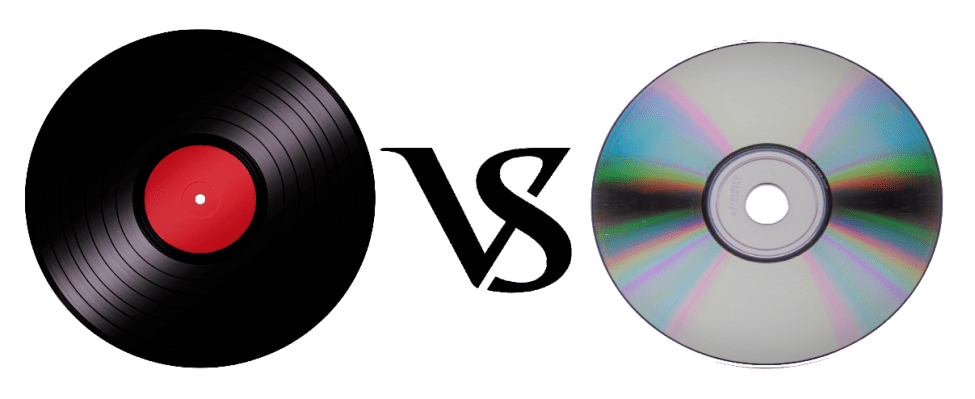
Does the boom from the analog discs come back?

In recent years, the world boom of analog discs has arrived. According to the Association of the Recording Industry of the Public Corporation in General of Japan, the national disk market is the production number of 2017 1063000 sheets. In terms of Amount, it was 1,916 million yen, the highest of the last 10 years.

You may have heard that sound quality is generally better than that of a CD, but what really differs is the recorded frequency band.

It is said that the frequency band that can be stored on a CD is up to about 22,000 Hz, while the analog record contains information of up to about 100,000 Hz. However, it is said that the audible human range is approximately 20Hz to 20,000Hz, so it does not make sense unless you notice the difference in sound. It seems that the parties other than the audible human range, the vibration of the air due to the sound and the force caused by it, are transmitted by other routes other than sound.

This is a great merit that can only be experienced with analog discs, and it can be said that it is the true emotion of the discs.

However, the care of the equipment, the deterioration of the plate, the difficulty of handling and the size can be disadvantages compared to the CDs and the data. (In the youngest generation of these days, this effort is quite new and many people enjoy it).

abstract

There are several formats for musical data files and each one has its own personality. Which of the music services and distribution sites that I have used casually so far?

It can also be good to listen and compare the differences with data such as CD and analog discs.

I want to take me well with musical data wisely according to my style!

There are several types such as WAV, MP3 and FLAC, but what is the difference? Part 3
There are several types such as WAV, MP3 and FLAC, but what is the difference? Part 3

Audio Formats

Relationship between the depth of bits, the sampling frequency and the frequency of bits

Audio File Formats

The musical data has numbers such as the depth of bits and the sampling frequency indicating the amount of musical data per second.

And the product of the two is the “bit rate”.

· Sampling rate
Also known as sampling frequency. It shows how many tens of thousands of sounds are collected per second.

The higher the value, the greater the number of divisions, which translates into a softer sound and an improved sound quality.

By the way, the CD is 44100Hz.

· Bit depth
Also known as quantification bits, bid reduction, sample bits count.

This shows how much capacity is given to divided data.

The greater the sound, the better the sound will be and the quality of the sound will be improved.

The CD is 16 bits.

· Bit rate
It is shown as BPS and shows the amount of data per second.

It is the product of the “sampling frequency” and the “bits depth” mentioned above.

In the case of a stereo file, there are two sounds, so if you formulate it …

Sampling rate (Hz) x Bit depth (bits) x 2 = Bit rate (BPS)
A large “bit rate” means a “sampling rate” and a large large bits depth, which means that sound quality is good.

By the way, in the case of CD,

44100 (Hz) x 16 (bits) x 2 = 1411200 (BPS)
This means that.

In this article, I specifically compared the difference in the file size.

cheep
Marker
Share
Pocket
Update: 2020.07.15 Published: 2018.08.14
Technology | Included in the Hall of Fame

There are several types such as WAV, MP3 and FLAC, but what is the difference? Comprehensive research on music file formats
keyword
Data and music
INDEX

I compared file sizes
So, what is the call frequency?
Is “dead mp3”?
Why are there so many formats in the first place?
I compared file sizes
Then, I compared what kind of difference is made from the point of view of the file size and if there is a difference in Hz that sounds depending on each file format. In comparison, Tucson Repertory Orchestra and Sierra Vista Symphony Orchestra were listening to the opinion of Japanese Director Toru Tagawa, who serves as musical director and director of the (Sierra Vista Symphony Orchestra), is the ninth of Beethoven is good advised me to play The Berlin Philharmonic directed by Karajan, one of the most famous recordings.

I compared file sizes

So, what is the call frequency?
Is “dead mp3”?
Why are there so many formats in the first place?
I compared file sizes
Then, I compared what kind of difference is made from the point of view of the file size and if there is a difference in Hz that sounds depending on each file format. In comparison, Tucson Repertory Orchestra and Sierra Vista Symphony Orchestra were listening to the opinion of Japanese Director Toru Tagawa, who serves as musical director and director of the (Sierra Vista Symphony Orchestra), is the ninth of Beethoven is good advised me to play The Berlin Philharmonic directed by Karajan, one of the most famous recordings.

Then, here is the CD used for this comparison.

Symphony n. ° 9 by Beethoven (choir) from director Herbert von Karajan released by Universal Music. In fact, it is said that the Ninth of Beethoven was the origin of the unit of a CD. (There are several theories about this).

When I really verified it, there was still a remarkable difference in the size of the file.

OLA 701.5 MB.
ALAC 308.6 MB.
MP3.
160 kbps 79.4 MB
256 Kbps 127 MB
320 kbps 158.8 MB
CAA.
160 kbps 80.2 MB
256 Kbps 127.8 MB
320 kbps 159.5 MB
However, for “MP3” and “AAC”, none of the bit rates appeared around 1 MB.

So, what is the call frequency?

With respect to the frequency, I tried to verify showing the waveform. The image above is in WAV format.

Compared to “WAV”, there were almost no changes in the frequency of acute and only a slight change in the bass was observed.

Comparing “MP3” and “AAC”, which have almost the same file size, you can see that “AAC” has a lower tone. In terms of frequency, “AAC” seems to have a better sound quality. In other words, the result of the verification shows that AAC, which is a more recent compression technology, is higher.


There are several types such as WAV, MP3 and FLAC, but what is the difference?

There are several types such as WAV, MP3 and FLAC, but what is the difference?

Music File Formats

Comprehensive research on file formats
Do they like music to all?

audio file formats

I think many people enjoy music by downloading or playing streaming instead of CD these days, but what kind of format music is stored as data?

I researched the differences, advantages and disadvantages of each format.

Types of audio compression

There are three types of music file formats: “Not compressed”, “compressed with loss” and “compressed without loss”.

File-based compression can reduce the size of the file and reduce the download time and storage capacity.

“Uncompressed format”
As its name indicates it, it is an uncompressed file. The point are the original data.

The advantage is the accuracy of the data. However, it also has the disadvantage of a large file, which uses about 10 MB for a 1-minute audio file.

The most used are “WAV” and “AIFF”. It is common to use “WAV” for Windows and “AIFF” for Macintosh.

“Compression format with loss”
This compression format is probably the one that most uses.

Although there are individual differences, it is said that the human audible range is 20 Hz to 20000 Hz. This file format has the advantage that the file size can be deleted while maintaining a certain level of sound quality when it is removed and compressed Other parts difficult to identify.

Even so, the disadvantage is that the sound quality is lower than the original data. It is not exaggerated to say that “MP3” is the best-known file format. As successors, “AAC” is often used, which was created to achieve higher sound quality. In addition, “WMA”, “Vorbis”, etc. They are also in this format.

“Format of compression without loss”
This format compresses the original data while preserves them.

During playback, you can decompress and return to the original uncompressed format, so the sound quality is the same as that of the original data. Although the file size can be reduced compared to the uncompressed format, it is still about half, so the size of the file is greater than that of the compressed format with loss and takes more time coding and decoding.

In addition, it is currently not handled by the main music distribution sites, and the number of devices that can be reproduced is less than that of uncompressed formats. The most common of these formats is “FLAC”, and Apple uses a single format called “ALAC”.

How Bluetooth Headphones Work Part 3

How Bluetooth Headphones Work Part 3

aptX BlueTooth

What is aptX, the savior of Bluetooth sound quality

bluetooth aptx


Let’s take a look: if you compare a Bluetooth headset to a person, the Bluetooth chip is like your heart and aptX technology is like your eloquence. Whether the transmitted sound is smooth and clear, so that the listener can know what you mean is an important indicator.

With the chestnuts finished, let’s get back to the topic: What is aptX anyway? Now, let’s take a look at it from a technical point of view.

There is a word involved in Bluetooth transmission technology called “bit rate”, which is the number of bits transmitted per second, and the unit is bps (bits per second). In the case of transmitting the same audio file, the higher the bit rate, the faster the data transmission speed and the shorter the time required. There should be “chestnuts” here, like when Yao Ming was practicing, he had 100 basketballs at A, and he had to throw them into the basket at B. Under the premise of making all the shots, Yao Ming would take more basketballs each . (Bit rate) and the more basketballs (bit rate) you put in, the shorter the total time required.

But for Bluetooth technology, because it is limited by the maximum bandwidth available in transmission, it is not always suitable for transmitting high-quality audio.

For this reason, Bluetooth “guardian angel” -aptX technology was born. It recodes and decodes the audio to be transmitted, significantly reducing the bit rate, without affecting the sound quality and without the transmission delay, which makes the Bluetooth stereo listening experience a revolutionary leap. So with aptX, you can enjoy pure wireless audio with CD-level sound quality anytime, anywhere.