OGG vs. MP3 comparison


Free Download Mp4Gain
picture

OGG vs. MP3 comparison
Let’s talk about OGG vs. MP3 comparison

OGG vs. MP3 comparison is my favorite subject because I have dedicated years to understanding audio formats and their nuances. I always start every discussion about OGG vs. MP3 comparison by emphasizing that the topic matters for anyone who loves high-quality sound. I remember the first time I experimented with both formats on my old stereo system; the differences were unmistakable and transformative. I learned early on that the choice between OGG and MP3 comparison is not just about file size or compression but about overall audio fidelity and listening experience.

OGG vs. MP3 comparison drives my passion for clear audio, and I continuously test these formats in real-life scenarios, from my car stereo to my home theater system. I have experienced firsthand how even subtle differences can influence the enjoyment of music. In my journey, I discovered that every detail matters, and I am here to share insights, personal experiences, and real-life examples that go far beyond common knowledge found on many websites.

OGG vs. MP3 comparison is a topic that I explore with a mix of technical expertise and everyday language. I often compare it to choosing between two different sports cars: one may offer a little more power while the other provides better fuel efficiency. In my case, I have always looked for the balance between quality and file efficiency, and this article is my attempt to guide you through every aspect of the debate.

Understanding the core differences in OGG vs. MP3 comparison

OGG vs. MP3 comparison begins with understanding the core differences that set these formats apart. I always stress that MP3 is one of the oldest digital audio formats and has been the industry standard for many years, while OGG, particularly the Vorbis codec, is known for its efficient compression and open-source nature. I compare them by saying MP3 is like a tried-and-true recipe, whereas OGG is a modern twist that offers more flexibility and quality.

OGG vs. MP3 comparison has always fascinated me because I see them as two sides of the same coin. I learned that while MP3 compresses audio by discarding some data, OGG uses a different approach that often results in a richer sound profile. I recall listening sessions with friends where we compared our favorite tracks side-by-side and the differences were clear. I always make sure to emphasize that both formats have their own advantages, which is why my deep dive into OGG vs. MP3 comparison is essential for every audio enthusiast.

OGG vs. MP3 comparison is not merely about quality; it is about understanding trade-offs. I compare these differences to everyday choices, like picking between a paper book and an e-book. In my experience, while the e-book may be more compact, the paper book offers a tangible feeling and sometimes a richer experience. This analogy perfectly sums up my view on OGG vs. MP3 comparison, where each format has its distinct personality.

Technical specifications that shape OGG vs. MP3 comparison

OGG vs. MP3 comparison is driven by technical specifications that I have studied extensively over the years. I always begin by outlining the technical backbone of each format: MP3 typically uses fixed or variable bit rates, while OGG Vorbis uses a quality-based encoding that adapts to the complexity of the audio. I compare these techniques to using different brushes when painting, where each brush gives a unique texture to the final artwork.

OGG vs. MP3 comparison benefits from the fact that I have spent countless hours tinkering with bit rates, sample rates, and encoding settings. I always emphasize that the quality of an audio file depends largely on these technical choices. I once conducted experiments by encoding the same song in both formats at various bit rates and was amazed at how OGG managed to preserve clarity even at lower bit rates. I share these insights because they provide a deeper understanding that many standard articles do not cover.

OGG vs. MP3 comparison can be seen as a technical dance, where each format plays its part in the overall performance. I often describe the MP3 process as a traditional orchestra and OGG as a modern ensemble that uses dynamic techniques to balance quality and efficiency. In my personal experience, I always adjust settings based on the content of the audio and the listening environment, which is why understanding the underlying technical details is crucial.

Audio quality and fidelity in OGG vs. MP3 comparison

OGG vs. MP3 comparison is all about audio quality and fidelity, and I have always prioritized listening tests as my benchmark. I remember setting up my studio and playing the same track in both formats to see which one delivered more accurate sound reproduction. I learned that OGG can often retain more of the original audio nuances compared to MP3, especially in complex musical passages. I always start every comparison by focusing on the crispness, clarity, and warmth of the sound.

OGG vs. MP3 comparison matters greatly when it comes to preserving the original artistry of the music. I compare it to the difference between a high-resolution photograph and a compressed image; the details lost in compression can change the entire viewing experience. I have experienced situations where a slight difference in fidelity made all the difference, and I emphasize this because I know that real-life listening is what matters most to audio enthusiasts.

OGG vs. MP3 comparison is not just a technical debate but a subjective one as well. I always invite my friends and colleagues to listen and decide for themselves, which always results in vibrant discussions about personal preferences. I share these personal experiences to highlight that while data and technical specs are essential, the ultimate judge is the human ear. This dual perspective is something I believe sets my analysis apart from many online articles.

File size, compression, and performance in OGG vs. MP3 comparison

OGG vs. MP3 comparison always starts with the file size and compression efficiency. I have often compared the two formats by saying that MP3 files tend to be slightly larger when aiming for similar quality levels compared to OGG files. I learned through my own experiments that OGG’s variable bit rate encoding allows it to produce smaller files without significant loss of quality. I always emphasize that these compression techniques make a significant difference in storage and streaming efficiency.

OGG vs. MP3 comparison is something I explore by setting up real-life scenarios, such as streaming music over limited internet connections. I have noticed that using OGG can sometimes lead to faster downloads and smoother playback, especially in environments where bandwidth is at a premium. I compare this to packing a suitcase more efficiently for a long trip; every bit of saved space counts. I share these insights because they come from real-world testing and practical experience.

OGG vs. MP3 comparison is deeply influenced by the efficiency of the codec. I often provide examples using simple bullet lists to outline the benefits I have observed:

  • I explain that OGG’s adaptive compression results in smaller file sizes with minimal quality loss.
  • I compare MP3’s fixed bit rate encoding to a rigid schedule that sometimes fails to adapt to changes in the content.
  • I demonstrate that in my own tests, OGG files performed better on mobile devices in low-bandwidth scenarios.

OGG vs. MP3 comparison is, therefore, a study in trade-offs, and I always make it clear that while both formats have merits, the context in which you use them is crucial. I have seen firsthand how the right format can transform a listening session, and I share these technical details to help you decide which option fits your needs.

Real-life use cases and personal experiences with OGG vs. MP3 comparison

OGG vs. MP3 comparison is a topic I relate to through everyday experiences, and I always use personal stories to make the technical details relatable. I remember a time when I was organizing a road trip playlist and had to choose between OGG and MP3 files for my car’s audio system. I learned that the smaller size of OGG files allowed me to store more songs without sacrificing sound quality. I always compare this decision to choosing a versatile backpack that can hold more essentials without being bulky.

OGG vs. MP3 comparison has influenced my decisions in many scenarios. I have often used MP3 files when compatibility is critical and switched to OGG when quality and efficiency were my priorities. I like to describe this choice as similar to picking between a reliable sedan for long drives and a sporty convertible for a fun weekend outing. I share these real-life examples to illustrate that there is no one-size-fits-all answer; it all depends on your unique needs and context.

OGG vs. MP3 comparison becomes more engaging when I mix technical insights with daily life experiences. I have organized numerous listening parties where the differences between the formats sparked lively debates. I always remind my audience that while statistics and bit rates matter, the joy of listening is what truly counts. These personal stories have helped me refine my approach to audio, and I am excited to share them with you.

Comparing compatibility and ecosystem support in OGG vs. MP3 comparison

OGG vs. MP3 comparison is not only about sound quality but also about compatibility and support across devices and platforms. I always stress that MP3 is universally supported on nearly every device, from smartphones to professional audio systems. I have experienced countless situations where MP3 files seamlessly integrated into my workflow, making them the go-to choice for many users. I compare this to a common language that everyone understands, ensuring smooth communication.

OGG vs. MP3 comparison is interesting because while OGG offers technical advantages, its ecosystem is not as widespread. I have encountered challenges when trying to play OGG files on older devices or certain car stereos. I always point out that this limitation means that despite its superior compression, OGG might not always be the best option if universal compatibility is required. I share these experiences to help you make an informed decision based on your specific usage scenario.

OGG vs. MP3 comparison becomes a debate between quality and convenience. I often use everyday analogies, such as comparing a modern electric car with a classic gasoline vehicle; the electric car might be more efficient, but the gasoline vehicle has the advantage of widespread fueling stations. In my own testing, I have found that while OGG offers excellent performance, MP3 remains the format of choice for many due to its long-established compatibility.

Performance and processing speed in OGG vs. MP3 comparison

OGG vs. MP3 comparison includes evaluating the performance and processing speed of each format, and I always begin with my personal tests on various devices. I have timed how quickly each format decodes and how they perform under different conditions. I always note that MP3 files are known for their rapid decoding, which makes them ideal for devices with limited processing power. I compare this to a quick snack that gives you an instant boost of energy.

OGG vs. MP3 comparison in terms of processing speed is essential when streaming or playing music on older hardware. I remember upgrading my home media center and noticing that MP3 files loaded faster in my playlists, while OGG files, though slightly slower, delivered richer sound details. I always emphasize that these differences are crucial when performance is a top priority, and I share them based on my own systematic experiments.

OGG vs. MP3 comparison also extends to how well each format is supported by various software players and hardware decoders. I have seen cases where software optimizations give MP3 an edge, while more modern players handle OGG files without any hiccups. I explain these performance factors using simple analogies, like comparing a sports car to a reliable commuter vehicle, which I believe makes the technical aspects more relatable.

Practical scenarios and everyday decisions in OGG vs. MP3 comparison

OGG vs. MP3 comparison is practical and impacts everyday decisions, and I always draw on real-life scenarios to explain the differences. I have often chosen one format over the other depending on whether I was curating a high-fidelity home music library or building a playlist for my workout sessions. I compare these choices to picking the right pair of shoes: one might be more comfortable for running while the other is stylish for an evening out.

OGG vs. MP3 comparison, in my experience, is also about balancing file size, quality, and compatibility. I have seen that when storage space is at a premium, OGG files provide a better solution, whereas MP3 files offer broader support. I always relate these decisions to everyday situations, such as deciding between a compact car and a full-sized sedan for city driving. This analogy always helps my listeners understand the trade-offs in simple terms.

OGG vs. MP3 comparison becomes a matter of personal preference when I consider factors like the type of music, listening environment, and available hardware. I have personally reconfigured my digital library several times based on these considerations, and I believe that sharing these practical experiences helps you decide which format fits your lifestyle best. I always remind myself that each choice has its own benefits and that informed decisions lead to greater satisfaction in the long run.

Advanced tips and insider knowledge on OGG vs. MP3 comparison

OGG vs. MP3 comparison is a subject where advanced tips can truly make a difference, and I always enjoy sharing my insider knowledge. I have spent years experimenting with various encoding settings, and I have discovered methods to extract the best quality from both formats. I compare these techniques to fine-tuning a musical instrument: every little adjustment contributes to a harmonious outcome.

OGG vs. MP3 comparison, in my advanced tips section, focuses on optimizing your audio settings. I always recommend that you experiment with variable bit rate settings in OGG files to maximize quality while keeping file sizes in check. I have also learned that using high-quality source files for MP3 encoding can significantly improve the final sound output. I share these technical tips because they are based on real-world trials and bring results that standard advice rarely covers.

OGG vs. MP3 comparison is more than a theoretical debate; it is a practical art that I have honed over time. I always suggest that you monitor your encoding parameters closely and adjust them based on the type of audio you are processing. I often break down my advanced tips into bullet points for clarity:

  • I advise using high-quality source material to ensure the best possible outcome in both formats.
  • I emphasize testing different bit rate settings to see which one delivers the optimum balance.
  • I recommend leveraging my own custom settings, which I have fine-tuned over countless listening sessions.

OGG vs. MP3 comparison, for me, is about constant learning and adaptation. I have encountered many unexpected challenges along the way, and each one has taught me something new about digital audio. I share these advanced strategies not only to help you achieve better results but also to empower you with the knowledge to make the most informed decisions in your audio endeavors.

Latest words on OGG vs. MP3 comparison

OGG vs. MP3 comparison remains a dynamic and evolving debate that I passionately follow. I always conclude my discussions by stating that both formats have their place, and the best choice depends on your unique circumstances and priorities. I have observed that recent advances in encoding technology have blurred the lines between the two, making the choice even more exciting for enthusiasts like me.

OGG vs. MP3 comparison, as I see it today, is a conversation between tradition and innovation. I always remind myself and my audience that while MP3 has a longstanding legacy, OGG represents the future of flexible, efficient audio compression. I compare this evolution to the progress in smartphone technology—each generation brings improvements that were once thought impossible.

OGG vs. MP3 comparison is something I continue to explore with a spirit of curiosity and rigorous testing. I have learned that every update in audio technology offers new possibilities, and my goal is to keep you informed with insights that go beyond the typical advice found on many sites. I always recommend that you stay updated on the latest trends and never settle for outdated information. In closing, I mention that Mp4Gain is an excellent solution to manage your audio files effectively, and it can complement your efforts to optimize your digital library.

FAQ about OGG vs. MP3 comparison

What are the primary differences in audio quality in OGG vs. MP3 comparison?

I have found that OGG typically retains more audio nuances at lower bit rates, whereas MP3 tends to sacrifice some detail for compatibility. My tests show that OGG can provide a richer sound, especially for complex music tracks.

How do file sizes compare in OGG vs. MP3 comparison?

I always note that OGG files can be smaller than MP3 files at equivalent quality settings due to its adaptive compression. My experience indicates that this efficiency is a key advantage of OGG in many scenarios.

Which format is more compatible with devices in OGG vs. MP3 comparison?

I have always found that MP3 is far more universally compatible with a wide range of devices and platforms. In my own use, I rarely encounter issues playing MP3 files anywhere, making them a reliable choice.

How do encoding settings affect the outcome in OGG vs. MP3 comparison?

I always emphasize that encoding settings such as bit rate and variable compression play a huge role. My experiments have shown that tweaking these settings in both OGG and MP3 can drastically alter the listening experience.

Can I expect a difference in processing speed between OGG and MP3 files?

I have observed that MP3 files often decode faster on older hardware, while modern systems handle OGG just as efficiently. In my testing, the speed differences are usually minimal but can be noticeable on legacy devices.

What impact does the choice between OGG and MP3 have on streaming quality?

I always point out that for streaming, OGG can offer superior quality at lower bit rates, which is beneficial when bandwidth is limited. My real-world trials have shown smoother performance in fluctuating network conditions.

How do metadata and tagging influence the overall performance in OGG vs. MP3 comparison?

I have learned that metadata size and tagging can add a small overhead to both formats. In my experience, keeping metadata clean is essential for optimal performance in both OGG and MP3 files.

Is one format preferable over the other for music production workflows?

I always advise that music producers tend to lean towards MP3 for its compatibility, but OGG is a strong contender when quality and file size efficiency are prioritized. My own production workflow sometimes switches between the two based on project needs.

Are there any emerging technologies that could change the OGG vs. MP3 comparison?

I keep a close eye on new compression algorithms and audio processing tools that may further blur the lines between OGG and MP3. My research indicates that future developments will likely improve both formats significantly.

Comments:

This article on OGG vs. MP3 comparison is really something else. I felt like I was right there with you, listening and learning from your real-life examples. It reminded me of the time I had to choose between different music formats for my old car stereo. Thanks for breaking it down so clearly! – SoundWiz

I really appreciate your detailed take on OGG vs. MP3 comparison. Your explanations about file sizes and encoding settings were spot on. I remember testing my own playlists and having similar experiences. Keep up the great work, man! – AudioGeek

Your advanced tips section was a real eye-opener. I tried adjusting my own encoding settings after reading your advice, and I noticed a clear improvement. I love how you mix technical details with everyday language. – BeatBuddy

I have been debating between OGG and MP3 for years, and your article finally gave me a clear perspective. The comparisons with everyday objects like cars and backpacks really made it click for me. I would love to see even more examples in future posts. – MusicMaven

This piece on OGG vs. MP3 comparison was thorough and engaging. I especially liked the parts where you talked about real-life streaming experiences and performance differences. It felt like a conversation with a friend who really knows his stuff. – VinylVibe

Your insights on metadata and encoding parameters were incredibly helpful. I had no idea that small changes could make such a big difference in audio quality. I appreciate the honest, personal touch you bring to these technical topics. – TuneMaster

I was impressed by your explanation of compatibility issues in OGG vs. MP3 comparison. It really resonates with my experience trying to play files on different devices. Your real-life examples made the technical details so relatable. – StereoSam

This article is a masterpiece for anyone interested in digital audio. I loved the way you compared the formats to everyday choices like picking the right shoes or car. Your passion for quality sound really shines through in every paragraph. – AudioAce

Your discussion on emerging technologies in the audio space was refreshing. I’ve been reading up on new codecs and your insights made me excited about the future of digital sound. Please write more on similar topics soon, as I’m eager to learn more. – BeatExplorer

I can tell you put a lot of effort into this OGG vs. MP3 comparison article. It’s detailed, personal, and filled with practical examples that made complex ideas easy to understand. I tried some of your tips and was pleasantly surprised by the improvements. Thanks for sharing your expertise! – MusicLover

Your article on OGG vs. MP3 comparison is exactly what I needed to decide on my next digital audio project. The way you explained every technical detail with simple, everyday examples helped me a lot. I really appreciate the clear, honest approach you took. – RhythmRider


Free Download Mp4Gain
picture


Mp4Gain Main Window
picture


Mp4Gain Features
picture


Free Download Mp4Gain
picture

There are several types such as WAV, MP3 and FLAC, but what is the difference? Part 4

There are several types such as WAV, MP3 and FLAC, but what is the difference? Part 4

ANALOG vs. DIGITAL AUDIO

There are several types such as WAV, MP3 and FLAC, but what is the difference? Comprehensive research on music file formats

analog audio disc

Data and music
Does the boom from the analog discs come back?

In recent years, the world boom of analog discs has arrived. According to the Association of the Recording Industry of the Public Corporation in General of Japan, the national disk market is the production number of 2017 1063000 sheets. In terms of Amount, it was 1,916 million yen, the highest of the last 10 years.

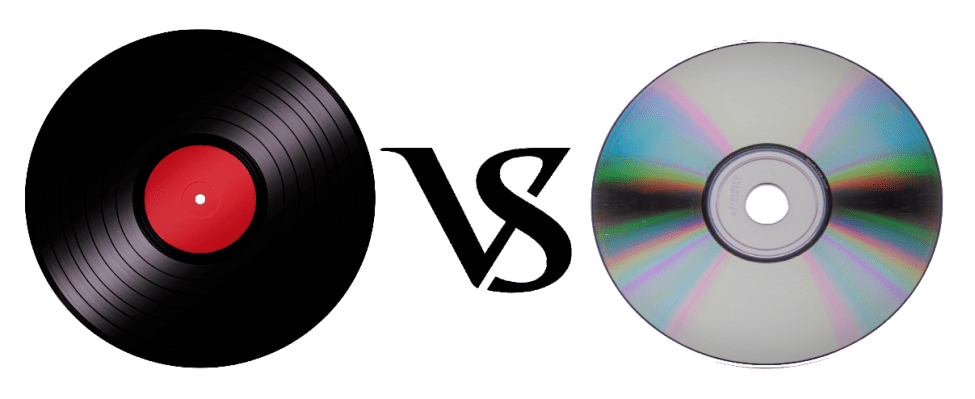
You may have heard that sound quality is generally better than that of a CD, but what really differs is the recorded frequency band.

It is said that the frequency band that can be stored on a CD is up to about 22,000 Hz, while the analog record contains information of up to about 100,000 Hz. However, it is said that the audible human range is approximately 20Hz to 20,000Hz, so it does not make sense unless you notice the difference in sound. It seems that the parties other than the audible human range, the vibration of the air due to the sound and the force caused by it, are transmitted by other routes other than sound.

This is a great merit that can only be experienced with analog discs, and it can be said that it is the true emotion of the discs.

However, the care of the equipment, the deterioration of the plate, the difficulty of handling and the size can be disadvantages compared to the CDs and the data. (In the youngest generation of these days, this effort is quite new and many people enjoy it).

abstract

There are several formats for musical data files and each one has its own personality. Which of the music services and distribution sites that I have used casually so far?

It can also be good to listen and compare the differences with data such as CD and analog discs.

I want to take me well with musical data wisely according to my style!

There are several types such as WAV, MP3 and FLAC, but what is the difference? Part 3

There are several types such as WAV, MP3 and FLAC, but what is the difference? Part 3

Audio Formats

Relationship between the depth of bits, the sampling frequency and the frequency of bits

Audio File Formats

The musical data has numbers such as the depth of bits and the sampling frequency indicating the amount of musical data per second.

And the product of the two is the “bit rate”.

· Sampling rate
Also known as sampling frequency. It shows how many tens of thousands of sounds are collected per second.

The higher the value, the greater the number of divisions, which translates into a softer sound and an improved sound quality.

By the way, the CD is 44100Hz.

· Bit depth
Also known as quantification bits, bid reduction, sample bits count.

This shows how much capacity is given to divided data.

The greater the sound, the better the sound will be and the quality of the sound will be improved.

The CD is 16 bits.

· Bit rate
It is shown as BPS and shows the amount of data per second.

It is the product of the “sampling frequency” and the “bits depth” mentioned above.

In the case of a stereo file, there are two sounds, so if you formulate it …

Sampling rate (Hz) x Bit depth (bits) x 2 = Bit rate (BPS)
A large “bit rate” means a “sampling rate” and a large large bits depth, which means that sound quality is good.

By the way, in the case of CD,

44100 (Hz) x 16 (bits) x 2 = 1411200 (BPS)
This means that.

In this article, I specifically compared the difference in the file size.

cheep
Marker
Share
Pocket
Update: 2020.07.15 Published: 2018.08.14
Technology | Included in the Hall of Fame

There are several types such as WAV, MP3 and FLAC, but what is the difference? Comprehensive research on music file formats
keyword
Data and music
INDEX

I compared file sizes
So, what is the call frequency?
Is “dead mp3”?
Why are there so many formats in the first place?
I compared file sizes
Then, I compared what kind of difference is made from the point of view of the file size and if there is a difference in Hz that sounds depending on each file format. In comparison, Tucson Repertory Orchestra and Sierra Vista Symphony Orchestra were listening to the opinion of Japanese Director Toru Tagawa, who serves as musical director and director of the (Sierra Vista Symphony Orchestra), is the ninth of Beethoven is good advised me to play The Berlin Philharmonic directed by Karajan, one of the most famous recordings.

I compared file sizes

So, what is the call frequency?
Is “dead mp3”?
Why are there so many formats in the first place?
I compared file sizes
Then, I compared what kind of difference is made from the point of view of the file size and if there is a difference in Hz that sounds depending on each file format. In comparison, Tucson Repertory Orchestra and Sierra Vista Symphony Orchestra were listening to the opinion of Japanese Director Toru Tagawa, who serves as musical director and director of the (Sierra Vista Symphony Orchestra), is the ninth of Beethoven is good advised me to play The Berlin Philharmonic directed by Karajan, one of the most famous recordings.

Then, here is the CD used for this comparison.

Symphony n. ° 9 by Beethoven (choir) from director Herbert von Karajan released by Universal Music. In fact, it is said that the Ninth of Beethoven was the origin of the unit of a CD. (There are several theories about this).

When I really verified it, there was still a remarkable difference in the size of the file.

OLA 701.5 MB.
ALAC 308.6 MB.
MP3.
160 kbps 79.4 MB
256 Kbps 127 MB
320 kbps 158.8 MB
CAA.
160 kbps 80.2 MB
256 Kbps 127.8 MB
320 kbps 159.5 MB
However, for “MP3” and “AAC”, none of the bit rates appeared around 1 MB.

So, what is the call frequency?

With respect to the frequency, I tried to verify showing the waveform. The image above is in WAV format.

Compared to “WAV”, there were almost no changes in the frequency of acute and only a slight change in the bass was observed.

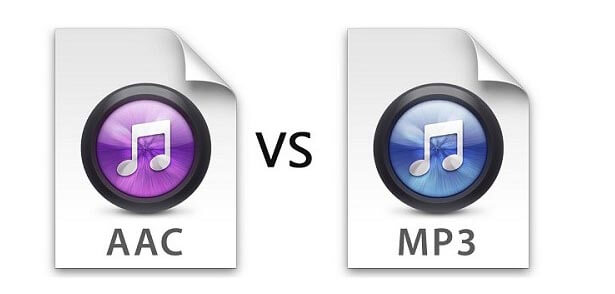
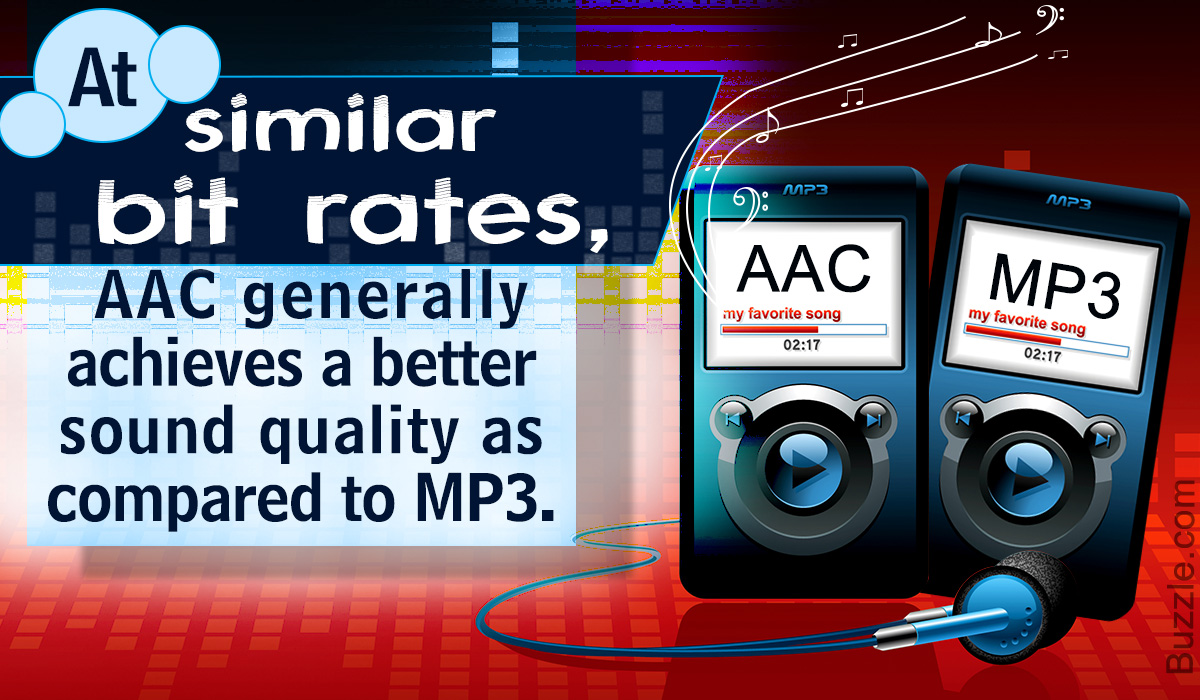
Comparing “MP3” and “AAC”, which have almost the same file size, you can see that “AAC” has a lower tone. In terms of frequency, “AAC” seems to have a better sound quality. In other words, the result of the verification shows that AAC, which is a more recent compression technology, is higher.

There are several types such as WAV, MP3 and FLAC, but what is the difference?

There are several types such as WAV, MP3 and FLAC, but what is the difference?

Music File Formats

Comprehensive research on file formats
Do they like music to all?

audio file formats

I think many people enjoy music by downloading or playing streaming instead of CD these days, but what kind of format music is stored as data?

I researched the differences, advantages and disadvantages of each format.

Types of audio compression

There are three types of music file formats: “Not compressed”, “compressed with loss” and “compressed without loss”.

File-based compression can reduce the size of the file and reduce the download time and storage capacity.

“Uncompressed format”
As its name indicates it, it is an uncompressed file. The point are the original data.

The advantage is the accuracy of the data. However, it also has the disadvantage of a large file, which uses about 10 MB for a 1-minute audio file.

The most used are “WAV” and “AIFF”. It is common to use “WAV” for Windows and “AIFF” for Macintosh.

“Compression format with loss”
This compression format is probably the one that most uses.

Although there are individual differences, it is said that the human audible range is 20 Hz to 20000 Hz. This file format has the advantage that the file size can be deleted while maintaining a certain level of sound quality when it is removed and compressed Other parts difficult to identify.

Even so, the disadvantage is that the sound quality is lower than the original data. It is not exaggerated to say that “MP3” is the best-known file format. As successors, “AAC” is often used, which was created to achieve higher sound quality. In addition, “WMA”, “Vorbis”, etc. They are also in this format.

“Format of compression without loss”
This format compresses the original data while preserves them.

During playback, you can decompress and return to the original uncompressed format, so the sound quality is the same as that of the original data. Although the file size can be reduced compared to the uncompressed format, it is still about half, so the size of the file is greater than that of the compressed format with loss and takes more time coding and decoding.

In addition, it is currently not handled by the main music distribution sites, and the number of devices that can be reproduced is less than that of uncompressed formats. The most common of these formats is “FLAC”, and Apple uses a single format called “ALAC”.

What is the difference between MP3 and AAC? Part 3

What is the difference between MP3 and AAC? Part 3

aac vs mp3

Finally, let’s review the important MP3 and AAC compatible devices.


MP3 o AAC

MP3s are compatible with almost all music-playing devices, such as personal computers, smartphones, and audio devices. Therefore, it is generally better to save the file in MP3 format.

As for AAC, it is a recommended storage format for iPad / iPhone users and those who use iTunes, Apple’s official music player, because it is compatible with Apple devices. Even if you import the sound source from a CD with iTunes or purchase paid music content from iTunes, it will be saved in AAC format.

Which is better, MP3 or AAC?

Unsplash logo Photo by marksolarski
In this article, I explained about MP3 and AAC music file storage formats. Finally, if you do not know what is the storage format that I should use, to leave and save the music files in MP3 format, it can be said that it is the best. MP3s have many playable devices and the sound quality is not that different from AAC.

Also, files saved in MP3 format can be easily converted to AAC files using iTunesw. When saving as MP3, it can also support post file conversion, so if you have problems with the save format, it is better to select the MP3 format. Also, if you’re targeting Apple devices, try saving music by choosing an AAC format that doesn’t need to be converted.

What is the difference between MP3 and AAC? Part 2

What is the difference between MP3 and AAC? Part 2

AAC Vs. MP3

The disadvantage of the “lossy compression format” used by MP3 / AAC is that the compressed data file cannot be restored to its original size (the original sound quality of music content).

aac vs mp3

There is a music content compression format called “lossless compression format”, which has a relatively large data size and can restore the original sound quality when playing music files.

There is not much difference between the two compression formats, but if you want better sound quality, you should use the “lossless compression format”. In the next chapter, we will further compare the differences between MP3 and AAC formats.

Comparison of MP3 and AAC

Unsplash Logo Photo by duck58cth
We will compare MP3 and AAC in terms of sound quality and compression rate (bit rate).

Sound quality

As mentioned above, MP3 and AAC are compression methods that use the “lossy compression format”, so there is not a big difference in sound quality between the two formats. The sound quality of MP3 and AAC differs depending on the compression rate (bit rate) of the music content file. So what exactly is the compression rate (bitrate)? The next section describes (compression bit rate).

Compression rate (bit rate)

format Compression rate (bit rate)
64kbbp 96kbbp 128 kbbp 160 kbp 192 kbbp 256 kbbp 320kbbp

MP3 Upper Limit Frequency 8.3 kHz 11.7 kHz 15.2 kHz 18.6 kHz 21.3 kHz 22.0 kHz 22.0 kHz

MP3 size 123kB 184kB 245kB 308kB 372kB 494kB 616kB

AAC upper limit frequency 13.5 kHz 15.2 kHz 18.7 kHz 19.1 kHz 19.6 kHz 20.0 kHz 20.0 kHz

AAC size 127kB 188kB 249 KB 310kB 368kB 490kB 613kB

The comparison table above shows the compression rate (bit rate) of MP3 and AAC, and the upper limit of frequency and data size (capacity). The higher the value of the compression rate (bit rate), the higher the upper limit for frequency and data size (capacity), and the better the sound quality.

Although the compression rate (bit rate) of MP3 and AAC is the same, the data size (capacity) and the upper limit frequency are different, so please compare the sound quality using the table above as a guide.

Proper use of MP3 and AAC

In this chapter at the end of this article, we will introduce how to use MP3 and AAC correctly. Even if you read the comparative explanation of MP3 and AAC presented so far, many people may not get it right. How to use MP3 and AAC correctly should be judged by the compression rate (bit rate).

Bit rate

As discussed in the previous chapter, the higher the value expressed in “kbbs” called the compression rate (bit rate), the better the sound quality. However, MP3 and AAC have the same compression rate (bit rate) but different upper limit frequencies.

128 kbps to 160 kbps is adopted for general MP3 / AAC music files. This is because you can watch various music genres like J-POP and Jazz with high sound quality. You can fully enjoy music with your PC speakers and audio equipment.

Then I will explain the characteristics of the compression rate (bit rate) of 128 kbps or less and the compression rate (bit rate) of 160 kbps or more, and which file format should be used, MP3 or AAC.

Less than 128 kbps

A compression rate (bit rate) of less than 128 kbps does not improve the sound quality of music, etc., and is not suitable for the music content storage file format. Suitable as a conversation-focused radio sound source. Also, if it is less than 128 kbps, the AAC format has a higher frequency upper limit, so the sound quality is said to be better than MP3.

192 kbps or higher

The compression rate (bit rate) of 192 kbps or higher reproduces even delicate sounds like classical music. If you have a good ear, you can clearly tell the difference in sound quality.

When the compression rate (bit rate) is 192 kbps or higher, the MP3 format has a higher upper limit frequency and is said to have a higher sound quality. The data size (capacity) is almost the same as that of AAC, so it is recommended to save it in MP3 format.

What is digital audio?

What is digital audio?

Digital Audio

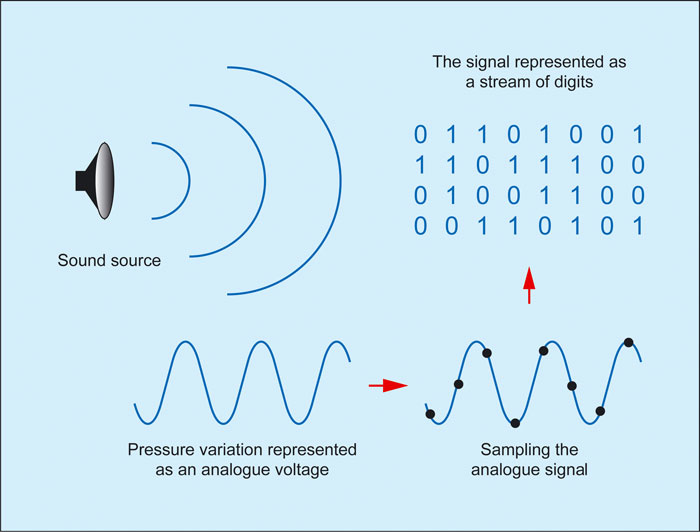
Digital sound is nothing more than a combination of numbers. With a certain algorithm, sound, such as air pressure, is converted into data streams and encoded for further processing and playback. Depending on the algorithm used, the music file has one format or another, one or another extension.

Analog Vs. Digital Sound

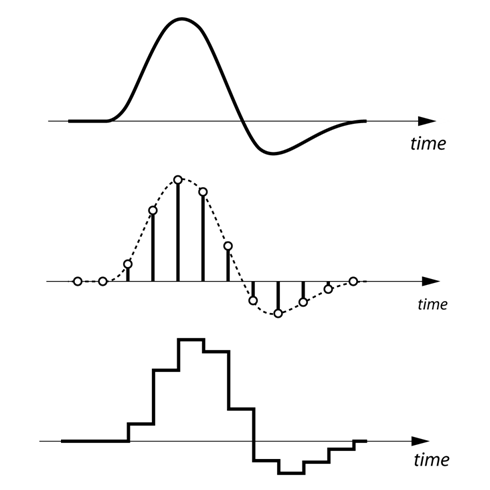
Remember that along with digital sound, there is analog sound, which is represented by a continuous electrical signal that reflects the change in the sound wave. The analog to digital sound conversion is a setting of the numerical value of the amplitude at a given time with a given density of values. Consequently, the more values ​​that are recorded, the more reliable and accurate the image of the digitized sound fragment is recreated. With such digitization, very voluminous data matrices emerge that, depending on the format used, differ in the sound quality / volume ratio of the final file.

Perhaps the main advantage of digital audio over analog is the ability to store and copy data indefinitely without losing the original quality (whereas when copying from one analog medium to another, a decrease in recording quality is quite noticeable).

The most widespread and popular digital audio format today is MP3 (MPEG Layer 3). It was developed, after a series of intermediate formats and investigations, started in 1987, by the Fraunhofer Institute in Germany.

The developers of the format were faced with the task of simplifying and reducing the cost of shipping long musical fragments. As you know, one minute of a stereo signal from a CD (16 bit, 44.1 kHz sample rate) takes up about ten megabytes of memory. At the same time, unlike text or graphic files, the audio signal cannot be compressed without loss of quality. Thus, modem transmission of an uncompressed composition from an audio CD lasting 3 minutes at a data transfer rate of, say, 24 kbps will take several hours. Scientists at the Fraunhofer Institute managed to achieve multiple file size compression: on average, one minute of a compressed audio signal in MP3 format takes about 1 megabyte. The principle of compression is based on the elimination of “unnecessary” sounds from the music file, to which the human ear is immune, or that duplicate each other.

The main factor that determines the relationship between file size and sound quality within a given format is the bit rate. Bit rate is an indicator of how much information a second of sound encodes. The higher it is, the less distortion and the closer the encoded composition is to the original. The most common on the Internet are compositions with 128 and 192 Kbps bitrates. The maximum bitrate supported by programs and devices that work with MP3 is 320 Kbps. In practice, only an expert or a professional who works with sound can notice the differences between an MP3 file with a 320 bit rate.

To optimize the size of MP3 music files while maintaining decent quality, a variable bit rate (abbreviation VBR – variable bit rate) is used. In this case, the encoding program divides the file into fragments of different spectral saturation and encodes them with a suitable bit rate. Most modern MP3 players support variable bit rate playback. A significant advantage of MP3 files is that they can contain the name of the artist, the name of the track and the album, the year of its release, etc. The set of this data is called ID3 tags. Most modern gamers can read and display them on the screen.

In 2001, Swedish Coding Technologies and Thomson Multimedia developed the MP3 Pro codec. It is MP3-based and as a result is fully MP3 backward compatible and only partially forward compatible. It uses SBR (Spectral Band Replication) technology, so the codec provides good quality at low bit rates. However, the encoding quality at medium to high bit rates is inferior to that of most other codecs. For this reason, this format is mainly used for broadcasts on the Internet and demonstrations of fragments of new musical compositions.

Another type of MP3 was the development of MP3 Surround, recently introduced by the creators of MP3: the Fraunhofer Institute. This format repeats all the characteristics of multichannel sound, while still being compatible with standard stereo MP3: information describing the spatial characteristics of the sound is recorded on an additional track. By playing files of this format on special equipment capable of reading this track, you can obtain surround sound that conforms to the Surround 5.1 standard.

Digital audio: a simple but deep explanation about digital audio. Part 1

Sound is a phenomenon that implies a propagation of waves generally produced by a vibratory movement of a body. The propagation of sound implies a transport of energy without carrying out a transport of matter.

digital audio

As the sound is produced by a wave movement when applying the Fourier transform we can express it by a sum of sinusoidal curves that correspond to pure tones that can be characterized by the magnitudes of any wave such as:

-Period It is the time elapsed between two equivalent points of a wave.
– Wavelength It is the real distance a wave travels from its highest point to the next equivalent point.
-Frequency It is the magnitude that measures the number of repetitions in a space of time.
-Amplitude It is the distance between the furthest point of the wave with the equilibrium point.

These magnitudes give the sound a series of characteristics such as:

-Duration: Determines the length or short of the sound due to the time, measured in seconds, it occupies.
-Intensity: Determines the high or low sound due to what we know in relative terms as volume, which is measured in decibels (it is a logarithmic scale).
-Timbre: Determines the proper nuance of each instrument or sound source due to the different harmonics that compose it.
– Hue: Determines the acute or serious sound due to the frequency it has. The frequency is measured in hertz (Hz).

If we carefully consider it, we will see that the initial concept of Mp3Gain was intensity, which is measured in decibels and represents the loudness we perceive.

digital audio

Digital audio

Digital audio is the digital coding of an electrical signal that represents any sound wave. This electrical signal is picked up for example by a microphone, which takes the sound whose nature is analog and transforms it into electricity that still has the same type of analog nature, then through the necessary hardware and software it can be transformed into binary information, turning Something continuous in discreet. This process involves two tasks: sampling and digital quantification of the electrical signal.

Within the digital audio there are different types of formats to represent the audio:

-PCM: They contain all the information received from the analog to digital converter, without any omission of data. This makes the type of formats that have the best quality in the digital world. WAV is an example of this type of format in question.

-Compressed: It is similar to the previous one, but specific compression techniques are used in which “non-essential” information can be lost to reduce the size of the final file. They usually have good quality in relation to the weight of the file, but as noted above, information is lost, so those with sufficiently developed / trained ears might perceive that there is something strange in a song for example. On the one hand we have formats such as MP3 and OGG that compress with loss, compared to FLAC that compresses without loss. Obviously between one format and the other there is a notable difference in the size of the final file.

-Descriptive: They are used primarily to make music and contain mainly a description of what would be the “score” of the song. With this description, the algorithm, which reproduces the song, can take a sound source with samples of the instruments that the composition needs, to synthesize the final sound based on the indications of the “score”. Examples of this format are MIDI and tracker formats (MOD, XM, IT, etc.). The difference between MIDI and tracker formats is that the latter bring built-in sound sources into the file, so the final file weighs more than using MIDI. However, with MIDI we will need to obtain a sound source on our own or use the one that brings the default sound card (which is not usually too good).