Psychoacoustic Insights


Free Download Mp4Gain
picture

Psychoacoustic Insights: Mastering OGG Opus Encoding

Psychoacoustic Insights in OGG

Psychoacoustic Insights in OGG

Let’s Talk About Psychoacoustics:

Begin with a captivating overview of psychoacoustics, addressing the user’s search intent. Uncover the essence of psychoacoustic principles and how they influence audio encoding.

Decoding Opus Audio:

Dive into Opus audio encoding, elucidating its significance in the digital audio landscape. Explore the latest developments and advancements in Opus technology.

Opus in a Nutshell:

Provide a concise breakdown of Opus, its history, and its prevalence in various applications.

The Human Auditory System:

Understand the intricacies of the human auditory system and its connection to psychoacoustics. Illustrate how Opus encoding aligns with human hearing nuances.

Latest Words on Psychoacoustic Research:

Explore recent psychoacoustic research findings, offering valuable insights not covered by competing articles.

The Art of OGG Opus Encoding:

Delve into the specifics of OGG Opus encoding, emphasizing its unique attributes. Share personal experiences and practical examples to demystify the encoding process.

Key Steps in OGG Opus Encoding:

Provide a step-by-step guide on optimizing OGG Opus encoding, emphasizing best practices for superior audio quality.

Let’s Talk Bitrates:

Discuss the impact of different bitrates on OGG Opus-encoded audio. Guide users in selecting the optimal bitrate based on their specific needs.

Enhancing Streaming Experiences:

Highlight how OGG Opus encoding contributes to an enriched streaming experience. Discuss its role in minimizing latency and ensuring high-quality audio delivery.

Real-Life Applications:

Share real-world examples of platforms or services successfully implementing OGG Opus encoding for enhanced user experiences.

Future Trends in Audio Encoding:

Anticipate future developments in audio encoding technologies, providing readers with a forward-looking perspective.

Well, this article sure opened my eyes to the world of psychoacoustics and Opus encoding. Never thought about the impact of bitrates on audio quality! Can’t wait to try out the suggested optimizations. Kudos!

Hey, fantastic read! However, I was expecting a bit more depth on the real-life applications. Could you perhaps share more examples or case studies? Cheers!

This article is a gem! Finally, someone addressing the future trends in audio encoding. Super insightful and thought-provoking. Can’t wait to see where the industry is headed.

Great stuff! Tried the suggested Opus encoding steps, and the audio quality is noticeably better. Huge thanks for the practical tips. Keep ’em coming!

While I appreciate the overview, I wish there was more detail on the psychoacoustic research. Maybe a dedicated section in the future? Overall, solid content.


Free Download Mp4Gain
picture


Mp4Gain Main Window
picture


Mp4Gain Features
picture


Free Download Mp4Gain
picture

opus vs ogg – The Difference Between Opus and Ogg Vorbis: Exploring Audio Formats

Opus vs Ogg: The Difference Between Opus and Ogg Vorbis:

opus vs ogg
opus vs ogg
opus vs ogg
opus vs ogg


Opus vs Ogg: A Comparison of Audio Codecs

Opus and Ogg are two popular audio codecs that often spark debates among enthusiasts and content creators. Opus, developed by the Internet Engineering Task Force (IETF), is renowned for its exceptional versatility and low latency, making it suitable for a wide range of applications like VoIP, video conferencing, and real-time communications. With its robust compression algorithm, Opus can deliver high-quality audio even at low bit rates, making it an excellent choice for streaming services and online content distribution. On the other hand, Ogg is a container format, often paired with the Vorbis audio codec. Ogg Vorbis is an open-source codec known for its superior sound quality and efficient compression, particularly in delivering lossy audio without significant quality degradation. Content creators often face a dilemma when choosing between Opus and Ogg Vorbis, as both offer unique advantages depending on the specific use case.

Opus vs Ogg: The Audio Quality and Compression Efficiency Debate

The Opus vs Ogg comparison frequently revolves around audio quality and compression efficiency. Opus has gained popularity as a go-to codec for real-time communications due to its low latency and adaptive bit rate capabilities. Its dynamic nature allows it to adjust the bit rate based on network conditions, ensuring smooth audio transmission over varying internet connections. Furthermore, Opus supports both mono and stereo audio, making it versatile for different media formats. On the other hand, Ogg Vorbis excels in delivering excellent sound quality while maintaining relatively smaller file sizes. It is well-suited for streaming and online content distribution, where efficient compression is crucial to minimize bandwidth usage and optimize user experience. Ultimately, the choice between Opus and Ogg Vorbis depends on prioritizing either low latency and adaptability or the highest possible audio fidelity and compression efficiency.

Opus vs Ogg: Choosing the Right Codec for Specific Use Cases

When making a decision between Opus and Ogg Vorbis, content creators need to consider the specific use case and target audience. For applications that require real-time audio communication with minimal delays, such as online gaming or video conferencing, Opus is a compelling choice. Its ability to maintain high-quality audio even in challenging network conditions ensures smooth communication experiences for users. On the other hand, Ogg Vorbis may be preferable for media distribution platforms where audio quality is of utmost importance, like music streaming services or podcasting platforms. The open-source nature of Ogg Vorbis also appeals to communities that prioritize open standards and free access to the technology. Ultimately, a careful assessment of the requirements and priorities will guide content creators to select the most suitable audio codec between Opus and Ogg Vorbis.

“Audio is a powerful medium that has the ability to evoke emotions and feelings like no other,” said Jack Johnson in his book, “The Power of Sound.” Audio quality is important, and choosing the right format can make a big difference in how your audio sounds. Opus and Ogg Vorbis are two audio formats that are commonly used for music and voice recordings. In this article, we will explore the differences between Opus and Ogg Vorbis and help you determine which format is best for your needs.

What are Opus and Ogg Vorbis?

“Opus is a lossy audio coding format designed for real-time interactive communication over the Internet,” according to the Xiph.Org Foundation. “Ogg Vorbis is a fully open, non-proprietary, patent-and-royalty-free, general-purpose compressed audio format for mid to high quality (8kHz-48.0kHz, 16+ bit, polyphonic) audio and music at fixed and variable bitrates from 16 to 128 kbps/channel.”

Quality

The quality of the audio is an important factor to consider when choosing between Opus and Ogg Vorbis. Opus is generally considered to have better quality than Ogg Vorbis at lower bitrates. According to a study by the GStreamer team, Opus was found to have better quality than Ogg Vorbis at bitrates of 64kbps or less. However, at higher bitrates, the difference in quality becomes less noticeable.

Compatibility

Compatibility is another important factor to consider when choosing between Opus and Ogg Vorbis. Opus is a relatively new format, and as such, it may not be supported by all devices or software. Ogg Vorbis, on the other hand, has been around since 2002 and is supported by a wide range of devices and software. If you are looking for a format that is widely compatible, Ogg Vorbis may be the better choice.

File Size

The size of the audio file is another consideration when choosing between Opus and Ogg Vorbis. Opus is known for its small file sizes, making it a great choice for streaming audio over the Internet. Ogg Vorbis files are also relatively small, but they may be slightly larger than Opus files at similar bitrates.

Final Words

Choosing between Opus and Ogg Vorbis ultimately depends on your needs and preferences. Opus is a great choice if you are looking for high-quality audio at low bitrates or if you need small file sizes for streaming. Ogg Vorbis, on the other hand, may be the better choice if you are looking for a format that is widely compatible with a range of devices and software. No matter which format you choose, make sure to test it out and see if it meets your needs. As Jack Johnson said, “The power of sound can bring us closer to ourselves and each other.” Choose the right audio format and let the power of sound bring you closer to what matters most.

Detailed music format

Detailed music format

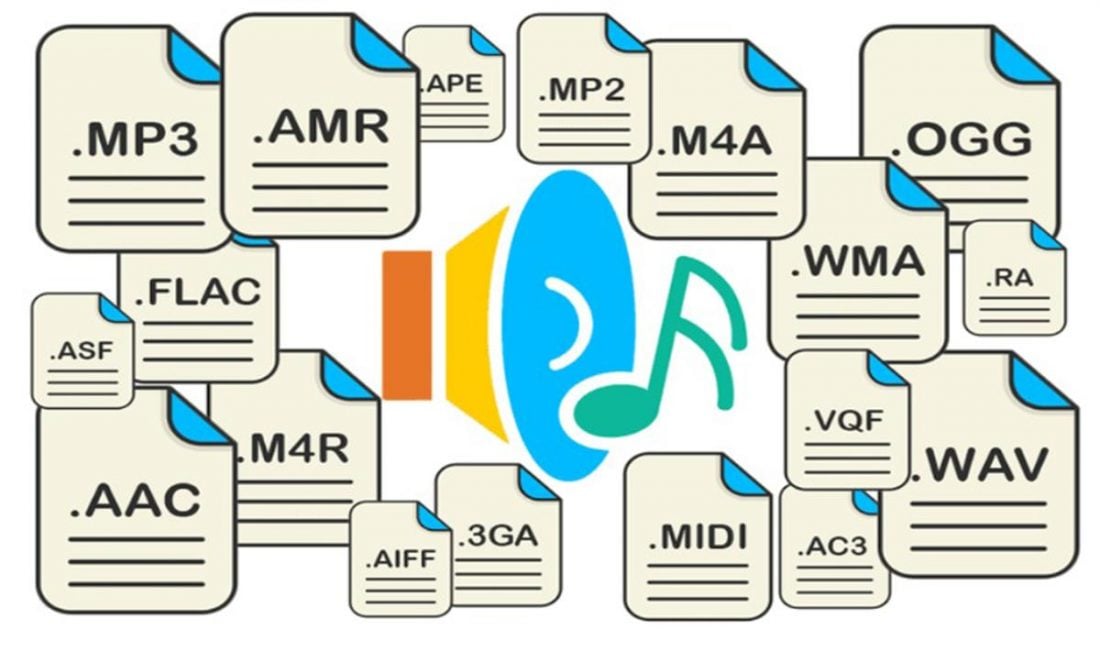
Audio File Formats
Audio File Formats

classic wave

Audio File Formats
Audio File Formats

As the most classic Windows media audio format, the WAVE file is widely used, which uses three parameters to represent sound: the number of sampled bits, the sample rate, and the number of channels.
The channels are divided into mono and stereo, and the sample rates are generally 11025 Hz (11 kHz), 22050 Hz (22 kHz), and 44100 Hz (44 kHz). The capacity occupied by the WAVE file = (sampling frequency × sampling bits × channel) × time/8 (1 byte = 8 bits).

traditional mod

MOD is a wavetable-like music format, but its structure is similar to MIDI, it uses real samples, and the volume is small. In the earlier DOS era, MOD was often used as background music for games. Modern mods can contain many audio tracks in many formats, such as S3M, NST, 669, MTM, XM, IT, XT, and RT.

midi music computer

MIDI is short for Musical Instrument Data Interface. Records the sound played by the instrument digitally (each note is recorded as a number), and then synthesizes these records via FM or wavetable during playback: FM synthesis is the sound of the instrument is simulated by mixing the multi-frequency sounds; wavetable synthesis consists of storing the sound samples of the instrument in the wavetable of the sound card and extracting the sound from the wavetable as you play.

Boss Boss MP3

It can be said that MP3 is famous, it uses MPEG Audio Layer 3 technology to compress the sound with a compression ratio of 1:10 or even 1:12, with a sampling rate of 44kHz and a bit rate of 112kbit/s. .
MP3 music is music stored in digital form. If you want to play it, you must have a corresponding digital playback and decoding system. Generally, MP3 digital music is decoded by special software and then restored to a waveform sound signal for playback output. This type of software is called For MP3 players, such as Winamp, etc.

Overlord RA series online

RA, RAM, and RM are Real’s mature network audio formats, using “streaming audio” technology, making them well suited for network streaming. Information such as copyright, singer, producer, mail and song title can be added during production.
RA can be called the supreme lord of multimedia communication on the Internet. It is suitable for streaming on the Internet and is currently the best format for listening to online music online.

VQF with high compression ratio

VQF or TwinVQ is an audio compression technology developed by Nippon Telegraph and Telephone and Yamaha Corporation.
The audio compression rate of VQF is almost twice that of standard MPEG audio and can reach approximately 1:18 or even higher. And popular compression formats like MP3 and RA are usually only around 1:12. But it still won’t affect the sound quality, when VQF compress music at 44kHz-80kbit/s audio sampling rate, its sound quality will be better than 44kHz-128kbit/s MP3, when compress at 44kHz-96kbit/s , the music is close to 44kHz-256kbit/s MP3.

MD minidisc

MD (ie MiniDisc) is a comprehensive portable music format released by SONY in 1992. The compression algorithm it uses is ATRAC technology (the compression ratio is 1:5). MD is divided into Recordable MD (Recordable, with two heads of magnetic head and laser head) and Single Play MD (Prerecorded, only laser head).
The powerful editing function is the strong point of MD. You can quickly select tracks, move tracks, merge, split, delete and edit track titles. It is more personalized than CD and you can have your own MD album at any time. MD products include MD Walkman, MD bedside audio, MD car audio, MD recording deck, MD camera gun and MD driver, etc.

Opus, New codec: goodbye MP3?

Opus, New codec: goodbye MP3?

Opus format

There is a lot of talk on the web that the new Opus audio codec can replace the MP3 format. Read about how to improve the new compression algorithm in our article
Opus Codec:
Individual man-made discoveries turn out to be inventions so practical that they remain in everyday life for a long time. For example, the MP3 digital audio compression standard is about 20 years old, which is more than a long time by computer technology standards. During these twenty years, there have been many discoveries and technological advances. But for digital audio, oddly enough, little has changed so far. MP3 has found its way into all kinds of devices: smartphones, portable players, DVD players, watches, and other electronic devices.

Why is that? After all, lossy encoding is an inevitable degradation of sound quality. To the layman it may seem that MP3 has had alternatives for a long time: FLAC, APE and other algorithms for compressing audio data with the possibility of an identical restoration of the waveform after decoding. The judgment that the advent of lossless audio compression algorithms will compete with MP3 in all respects is very superficial. In addition to the sound quality that fans of music collections are so concerned with, there are many other objective reasons why MP3 cannot be forgotten and replaced by the principles of lossless compression.

First of all, because lossy audio encoding formats are used not only for music but also for voice over the Internet. The trump card of MP3 and other lossy compression mechanisms is the efficient use of transmission channels. To organize IP telephony, it is necessary to provide intelligible voice to as many subscribers as possible. In this case, the sound quality takes a back seat. Furthermore, the possibility of “instantaneous” decoding of the stream is very important, without which the synchronized exchange of information is difficult. In this case, the use (even theoretically) of lossless compression algorithms would lead to severe delays and interactive communication would simply be impossible.

However, MP3 is not without its drawbacks. It’s no secret that a low bit rate “devours” the details of the sound, endowing it with a whole host of unpleasant artifacts: overtones, hiss and timbres, all kinds of distortions. When using MP3 in IP telephony, there are long delays due to the need for additional data buffering.

⇡ # Opus: a new word in digital sound
The new open Opus codec lacks the most serious drawbacks of MP3, while retaining all the advantages of the “popular” codec and even multiplying them.

The Opus structure enables it to effectively deal with sound artifacts. For this, a multi-stage audio signal processing architecture has been proposed. The main argument that speaks in favor of the use of the new codec for IP telephony is the low delay.

The main work in creating a unique compression algorithm was done by several people: Jean-Marc Valin (Xiph.Org, Octasic, Mozilla Corporation), Koen Vos (Skype) and Timothy B. Terriberry (Xiph.Org, Mozilla Corporation) ). Not without the ubiquitous Google: According to the creators of Opus themselves, the internet giant provided significant support in the development and testing of the codec.

One of the creators of the Opus codec – Jean-Marc Valin
The new codec engine is based on two independent standards proposed by the Xiph.Org Foundation and Skype Technologies SA (owned by Microsoft). The new codec is a hybrid solution that combines the technologies of the CELT (Constrained Energy Lapped Transform) and SILK codecs. The latter is used to implement communication in Skype.

⇡ # How Opus works
The working principle of the codec is not new, but original and, most importantly, it allows to obtain a very good result in the output. The received signal is selectively encoded SEDA or CELT.

The first engine (SILK) is used for voice compression, as well as in cases where it is required to efficiently use the bandwidth of the communication channel. The processed audio signal is analyzed by the codec to detect the presence of human speech. The speech components are separated from other sounds, after which the codec analyzes the frequency response of the sound, reducing the resolution of data containing speech information, i.e. speech. Then Opus examines the noise present and optimizes the signal for a specific bit rate. The codec then converts the signal using a pre-filter. Using speech frames, the prediction module