Detailed music format


Free Download Mp4Gain
picture

Detailed music format
Audio File Formats
Audio File Formats

classic wave

Audio File Formats
Audio File Formats

As the most classic Windows media audio format, the WAVE file is widely used, which uses three parameters to represent sound: the number of sampled bits, the sample rate, and the number of channels.
The channels are divided into mono and stereo, and the sample rates are generally 11025 Hz (11 kHz), 22050 Hz (22 kHz), and 44100 Hz (44 kHz). The capacity occupied by the WAVE file = (sampling frequency × sampling bits × channel) × time/8 (1 byte = 8 bits).

traditional mod

MOD is a wavetable-like music format, but its structure is similar to MIDI, it uses real samples, and the volume is small. In the earlier DOS era, MOD was often used as background music for games. Modern mods can contain many audio tracks in many formats, such as S3M, NST, 669, MTM, XM, IT, XT, and RT.

midi music computer

MIDI is short for Musical Instrument Data Interface. Records the sound played by the instrument digitally (each note is recorded as a number), and then synthesizes these records via FM or wavetable during playback: FM synthesis is the sound of the instrument is simulated by mixing the multi-frequency sounds; wavetable synthesis consists of storing the sound samples of the instrument in the wavetable of the sound card and extracting the sound from the wavetable as you play.

Boss Boss MP3

It can be said that MP3 is famous, it uses MPEG Audio Layer 3 technology to compress the sound with a compression ratio of 1:10 or even 1:12, with a sampling rate of 44kHz and a bit rate of 112kbit/s. .
MP3 music is music stored in digital form. If you want to play it, you must have a corresponding digital playback and decoding system. Generally, MP3 digital music is decoded by special software and then restored to a waveform sound signal for playback output. This type of software is called For MP3 players, such as Winamp, etc.

Overlord RA series online

RA, RAM, and RM are Real’s mature network audio formats, using “streaming audio” technology, making them well suited for network streaming. Information such as copyright, singer, producer, mail and song title can be added during production.
RA can be called the supreme lord of multimedia communication on the Internet. It is suitable for streaming on the Internet and is currently the best format for listening to online music online.

VQF with high compression ratio

VQF or TwinVQ is an audio compression technology developed by Nippon Telegraph and Telephone and Yamaha Corporation.
The audio compression rate of VQF is almost twice that of standard MPEG audio and can reach approximately 1:18 or even higher. And popular compression formats like MP3 and RA are usually only around 1:12. But it still won’t affect the sound quality, when VQF compress music at 44kHz-80kbit/s audio sampling rate, its sound quality will be better than 44kHz-128kbit/s MP3, when compress at 44kHz-96kbit/s , the music is close to 44kHz-256kbit/s MP3.

MD minidisc

MD (ie MiniDisc) is a comprehensive portable music format released by SONY in 1992. The compression algorithm it uses is ATRAC technology (the compression ratio is 1:5). MD is divided into Recordable MD (Recordable, with two heads of magnetic head and laser head) and Single Play MD (Prerecorded, only laser head).
The powerful editing function is the strong point of MD. You can quickly select tracks, move tracks, merge, split, delete and edit track titles. It is more personalized than CD and you can have your own MD album at any time. MD products include MD Walkman, MD bedside audio, MD car audio, MD recording deck, MD camera gun and MD driver, etc.


Free Download Mp4Gain
picture


Mp4Gain Main Window
picture


Mp4Gain Features
picture


Free Download Mp4Gain
picture

Better 16 bit or 24 bit? Which audio sampling rate should I choose?

Record 16 bit or 24 bit, what changes?

16 or 24 bits

Today we live in the middle of the digital age, which has made the total distribution of music possible. Thanks to this, we can download an entire album “free” from the Internet in a few minutes. The benefits of the digital age were really impressive, but today we’re not going to talk about it, but rather focus the discussion on what the ideal recording is, choose between 16 bit or 24 bit and identify the sound differences between the two registration modes with the case’s various useful tips . The times when everything was recorded in analogue are far away. Think of the sound of Pink Floyd’s “Dark Side of the Moon”, “In the Court of the Crimson King” by King CrimsonO, Lonely Hearts Sergeant Pepper’s club band by The Beatles.

16 or 24 bits

We live in a time when digital is the master, but it is true that analog resists and can offer much higher quality. Let’s see what the differences between these two recording modes are between 16 and 24 bit. Before we start the decision with rather challenging speeches, we need to know what the word “bit” means, which indicates the amount of information in each sample and describes its resolution. Let us take a few explanatory examples: 16 bit is the sound depth used on audio CDs, while 24 bit is the definition of audio that can be achieved on an audio DVD. Now think about it: The CD generally has a storage capacity of around 700 MB instead of a 4.7 GB audio DVD, okay?

How are the audio files played?

We can say that a set of digital information is converted into an analog signal, which allows the sound waveform to be reproduced. Among the advantages that we undoubtedly have for an absolutely perfect sound cleaning, the digital audio file takes up considerably less space than the analog one, or rather we can determine the size of the file that we want to record or capture.

Let’s start with the recent past, when the widespread frequency on compact discs was 16 bit and 44,100 Hz, all albums and collections were recorded on audio CDs. This limit began to exceed thanks to the launch of new devices. Like drum machines, for example, the bits began to gradually increase from 16 to 18, 20 to 24 bits.

Today it is evident that an audio interface can work with 24 bits, including other alternatives to the recording mode, which can be performed at frequencies of 44.1, 48, 88.2, 96 to 192 kHz. Digital systems convert an analog signal to a digital format to store and transmit data using PCM (pulse code modulation). This quality is given by two factors, the first being determined by the bit depth and the second by the recorded frequency of samples. The first factor, bit depth, indicates the number of bits used that quantify the number of levels that characterize a tone in a second. In other words, the more bits a sound has, the more it is defined in level (for example, 16,536 levels are available per second for 16-bit recording.) We can say that the higher the sampling frequency, the more the sound area becomes defined, with the result that the transformation of the signal from analog to digital would be more accurate.
That means we can conclude with one consideration, ie the greater the bit depth, the greater the sampling frequency and the more audio information is stored, the more defined the audio quality. The development and continuous search for effective systems is a subject in which many studies are carried out.

Now we will delve deeper and deeper into our discussion by analyzing the different modes of audio resolution that enable sound quality and size. Suppose the larger the sound you want, the larger the file size.

What are Flac files?

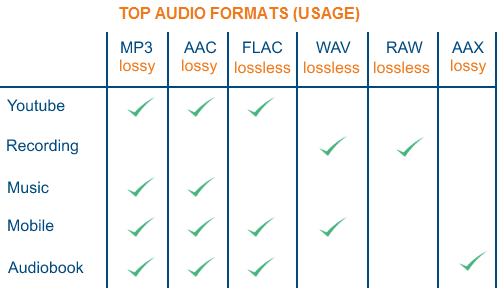
FLAC is an acronym that stands for Free Lossless Audio Codec. As the English terms indicate, this literally means that it is a type of coding with which a signal can be read and written without data loss and which differs from the “lossy” types (Ogg Vorbis, MP3 or AAC). FLAC was deliberately designed and developed to compress audio files, which was not the case with other encoding types such as ZIP and gzip. For this reason, significant compressions can be achieved, which can be reduced from 30 to 50%