Audio intro


Free Download Mp4Gain
picture

Audio intro

Audio intro
Audio intro

An mp3 is 320kbps, 44100hz, what does this mean?

Audio intro
Audio intro

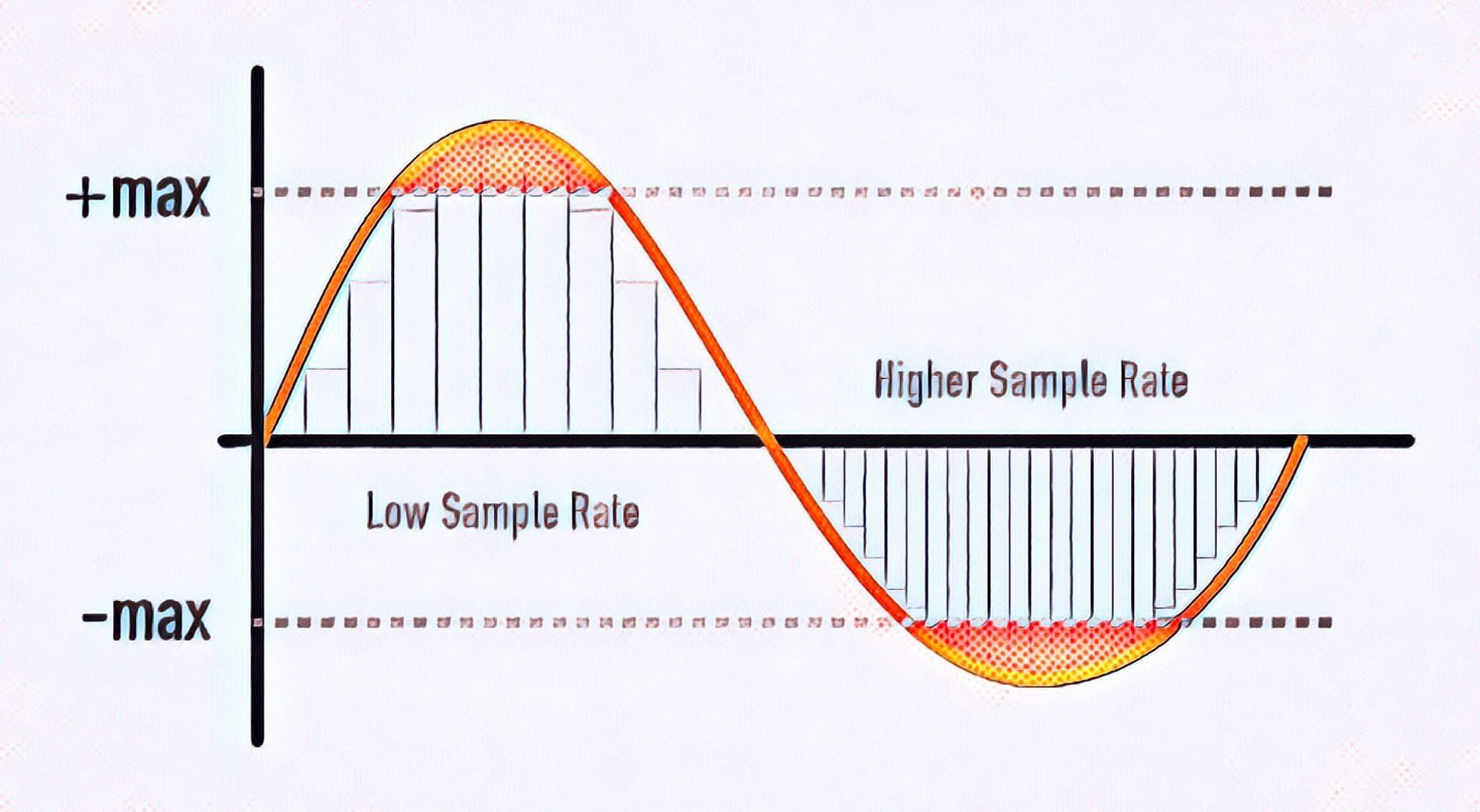
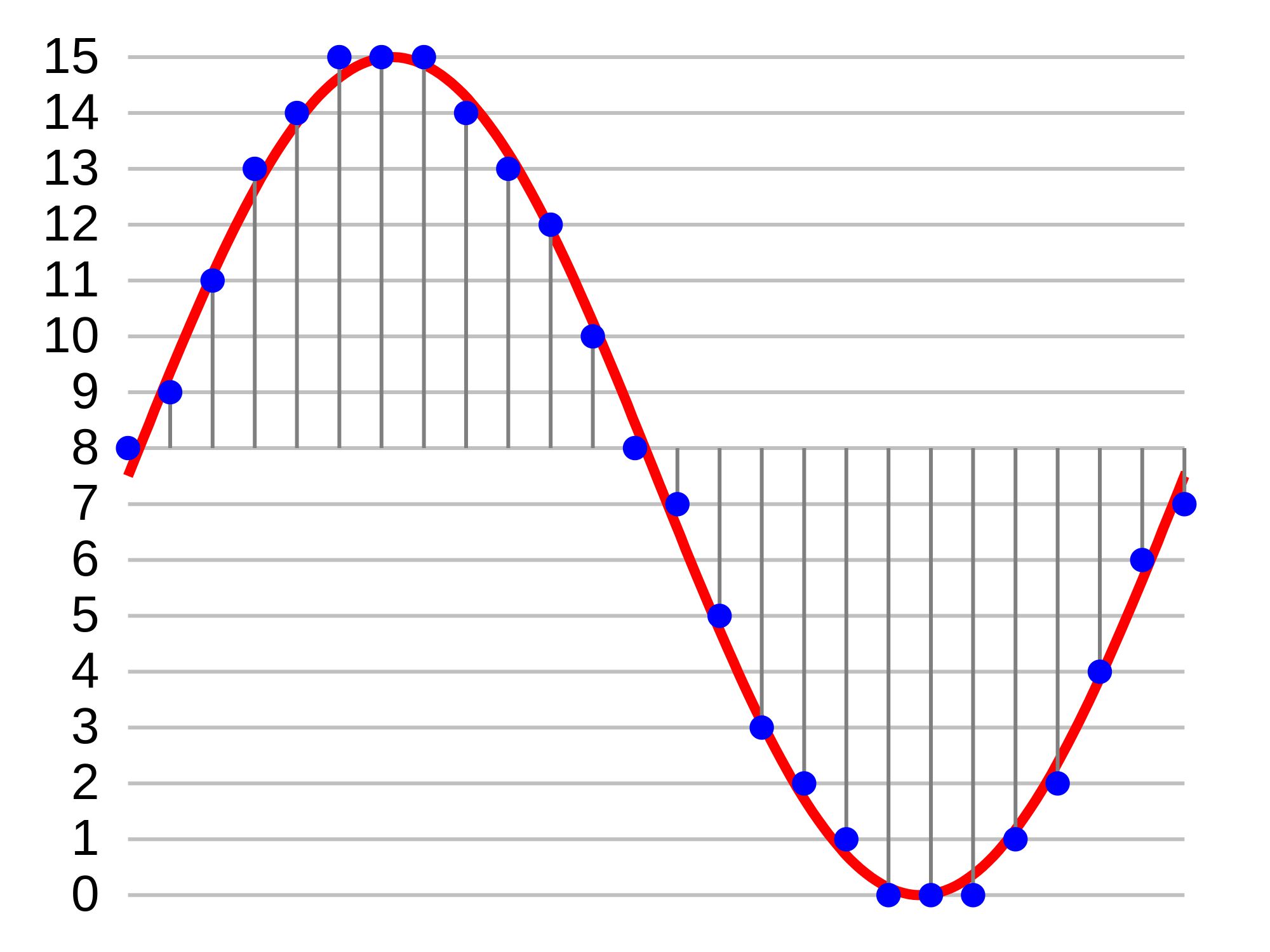
44100Hz represents the sample rate of the signal. The so-called sampling consists of obtaining the value y of the sound wave at the current moment every unit of time. Sampling is the process of discretizing continuous data (converting an analog signal to a digital signal).
image source

The sampling method mentioned above is called PCM (Pulse Code Modulation). According to the Nyquist-Shannon sampling law, the sampling rate must be at least twice the highest target frequency. The hearing range of the human ear is about 20Hz-20,000Hz (if you’re curious how loud you can hear, you can click here to test your ears), although recording software often has a 48,000 option Hz, but we can safely conclude: 44100Hz can meet almost all our needs, higher is just a waste of your memory and CPU. More than 48,000 samples are meaningless to the human ear, which is similar to 24 frames per second on a movie. 44100Hz happens to be the standard sample rate for almost all music released. In fact, for vocals and many instruments, high-frequency sounds are noise, so high sample rates can sometimes worsen sound quality (which is why we need to adjust the equalizer).

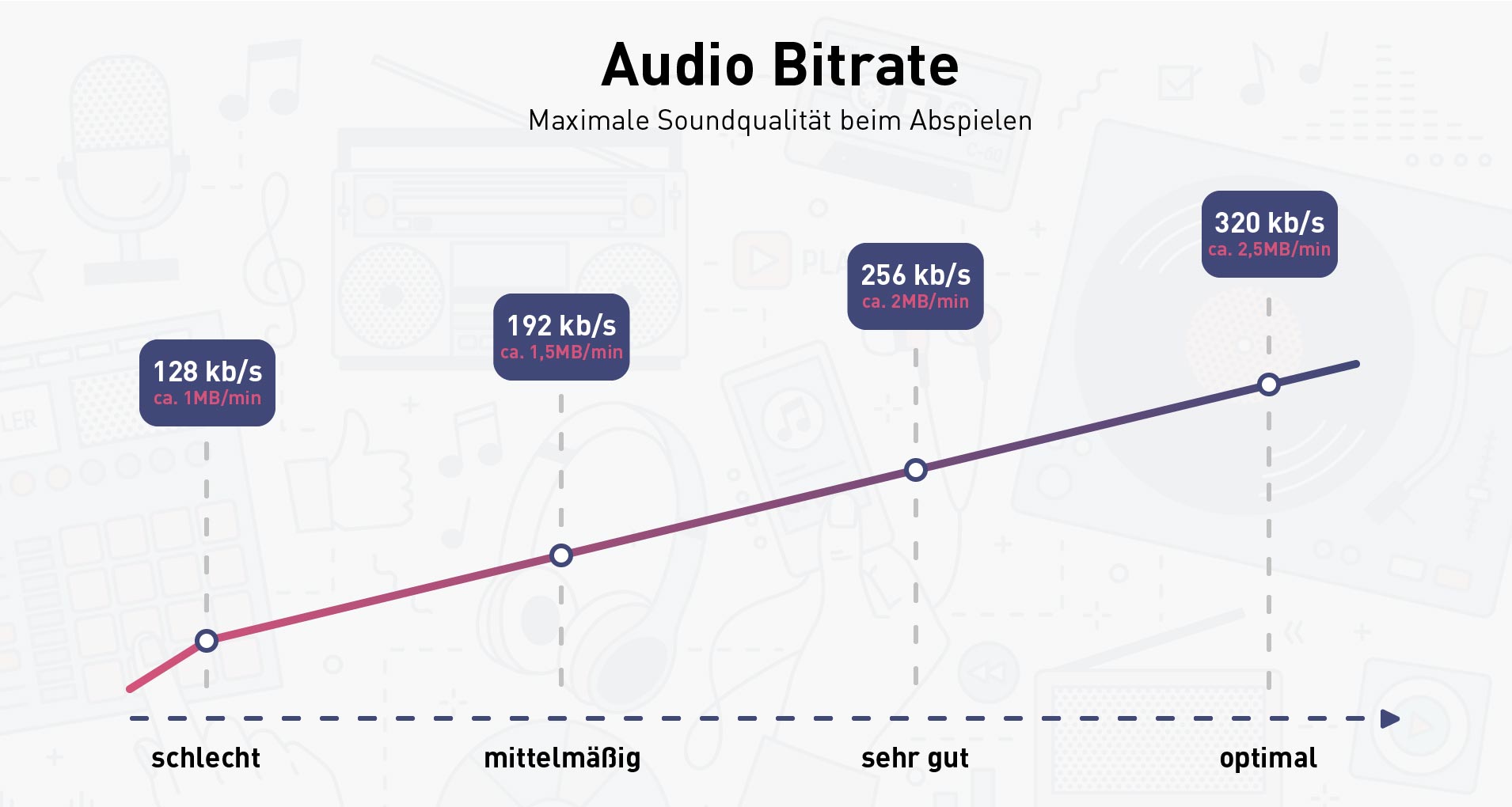
320 kbps represents your bitrate/bitrate, which is shorthand for kilobits per second, which represents the size of the data used to describe sound. In CD (uncompressed audio file), the bit rate is 1411.2kbps, and the mp3 sound quality to achieve CD quality should be higher than 128kbps/44100Hz (128kbps can be said to be the most common bit rate). Generally, a higher number means better quality. The quality depends on many factors (such as the encoding algorithm). Many times we don’t need too high bitrate: our device can play mp3 and CD without difference (sound/sound card is normal).


Free Download Mp4Gain
picture


Mp4Gain Main Window
picture


Mp4Gain Features
picture


Free Download Mp4Gain
picture

What is bit rate? Knowledge of the MP3 audio format. Part 2

What is bit rate? Knowledge of the MP3 audio format. Part 2

bit rate
bit rate

Bitrate is a benchmark indicator of the efficiency of digital music compression.

bit rate.
bit rate

The bit rate represents the number of bits bps (bit per second, bits per second) transmitted per unit of time (1 second). We usually use kbps (in simple terms, it is per second) clock 1000 bits) as the unit. The bit rate of digital music on CD is 1411.2 kbps (ie recording 1 second of CD music requires 1411.2 × 1024 bits of data). The higher the bit rate of the music file, the more data (Bit) must be processed in a unit of time (1 second), and the better the sound quality of the music file. However, when the bit rate is high, the file size increases, which will occupy a large amount of storage capacity. 8 to 320 kbps.

1. WMA (Windows Media Audio, Windows Media Audio)

As a Microsoft media compression method, it is a part of the technology that only compresses audio data in Windows Media Technologies. The sound quality is similar to MP3 and can be compressed with half the technology of MP3. It has the copyrighted Windows Media Rights Manager and can be played by installing it in WMP (Windows Media Player, Windows Media Player). Due to the strong influence of Microsoft and Windows, as well as major copyright reasons, the major American record companies, EMI and BMG, officially confirmed that they use the WMA method developed and produced by Microsoft. It is believed that this advanced method will become even more popular in the future.

2. MP3 (CBR, VBR, ABR)

MP3 is currently the most widely used and widely used lossy compressed digital audio format. It has been explained above and will not be repeated here.

CBR (constant bit rate)

CBR is the oldest and simplest MP3 encoding (compression) method. When this method is used for encoding, the bit rate of the entire file is the same, in other words, the bit rate used by the MP3 file per second is the same. Although the music file has sections of varying complexity, the encoder always keeps the bitrate constant, unless you use the highest sound quality; otherwise the sound quality of the different sections of the MP3 file will vary. The more complex the passage, the worse the sound quality. Its biggest advantage is that the file size is fixed, which is convenient for calculating storage space.

VBR (Variable Bit Rate, Variable Bit Rate)

VBR is a variable encoding rate MP3 compression method. Its principle is to encode the complex part of a song with a high bit rate and the simple part with a low bit rate. Through this dynamic adjustment of the encoding rate, the sound quality can be improved. additionally obtained and the size of the file. Its main advantage is that the entire song can approximately meet our sound quality requirements, but the disadvantage is that the size of the compressed file cannot be estimated during encoding.

Most MP3 players released now support VBR, but although some machines can play songs in VBR format, they can’t display the playing time correctly. Nowadays, a lot of high-quality MP3 music is encoded in VBR.

What is bit rate? Knowledge of the MP3 audio format.

What is bit rate? Knowledge of the MP3 audio format.


bit rate
bit rate

Digital audio formats are audio signals that are recorded, processed, and reproduced in digital form.

bit rate
bit rate

The emergence of digital audio formats is to meet the needs of high-fidelity playback, storage and transmission. Simply put, early analog audio formats had issues with playback distortion and glitches due to media wear. Since the advent of the CD, digital format audio files have become popular, but another problem has arisen: the limitation of the storage volume, and the CD still has the phenomenon of wear. Saving to hard drive (relatively longer storage time) is not a good solution when storage media (mainly hard drives) are still expensive at the time. The rise of the Internet has created a requirement for long-distance file transmission. Under the restriction of bandwidth, the demand to reduce file size has become more intense. All this has led to the generation of lossy compressed digital audio formats from external factors!

In terms of internal factors, with the improvement of computing and coding capabilities, the progress of various acoustic psychological models has promoted the emergence of various lossy compressed digital audio formats. Some of the most commonly used audio formats in MP3 players are briefly introduced below: MP3 (CBR, VBR, ABR), WMA, WAV, ADPCM, and the emerging audio formats AAC, ASF, and OGG.

Before introducing various digital audio formats, let’s clarify one concept: bitrate.

In the field of computing, all information is digitized. Bit is the smallest unit of data in a computer, it refers to a number of 0 or 1, which is a mathematical binary number, a “0” or “1” , is a bit. For example, when we say a 2-digit number, it means that it is a two-digit binary number, and there are 4 combinations of “00”, “01”, “10” and “11”, which represent 0, 1, 2 and 3 is four numbers.

What is the MP3 compression principle?

What is the MP3 compression principle?

Mp3 Volume Booster

In fact, there are many audio compression technologies and MP3 compression technology is not the best.

Volume Booster

But now it seems that it is still mainstream.
Musical signals have many redundant components, including spacing and information that the human ear cannot distinguish (such as weak signals mixed with a strong background). The CD sound is not compressed and uses a fixed sampling frequency of 44.1 kHz, which can ensure good playback of maximum dynamic music. Of course, the amount of data is the same where the amount of information is less, so there is a possibility of compression. The audio bandwidth of 20 ~ 20 kHz (upper CD player can be extended up to 2 Hz) has become the current music standard. To reduce sound distortion, MP3 adopts an encoding algorithm called “sensory encoding technology”: the audio file first undergoes spectral analysis during encoding, and then the noise level is reduced by filter, and then the remaining components are quantized by quantization The bits are scattered and arranged, and finally an MP3 file with a higher compression ratio is formed, and the compressed file can achieve a sound effect closer to the original sound source during playback . Although it is a lossy compression, its biggest advantage is very little sound distortion in exchange for a higher compression ratio. And now MP3 adopts a variable compression ratio (VBR) compression technology similar to Dolby AC-3. The sampling compression ratio depends on the amount of information in the music, and the masking effect of the human ear is used to reduce redundant data.

Mp3 Increase Volume Part 3

Mp3 Increase Volume Part 3

Increase MP3 Volume

In the two previous parts about Mp3 Volume Increaser, we have seen how and why it is necessary to normalize the volume of audio and video files (something that only Mp4Gain can do) and for them we have begun to delve into how the compression.

Increase MP3 Volume

Audio compression algorithms

coding

Audio compression technology refers to the application of suitable digital signal processing technology to the original digital audio signal stream (PCM encoding), without losing the amount of useful information, or under the condition that the loss introduced be insignificant, reduce (compress) its code rate, and also called compression encoding. It must have a corresponding inverse transform, called decompression or decoding. Audio signals can introduce a great deal of noise and some distortion after passing through a codec system.

1. Redundant audio signal information
Digital audio signals, if transmitted directly without compression, would consume a large amount of bandwidth. For example, if the sample rate of a two-channel digital audio set is 44.1 KHz and each sample value is quantized to 16 bits, its code rate is:

2*44.1kHz*16bit = 1.411Mbit/s

Such a large bandwidth will bring a lot of difficulties for signal transmission and processing, so the audio data must be processed with audio compression technology to transmit audio data effectively.

Digital audio compression coding compresses the audio data signal as much as possible on the premise of ensuring that the signal is not audibly distorted. Digital audio compression coding is implemented by removing redundant components in sound signals. So-called redundant components refer to signals in the audio that cannot be perceived by the human ear and do not help determine the timbre, pitch, and other information of the sound.

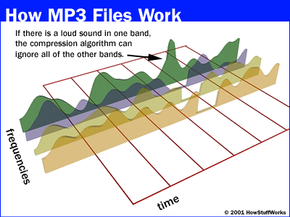
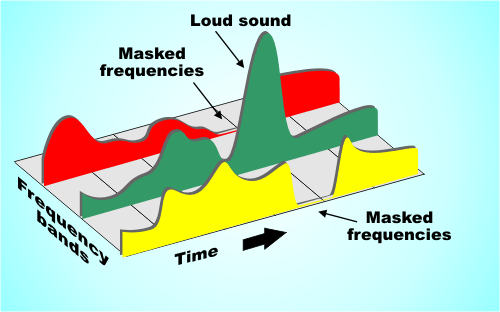
Redundant signals include audio signals outside the range of human hearing and masked audio signals. For example, the frequency range of the sound signal that can be perceived by the human ear is 20 Hz to 20 KHz, and frequencies other than this frequency cannot be detected by the human ear and may be considered as redundant signals. In addition, according to the physiological and psychoacoustic phenomena of the human ear, when a strong signal and a weak signal exist at the same time, the weak signal will be masked by the strong signal and cannot be heard, so the weak signal can be regarded as a redundant signal. Do not send. This is the masking effect of human hearing, which is mainly manifested in the spectral masking effect and the time-domain masking effect, which are presented as follows:

1.1 Spectral masking effect
After the sound energy of a frequency is lower than a certain threshold, the human ear will not hear it, and this threshold is called the minimum audible threshold. When there is another sound with higher energy, the threshold value close to the frequency of the sound will increase considerably.

Mp3 Increase Volume Part 2

Mp3 Increase Volume Part 2

mp3 increase volume

We talked in the previous chapter about the need to achieve an mp3 volume increaser, although the volume increaser is not limited to mp3s in Mp4Gain. You can actually achieve a volume increaser in all major audio and video formats.

mp3 increase volume

To better understand, we were talking about and analyzing how the compression of an audio file works.

Quantification encoding. Quantization encoding uses a three-layer iterative loop model for bit allocation and quantization. These three layers include: frame loop, outer loop, and inner loop. The frame loop resets all iterative variables, calculates the maximum number of bits that can be provided to each data slice, and then calls the external iterative model; the outer iterative model first uses the inner iterative model, which quantizes the input vector by incrementing The size of the quantization step allows the quantized output to be encoded within a certain bit limit. Huffman coding has a limit on the maximum quantization value, so it is necessary to judge whether all quantization values ​​exceed the limit. If it exceeds the limit, the inner iteration loop must increase the size of the quantization step and quantize again. Then determine the number of Huffman encoding bits such that the number of occupied bits is less than the maximum number of bits that can be provided by each encoding section computed by the frame cycle; otherwise, the size of the quantization step must be increased for requantization. When the quantization meets the requirements, store the final scale factor value, exit the outer loop, and compute the number of bits used to store each data section in the frame loop.

Mp3 Increase Volume

Mp3 Increase Volume

mp3 increase volume

First we need to understand how an mp3 works, how it compresses the original wav to a tenth of its size, to understand why we always need to normalize all the volumes of the different mp3s.

increase mp3 volume

Mp3 Increase Volume

A wav saves a lot of information, including information that humans cannot hear, also redundant information and ends up taking up a lot of space on the hard drive or on flash drives.

This has generated from the beginning the need to ensure that the different mp3s have a constant or similar volume when comparing some mp3s with others.

This currently with Mp4Gain can be applied to the most used audio and video formats.

Let’s understand a little how the compression of an mp3 works:

MP3 encoding is mainly composed of 3 main functional modules, including hybrid filter bank (subband filter and MDCT), psychoacoustic model, quantization encoding (bit mapping and bit factoring, and Huffman encoding).
1. Hybrid filter bank. This part includes two parts of the subband filter bank and MDCT. Subband filterbank encoding completes the mapping of the sampled signal from time domain to frequency domain and decomposes the specified audio signal into 32 subbands through the bandpass filterbank for output. All 32 subbands output by the subband filter bank have the same bandwidth, while the critical bandwidth derived from the psychoacoustic model is not. Therefore, to match each scaling factor band for encoding to the critical band, it is necessary to transform subband signals into MDCTs. Once the output of the subband filter bank is sent to the MDCT filter bank, each bank is subdivided into 18 frequency lines, resulting in a total of 576 frequency lines. Next, the number of bits allocated to the 576 spectral lines is determined using the signal-to-mask ratio of the computed subband signals in the psychoacoustic model.

2. Psychoacoustic models. The psychoacoustic model takes advantage of the masking effect of the human auditory system to remove a large number of irrelevant signals, in order to achieve the effect of compressing the audio data. To accurately calculate the masking threshold, the signal is required to have better resolution in the frequency domain, so the signal is Fourier transformed before using the psychoacoustic model. MPEG-I provides two psychoacoustic models. The first model is easy to compute and provides adequate accuracy when encoding at high bit rates. The second model is more complex and is generally used when encoding at lower bit rates. Psychoacoustic model II is generally used in MP3 encoding. The purpose of the psychoacoustic model is to find the masking threshold value of each subband and use it to control the quantization process. The implementation process of the psychoacoustic model generally consists of first using FFT to obtain the spectral characteristics of the signal and find the tonal components (some called musical components) and the non-tonal components (or noise components) at each frequency point according to the spectral features; The curve determines the masking domain value of each tonal component and non-pitch component at other frequency points; finally, the general masking domain of each frequency point is obtained and converted to the coding subband. For noise generated after quantization of the spectral value emitted by the subband filter bank, if the noise can be controlled below the masking threshold, the final compressed data decoded result may be indistinguishable from the original signal. The masking ability of a given signal depends on its frequency and loudness, so the end result of the psychoacoustic model is the signal-to-mask ratio (signal to mask ratio), which is the ratio of the intensity of the signal and masking. limit.

Mp3 To wav converter

Mp3 To wav converter

Mp3 to Wav Converter

Mp3 to wav

MP3 to WAV converter

Converting an mp3 to a wav is really easy. Most likely, the mp3 file itself was encoded from a wav.

Convert from Wav to Mp3

In fact, this whole matter of compression to mp3 format began with the search to save space, without losing quality. Why would you want to save space? Firstly to be able to stream the music file over the internet, in days when bandwidth was low, and secondly to save space at a time when available hard drives were quite limited in capacity. The technology did not exist at all neither on the internet nor on hard drives that we have today.

What’s the point of converting an mp3 back to a wav?

The mp3 must have discarded information from the original wav and that information will not be recovered if we do the reverse conversion, in this case from mp3 to wav.
Let us remember what was said above: it was necessary to reduce the size and to achieve this, psychoacoustics were used to find out what information was redundant or could be discarded without it meaning an “audible” loss for human beings.

The mp3 audio format is considered lossy for this reason, because it discards information in order to be compressed. And that information cannot be retrieved if we do the reverse conversion.

Sure, many experiments have been done that have shown that 99% of people can’t tell a 192kb compressed mp3 apart from the original wav, so converting the mp3 to wav again would produce a wav that is indistinguishable from the original wav. most people compare it to the original wav.

mp3 to wav converter using Mp4Gain

Mp4Gain is, in addition to a very modern and efficient normalizer (the most efficient in fact), it is also a very efficient converter. Therefore, you could use Mp4Gain to convert mp3 to wav and get excellent results.