MP3 Normalizer


Free Download Mp4Gain
picture

MP3 Normalizer

MP3 Normalizer
MP3 Normalizer
MP3 Normalizer
MP3 Normalizer

MP3 Normalizer is an advanced tool designed to optimize and enhance the audio quality of your MP3 files. With this powerful software, you can easily adjust and balance the volume levels of your MP3 tracks, ensuring a consistent and enjoyable listening experience. Whether you have a music collection, podcasts, or audio recordings, MP3 Normalizer provides the perfect solution for achieving optimal audio levels.

Volume Equalizer

Improve the audio quality of your MP3 files with our advanced volume equalizer. This feature allows you to adjust and normalize the volume levels across all your MP3 tracks, eliminating any discrepancies and ensuring a smooth and pleasant listening experience.

Sound Level Normalization

Bring uniformity to your MP3 collection by normalizing the sound levels. Our MP3 Normalizer analyzes each audio file and adjusts the volume to achieve consistent levels, eliminating the need to constantly adjust the volume while listening to your favorite tracks.

Audio Quality Enhancement

Elevate the audio quality of your MP3 files with our advanced normalization techniques. MP3 Normalizer enhances the overall sound clarity and richness, allowing you to enjoy your music or podcasts with improved dynamics and balanced volume levels.

Device-Specific Volume Optimization

MP3 Normalizer provides the flexibility to optimize the volume levels of your MP3 files for different playback devices. Whether you’re using headphones, speakers, or car stereo systems, our software ensures that the volume is optimized for each specific device, delivering an optimal audio experience.

Volume Fluctuation Correction

Eliminate annoying volume fluctuations in your MP3 tracks. MP3 Normalizer detects and corrects any sudden changes in volume, ensuring a smooth and consistent playback experience without any unexpected loud or soft sections within your audio files.

Preserving Audio Quality

Our MP3 Normalizer employs advanced algorithms to normalize the volume levels while preserving the original audio quality. You can confidently normalize your MP3 files without worrying about any degradation in sound or loss of fidelity.

Professional-Grade Audio Output

If you’re a content creator or podcaster, MP3 Normalizer helps you achieve professional-grade audio quality. By normalizing your MP3 files, you can ensure that your recordings have consistent volume levels that meet industry standards.

Batch Processing Efficiency

Save time and effort with the batch processing feature of MP3 Normalizer. This allows you to normalize multiple MP3 files simultaneously, streamlining the optimization process for your entire audio library.

User-Friendly Interface

MP3 Normalizer features a user-friendly interface, making it easy for both novice and advanced users to navigate and utilize its functionalities. The software provides clear instructions and options, ensuring a hassle-free experience in normalizing your MP3 files.

Customizable Normalization Settings

Customize the normalization settings according to your preferences. Adjust the target volume, set desired loudness levels, and fine-tune the normalization process to achieve the perfect balance for your MP3 files.

Compatibility with Various Audio Formats

In addition to MP3 files, MP3 Normalizer supports a wide range of audio formats, including WAV, FLAC, AAC, and more. You can confidently normalize the volume levels of different audio file types, allowing for a unified and harmonious audio experience.

Efficient Performance and Reliable Results

MP3 Normalizer is built to deliver efficient performance. The software operates seamlessly, swiftly processing your MP3 files and providing accurate volume normalization results, ensuring that your audio library is optimized effectively.

Enhanced Music Listening Experience

By normalizing your MP3 files, you can enhance your music listening experience. Say goodbye to constantly adjusting the volume and enjoy a seamless playback with consistent volume levels, allowing you to fully immerse yourself in the music.

Optimal Sound Balance

MP3 Normalizer ensures optimal sound balance in your MP3 files. It intelligently analyzes and adjusts the volume levels, preventing any parts of the audio from being too loud or too soft. This results in a well-balanced audio output that is pleasing to the ears.

Distraction-Free Audio Recordings

If you have audio recordings with inconsistent volume levels, MP3 Normalizer is the solution. By normalizing the volume, you can eliminate distractions caused by sudden changes in volume, ensuring that your focus remains on the content of the recording.

Compatibility with Different Operating Systems

MP3 Normalizer is compatible with various operating systems, including Windows, macOS, and Linux. Regardless of the platform you use, you can easily access and utilize the software to optimize the volume levels of your MP3 files.

Data Integrity and Lossless Normalization

During the normalization process, MP3 Normalizer ensures the integrity of your data. The software performs lossless normalization, meaning it preserves the original audio data without any degradation or loss of quality.



Free Download Mp4Gain
picture


Mp4Gain Main Window
picture


Mp4Gain Features
picture


Free Download Mp4Gain
picture

MP3 Normalizer: How to Select the Best Software for Audio Quality Improvement

MP3 Normalizer: How to Select the Best Software for Audio Quality Improvement

Mp3 Normalizer
Mp3 Normalizer
Mp3 Normalizer
Mp3 Normalizer

MP3 audio files are a popular format for music and other audio recordings, but they can vary widely in volume levels and quality. To improve the listening experience, many people turn to MP3 normalizer software. But with so many options available, what features should you look for when selecting the best software for audio quality improvement? In this article, we’ll explore the top features to consider and answer some common questions about MP3 normalizer software.

Features to Look for in MP3 Normalizer Software

When selecting MP3 normalizer software, there are several key features to consider:

Batch Processing

If you have a large collection of MP3 files, you’ll want software that can process multiple files at once. Batch processing allows you to select a folder or group of files to be normalized, saving you time and effort.

Preserve Audio Quality

The primary goal of MP3 normalizer software is to improve audio quality. Look for software that can normalize volume levels without causing any distortion or loss of quality to the audio file.

Customizable Settings

Different audio files may require different normalization settings. Look for software that allows you to adjust the normalization settings, such as target volume level, peak normalization, and RMS normalization.

File Format Support

While MP3 is a popular audio format, it’s not the only one. Look for software that supports a wide range of audio file formats, such as WAV, FLAC, and AAC.

Simple User Interface

MP3 normalizer software should be user-friendly and easy to use. Look for software with a simple and intuitive interface that allows you to quickly select and normalize your audio files.

How MP3 Normalizer Software Works

MP3 normalizer software works by analyzing the volume levels of an audio file and adjusting them to a target level. The software scans the entire audio file, identifies the loudest and quietest parts, and then adjusts the volume levels to create a more consistent listening experience. This can improve the overall audio quality and prevent the need to constantly adjust the volume levels during playback.

Free vs. Premium MP3 Normalizer Software

There are both free and premium options available for MP3 normalizer software. Free software can be a great option for those on a budget, but it may not offer the same level of features or customization options as premium software. Premium software typically offers more advanced features and better performance.

Potential Loss of Quality or Distortion

While MP3 normalizer software is designed to improve audio quality, it is possible for the software to cause loss of quality or distortion during the normalization process. To avoid this, select software that uses advanced algorithms to preserve audio quality and avoid any unnecessary adjustments that could cause distortion.

Normalization Time

The amount of time it takes to normalize an MP3 file can vary depending on the size of the file and the processing power of your computer. In general, however, most files can be normalized within a few minutes.

Advantages of MP3 Normalizer Software

Using MP3 normalizer software can offer several advantages over adjusting the volume levels manually. For one, it can save you time and effort, as you won’t need to manually adjust the volume levels for each file. Additionally, MP3 normalizer software can improve the overall listening experience by creating a more consistent volume level across multiple files.

Best Software for Different Audio Files

Certain MP3 normalizer software programs may be better suited for certain types of audio files. For example, some software may be better suited for music files, while others may be better suited for speech recordings. Look for software that offers customizable settings and options to ensure optimal results for the specific type of audio file you’re working with.

File Size and Normalization

The normalization process can affect the overall file size of an MP3 audio file. When normalizing, the software may need to make adjustments to the audio file, which can result in a larger file size. However, this increase in file size is usually minimal and shouldn’t be a significant concern.

Cost of MP3 Normalizer Software

The cost of MP3 normalizer software can vary widely, depending on the features and level of performance offered. Some software may be available for free, while others may cost several hundred dollars. Additionally, some software may require ongoing subscription fees or additional costs for updates or advanced features. When selecting MP3 normalizer software, consider your budget and the features you require to find the best option for your needs.

Recommended Settings and Best Practices

To ensure optimal results when using MP3 normalizer software, there are some recommended settings and best practices to follow. For example, it’s important to choose the correct normalization settings for the specific type of audio file you’re working with. Additionally, it’s a good idea to make a backup copy of your original audio files before normalizing them, in case of any unexpected issues or changes.

Conclusion

Selecting the best MP3 normalizer software for your needs can help improve the overall audio quality of your files and provide a more consistent listening experience. When selecting software, consider features such as batch processing, customizable settings, and file format support, and be sure to choose software that can preserve audio quality and avoid distortion. With the right software and best practices, you can easily normalize your MP3 files and enjoy a better listening experience.

Why MP3 is so Popular

Why MP3 is so Popular

Mp3 is so popular
Mp3 is so popular

The MP3 file format has been around since the early 90s and is still the most popular audio format of choice for music, podcasts, and audio books. MP3 is a digital audio encoding format that compresses audio files so that they can be stored and transferred easier. It is an ideal format for those who want to listen to music on their computer, portable device, or car stereo.

Mp3 is so popular
Mp3 is so popular

The popularity of MP3 is due to its convenience, compatibility, and ease of use. Since MP3 files are small in size, they can easily be transferred from one device to another without taking up too much space. This makes it easy to store music, podcasts, and audio books on a computer, phone, or other device.

MP3 files are compatible with almost any device. This means that you can listen to MP3s on your computer, smartphone, car stereo, or any other device that supports the format. This makes it incredibly easy to access your music, podcasts, and audio books wherever you go.

The MP3 format is also incredibly easy to use. All you need to do is download the file, open it with a media player, and you’re ready to go. It’s a simple process that anyone can do.

The Benefits of MP3s

MP3s offer many benefits over other audio formats. Since they are compressed, they take up less space than other formats such as WAV or AIFF. This makes them easier to share and store on your computer or other device.

MP3s also have better sound quality than other formats. They can be encoded at higher bitrates, which means that the sound is more detailed and clear. This makes them ideal for listening to music, podcasts, and audio books.

Finally, MP3s are widely supported by most devices. This makes them ideal for sharing music, podcasts, and audio books with friends and family.

Why MP3s are so Popular

The popularity of MP3s is due to their convenience, compatibility, and ease of use. They are small in size, making them easy to share and store on a device. They are also compatible with most devices, making them easy to access wherever you go. And finally, they are incredibly easy to use, making them ideal for those who are new to digital audio.

Conclusion

The MP3 file format is popular due to its convenience, compatibility, and ease of use. It is the go-to format for music, podcasts, and audio books, and is supported by almost any device. It is also incredibly easy to use, making it ideal for those who are new to digital audio. In conclusion, MP3 is the ideal format for those looking to listen to music, podcasts, and audio books on the go. For the best MP3 audio experience, Mp4Gain is the best solution.

Mp3 Normalize Volume

Mp3 Normalize Volume

Mp3 Normalize Volume

MP3 audio files are popular among music and audio fans because of their small file size and high-quality sound. But sometimes, the volume of these audio files may be too low or too loud. Normalizing the audio volume ensures that all your audio files have the same volume level, so you can enjoy your music or audio files without adjusting the volume manually.

Mp3 Normalize Volume

What is Volume Normalization?

Volume normalization is the process of adjusting the volume of an audio file to a predetermined level. It ensures that all of your audio files are played back at the same volume level. This is especially useful if you have audio files from multiple sources, as some of them may be louder or quieter than others. By normalizing the audio files, you can enjoy them without having to manually adjust the volume.

Why Should You Normalize Volume?

Normalizing the volume of your audio files has several benefits. For one, it helps you maintain a consistent volume level throughout your playlist. This is especially useful if you have a large collection of audio files from different sources. Additionally, it prevents you from having to manually adjust the volume level every time you play a new song or audio file. Finally, it helps keep your audio files safe from distortion or clipping, which can occur when the audio is too loud.

How to Normalize Volume of MP3 Audio Files

Normalizing the volume of your MP3 audio files is a simple process. All you need is an audio editor that supports MP3 files. Many popular audio editors, such as Audacity, support this feature. Once you have an audio editor that supports MP3 files, you can follow these steps to normalize the volume of your audio files:

  • Open your audio editor and import the MP3 audio file.
  • Select the entire audio file by pressing “Ctrl+A”.
  • Go to the “Effects” menu and select “Normalize”.
  • Adjust the “Normalize to” value and click “OK”.
  • Save the file by going to “File” > “Save As”.

After you have followed these steps, your audio file will be normalized to the volume level you specified. You can repeat the process for all your MP3 files to normalize their volume.

Alternatives to Normalizing MP3 Volume

In addition to normalizing the volume of your MP3 files manually, there are several other methods you can use. For example, you can use a dedicated audio normalization software such as Mp4Gain to normalize the volume of multiple files at once. Additionally, many streaming services offer a built-in normalization feature that automatically adjusts the volume of your audio files to a consistent level.

Conclusion

Normalizing the volume of your MP3 audio files is a simple process that helps you maintain a consistent volume level throughout your playlist. There are several methods you can use to normalize the volume of your audio files, including manually using an audio editor and using a dedicated audio normalization software such as Mp4Gain. With the right tools and techniques, you can easily normalize the volume of your audio files for an enjoyable listening experience.

Mp3 normalize volume

Mp3 normalize volume

Mp3 normalize volume

MP3 Normalization: What it is and How to Do it

mp3 normalize volume

MP3 normalization is the process of adjusting the volume level of an MP3 audio file so that it plays at a consistent volume across different devices and playback systems. This is important because MP3 files can have varying levels of volume due to the way they were recorded or encoded.

There are several ways to normalize the volume of an MP3 file. One popular method is to use a software program such as MP3Gain or AIMP. These programs analyze the audio data in an MP3 file and adjust the volume level accordingly. They also provide a “normalize” or “gain” function that can be used to bring the volume level up to a desired level.

Another method for normalizing MP3 volume is to use an online service such as mp3Doctor or AudioNormalizer. These services allow you to upload your MP3 file and then adjust the volume level using a web-based interface. The advantage of using an online service is that you don’t need to download or install any software on your computer.

When normalizing the volume of an MP3 file, it’s important to be careful not to overdo it. If the volume level is too high, it can cause distortion and damage your hearing. It’s also important to keep in mind that some devices and playback systems have a limited dynamic range, so it may not be possible to bring the volume level up to the maximum level without causing distortion.

In conclusion, normalizing the volume of MP3 files is a simple process that can help ensure that your music is heard at the same volume level across different devices and playback systems. Whether you use a software program or an online service, it’s important to be mindful of the volume level and not to overdo it. With the right tools, you can make sure that your music sounds great no matter where or how you listen to it.

How to get all your mp3s to have the same volume level?

How to get all your mp3s to have the same volume level?

MP3 Normalizer

The question is clear but can be expressed in many ways:

mp3 volume level equalizer

-How do I get my mp3s to have the same volume?
-How to make all your mp3s have the same level of dbs (decibels)?
-How do I make sure that all my mp3s have a similar volume and there are no drops or increases in volume?
-How to get my mp3 to play at the same volume level?

-Volume level equalizer?

And so, I could continue writing many of the questions that come to us at Mp4Gain and that basically mean the same thing, but people have some difficulty expressing exactly what they need or want.

Because basically what they are looking for is that the different mp3s have the same sound… that they sound at a similar volume to each other.

That can be called normalize, although some people use the word “compress sound volume” even though it has its own difference… but we understand what they mean.

And the answer is simple: use Mp4Gain.

Mp4Gain offers various options (from Replay Gain to audio volume compression) to give you what you are looking for. It is by far the most advanced normalizer, although it is very simple to use.

In general terms you will only need to download the program, load your music or videos (Mp4Gain normalizes many audio and video formats and can do it in batch mode even if you use different formats) and click “NORMALIZE” and that’s it.

You don’t even need to understand what a decibel is or understand anything, just load your files and click on it and you already have the volume level problem solved.

What is the MP3 compression principle?

What is the MP3 compression principle?

Mp3 Volume Booster

In fact, there are many audio compression technologies and MP3 compression technology is not the best.

Volume Booster

But now it seems that it is still mainstream.
Musical signals have many redundant components, including spacing and information that the human ear cannot distinguish (such as weak signals mixed with a strong background). The CD sound is not compressed and uses a fixed sampling frequency of 44.1 kHz, which can ensure good playback of maximum dynamic music. Of course, the amount of data is the same where the amount of information is less, so there is a possibility of compression. The audio bandwidth of 20 ~ 20 kHz (upper CD player can be extended up to 2 Hz) has become the current music standard. To reduce sound distortion, MP3 adopts an encoding algorithm called “sensory encoding technology”: the audio file first undergoes spectral analysis during encoding, and then the noise level is reduced by filter, and then the remaining components are quantized by quantization The bits are scattered and arranged, and finally an MP3 file with a higher compression ratio is formed, and the compressed file can achieve a sound effect closer to the original sound source during playback . Although it is a lossy compression, its biggest advantage is very little sound distortion in exchange for a higher compression ratio. And now MP3 adopts a variable compression ratio (VBR) compression technology similar to Dolby AC-3. The sampling compression ratio depends on the amount of information in the music, and the masking effect of the human ear is used to reduce redundant data.

Mp3 Increase Volume Part 3

Mp3 Increase Volume Part 3

Increase MP3 Volume

In the two previous parts about Mp3 Volume Increaser, we have seen how and why it is necessary to normalize the volume of audio and video files (something that only Mp4Gain can do) and for them we have begun to delve into how the compression.

Increase MP3 Volume

Audio compression algorithms

coding

Audio compression technology refers to the application of suitable digital signal processing technology to the original digital audio signal stream (PCM encoding), without losing the amount of useful information, or under the condition that the loss introduced be insignificant, reduce (compress) its code rate, and also called compression encoding. It must have a corresponding inverse transform, called decompression or decoding. Audio signals can introduce a great deal of noise and some distortion after passing through a codec system.

1. Redundant audio signal information
Digital audio signals, if transmitted directly without compression, would consume a large amount of bandwidth. For example, if the sample rate of a two-channel digital audio set is 44.1 KHz and each sample value is quantized to 16 bits, its code rate is:

2*44.1kHz*16bit = 1.411Mbit/s

Such a large bandwidth will bring a lot of difficulties for signal transmission and processing, so the audio data must be processed with audio compression technology to transmit audio data effectively.

Digital audio compression coding compresses the audio data signal as much as possible on the premise of ensuring that the signal is not audibly distorted. Digital audio compression coding is implemented by removing redundant components in sound signals. So-called redundant components refer to signals in the audio that cannot be perceived by the human ear and do not help determine the timbre, pitch, and other information of the sound.

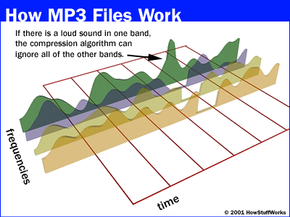
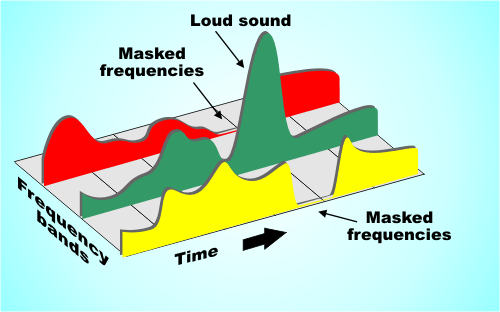
Redundant signals include audio signals outside the range of human hearing and masked audio signals. For example, the frequency range of the sound signal that can be perceived by the human ear is 20 Hz to 20 KHz, and frequencies other than this frequency cannot be detected by the human ear and may be considered as redundant signals. In addition, according to the physiological and psychoacoustic phenomena of the human ear, when a strong signal and a weak signal exist at the same time, the weak signal will be masked by the strong signal and cannot be heard, so the weak signal can be regarded as a redundant signal. Do not send. This is the masking effect of human hearing, which is mainly manifested in the spectral masking effect and the time-domain masking effect, which are presented as follows:

1.1 Spectral masking effect
After the sound energy of a frequency is lower than a certain threshold, the human ear will not hear it, and this threshold is called the minimum audible threshold. When there is another sound with higher energy, the threshold value close to the frequency of the sound will increase considerably.

Mp3 Increase Volume Part 2

Mp3 Increase Volume Part 2

mp3 increase volume

We talked in the previous chapter about the need to achieve an mp3 volume increaser, although the volume increaser is not limited to mp3s in Mp4Gain. You can actually achieve a volume increaser in all major audio and video formats.

mp3 increase volume

To better understand, we were talking about and analyzing how the compression of an audio file works.

Quantification encoding. Quantization encoding uses a three-layer iterative loop model for bit allocation and quantization. These three layers include: frame loop, outer loop, and inner loop. The frame loop resets all iterative variables, calculates the maximum number of bits that can be provided to each data slice, and then calls the external iterative model; the outer iterative model first uses the inner iterative model, which quantizes the input vector by incrementing The size of the quantization step allows the quantized output to be encoded within a certain bit limit. Huffman coding has a limit on the maximum quantization value, so it is necessary to judge whether all quantization values ​​exceed the limit. If it exceeds the limit, the inner iteration loop must increase the size of the quantization step and quantize again. Then determine the number of Huffman encoding bits such that the number of occupied bits is less than the maximum number of bits that can be provided by each encoding section computed by the frame cycle; otherwise, the size of the quantization step must be increased for requantization. When the quantization meets the requirements, store the final scale factor value, exit the outer loop, and compute the number of bits used to store each data section in the frame loop.

Mp3 Increase Volume

Mp3 Increase Volume

mp3 increase volume

First we need to understand how an mp3 works, how it compresses the original wav to a tenth of its size, to understand why we always need to normalize all the volumes of the different mp3s.

increase mp3 volume

Mp3 Increase Volume

A wav saves a lot of information, including information that humans cannot hear, also redundant information and ends up taking up a lot of space on the hard drive or on flash drives.

This has generated from the beginning the need to ensure that the different mp3s have a constant or similar volume when comparing some mp3s with others.

This currently with Mp4Gain can be applied to the most used audio and video formats.

Let’s understand a little how the compression of an mp3 works:

MP3 encoding is mainly composed of 3 main functional modules, including hybrid filter bank (subband filter and MDCT), psychoacoustic model, quantization encoding (bit mapping and bit factoring, and Huffman encoding).
1. Hybrid filter bank. This part includes two parts of the subband filter bank and MDCT. Subband filterbank encoding completes the mapping of the sampled signal from time domain to frequency domain and decomposes the specified audio signal into 32 subbands through the bandpass filterbank for output. All 32 subbands output by the subband filter bank have the same bandwidth, while the critical bandwidth derived from the psychoacoustic model is not. Therefore, to match each scaling factor band for encoding to the critical band, it is necessary to transform subband signals into MDCTs. Once the output of the subband filter bank is sent to the MDCT filter bank, each bank is subdivided into 18 frequency lines, resulting in a total of 576 frequency lines. Next, the number of bits allocated to the 576 spectral lines is determined using the signal-to-mask ratio of the computed subband signals in the psychoacoustic model.

2. Psychoacoustic models. The psychoacoustic model takes advantage of the masking effect of the human auditory system to remove a large number of irrelevant signals, in order to achieve the effect of compressing the audio data. To accurately calculate the masking threshold, the signal is required to have better resolution in the frequency domain, so the signal is Fourier transformed before using the psychoacoustic model. MPEG-I provides two psychoacoustic models. The first model is easy to compute and provides adequate accuracy when encoding at high bit rates. The second model is more complex and is generally used when encoding at lower bit rates. Psychoacoustic model II is generally used in MP3 encoding. The purpose of the psychoacoustic model is to find the masking threshold value of each subband and use it to control the quantization process. The implementation process of the psychoacoustic model generally consists of first using FFT to obtain the spectral characteristics of the signal and find the tonal components (some called musical components) and the non-tonal components (or noise components) at each frequency point according to the spectral features; The curve determines the masking domain value of each tonal component and non-pitch component at other frequency points; finally, the general masking domain of each frequency point is obtained and converted to the coding subband. For noise generated after quantization of the spectral value emitted by the subband filter bank, if the noise can be controlled below the masking threshold, the final compressed data decoded result may be indistinguishable from the original signal. The masking ability of a given signal depends on its frequency and loudness, so the end result of the psychoacoustic model is the signal-to-mask ratio (signal to mask ratio), which is the ratio of the intensity of the signal and masking. limit.