Mp3 Increase Volume Part 3

In the two previous parts about Mp3 Volume Increaser, we have seen how and why it is necessary to normalize the volume of audio and video files (something that only Mp4Gain can do) and for them we have begun to delve into how the compression.

Audio compression algorithms
coding
Audio compression technology refers to the application of suitable digital signal processing technology to the original digital audio signal stream (PCM encoding), without losing the amount of useful information, or under the condition that the loss introduced be insignificant, reduce (compress) its code rate, and also called compression encoding. It must have a corresponding inverse transform, called decompression or decoding. Audio signals can introduce a great deal of noise and some distortion after passing through a codec system.
1. Redundant audio signal information
Digital audio signals, if transmitted directly without compression, would consume a large amount of bandwidth. For example, if the sample rate of a two-channel digital audio set is 44.1 KHz and each sample value is quantized to 16 bits, its code rate is:
2*44.1kHz*16bit = 1.411Mbit/s
Such a large bandwidth will bring a lot of difficulties for signal transmission and processing, so the audio data must be processed with audio compression technology to transmit audio data effectively.
Digital audio compression coding compresses the audio data signal as much as possible on the premise of ensuring that the signal is not audibly distorted. Digital audio compression coding is implemented by removing redundant components in sound signals. So-called redundant components refer to signals in the audio that cannot be perceived by the human ear and do not help determine the timbre, pitch, and other information of the sound.
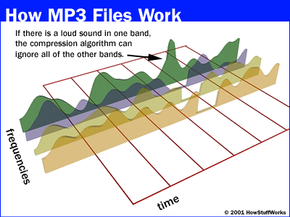
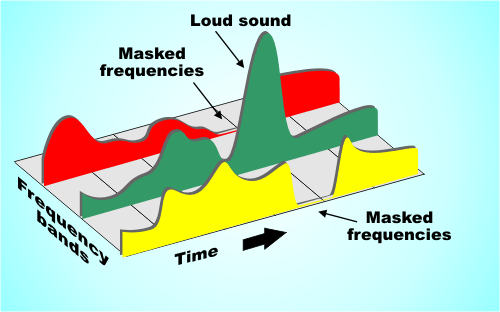
Redundant signals include audio signals outside the range of human hearing and masked audio signals. For example, the frequency range of the sound signal that can be perceived by the human ear is 20 Hz to 20 KHz, and frequencies other than this frequency cannot be detected by the human ear and may be considered as redundant signals. In addition, according to the physiological and psychoacoustic phenomena of the human ear, when a strong signal and a weak signal exist at the same time, the weak signal will be masked by the strong signal and cannot be heard, so the weak signal can be regarded as a redundant signal. Do not send. This is the masking effect of human hearing, which is mainly manifested in the spectral masking effect and the time-domain masking effect, which are presented as follows:
1.1 Spectral masking effect
After the sound energy of a frequency is lower than a certain threshold, the human ear will not hear it, and this threshold is called the minimum audible threshold. When there is another sound with higher energy, the threshold value close to the frequency of the sound will increase considerably.