Best Audio Codecs


Free Download Mp4Gain
picture

Best Audio Codecs

Best Audio Codecs
Best Audio Codecs
Best Audio Codecs
Best Audio Codecs

Audio codecs, short for compression-decompression algorithms, are essential tools in the world of digital audio. Think of them as translators that help digital audio files communicate efficiently while conserving storage space and maintaining sound quality. They achieve this by encoding audio data during compression and decoding it during playback.

Imagine you’re packing for a trip, and you want to save space in your suitcase. You decide to use vacuum-sealed bags for your clothes. Similarly, an audio codec compresses audio data into a more compact format for efficient storage or transmission. When you unpack your suitcase at your destination, you release the air from the bags to restore your clothes to their original form—this is akin to an audio codec decoding compressed audio data for playback.

There’s a wide range of audio codecs available, each with its own strengths and weaknesses. Some prioritize small file sizes, making them ideal for streaming, while others emphasize preserving audio quality, a must for audiophiles. Understanding these differences helps you choose the right codec for your specific needs.

What Are Lossless Audio Codecs?

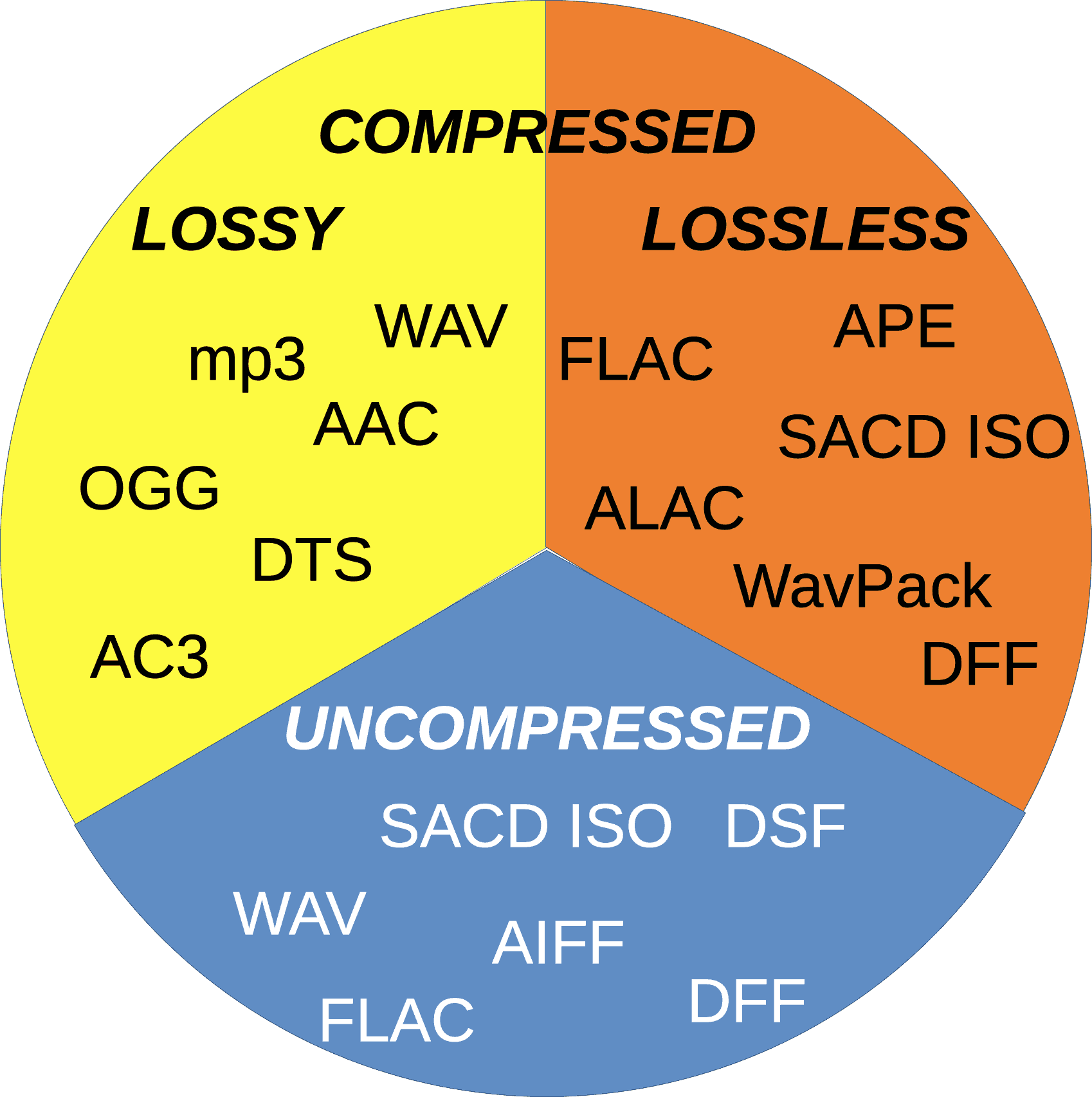
Lossless audio codecs are like the archivists of the audio world. They compress audio data without sacrificing any of the original quality. This is akin to zipping a file on your computer; when you unzip it, you get back an identical copy of the original.

Imagine you have a precious handwritten letter. You want to make a copy for safekeeping, but you don’t want to lose any detail or quality. A lossless audio codec accomplishes this by finding patterns in the audio data and encoding them more efficiently. When you want to listen to the music or sound stored with a lossless codec, it’s like opening the envelope of your preserved letter—you get the same experience as the original.

Lossless audio codecs are favored by audiophiles and professionals who prioritize audio quality over file size. They are ideal for archiving music collections and audio recordings where every nuance matters.

Popular Audio Codecs

When it comes to audio codecs, several popular options are commonly used in various applications. One of the most recognizable is MP3, which revolutionized digital music. MP3, short for MPEG-1 Audio Layer 3, achieves significant compression while maintaining decent audio quality, making it suitable for music streaming and portable devices.

AAC (Advanced Audio Coding) is another well-known codec, commonly used by Apple devices. It offers superior sound quality compared to MP3 at similar bitrates, making it a popular choice for iTunes and other Apple platforms.

For lossless audio, FLAC (Free Lossless Audio Codec) stands out. It’s widely adopted by audiophiles and music enthusiasts for its ability to compress audio without any loss in quality. FLAC files are perfect for preserving high-fidelity audio.

As an expert in audio technology, I can confidently say that understanding audio codecs is crucial for anyone working with digital audio. Whether you’re a music lover, a content creator, or a tech enthusiast, the right knowledge about audio codecs can significantly enhance your experience and the quality of your audio content.


Free Download Mp4Gain
picture


Mp4Gain Main Window
picture


Mp4Gain Features
picture


Free Download Mp4Gain
picture

Which Audio Codec is Better?

Which Audio Codec is Better?

Audio Codec
Audio Codec

When it comes to audio, the codec is the magic behind the scenes that helps you hear your favorite songs and sounds. But have you ever wondered what makes one codec better than another? In this article, we’ll explore the world of audio codecs and find out which one is the best.

Audio Codec
Audio Codec

What is an audio codec?

An audio codec is a type of software that compresses and decompresses audio files. This process makes the audio smaller, so it can be easily stored and shared on your computer, phone, or online. When you want to listen to the audio, the codec decompresses it so you can hear it in its original quality.

Why are there different codecs?

Just like how you can choose between different types of ice cream flavors, there are different types of codecs because everyone has different tastes and preferences. Some codecs are better for music, while others are better for speech. Some are easy to use, while others are more complex. The choice of codec depends on the type of audio you want to compress, the size of the file, and the quality of the sound you want to preserve.

The most popular codecs

There are many different audio codecs out there, but here are some of the most popular ones:

  • MP3
  • AAC
  • FLAC
  • WAV

MP3

MP3 is one of the most popular codecs and has been around for over 20 years. It’s a great choice for music because it compresses audio files into smaller sizes while still preserving the quality of the sound. MP3 is also compatible with most devices and players, making it a convenient option for many people.

AAC

AAC stands for Advanced Audio Coding and is a newer codec that was developed by Apple. It’s commonly used by Apple devices, like the iPhone and iPad, and provides better sound quality than MP3 at a lower bit rate. AAC is also used by many online streaming services, like Spotify and Apple Music, to deliver high-quality audio to their users.

FLAC

FLAC stands for Free Lossless Audio Codec and is a popular option for audiophiles. This codec compresses audio files into smaller sizes without losing any quality, making it the perfect choice for people who want the best sound possible. The downside to FLAC is that it’s not as widely supported as MP3 and AAC, so you may need to use special software to play FLAC files on your device.

WAV

WAV is a common codec for professional audio and is often used in recording studios. It’s a lossless codec, which means it doesn’t compress audio files and preserves the original sound quality. However, WAV files are usually much larger than files compressed with other codecs, so they may take up a lot of space on your device.

Conclusion

In conclusion, the choice of codec depends on the type of audio you want to store and share, and your personal preferences. MP3 is a classic and widely supported option, while AAC offers better sound quality. FLAC is the perfect choice for audiophiles who want to preserve the original sound quality, and WAV is used in professional settings. To find the best solution for you, consider your needs and try out different codecs to see which one works best for you. And finally, if you want to enhance the audio quality of your files, you can use Mp4Gain to adjust the volume and improve the sound of your audio files.

It’s important to remember that the audio codec you choose will affect the size, quality, and compatibility of your audio files. So choose wisely, and enjoy the world of audio!

Audio codec

Audio codec

Audio Codec

Software codec

AUDIO CODEC

A software level audio codec is a specialized computer program, a codec that compresses (compresses) or decompresses (decompresses) digital audio data according to an audio file format or streaming audio format. The task of an audio codec as a compressor is to provide an audio signal with a certain quality / precision and the smallest possible size. Compression reduces the amount of space required to store audio data, and it is also possible to reduce the bandwidth of the channel through which the audio data is transmitted. Most audio codecs are implemented as software libraries that interact with one or more audio players such as QuickTime Player, XMMS, Winamp, VLC Media Player, MPlayer, or Windows Media Player.

Popular software audio codecs by application:

MPEG-1 Layer III (MP3): a proprietary audio codec (music, audiobooks, etc.) for computers and digital players
Advanced Audio Codec (AAC) – The second most common proprietary codec, positioned as an alternative to MP3. Most popular along with H.264 (AVC) video codec received in online video (eg flash video on YouTube)
Ogg Vorbis (OGG) is a free codec widely used in computer games and file-sharing networks to transfer music.
Free Lossless Audio Codec (FLAC) is a free codec that uses lossless compression. Alternative and less common lossless codecs: WavPack (WV), Monkey’s Audio (APE), etc.
GSM-FR is the first digital voice coding standard used in GSM phones
Adaptive multi rate (AMR): human voice recording on mobile phones and other mobile devices
G.723.1: one of the basic codecs for IP telephony applications
G.729 is a proprietary narrowband codec used to digitally represent speech
Internet Low Bit Rate Codec (iLBC) – A popular free codec for IP telephony (in particular for Skype and Google Talk)

Hardware codec
Realtek ALC 882 HD audio codec chip on motherboard
A hardware audio codec refers to a separate chip that encodes and decodes an analog audio signal into a digital signal and vice versa using analog-to-digital and digital-to-analog converters. Digital-to-analog conversion occurs when the computer sends sound to external speakers, and analog-to-digital conversion occurs when sound enters the computer from outside.

The audio codec is the main, but not always the only, component of a sound card. It is an intermediate link, an interface between analog ports to receive and transmit sound and digital sound processing units

In massive onboard sound cards on motherboards, the audio codec actually represents the entire sound card: it converts the analog signal received from the connectors into digital and transmits it to the south bridge of the motherboard, from where the sound digital goes to the central processor. This technology for processing digital audio in a central processor is called host signal processing.

In discrete sound cards connected to the motherboard, the audio codec performs the same function as in the integrated ones, but after digitization it transmits the audio signal not to the central processor, but to an audio processing and control chip special, also located on the sound card.

An audio codec chip is typically about 7mm², and in the case of an integrated sound card, it is typically located near the back of the motherboard. The main manufacturers of hardware audio codecs are Realtek, VIA Technologies, C-Media, Intel, and Analog Devices.

Choosing an audio codec for online streaming and recording.

Choosing an audio codec for online streaming and recording.

Audio Codec

Are you interested in what is an audio codec and how to choose the right one to get the best result from online streaming or recording?

Audio Codecs

Imagine that we live in a completely analog world. Then there would be no need for audio codecs. What is it, you ask? It is an algorithm used to convert analog audio to digital. This is what is needed in the world of digital devices, media players and the Internet.

The quality of audio codecs has improved significantly over the years. Let’s go back, for example, to the 80s, when the first digital amplifiers appeared. Compared to the reproduction quality of a modern digital amp, the difference will be obvious. The best audio codecs offer better and more realistic sound.

But now there are so many different audio codecs. Which to choose?
Many codecs are quite specific. Some of them are proprietary, while others were created for specific applications, most often telecommunications. For voice signals, such as on your phone, you do not need to use high-fidelity audio codecs, as the reproduction of a signal with a limited audio range is more suitable in this case. But for music playback, a high-quality audio signal is certainly preferable.

If you dig deeper, you will find that different audio codecs serve different purposes in processing the original analog signal. For example, an audio codec like PCM is a lossless compression algorithm. This means that the signal is reproduced in digital form without losing a single bit of original information. Other audio codecs, such as AAC and MP3, compress audio with some loss.

Compression reduces the bits of the original content and therefore reduces the file size. If you are listening to songs on a mobile device, you can be sure that these files have been compressed to take up less space. And that is why you can save a large number of music files on your device, but their quality will differ from optimal.

Audio codecs for Epiphan Pearl and Pearl-2
Of course, it is impossible to tell in detail all the characteristics of audio codecs in one article, but it can still help to clarify some of the nuances in choosing the correct audio codec for live streaming or recording using Epiphan Pearl or Pearl- 2 .

There are 3 audio codecs available:

-PCM – Uncompressed audio codec, which may be the best option if you plan to record shows for further editing and if you are not limited by network bandwidth.

-AAC: audio codec with compression algorithm best suited for live streaming or content recording with immediate playback on media players or for uploading to the Internet. Experts believe that AAC plays better audio than MP3 with the same audio bit rate. As a rule, the newer codecs reproduce the analog signal better than their predecessors, you can trust the experts on this.

-MP3: a fairly old, but still very popular audio code compression algorithm, also suitable for live streaming or recording content with immediate playback on media players or uploading to the Internet.
Choosing the correct audio codec is important when setting up live streaming or recording with the Epiphan Pearl or Pearl-2. Sample rate and audio oversampling effects are other important parameters for improving sound quality.

What is a codec? – clearly explained

Codecs are crucial to the quality and efficiency of data encoding. In this practical tip we explain exactly what a codec is.

What is a video codec

What is a codec? – 10 facts

The following information will help you understand what a codec is. The following example shows the differences between format, encoder, and decoder and shows how quality and efficiency depend on the codec.

What Is A Codec

-A codec is a combination of encoder and decoder.
-The objective of a codec is usually to reduce the amount of data for transmission or storage.
-Codecs are used in particular for audio, video and image data, as well as for text compression and encryption.
-In the audio sector there are special codecs for voice or music. -Video and graphics codecs are specially designed for comics / cartoons and real pictures / movies.
Lossy data reduction primarily uses psychophysical tricks to inaccurately encode those parts of image and sound that humans can barely or barely perceive.
-The most popular audio codecs are FLAC and MP3, where FLAC specifies both the format and the codec. MP3 is a codec for audio in MPEG I or MPEG II format.
-The MP3 decoder side is standardized by Fraunhofer and can be obtained without a license. However, the encoder is paid. Therefore, many use the free LAME encoder.
-G.722.2 and Full Rate (FR) voice codecs are used especially in telephony.
-The most popular video codecs are H.265 for UHD TV, DivX and XviD in MPEG-4 Part 2 and H.264 for QuickTime.
-Often various encoded formats like MP3 and JPG are combined into one container file, for example in AVI, MKV, MP4 and FLV.

A simple codec example

The principle of a codec is clarified with an example. An abbreviation codec reduces typed text to abbreviated text and uses it to generate typed text:

-Format: Your digital font format might dictate how all the letters and characters you use are encoded in binary.
-You define the type of encoding in a specification, for example, the rule that each character consists of 8 bits. To do this, write a table showing which bit sequence is assigned to which letter or character.
-Codec: You can now create an abbreviation codec to convert typed text into font formatted abbreviated text.
-To do this, your codec must specify which words will be abbreviated and how, for example, through a set of rules, a large list of abbreviations or a combination.
Encoder – An encoder can now convert typed text to abbreviation format using the rules and directory.
Decoder: a decoder can convert it to written text.
-The efficiency of data reduction is highly dependent on your codec.
-If you only created a directory with three abbreviations, most of the texts will not be noticeably shorter. Compression is low.
-If your list of abbreviations is huge, the device that is going to encode and / or decode the text must have a large memory and a high reading speed.
-However, if you set up a smart set of rules for encoding, your codec is ideally small and the end device doesn’t have to do a lot of computing or reading work.
-If a word can be abbreviated in more than one way, that’s fine. A good encoder would use the most efficient abbreviation.
-However, if an abbreviation can have multiple meanings, you have lost information. This will probably render your codec unusable.
-However, if only the words that you know you are omitting were abbreviated ambiguously, you would have invented a lossy psychophysical encoding. This takes advantage of the fact that you do not visually perceive every existing word optically.
-This idea is not entirely false. Because, as this example shows, we don’t necessarily read exactly what is written.

What is the CODEC?

CODEC is a program that reduces the number of bytes contained in large files (similar to WinZIP) so that they can be stored on storage media and then played back. Typically used to compress and decompress multimedia files such as songs or videos (CODEC is actually short for CO compression / DEC compression, ie compression / decompression). There are audio and video codecs. MPEG-1, MPEG-2, MPEG-4, Vorbis, DivX, … are examples of CODEC.

codec

The main difference between a CODEC and a compression algorithm like WinZIP is that in CODECs the compression / decompression is done in real time. This means that while CODEC is watching a video behind the scenes, it processes the data stream by unpacking it. A CODEC can consist of two parts: an encoder for compressing the multimedia file (encoding) and a decoder for decompressing the file (decoding). Some CODECs can contain both parts, others only one.

codec

CODECs can be installed and updated on older computers or multimedia devices or integrated in dedicated hardware components (e.g. CD or DVD players). CODECs should not be confused with containers. A container contains one or more streams that have already been coded by CODEC. Very often you will find an audio and a video stream in the container at the same time. AVI, Ogg, MOV, ASF, … are examples of containers. while others just one of them.

CODECs should not be confused with containers. A container contains one or more streams that have already been coded by CODEC. Very often you will find an audio and a video stream in the container at the same time. AVI, Ogg, MOV, ASF, … are examples of containers. Very often you will find an audio and a video stream in the container at the same time. AVI, Ogg, MOV, ASF, … are examples of containers. Very often you will find an audio and a video stream in the container at the same time. AVI, Ogg, MOV, ASF, … are examples of containers.

Where can I find the CODEC?

If Tizio creates a document with the Word program and sends it to Caio, the latter must use the Word program to open it. If a film is compressed with the XYZ-CODEC, the same CODEC must be used for the display.
At this point the question arises: Where can the CODECs be found? CODECs are available on the Internet. There are dozens of audio and video formats and related CODECs. However, there is no point in downloading them individually and then installing them on the computer. It is much better to download a collection of CODECs like K-Lite Codec Pack. K-Lite Codec Pack is a collection of CODEC for Microsoft Windows, with which the operating system can play various audio and video formats that are not supported by default.

In addition to CODECs, the K-Lite Codec Package can also contain other tools, including: Media Player Classic for playing multimedia files, information tools such as Media Info and tools for editing CODECs. There are four versions of the K-Lite codec package:

Basic – Plays many of the popular video file formats, e.g. B. AVI, MKV, MP4, OGM and FLV
Standard: Contains everything that is required to reproduce the most commonly used formats.
Full: Supports multiple audio and video formats. It also has coding support
Mega: combines the content of “K-Lite Codec Pack (Full)” and Real Alternative. In the past, it also included QuickTime Alternative. QuickTime Alternative (with Media Player Classic) and QT Lite (without Media Player Classic) are now available as separate programs
The standard version is for the average user, while the full version is for advanced users who edit and decode videos. The K-Lite Codec Pack is updated regularly and contains everything you need to play all movies and music. Any uninstallation will also remove everything that has been installed from the package.

What is a Codec? Clarifying concepts

What is a Codec? Clarifying concepts

Speaking of multimedia terminology, there is a fairly widespread confusion between the concept of image and / or sound format and that of audio and / or video container format (also called multimedia container format) To finish bundling it, it is very common to refer to both with the term codec that does not express any of the two previous concepts.

The image, video, audio format… is the way in which this type of information is encoded so that it can be treated by computer, which includes both being able to store it and transmit it. That format, therefore, would be a series of rules to describe images and sound in a computer way; a mathematical model, if you want to see it that way.

A codec (or codec, with tilde, in its Spanish version) is a program that encodes or decodes multimedia information according to a certain format. Once the data is encoded, it can be processed, for example stored or transmitted. As you may have guessed, the word codec is an acronym formed by the English words coder and decoder: encoder and decoder in Spanish.

An audio / video container format (or multimedia container format) is a computer file structure according to which audio and / or video is stored or transmitted as well as information associated with them (such as subtitles or bookmarks) The same container You can include together (multiplexed) the different components (tracks) in a single document. It is very common to add an extension to the name of the documents (those few letters that are at the end of the name separated by a period) that usually refer to the type of document. If you are rigorous in establishing that extension, it can serve as a clue to know which container is the document.

Considering the above, we could say that the document «feature film.avi» is a container in AVI format that includes video in MPEG4 format encoded using the Xvid codec. As the orthodox version is a very long phrase, it is common, for example, to say colloquially that the document “short.avi” is an MPEG4: it is obvious that it is an AVI container and everyone will know what codec has installed in their system for what formats

Most of the time, when packaging the information according to a certain format, it is compressed, that is, it is transformed so that the resulting information requires less memory to be stored or less bandwidth when transmitted than the original information.

There are two ways to compress information, with or without losses. Lossless (or lossless) formats allow you to reconstruct the information as it was originally, before compressing, without any difference from the original. In most cases the lossless coding usually allows (much) less compression (takes up much more) and is reserved for the documents that are going to be edited, that is, that they are not final documents.

The most frequent image and sound coding is with losses (lossy) Of course, the coding system seeks to make these losses as less noticeable as possible, considering for this, for example, the movement (What changes the image between a frame and another) The level of quality-compression is usually configurable so you can choose the degree you want between occupying more and having more quality. In line with what has been said about lossless formats, it is not a good idea to code according to a material loss format that is going to be edited since the successive recompressions cause more and more quality information to be lost to images and sound. Do not compress again and again using a lossy format!

One moment, you said that it is better to encode the original material using a lossless format but also that it will take up more. Then I must give the button on my camera that records video without compression? For starters, unfortunately, it is quite rare for your camcorder to have that button (in those of taking pictures and in audio systems it is something that is usually possible) Only in some cameras you can do something like that, they will usually be professionals and of the highest range. On the other hand, be prepared to spend a lot of memory and quickly, since you will need to store a lot and at full speed. So, what should I do? Our advice is that you choose, if you can, the best possible quality, even with losses, for the images you are going to edit and suitable for those that do not require more editing than the “cut” assembly since, properly processed , does not have to be compressed again.