What is a codec? – clearly explained


Free Download Mp4Gain
picture

Codecs are crucial to the quality and efficiency of data encoding. In this practical tip we explain exactly what a codec is.

What is a video codec

What is a codec? – 10 facts

The following information will help you understand what a codec is. The following example shows the differences between format, encoder, and decoder and shows how quality and efficiency depend on the codec.
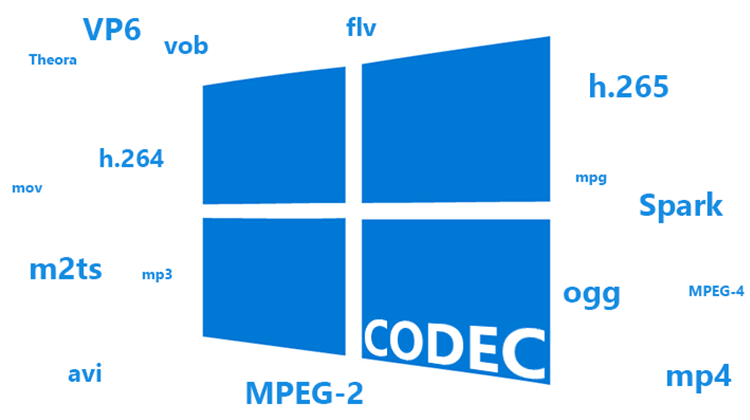
What Is A Codec

-A codec is a combination of encoder and decoder.
-The objective of a codec is usually to reduce the amount of data for transmission or storage.
-Codecs are used in particular for audio, video and image data, as well as for text compression and encryption.
-In the audio sector there are special codecs for voice or music. -Video and graphics codecs are specially designed for comics / cartoons and real pictures / movies.
Lossy data reduction primarily uses psychophysical tricks to inaccurately encode those parts of image and sound that humans can barely or barely perceive.
-The most popular audio codecs are FLAC and MP3, where FLAC specifies both the format and the codec. MP3 is a codec for audio in MPEG I or MPEG II format.
-The MP3 decoder side is standardized by Fraunhofer and can be obtained without a license. However, the encoder is paid. Therefore, many use the free LAME encoder.
-G.722.2 and Full Rate (FR) voice codecs are used especially in telephony.
-The most popular video codecs are H.265 for UHD TV, DivX and XviD in MPEG-4 Part 2 and H.264 for QuickTime.
-Often various encoded formats like MP3 and JPG are combined into one container file, for example in AVI, MKV, MP4 and FLV.

A simple codec example

The principle of a codec is clarified with an example. An abbreviation codec reduces typed text to abbreviated text and uses it to generate typed text:

-Format: Your digital font format might dictate how all the letters and characters you use are encoded in binary.
-You define the type of encoding in a specification, for example, the rule that each character consists of 8 bits. To do this, write a table showing which bit sequence is assigned to which letter or character.
-Codec: You can now create an abbreviation codec to convert typed text into font formatted abbreviated text.
-To do this, your codec must specify which words will be abbreviated and how, for example, through a set of rules, a large list of abbreviations or a combination.
Encoder – An encoder can now convert typed text to abbreviation format using the rules and directory.
Decoder: a decoder can convert it to written text.
-The efficiency of data reduction is highly dependent on your codec.
-If you only created a directory with three abbreviations, most of the texts will not be noticeably shorter. Compression is low.
-If your list of abbreviations is huge, the device that is going to encode and / or decode the text must have a large memory and a high reading speed.
-However, if you set up a smart set of rules for encoding, your codec is ideally small and the end device doesn’t have to do a lot of computing or reading work.
-If a word can be abbreviated in more than one way, that’s fine. A good encoder would use the most efficient abbreviation.
-However, if an abbreviation can have multiple meanings, you have lost information. This will probably render your codec unusable.
-However, if only the words that you know you are omitting were abbreviated ambiguously, you would have invented a lossy psychophysical encoding. This takes advantage of the fact that you do not visually perceive every existing word optically.
-This idea is not entirely false. Because, as this example shows, we don’t necessarily read exactly what is written.


Free Download Mp4Gain
picture


Mp4Gain Main Window
picture


Mp4Gain Features
picture


Free Download Mp4Gain
picture

What is a Codec? Clarifying concepts

What is a Codec? Clarifying concepts

Speaking of multimedia terminology, there is a fairly widespread confusion between the concept of image and / or sound format and that of audio and / or video container format (also called multimedia container format) To finish bundling it, it is very common to refer to both with the term codec that does not express any of the two previous concepts.

The image, video, audio format… is the way in which this type of information is encoded so that it can be treated by computer, which includes both being able to store it and transmit it. That format, therefore, would be a series of rules to describe images and sound in a computer way; a mathematical model, if you want to see it that way.

A codec (or codec, with tilde, in its Spanish version) is a program that encodes or decodes multimedia information according to a certain format. Once the data is encoded, it can be processed, for example stored or transmitted. As you may have guessed, the word codec is an acronym formed by the English words coder and decoder: encoder and decoder in Spanish.

An audio / video container format (or multimedia container format) is a computer file structure according to which audio and / or video is stored or transmitted as well as information associated with them (such as subtitles or bookmarks) The same container You can include together (multiplexed) the different components (tracks) in a single document. It is very common to add an extension to the name of the documents (those few letters that are at the end of the name separated by a period) that usually refer to the type of document. If you are rigorous in establishing that extension, it can serve as a clue to know which container is the document.

Considering the above, we could say that the document «feature film.avi» is a container in AVI format that includes video in MPEG4 format encoded using the Xvid codec. As the orthodox version is a very long phrase, it is common, for example, to say colloquially that the document “short.avi” is an MPEG4: it is obvious that it is an AVI container and everyone will know what codec has installed in their system for what formats

Most of the time, when packaging the information according to a certain format, it is compressed, that is, it is transformed so that the resulting information requires less memory to be stored or less bandwidth when transmitted than the original information.

There are two ways to compress information, with or without losses. Lossless (or lossless) formats allow you to reconstruct the information as it was originally, before compressing, without any difference from the original. In most cases the lossless coding usually allows (much) less compression (takes up much more) and is reserved for the documents that are going to be edited, that is, that they are not final documents.

The most frequent image and sound coding is with losses (lossy) Of course, the coding system seeks to make these losses as less noticeable as possible, considering for this, for example, the movement (What changes the image between a frame and another) The level of quality-compression is usually configurable so you can choose the degree you want between occupying more and having more quality. In line with what has been said about lossless formats, it is not a good idea to code according to a material loss format that is going to be edited since the successive recompressions cause more and more quality information to be lost to images and sound. Do not compress again and again using a lossy format!

One moment, you said that it is better to encode the original material using a lossless format but also that it will take up more. Then I must give the button on my camera that records video without compression? For starters, unfortunately, it is quite rare for your camcorder to have that button (in those of taking pictures and in audio systems it is something that is usually possible) Only in some cameras you can do something like that, they will usually be professionals and of the highest range. On the other hand, be prepared to spend a lot of memory and quickly, since you will need to store a lot and at full speed. So, what should I do? Our advice is that you choose, if you can, the best possible quality, even with losses, for the images you are going to edit and suitable for those that do not require more editing than the “cut” assembly since, properly processed , does not have to be compressed again.

Codecs: How an audio or video codec works

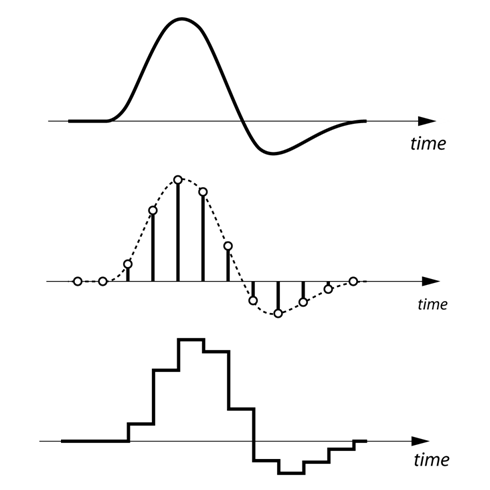
To understand in a simple way what a codec is and how it works, the first thing we have to keep in mind is that the human voice is a continuous (analog) waveform, while the information that circulates through a data network is discrete ( digital). This means that if we want to send packets with data that contain the information needed to reproduce a voice fragment, we will have to digitize the voice beforehand.

codecs

The process of converting an analog signal to a digital signal is done through an element called an encoder. If the encoder is also capable of performing the opposite process, that is, moving from a digital signal to an analog signal even if only approximately, then we will have an encoder-decoder. An encoder-decoder is also called a ‘codec’.

Although it may seem that we would only be interested in selecting one or two codecs taking into account the voice quality (MOS, Mean Opinion Score) and bit-rate parameters that each codec needs, the truth is that we also have to face our network Look closely at the size of the packets that we are going to send since each voice packet is also made up of bits that are used for routing and error correction issues. As they add load, they saturate the network and make the entire system go slower. Do we reduce the number of packages we have to send making them larger? It is not always a good idea because the loss of a large package will have a greater impact on the output, even a cut in communication! What is recommended in these cases is to have a certain compromise between the number of packets that are sent to the network and the protection we want to have. The reference size should be about 20ms of voice per package.

codecs

How codecs work

The codecs reduce the information of the clips to facilitate and enable their publication and viewing through the Internet. There are two methods of compression, the so-called spatial and temporal compression.

In the first one, reduce the information by compressing the existing one inside each frame. Instead of describing the pixel-to-pixel image, pointing out for example the position and color of the pixels, the compression codec generalizes describing similar areas and their light and color characteristics. For example, instead of reproducing a blue sky pixel by pixel, it would be described as an area with similar light and color characteristics. In this sense, the less varied details an image presents, the codec can generalize and compress more easily. Creating videos with simple backgrounds facilitates compression and reduction, just as working with a tripod instead of a camera in hand means stabilizing the backgrounds and therefore facilitating subsequent compression.

The other compression method is temporary, where the information between consecutive frames is compared and only the details that vary are stored. The reference frames from which the differences are analyzed and the subsequent ones are supported are called keyframes and contain the complete image. On the contrary, the frames that reflect the differences are called “delta frames” and only contain the information of the areas that vary with respect to the previous images.

In general, videos that show few changes between frames are compressed better and this necessarily affects the realization. At present, both the television and the cinematographic realization tend to use the camera in motion. However, the compression of dynamic videos is more problematic than the cases of more static images.