
To understand in a simple way what a codec is and how it works, the first thing we have to keep in mind is that the human voice is a continuous (analog) waveform, while the information that circulates through a data network is discrete ( digital). This means that if we want to send packets with data that contain the information needed to reproduce a voice fragment, we will have to digitize the voice beforehand.
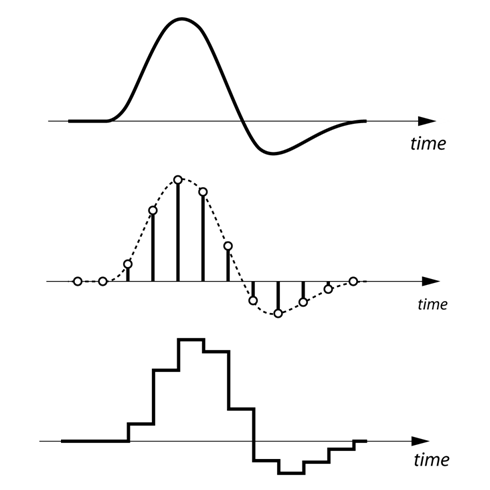
The process of converting an analog signal to a digital signal is done through an element called an encoder. If the encoder is also capable of performing the opposite process, that is, moving from a digital signal to an analog signal even if only approximately, then we will have an encoder-decoder. An encoder-decoder is also called a ‘codec’.
Although it may seem that we would only be interested in selecting one or two codecs taking into account the voice quality (MOS, Mean Opinion Score) and bit-rate parameters that each codec needs, the truth is that we also have to face our network Look closely at the size of the packets that we are going to send since each voice packet is also made up of bits that are used for routing and error correction issues. As they add load, they saturate the network and make the entire system go slower. Do we reduce the number of packages we have to send making them larger? It is not always a good idea because the loss of a large package will have a greater impact on the output, even a cut in communication! What is recommended in these cases is to have a certain compromise between the number of packets that are sent to the network and the protection we want to have. The reference size should be about 20ms of voice per package.
How codecs work
The codecs reduce the information of the clips to facilitate and enable their publication and viewing through the Internet. There are two methods of compression, the so-called spatial and temporal compression.
In the first one, reduce the information by compressing the existing one inside each frame. Instead of describing the pixel-to-pixel image, pointing out for example the position and color of the pixels, the compression codec generalizes describing similar areas and their light and color characteristics. For example, instead of reproducing a blue sky pixel by pixel, it would be described as an area with similar light and color characteristics. In this sense, the less varied details an image presents, the codec can generalize and compress more easily. Creating videos with simple backgrounds facilitates compression and reduction, just as working with a tripod instead of a camera in hand means stabilizing the backgrounds and therefore facilitating subsequent compression.
The other compression method is temporary, where the information between consecutive frames is compared and only the details that vary are stored. The reference frames from which the differences are analyzed and the subsequent ones are supported are called keyframes and contain the complete image. On the contrary, the frames that reflect the differences are called “delta frames” and only contain the information of the areas that vary with respect to the previous images.
In general, videos that show few changes between frames are compressed better and this necessarily affects the realization. At present, both the television and the cinematographic realization tend to use the camera in motion. However, the compression of dynamic videos is more problematic than the cases of more static images.

