FLAC Louder


Free Download Mp4Gain
picture

FLAC Louder

FLAC Louder
FLAC Louder
FLAC Louder
FLAC Louder

Is FLAC volume higher than MP3?

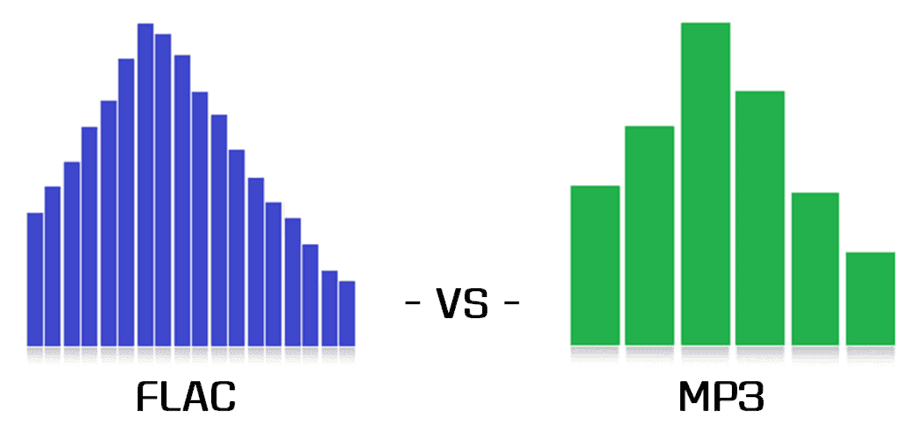
The FLAC (Free Lossless Audio Codec) and MP3 are both audio formats, but they have different technical structures and purposes. Many users often wonder if FLAC volume is inherently higher than MP3. To answer this, we need to understand the nature of these formats. FLAC is lossless, meaning it retains all the audio data from the original source. MP3, on the other hand, is lossy and compresses audio by removing some of its information. The perception of loudness can be influenced by the quality and details retained in an audio file. With FLAC’s lossless nature, it can potentially sound more detailed and vibrant, leading some to believe it’s “louder” than its MP3 counterpart.

Yet, the actual loudness of a track is determined by its mastering process, not just its format. A well-mastered MP3 might sound louder and clearer than a poorly mastered FLAC. It’s essential to differentiate between clarity and loudness.

“Music is the divine way to tell beautiful, poetic things to the heart.” – Pablo Casals

Does FLAC format have increased loudness?

It’s a misconception to think that FLAC format intrinsically has increased loudness. The format itself is designed to deliver lossless audio quality, preserving all the nuances and details of the original recording. This retention of detail can sometimes lead to a perception of greater dynamic range, which some listeners equate with loudness.

However, it’s vital to note that perceived loudness is multifaceted. Factors like frequency, duration, and intensity all play a role. FLAC’s fidelity might make certain aspects of a track more noticeable, but that doesn’t necessarily equate to an increased volume.

“Without music, life would be a mistake.” – Friedrich Nietzsche

Can FLAC files sound louder than other formats?

FLAC files have the potential to sound more detailed and full than some other formats because of their lossless nature. However, saying they are categorically “louder” can be misleading. The actual volume of any audio track, regardless of its format, largely depends on its original mastering. For example, a song released in the 1960s might inherently be quieter than a song released in the 2010s due to differences in recording technology and mastering standards.

It’s also worth considering the playback equipment. On certain sound systems or headphones, FLAC files might seem to have a richer sound or more depth, leading some listeners to perceive them as “louder.”

“Music can change the world because it can change people.” – Bono

Why might FLAC audio seem louder?

The perceived loudness of FLAC audio might stem from its detailed and uncompressed nature. Without the loss of data, FLAC can reproduce frequencies and nuances that might be lost in other formats. Such details might be subtle reverberations, background instruments, or the resonance of vocals. When these elements are more apparent to the listener, the audio can feel fuller, more layered, and thus, “louder.”

It’s a sensory experience more than an objective measurement. Our ears pick up on the richness of the sound, and our brains might interpret this as increased loudness.

“The only truth is music.” – Jack Kerouac

Comparing volume levels in FLAC files.

When comparing volume levels between FLAC files and other formats, one might not always find consistent differences. That’s because the format itself doesn’t dictate loudness; the mastering does. Two tracks, one in FLAC and the other in a different format, might have the same loudness levels if they were mastered the same way.

However, FLAC’s ability to reproduce audio without data loss means that if there are any details in the original audio that contribute to its fullness or depth, FLAC will render them accurately. This fidelity can sometimes be mistaken for increased volume.

“Music touches us emotionally, where words alone can’t.” – Johnny Depp

Is loudness different in FLAC versus WAV?

Both FLAC and WAV are lossless audio formats. They retain all of the original audio data, which means their fidelity is high. However, they store data differently. FLAC is compressed (without data loss), while WAV is generally uncompressed. Despite this, their sound quality is largely comparable. When it comes to loudness, neither format has an inherent advantage. The perceived volume will mostly hinge on the track’s mastering.

“Music is the shorthand of emotion.” – Leo Tolstoy

What causes the perceived loudness in FLAC tracks?

Several factors contribute to the perceived loudness in FLAC tracks. First, the preservation of all audio data means no detail is lost. Second, listeners might be using high-quality audio equipment that better reproduces the nuances of FLAC files. Lastly, psychoacoustics plays a role; our brains might interpret the richness and fullness of FLAC as louder, even if the decibel level remains unchanged.

“Music is the wine that fills the cup of silence.” – Robert Fripp

Does FLAC have a better dynamic range?

Dynamic range refers to the difference between the quietest and loudest parts of a track. FLAC, being lossless, has the potential to preserve the dynamic range of the original recording fully. This means, if the original audio had a broad dynamic range, the FLAC file would reflect that. However, it’s not the format itself but the source that determines dynamic range.

“Where words fail, music speaks.” – Hans Christian Andersen

Loudness factor in FLAC audio.

The loudness factor in FLAC audio is more about its ability to capture every detail from the source than about boosting volume. It provides a more authentic and unaltered listening experience. This fidelity can make certain elements of a track stand out more, which some might interpret as a volume increase.

“Music is the divine way to tell beautiful, poetic things to the heart.” – Pablo Casals

How does FLAC’s bit rate affect volume?

FLAC’s bit rate pertains to the amount of data processed per second. A higher bit rate often equates to better audio quality, as more data means more detail can be captured. However, bit rate doesn’t directly influence volume. It does, however, influence the clarity and richness of sound. Therefore, while a higher bit rate might make a track sound


Free Download Mp4Gain
picture


Mp4Gain Main Window
picture


Mp4Gain Features
picture


Free Download Mp4Gain
picture

What is free lossless audio codec (flac)?

What is free lossless audio codec (flac)?

FLAC

Definition – What does Free Lossless Audio Codec (FLAC) mean?
Techopedia explains the Free Lossless Audio Codec (FLAC)

FLAC

Definition – What does Free Lossless Audio Codec (FLAC) mean?
Free Lossless Audio Codec (FLAC) is an open source codec used to compress audio data without loss of audio quality. Similar to MP3 audio format, it is specially designed for audio and supports album art and audio tags, and is suitable for listening, archiving and recording.
Techopedia explains the Free Lossless Audio Codec (FLAC)
Many hardware devices support free lossless audio codecs. Completely lossless because the audio data is encoded losslessly and the decoded data is the same as the encoder input. The format uses MD5-based signatures to ensure the integrity of the audio data. Free lossless audio codec supports fast and accurate sampling. This makes the format and playback options suitable for editing applications. The metadata format is flexible and supports various lookup tables, covers, and labels. The FLAC format is suitable for archiving and is also excellent for archiving to CDs. The framing technique used in FLAC ensures that the format is error resistant.

There are many advantages to using the FLAC format. Since it is open source, no license is required. It has strong hardware support and is portable across many platforms and systems. It supports streaming and decoding is fast regardless of the compression ratio. Another benefit of using this format is the ability to partially restore damaged files.

However, the compression rates used in this format are less efficient compared to other encoders.

What makes an audio format lossless?

What makes an audio format lossless?

Lossless Audio

The best audio formats for your music library

Apple Music lossless

You might think of the word “lossless” as being used for audio formats that don’t use any kind of compression. However, even lossless audio formats use compression to reduce file sizes to reasonable levels.

Lossless formats use compression algorithms to save audio data so that the audio is exactly the same as the original source. This contrasts sharply with lossy audio formats like AAC, MP3, and WMA, which use algorithms that discard data to compress the audio. Audio files consist of sounds and silences. Lossless formats can compress silence to almost zero space while preserving all sound data, making them smaller than uncompressed files.

What lossless format is commonly used for digital music?
Popular lossless formats for storing music include:

FLAC
WAV
A THE C
lossless WMA
The effect of lossless formats on music quality
If you are downloading lossless music tracks from an HD music service, you would expect the sound quality to be really high. On the other hand, if you digitize a low-quality music box using a lossless audio format, the audio quality will not improve.

Is it possible to convert lossy songs to lossless?
Going from lossy to lossless is never a good idea. This is because a song that has been compressed using a lossy format always does. If you convert it to a lossless format, all you do is waste storage space on your hard drive or mobile device. There is no way to improve the quality of lossy songs using this method.

Advantages of using lossless audio formats for your music library
Using a lossy format like MP3 is still the most common method people use to store their music collection. However, there are clear advantages when it comes to building a lossless music library.

Perfect Music CD Backup: Lossless Copy to Audio Files gives you an exact bit-level copy of the original music CD. This means that no matter what audio format comes out in the future, you’ll know you have a perfect copy of the original.
Recover from lost or damaged: After playing music in lossless format, you can recover a damaged original CD or any CD that has been lost to a blank CD.
Convert to any format: Since your music is in a lossless format, you can convert it to any format and achieve the highest quality the format supports.
Disadvantages of Storing Music in a Lossless Format
Incompatible – Unlike formats like MP3, hardware devices like smartphones and tablets do not support lossless formats.
Requires more storage space: Lossless audio files generally require more storage space than lossy encoded files.

What equipment do you need to enjoy lossless audio? Part 2

What equipment do you need to enjoy lossless audio? Part 2

Apple Music Lossless Audio

digital to analog converter

Apple Lossless

Sound is an analog signal. Vibrations from objects generate it and air molecules spread it, so we can hear it. For this reason, there is no sound in space because there is no air to transmit it.

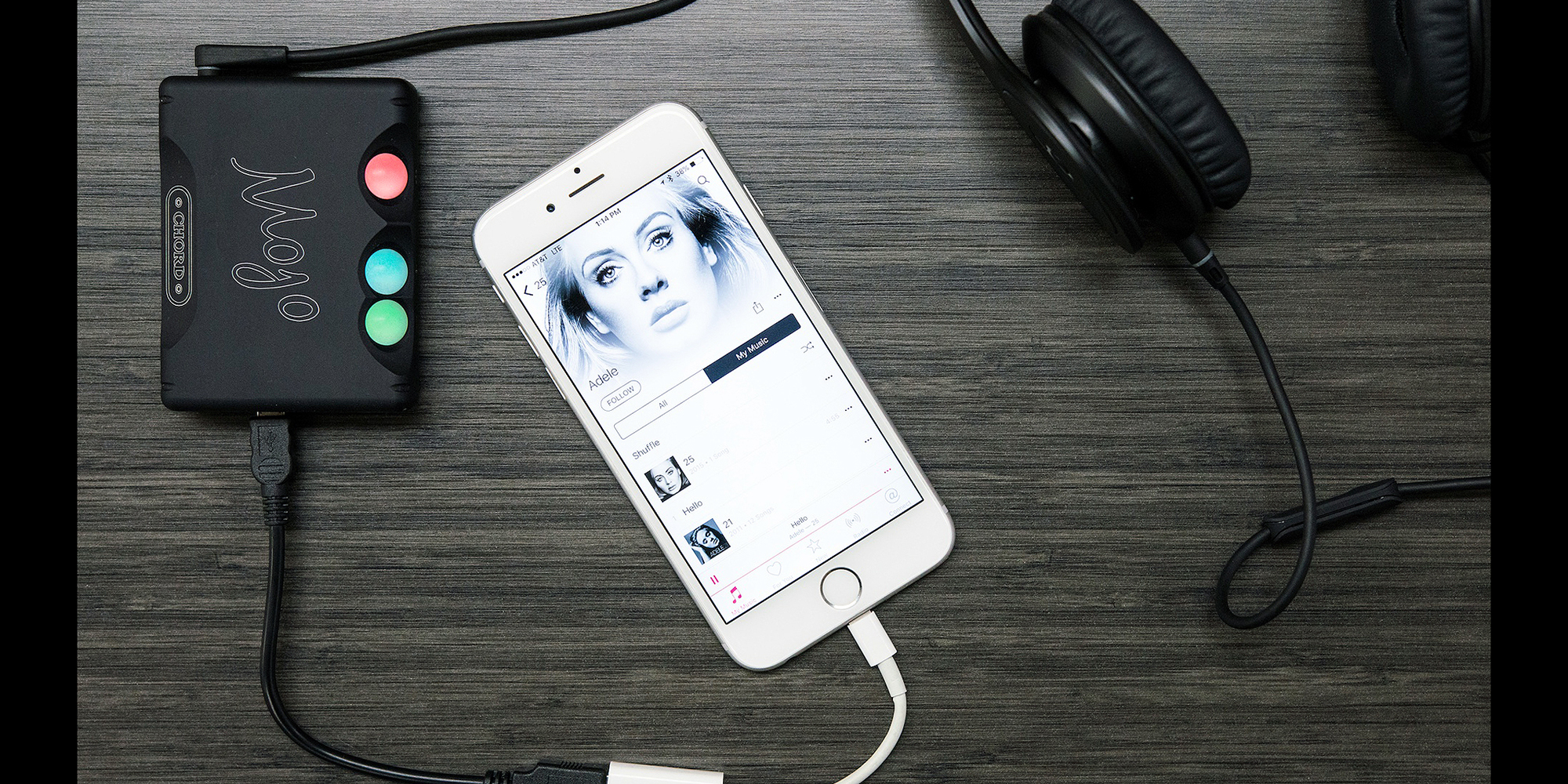
This is why you need a dedicated digital-to-analog converter (DAC). These devices are designed to convert digital signals to analog signals. While computers, smartphones, and other devices have built-in DACs, they’re often not optimized for music.

Also, analog signals are susceptible to interference. The DAC inside the device may receive interference from other components, such as the computer’s power supply or the smartphone’s 5G antenna. If you find that your audio output is too low, you definitely need a DAC with an integrated amplifier.

2.4 GHz wireless or wired speakers, headphones or earphones

If you want to take full advantage of lossless files, you need earphones or headphones capable of outputting high-fidelity audio. Unfortunately, even the best Bluetooth headphones cannot transmit uncompressed sound data.

While recent Bluetooth technology can transmit high-resolution sound, it’s still not enough for lossless audio. If you want to listen wirelessly, you must use a 2.4 GHz USB wireless connection. This is the only wireless audio technology that offers lossless transmission. Some alternatives, like Sony’s LDAC or Qualcomm’s aptX HD, come close, but it’s not “true lossless” audio.

However, if you need high-quality audio, it’s best to stick with the wired audio output. Since wired headphones are physically connected to your DAC, they receive analog audio signals directly. So your music will no longer go through conversion, compression or any other process. This ensures that you can enjoy the audio output of the DAC as it is.

High fidelity audio output

Of course, the most critical part of any listening experience is the speakers or headphones. Whether you’re playing lossy or lossless audio, if your audio equipment isn’t up to the task, you won’t be able to enjoy your music.

You need to look at various audio specifications, such as driver type, impedance, etc., to understand what makes a good speaker or headphone. Still, having impressive specs on paper doesn’t equate to great sound quality.

The only way to find the best speakers or headphones for your ears is to try them out in real life. You can also trust product reviews and comparisons from trusted sites; this way you can see other options that you haven’t considered before.

But if you have the budget, you can go ahead and invest in Bang & Olufsen. and Harman International. These speaker and headphone brands cost more than their competitors. But it is almost guaranteed that you will get the best audio quality from them.

The products of such companies are made of high-quality materials. They also have R&D facilities to ensure their speakers, headphones and earphones deliver the best sound quality possible.

What equipment do you need to enjoy lossless audio?

What equipment do you need to enjoy lossless audio?

Lossless

If you like high-fidelity audio, you’ve probably heard of lossless audio. You have probably read some articles about it and now you want to enjoy it for yourself.

Apple Music Lossless

But what hardware do you need to access high-quality audio? Can you use an existing device or do you need specialized drivers? Here’s a quick introduction to the hardware you need to enjoy lossless audio.

What is lossless audio?

Lossless recordings take up a lot of space: about 30 MB per song. But in the past, storage space was at a premium. The internet connection is also slow and unreliable. Therefore, the first iPod’s 5GB of storage could only hold about 166 lossless audio files.

That is why lossy file formats like MP3 were introduced. About 3-5 MB per song, you can store more than a thousand songs on the first generation Apple iPod. But as the Internet has gotten faster and storage space has become more affordable, the need for highly compressed audio has diminished.

File compression reduces file size by sacrificing quality. So if you’re listening to music with lossless audio, that means you’re listening to what was recorded. Lossless audio uses a compression format that does not cause any data loss or does not compress the audio at all.

Related: What’s the difference between lossless and hi-res audio?

Lossless device for lossless audio
Now that you have a lossless audio file, it’s no good if you plan to play it on an audio device that compresses the data. After all, if data is lost between the computer and the speakers, you won’t be able to enjoy the best audio quality.

So this is what you need to get the best audio out of your lossless music files.

Lossless Audio vs. Hi-Res Audio: What’s the Difference? Part 4

Lossless Audio vs. Hi-Res Audio: What’s the Difference? Part 4

Apple Music

Difference Between Lossless and Hi-Res Audio
As we explained earlier, lossless audio is an audio sample without any downstream compression on top of it. Such samples are in raw form.

Apple Music

So lossless audio does not mean higher quality audio. Any audio, hi-res or not, can be lossless.

Hi-Res Audio, on the other hand, is better quality audio with higher bit depth and high sample rate. High-Resolution Audio can be lossless or lossy.

Hi-Res Audio Format

With the rise of Hi-Res Audio, streaming services have started to introduce some proprietary audio formats. Some of the more popular formats include FLAC, AIFF, WAV, and ALAC. All of these formats support High-Resolution Audio with lossy or lossless compression.

For example, Apple uses ALAC for high resolution streaming on Apple Music. ALAC is a lossless format, which means that its compression does not degrade sound quality. It is also very space efficient. Compared to WAV without applying compression, ALAC takes up half the storage space.

Related: The Most Common Audio Formats: Which One Should You Use?

Like Apple, Tidal uses its own audio format, MQA. MQA has lossless compression and offers almost the same sound quality and storage space advantages as ALAC.

Audio without loss against high resolution audio: What is the difference? Part 3

Audio without loss against high resolution audio: What is the difference? Part 3

Apple Music lossless

What is the sampling frequency and the depth of bits?

Lossless Audio

Computers are digital machines that handle 1 and 0. Therefore, any information that a computer needs to store, including audio, should be stored as a chain of some and zeros.

On the other hand, the sound is not digital. It is analog and continuous nature. Then, if we want to store the sound in the computer storage unit, we must convert it to 1 and 0.

There are many ways to make this conversion. The simplest is the pulse code modulation (PCM).

The representation of the pulse code modulation is shown below.

In PCM, we take analog audio, reproduce it and sample it at a predetermined speed in the form of some and zeros. This data is then stored in audio format.

To better understand the process, imagine a photo of you playing baseball with the children. If you take 30 photos per second in an hour, you will have enough data to make an hour of video clips of 30 fps.

The same happens when you show an audio signal. It is taking a pictorial snapshot of the audio signal at an established speed. Codify all those snapshots and you will have an audio file.

To play an audio file, your computer only needs to play the snapshot at the same speed that was captured. This frequency is called sampling frequency.

We measure the sampling frequency in KHz. The standard sampling frequency for audio CDs is 44.1 kHz.

Now, since any audio consists of multiple sounds of different frequencies, we need to store multiple 1 or 0 to store all the necessary information. Therefore, we must strive to obtain the largest possible sample size, because the greater the sample, the better the sound quality will be.

The sample size, which is the number of bits in each sample, is called depth of bits. The depth of standard bits on the audio CDs is 16 bits.

High resolution audio

In spite of all the uproar over high resolution audio music transmission services, surprisingly there is no standard definition. There is no consensus on what is high resolution audio.

That said, the consensus is that the audio samples with high sampling and high-depth bits are called high resolution.

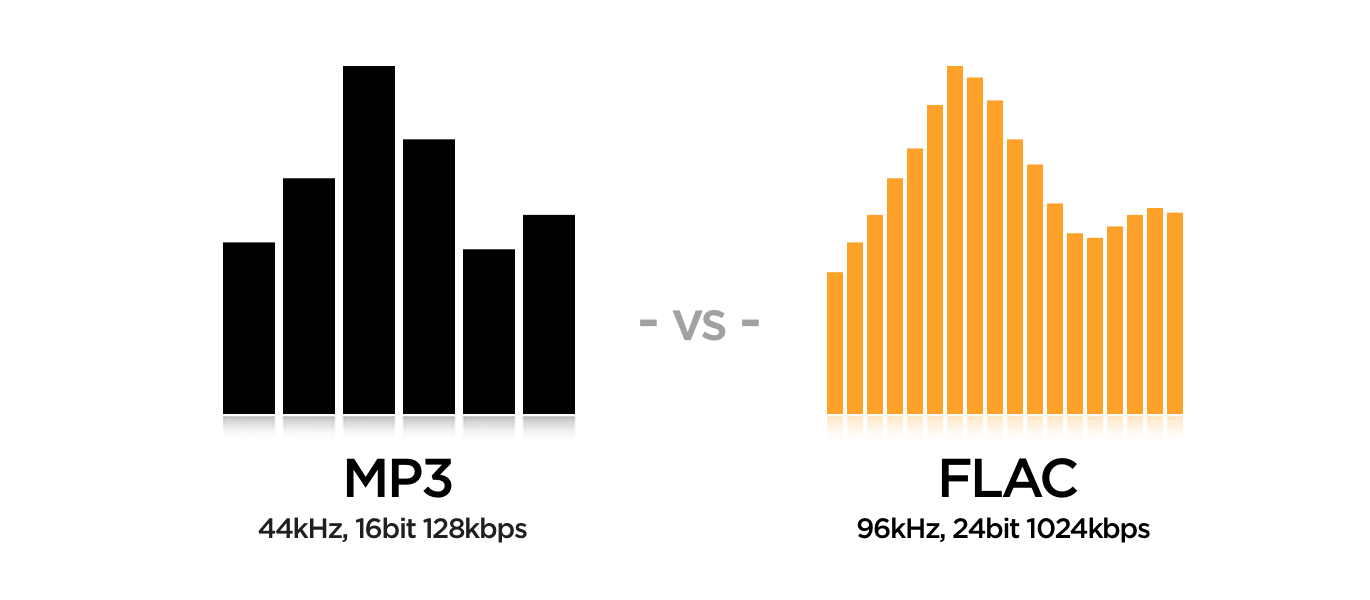
As you can see, the previous definitions change constantly. For example, when the 8-bit audio is the standard, 16 bits / 44.1 kHz is high resolution. Nowadays, when 16 bits / 44.1 kHz is the standard, 24 bits / 96 kHz is located in the field of high resolution.

In theory, high resolution audio sounds clearer and better. It has a greater dynamic range, better separation of instruments and low noise level.

Audio without loss against high resolution audio: What is the difference? Part 2

Audio without loss against high resolution audio: What is the difference? Part 2

Apple Music

While files with loss save storage space, they sacrifice the quality of the audio to be highly compressed. However, the industry adopts audio files with loss such as the de facto standard to deliver music to listeners.

Apple Music lossless

Related: How does file compression work?

The loss audio files are everywhere these days. All transmission sites, from YouTube to Spotify, reproduce compressed music. Fortunately, with the use of modernized coders and audio formats, these files sound good. Then, most people will not complain.

That is, the music we play is different from the study version. It is of less quality. Part of the reason are the compression techniques that use musical production in addition to the original recording.

The loss audio files are completely decompressed or use compression techniques that do not cause any data loss. Then, if it is transmitting audio without losses, it is transmitting music without compression artifacts. This can improve audio quality.

However, lossless files do not always produce a better quality sound. If the compressed file itself is of poor quality, decompress it will not help. Therefore, try to see if lossless audio makes a significant difference.

Audio without loss against high resolution audio: What is the difference?

Audio without loss against high resolution audio: What is the difference?

Apple Music lossless

If the transmission of music is your favorite, you have probably heard that Apple is entering its Alac format without losses in Apple Music for all users.

Apple Music

Like other important music transmission services, Apple is promoting the advantages of lossless audio and high resolution on traditional audio reproduction.

The change throughout the industry to offer high resolution audio options and without losses poses each of the following questions:

What is lossless audio? Is it the same as high resolution? If not, what is the difference and why should you care?

Let’s examine the terms to see if there is something that supports the exaggeration.

Audio without losses

In the first days of music transmission, transferring music files through the Internet was cumbersome. The Internet is still in diapers, so the speeds are low and questionable reliability.

In the past, the storage space was also quite expensive. Therefore, music publishers must find ways to launch music using the least amount of resources possible. This is where the audio is entered with loss.

When it comes to music, study recordings are quite large. They can occupy dozens of storage space megabytes. In an era in which most people do not have storage gigabytes, it is not practical to offer uncompressed study recordings.

Therefore, musical production creates highly compressed audio files to significantly reduce the size of the file. These compressed files are what we know today as audio files with loss.