Things You Should Know About Digital Music Quality (Part 2)


Free Download Mp4Gain
picture

Things You Should Know About Digital Music Quality (Part 2)

digital music

4. The search for an ideal is harmful.
Each of us wants the world and its components to be ideal; this is the axiom. Any DJ wants to have speakers in clubs connected and in tune, every track in the collection shines with quality mastering, and so on. But only the results of the work done are taken into account, each of us is forced to make commitments every day.
DIGITAL MUSIC

So interestingly, this also applies to the quality of the music. We already noted at the beginning that this is an important point, but not enough to deny the space of options and the possibilities of making decisions, perfectionism is completely out of place here. For example, an original underground producer puts out a new track at 128 KBPS, and it will definitely break the crowd. A dilemma arises: to play it or not?
Purists will answer negatively. But you have to be honest with yourself and judge by the emotions you want to convey through music. If the cumulative mass of factors exceeds five minutes of not-so-high-quality sound on your computer, the doubt can be dismissed. Don’t let dogma and the false pursuit of perfection damage your mission as an artist. You can buy the version in the best quality later. For now, do your thing.

5.Music is created with the playing environment in mind.
Good sound producers listen to the tracks as if they are making them in every possible system: in earplugs, cheap plastic speakers for a computer, etc., with the idea of ​​how other people will eventually hear it.
This brings us back to the first point: the work of the producer and the mastering engineer decides much more than the minor aspects. Club tracks with abundant bass sub-registers sound bad on the radio, and loud, howling radio mixes with tight dynamic range sound bad in the club. And the file format is irrelevant here. Producers are forced to compromise – this is an integral part of their workflow, and no expensive equipment or ghost software can affect this like you can.

6. The “golden age of audio” is fiction.
People ooze feelings or chant mantras too often, as was good in the past. That, in general, does not stand up to criticism: Stereo as such did not exist until the late 1960s, and the golden age of declining pop music gave rise to formats as unhealthy as eight-track cassettes.
Amplifiers and monitors have changed dramatically for the better, keeping pace with advances in technology. Yes, in the 70s and 80s it was possible to achieve good sound from high quality printed records, but in proportion to them there were many terrible circulations and publications that just sounded disgusting, ask older DJs and music lovers.

7. Technology comes first.
Thanks to technological progress, we can listen to as much music as ever, good or bad, until we can tell. The most suitable music fans are happy to listen to a variety of genres and styles in different formats on different devices and have fun. Because the main thing is the music, if it is good in itself, you can abstract from background noise and interference from shortwave radio, a joke club stereo system, and excessive volume.
So, gentlemen, intellectual audiophiles and expensive equipment manufacturers, we perfectly feel the difference. A hamburger eaten at the race on Wednesday does not prohibit a gourmet restaurant on Saturday. Everything must have its place and its time
Wireless audio systems, streaming, portable players … all have contributed to making music available to more people than ever. But even such a positive dynamic meets fierce resistance from fans of luxury sound at any price and sacrifice.
You have the option to choose between two completely contradictory situations. In the first, you find yourself in a sound-dampened listening room, where a stereo system is playing for thousands of dollars, and your friends stroking their beards and curling their mustaches, praising the “delicious” sound of the hi-hat and noticing “Texture” of the percussion nuances in the bass player’s performance. And in the second, you’re tearing up a crowded little bar, playing your set on lousy gear at full volume, where the girls start turning the tables because you’ve just started a crazy 128 kilobits-per-second remix.


Free Download Mp4Gain
picture


Mp4Gain Main Window
picture


Mp4Gain Features
picture


Free Download Mp4Gain
picture

Things to know about the quality of digital music ( Part 1)

Things to know about the quality of digital music

DIGITAL MUSIC

One of the key aspects of a positive music experience is the quality of the recordings and the quality of the sound that we enjoy. This is a very speculative topic, clashing technologies, devices and, first of all, the listeners themselves. The mass of the common people oppose audiophiles of all kinds with views of varying degrees of radicalism, but with an equally high level of rejection of the habits of their opponents.

digital music

This crowd of connoisseurs of $ 500 cables, tube amps, and high-end stereos are joined by respected artists and producers who explain that music should sound great, that it sounded like that at the time of recording, but with the advent of digital technology (so there is a mastery of audio file compression and the general portability of playback devices), the quality of music inevitably deteriorates, and generally we need to do something about it. Stop the loudness race or buy expensive CDs, get a player, amplifier and speakers, for example, at a decent price.
They think we are fools that we buy MP3s from online retailers like iTunes. Who listen to satellite radio and the internet. Who get fresh music every day on popular digital audio platforms. Who are happy with DJ sets playing from flash drives.
But these “nuances” not only prevent us from listening to a large amount of music using the above methods, but also from enjoying it.

Without a doubt, the quality of the music plays an important role. For example, DJs know this very well, working with musical material much closer and closer than the public. There is a difference between a specially compressed MP3 file and its source on a CD; it is a fact. However, the authoritarian tone of audiophiles and high-end music equipment manufacturers should soften, and the rhetoric should become more mundane and closer to the average consumer of music products.

We decided to collect 7 data on sound quality that will dissipate the clouds a bit over digital formats and portable audio.

1. The file format is not critical.
What the producer of a track does with it in the studio is a thousand times more important than in what format the result of this work will be encoded. You can’t make candy out of shit – a decent track with an artistic message, properly produced, mixed, and mastered in an acceptable dynamic range (where you didn’t go overboard with compression in the first place), even on unimportant speakers, will sound better than a dull, gray and poorly mastered track. even if you hear it in lossless format on a stylish stereo system. Always. This should be obvious to everyone.

2. Compressing the file size by 80% does not reduce the audio quality proportionally.
When you compress digital audio, you get rid of the main ballast without affecting the quality of music the human ear can hear. This process is called lossless compression (very similar to RAR or ZIP files). If you want to reduce the size of the audio file even more radically, you will have to shred the source and its sound forever; this is already a case of the notorious “quality loss”. Yes, as a result, the track undergoes irreparable changes, but people too often create darkness, claiming that this happens indiscriminately.
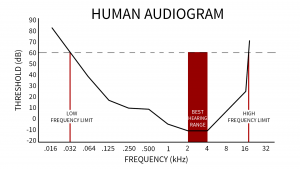
It’s time to admit that most people can’t hear some of the details on the album. It’s just that our ears are not comparable to the hearing of a dog and other animals. You can get rid of a lot of secondary information in the audio and no one will know the difference. This is psychoacoustics in action, this is how lossy audio compression works. There is a certain threshold below which the difference begins to be heard (MP3 with a bitrate of 96 kilobits per second cannot be compared with an analog of 320), but this does not mean that the myth about the relationship between the percentage of compression and the end result is true. It is a myth.

3. People make the most of life when music isn’t of the best quality.
Life story. In the 90s, the article’s conditional hero came to an illegal rave, spent the whole night, and decided he would make DJing the profession of his life. A brave step and a fateful decision. But what happened to the sound at that party? Everything was wrong, remember. The needle flew, the EQ not tuned, and the amps periodically cut out. Has anyone fired on this? Barely.
Have you ever been to a nasty sounding party that changed your life? Danced all night by bad announcers in a strange club and left in the morning with your future life partner?

The benefits of digital audio

The benefits of digital audio

DIGITAL AUDIO

The basics of “numbers”

Digital Audio

Each of the multimedia devices on sale today, be it a CD player, a voice recorder or a flash memory player, uses many different types of presentation of data streams, which are then converted into sound. And even more sound formats used for professional purposes have been invented. An inexperienced buyer is forced to gather information about designations on boxes and devices from a variety of sources, often receiving incorrect information or even more confusion.

Almost all devices in the “Portable Audio” section of the ZOOM.CNews.ru catalog support multiple sound formats at the same time, and many devices that do not belong in this category are also tagged with support for playing sound files. To help our reader, we decided to create a short glossary of abbreviations and talk about the most common formats. We plan to leave it open for updates and modifications, adding new formats and describing in more detail the advantages and disadvantages of the already common or forgotten ones.

A little theory

To begin with, remember that digital sound is nothing more than a collection of numbers. The determining factor is the system by which sound as air pressure is converted into data streams and encoded for further processing and reproduction. Consequently, digital sound is usually included in computer files with various extensions, which more often (but not always) can determine their format. And the same concept of format can have, paradoxically, two meanings. First, the format may exist as a general characteristic, including both the type and the physical characteristics of the medium (disk or cassette), recording method, encoding principles, and protection against errors. Second, the format can only be understood as the method of encoding and compressing sound, as standard media are used for transfer, for example a computer.

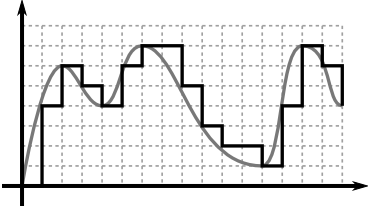
Analog sound, unlike digital, is reproduced on analog devices and has a number of significant differences. While not a data stream, analog audio is represented as a continuous electrical signal that represents a change in the sound wave. To translate it into digital format, the sound is “digitized”, that is, it is divided into certain segments, in which the numerical value of the amplitude is fixed at that moment. We will not delve into the principles of digital sound creation, but it is absolutely necessary to note that the more often a sound segment is divided and its characteristics described, the clearer and more complete the sound image itself is created.

This process generates an enormous flow of data that describes the sound, and it is clear that each digital audio format is nothing more than a compromise between the need to present the sound as loud as possible and the limitations of the memory of the computer or device. Of reproduction.

A little more theory. In most cases, the human ear perceives sound with a frequency no higher than 22,000 Hz and, to describe it fully in digital form, a sampling frequency of at least 44.1 kHz is required. Since it is absolutely impossible to determine the value of the signal at any given moment, during digitization quantization occurs, that is, the replacement of the actual values ​​of the signal by approximate values. The more levels of audio quantization, the more accurately the signal level is described. As a result, each standard CD carries an audio signal with a sampling frequency of the same 44.1 kHz and a 16-bit quantization level,

The benefits of digital audio

And now, briefly on why this algorithm was developed. Digital sound has enormous advantages over analog, although we must not forget its certain disadvantages. The main value of digital sound is the possibility of infinitely long storage and endless playback of material without losing the original quality, while analog sound loses quality with each re-recording. In addition, the transmission of sound and its processing by modern digital means is facilitated, first of all, by specialized computers. Furthermore, the digital signal on transmission lines is more resistant to interference than the analog signal. It is also important that digital technology,

Historically, digital sound was undoubtedly the initiative of company engineers who adopted Philips-developed Audio-CDs, also called CDDA – Compact Disk Digital Audio.

Digital audio encoding

Digital audio encoding

Digital audio encoding

In fact, this or that digital form of representation of analog audio signals is already a coding method. – a sequence of numbers that describes an analog audio signal is itself a digital code.

Digitl Audio Encoding

However, the encoding that we are going to talk about now is something else. Now let’s look at the methods of encoding digital audio signals.
A digitized audio signal “in its pure form” (for example, in the form of one of the PCM variations discussed above) is a fairly accurate, but not the most compact, way of recording the original analog signal.

Judge for yourself. To obtain complete information about the original analog signal in the frequency range 0-20 kHz (in the audible frequency range), the analog signal must be sampled at a frequency of at least 40 kHz. Thus, the CD – DA standard (the standard for recording data on audio CDs familiar to all) establishes the following encoding parameters: recording of two or one channel in PCM format with a sampling frequency of 44.1 kHz and a depth 16-bit quantization bits. One hour of music in this format takes approximately 600 MB (60 minutes * 60 seconds * 2 channels * 44100 samples per second * 2 bytes per sample = approximately 605 MB). Considering that, for example, an ordinary music lover’s music collection may have 5000 tracks with an average length of about 3 minutes each, the amount of memory required to store it in its original digital form turns out to be very impressive. . Therefore, storing relatively large amounts of audio data, ensuring fairly good sound quality, requires the use of various “tricks” to compress the data.

In general, all existing methods for encoding audio information can be conditionally divided into only two types.

1. Lossless data compression (“Lossless encoding”) is a method of encoding (compacting) digital audio information, which enables one hundred percent recovery of the original data from the compressed stream (the term “data Original “here means the original form of the digitized audio data). This method of data compression is used in cases where one hundred percent absolute preservation of the quality of the original audio data is required. Lossless compression algorithms that exist today can reduce the volume of data occupied by 20-50% and at the same time guarantee a 100% recovery of the original digital material from the compressed data. The operating mechanisms of such encoders are similar to the operating mechanisms of general data archivers, such as ZIP or RAR, but at the same time they are specially adapted to compress audio data …. Lossless encoding While it is ideal in terms of preserving the quality of audio materials, it cannot provide a high level of compression.

2. There is another more modern form of data compaction. This so-called lossy data compression (Engl. “Lossy encoding”) The purpose of encoding is to achieve the highest data compression rate by all means while keeping sound quality at an acceptable level. The idea behind lossy encoding is based on two simple underlying considerations:

original digital audio data is redundant: it contains a lot of unnecessary information that is useless to the ear, which can be removed, thereby increasing the compression ratio;
Requirements for the sound quality of audio material may vary and depend on specific purposes and areas of use.
Lossy encoding is therefore called “lossy”, which results in the loss of some of the audio information. Such encoding leads to the fact that the decoded signal, when reproduced, sounds similar to the original, but in reality it is no longer identical to it. Most lossy coding methods rely on the use of psychoacoustic properties of the human auditory system, as well as various tricks associated with resampling and resampling the signal. In frequency, during the compression process, the encoder analyzes the audio data to identify various details of the sound that can be ignored. Disguised frequencies, inaudible and inaudible sound details can be sacrificed for a higher compression ratio. There, where only intelligibility is important in sound (for example, in telephony, where the presence of frequencies above 4 kHz is not necessary), the audio information in the encoding process is seriously “simplified”.

Why can the difference in bitrate make it sound great (high, medium, low)?

Why can the difference in bitrate make it sound great (high, medium, low)?

Bit Depth vs. Bit Rate

Reply:
Just to make sure this is clear, let’s differentiate

BIT RATE BIT DEPTH

sample rate vs bit depth

as much as

Bit rate

how they relate to audio in the digital domain …

Sampling frequency:

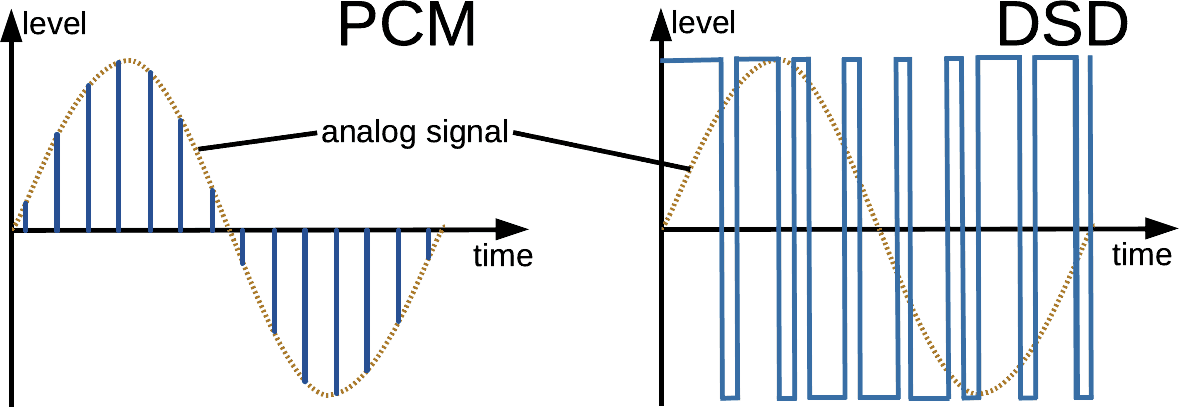
The sample rate is specified as a frequency (samples per second), for example, 44.1 kHz for CD. Other common values ​​are 48, 88.2, 96, 176.4, and 196 kHz, although some formats (such as DSD) have sample rates greater than 2.8 MHz. The sample rate indicates

how often the audio signal is measured

While some people view lower readings as a tiered bar graph, I prefer to view them as a child bitmap. If you take the outline of a horse and simplify it to 20 points so the child can connect, it’s not so much that you end up with steps (using straight and curved lines to connect 20 correctly spaced points can lead to a decent figure), but there won’t be without subtlety. Whereas with 200 (or 2000) points, you could approximate the wavy strands along the horse’s mane.

In audio, a lower sample rate does not make the sound “bad” (eg, fuzzy, fuzzy, or distorted), but rather limits the maximum frequency (pitch) that can be recorded / played back as intended.

Nyquist theorem formula

, The 44.1 kHz sampling rate was chosen for CD because it can record and play back frequencies up to 20 kHz. To record a spoken word (such as a speech, a sermon, or an audiobook), it would be difficult to detect a much lower sample rate, as the human voice has less and less harmonic information above 10 kHz.

Depth bits:

Considering that the sampling frequency determines how

often

audio signal is measured, bit depth indicates

scale accuracy

Since we are talking about digital audio, we describe this measurement scale in bits, where each bit is 0 or 1, and we concatenate a certain number of them to represent the value. When we have 8 bits, there are 256 possible numerical values, including zero. With 16 bits, there are 65,536 possible values. A 24-bit register can use 16,777,216 values.

When we convert analog audio to digital representation (A-to-D) and vice versa (D-to-A), we find interesting mathematical relationships. Each bit (digital) doubles the number of possible values ​​… And doubling the amplitude (approximately 4 times the power) of the sound wave (analog) corresponds to + 6 dB of loudness. Therefore, we can estimate the maximum dynamic range * of a digital recording at 6 dB / bit. Therefore, 8-bit recording has ~ 48 dB of dynamic range, 16-bit recording (such as a CD) has ~ 96 dB, and 24-bit recording has ~ 144 dB.

* For those of you unfamiliar with this term, dynamic range basically describes the difference between the quietest and loudest sound waves that can be recorded / played back. The CD has a difference of approximately 96 dB, which can be used to represent the most subtle pause compared to the incredibly loud burst of the cannon at Tchaikovsky’s climax.

1812 Overture

,

Three quick notes for those interested in delving into the rhythm …

There is a formula for the actual dynamic range of a digital recording that may differ slightly from the previous estimate, but it is a fairly minimal deviation, so an estimate of 6 dB / bit is what you normally see in quotes.
The latest 32-bit floating point representations combine a 24-bit number and an 8-bit exponent to represent many more possible values ​​than 24-bit registers. The dynamic range estimate is getting a bit dubious, but suffice it to say it’s well above 144 dB.
Using a lower bit depth, while you might think in terms of warp plugins with names like “bit-grinder”, doesn’t have to sound “bad” (eg fuzzy, fuzzy, or distorted), but just represents a reduced dynamic range. But since a 16-bit recording with a dynamic range of 96 dB (65,536 numerical values) cannot be represented in 8 bits (48 dB and 256 numerical values), to reduce the bit depth of the already digitized audio, a mathematical correction of the numbers down. (for example, 65535 becomes 255) using a compressor or limiter, which can cause the quietest recording bits to be lost so that the difference between soft and loud parts is <48 dB. Without such scheme, the transformation will cause clipping (numerical values ​​above the maximum),
Bit rate:

In digital audio, the bit rate is a measure of

how many bits are transmitted / processed per second

Benefits of “digital audio”

Benefits of “digital audio”

Digital Audio

The digitized audio signal has the following advantages:

DIGITAL AUDIO

-the possibility of infinitely long storage without loss of original quality,

-the ability to reproduce for a long time without losing the original quality,

-the possibility of infinite reproduction without loss of original quality,

-simplicity and wide possibilities of processing by modern means,

-Resistance to interference in signal transmission lines.

From CD to Super Audio CD and DVD Audio

CD (Compact Disk) is a type of removable plastic disk with optical reading of information.

In 1979, Sony and Philips proposed the Red Book standard for digital audio recording.

Analog sound is digitized and recorded as a spiral track of alternating zeros and ones (micron holes and a smooth surface) on a 12 cm polycarbonate disc, slightly thicker than a millimeter, covered with the thinner layer gold (later aluminum).

The player’s laser illuminates the disc and detects binary “zeros” and “ones”, which, after processing, are converted back to sound. It is almost impossible to mistake zero for one. Possible problems associated with read errors and scratches on the disc surface were compensated for using digital error correction.

As a result, not only did the physical dimensions of the record holder decrease compared to vinyl record, but also the musical capacity increased significantly: up to 74 minutes (the then owner of Sony wanted his favorite Beethoven Ninth Symphony to fit into a disk).

In 1982 in Langenhagen (Germany) the mass production of compact discs (CD) began with the “Alpine Symphony” by I. Strauss.

Real

High-quality audio is now recorded in Super Audio CD and DVD Audio formats, which:

use a DVD media,

use multichannel recording (up to 5.1),

sampling rate up to 192 kHz,

quantization level: up to 24 bits (each bit doubles the precision of sound transmission and, at such a depth of quantization, the dynamic range of the reproduced sounds can exceed 130 dB).

The new recording formats offer the highest quality, are expensive ($ 15 per disc), and are not popular because most listeners, sadly, don’t care too much about sound quality.

Digital audio options

The important parameters of the digital representation of sound are the sample rate of the audio signals and the quantization of bits.

Quantization rates indicate how many times per second a signal is sampled (measured in amplitude) for conversion to digital code.
For CD standard it is 44KHz (44 thousand times per second), for SACD 192KHz

The quantization bit characterizes the number of signal steps and is measured by the power of 2.

For the CD standard, 16-bit audio adapters are used, which have 65,536 quantization steps (2 to the 16 power), as in an audio CD. For standard and 24-bit SACD.

Digital audio storage

About digitizing sound has a set of signal amplitude values ​​taken at regular intervals and can be written to file sequence numbers (amplitude values).

Two methods are widely used to encode audio information:

PCM (pulse code modulation)

ADPCM (Adaptive Relative Pulse Code Modulation)

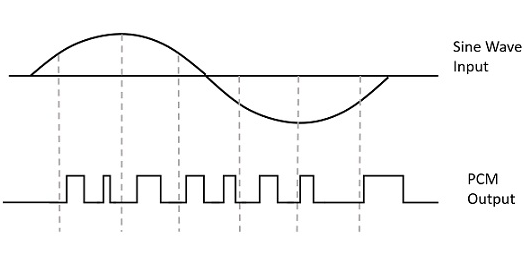
PCM (Pulse Code Modulation) is a method of digitally encoding a signal by recording the absolute values ​​of the amplitudes. This is how data is recorded on all audio CDs.

ADPCM (Adaptive Delta PCM) – Records signal values ​​in relative amplitude changes (increments), allowing you to simplify data to take up less memory.

Lossless encoding (for lossless data odirovanie) allows data recovery from fully compressed (20-50%) stream.

Popular L ossless encoding algorithms:

Windows Wave (WAV) is the primary audio file format for Windows.
The Audio Interchange File Format (AIFF) is the primary audio format for the Macintosh.

L ossy encoding (lossy data encoding) enables you to achieve sound similarity of the reconstructed signal to the original with the highest possible data compression (10-1 5 times).

The basis of lossy-encoders is the use of psychoacoustic models: certain portions of the signal, in certain frequency ranges that are inaudible to the human ear, nuances (masked or inaudible frequencies) and occurs to remove them from the original signal.

Analog Audio and Digital Audio

Analog Audio and Digital Audio

Analog vs Digital Audio

A sound wave is a kind of complex function, the dependence of the amplitude of a sound wave on time.

Analog Audio vs. Digital Audio

The information contained in the acoustic wave is not determined by the parameters of the medium in which the elastic wave propagates, and the oscillation parameters (amplitude and frequency, tone and harmonics).

Any form of recording (mechanical and Skye, magnetic, optical, laser) is based on the previous conversion of the sound wave into an alternating electrical current with the same parameters of the oscillations (via microphone).

Analog sound is represented on the device as a continuous electrical signal.

Sound quality depends on the fidelity of the waveform, which is very difficult to maintain.

Until 1982, the world was consuming “canned music” only from analog media: vinyl records and magnetic tapes.

Good vinyl records, played with good equipment, offered excellent sound quality, which unfortunately deteriorated a little with each listening due to mechanical wear as the stylus moved along the sound groove and into the dust that permeated everything.

Tape recorders required precision read heads and high tape feed speeds to reproduce smoothly. Over time, the tape demagnetized, the magnetic layer crumbled.

But the main disadvantage of analog audio recording is the inevitable loss of quality when copying.

The mystery of trigonometry

According to the theory of the mathematician Jean Baptiste Fourier, a sound wave can be represented as a spectrum of frequencies included in it.

The frequency components of the spectrum are sinusoidal oscillations (pure tones), each of which has its own amplitude and frequency.

According to Kotelnikov’s theorem, any vibration, even the most complex shape (for example, a human voice), can be recovered unambiguously and without loss from its discrete samples taken with a frequency equal to its doubled maximum frequency.

Vladimir Aleksandrovich Kotelnikov (1908-2005) – a prominent Soviet and Russian scientist in the field of radio engineering, radiocommunication and radio astronomy.

Observation . The finite duration signal has an infinitely wide spectrum. Therefore, when a signal with a finite duration is sampled, it is impossible to recover it from the samples without loss of quality.

Digitization of audio information

The digitization of sound is the recording of the amplitude of the signal at certain intervals and the recording of the amplitude values ​​obtained in the form of rounded digital values.
Any computer includes a motherboard, an audio adapter (sound card).

Sound cards include: ADC (analog to digital converter), synthesizer, mixer, DAC (digital to analog converter) amplifier s, MIDI interface port for gaming devices.

To record digital sound, the ADC produces:

temporal sampling of a continuous signal (determines the value of the amplitude of the signal with the frequency necessary to recreate its original shape = twice the maximum frequency of the sound wave);

quantization by the levels of the measured signal values ​​(determines the number of fixed values ​​(levels, gradations) of the amplitude of the signal);

signal coding (writing in a binary number system).

The reverse operation is performed by the DAC (digital to analog converter).

Bitrate

Bit rate (bit rate): literally bits of information of the transmission rate.

The bit rate is the effective information transmission rate through the channel (the transmission rate of “useful information”, in addition to the service information) expressed in kilobits per second (kilobits per second, kbps).

In lossy compression video and audio transmission formats, the bit rate parameter expresses the degree of compression of the stream and thus determines the size of the channel for which the data stream is compressed.

P-mode compression data stream:

with constant bit rate (constant bit rate, CBR) – The required bit rate is initially set, which does not change throughout the file. It makes it possible to predict the final file size quite accurately, but it does not provide an optimal size / quality ratio for musical works, the sound of which changes dynamically over time.

with variable bit rate (VBR): the codec changes the value of the bit rate based on the desired quality level according to the psychoacoustic model. It offers the best quality of the output file, but its size is unpredictable (it may differ several times).

with an average bit rate (ABR): a hybrid of constant and variable bit rates: the user sets the bit rate in kbit / s and the program varies it within certain limits.

DRM is a modern digital broadcast standard

DRM is a modern digital broadcast standard

DRM

Consider the problem of a compact representation of Nia’s audio signals in standard DRM, the new wasp standard that has the som index ISO / IES 14496 (MPEG -4 standard).

DRM

The third part of this standard (“Sound”) describes the encoded representation of natural and synthetic sound samples. This distinction makes it possible to distinguish the main part, which is an individual characteristic of the given signal, from the transmitted sound compositions, and the part that can be synthesized on a computer. When transmitting an audio signal, it is necessary to transmit its main part and descriptionThis is the part of the signal that can be synthesized at the receiving end. The transmission of a description of the signal instead of itself allows to recreate in real time on the receiving side an exact analogy of the original sound fragment
at low traffic flow speeds. This was one of the problems that the DRM community solved based on the MPEG-4 standard.

DRM uses advanced audio coding (AAC) and harmonic vector linear predictive speech coding (CELP and HVXC). For a tangible improvement in sound quality (especially with AAS), a special method can be used to increase the efficiency (high frequency reconstruction) of sound coding (SBR).

The encoded audio transmission signal is represented as superframes (superframes) of constant length. In superframes, an information service UEP is provided (ie, purely voice). Specific information to configure the audio data stream is transmitted on the SDC channel. Note that if no special measures are taken, when encoding a channel, all information bits are equally protected against channel errors (EEP algorithm), that is, the protection is carried out with the same degree of redundancy. At the same time, it is known that human perception of sound is characterized by uneven sensitivity to errors arising in the digital information stream at the output of the encoder. Therefore, it is quite natural to want to provide unequal protection against errors, that is, to extend a higher degree of protection for that part of the information bits,

MPEG-4 AAC
Figure 1. Structure of the AAC audio superframe For universal audio encoding, the MPEG-4 AAC algorithm is used, the best of similar algorithms suitable for use in DRM system. In the standard application of a mono AAC encoder on the shortwave (KB) channel, a bit rate of 20 kbps is provided. Of the possible extensions to the standard, only SBR technology is allowed.

The MPEG-4 AAC audio coding standard is part of the MPEG-4 audio standard (ISO / IEC 14496-3 + ISO / IEC 14496-3 / Amd1). The AAC digital stream in the DRM system is a digital stream of the MPEG-4 audio standard, version 2 (designed for use on channels with a high level of interference). Of the possible types of audio encoders (ISO / IEC standard objects), only the low complexity (LC) version of the ER AAC encoder belongs to the high-quality encoding algorithms – it is used in the DRM system. Among the existing methods to organize a digital stream MPEG-4 AAC, version 2, the version immune to noise HCR (Huffman Codeword Reordering) is selected, which is characterized by a low sensitivity of the audio data to errors in the transmission channel and a minimum digital bit rate.

The characteristics of the digital stream formation at the output of the AAC encoder in the DRM system are as follows:

the bit rate can be arbitrary, however it must be changed in steps of 20 bps to ensure alignment of the 400 millisecond audio overframe;
sampling frequency values ​​(f d) – 12 and 24 kHz;
the conversion length is 960 samples, which corresponds, depending on the sample rate, to the duration of a sound frame of 80 or 40 ms. This selection ensures that the duration of the audio frames is consistent with the logical frame at the MSC;
noise immunity. The MPEG-4 encoder has the means to protect the AAC – digital stream on channels with a high level of interference;
Super Audio Frames: 5 (f d = 12 kHz) or 10 (f d = 24 kHz) audio frames make up a super frame. An audio superframe has a constant length (400 ms), which determines the possibility of filling it with a number (5 or 10) of the simplest audio frames, each of which must also consist of two parts. An audio superframe is always transmitted in a logical frame (see Part 2, BC No. 8). Because of this, there is no need for additional synchronization during audio encoding. The structure of the audio superframe also provides for the implementation of the uneven protection function;

DIGITAL TELEVISION: WHAT IS IT?

DIGITAL TELEVISION: WHAT IS IT?

Digital Television

The difference in the propagation conditions of the signals according to their path (terrestrial, cable or satellite) is not only physical. The way to use the frequency range is also different.

DIGITAL TELEVISION

It is time to remind the reader that any information can be transmitted over a radio channel (that is, not over wires) using a high frequency signal. For this, the information to be transmitted is presented in the form of a low frequency signal and with its help a change in any characteristic of the high frequency signal occurs. Thus, the useful (informative) signal to be transmitted results, as it were, enclosed in a high-frequency signal that is easily transmitted. This process is called modulation, the high frequency signal (information carrier) is called the carrier, and the signal received after modulation is called the modulated carrier. The reverse process of recovering the modulated carrier information signal at the receiver is called demodulation.

With a land path, when signals are transmitted through the air over a distance of several kilometers, their quality is adversely affected by pollution in the lower layers of the atmosphere, reflections from various landforms and structures, etc. Although in the dedicated VHF (VHF) and UHF (UHF) frequency ranges, the signals propagate almost linearly, they are well reflected from various obstacles, therefore, even when the transmitter is in line of sight, the antenna receives not only direct waves, but and reflected by various obstacles, as well as by waves emitted by other transmitters on the same frequency. All this leads to distortions, if not the disappearance of the signal. To avoid this, with the terrestrial method, the transmission is carried out simultaneously at different carrier frequencies. Nearly several thousand carrier frequencies are combined into one multicarrier waveform, called orthogonal multiplexing (frequency division multiplexing) of COFDM (coded orthogonal frequency division multiplexing) channels. The full version of this system allows the use of 6785 individually modulated carriers.

For cable networks with good dielectric and electromagnetic properties and almost no interference, the quadrature amplitude modulation method QAM (Quadrature Amplitude Modulation) is used. Double your bandwidth efficiency by transmitting two signals simultaneously on the same carrier. This type of modulation is used in the ETS 400429 cable transmission standard.

When transmitting from satellites, the signal path is characterized by low interference and good reception conditions, which, however, can deteriorate in bad weather, for example rain, fog, snowfall, as well as under the influence of strong winds. that disturb the correct orientation of the antenna. The peculiarity of this method is the low power of the received signal. Therefore, the antenna must be installed at a sufficient height and have a sufficient parabola diameter, and the converter (amplifier and frequency converter) must have the necessary gain and low noise factor. For satellite transmission, the QPSK (Quadrature Phase Shift Keying) method was invented, which transmits two bits per symbol and thus allows you to double the bandwidth.

Signal coding
In digital television broadcasting, digital signals that have passed through encoders are first multiplexed (several input streams are combined into a single output stream) into a single elemental stream of a program, and then the elemental streams of all programs are multiplexed into a single elementary transport stream (also called transport multiplex).

Then, the digital signal during channel coding is complemented by a security code that protects against transmission errors, modulated and transmitted through the appropriate channel (terrestrial – terrestrial, satellite or cable) to the viewer.

Before encoding, the component signals for luma (Y), chrominance (CR and CB), and left and right audio channels (R and L, respectively) are sampled on an ADC. The sampling rate according to the CCIR 601 unified digital television standard is 13.5 MHz, the bit rate for the eight-bit quantization is 216 Mbps, and for the ten-bit quantization 270 Mbps.

When encoding sound signals, the psychoacoustic properties of a person are mainly used, for example a masking effect, in which loud sounds make silent sounds of other frequency subbands inaudible simultaneously with them.

How a digital signal is transmitted over the air.

How a digital signal is transmitted over the air.

Digital Signal

Any signal, analog or digital, are electromagnetic oscillations that propagate at a certain frequency, depending on what signal is transmitted, the device that receives this signal translates it into text, graphic or sound information that is convenient for the user or himself. device. For example, a television or radio signal, a tower or a radio station can transmit both analog and, for the moment, digital signals. The receiving device, upon receiving this signal, converts it into image or sound, supplementing it with text information (modern radio receivers).

Digital Signal

The sound is transmitted in analog form and already through the receiving device it is converted into electromagnetic oscillations, and as already mentioned, the oscillations propagate at a certain frequency. The higher the frequency of the sound, the higher the vibration, which means that the output sound will be louder. Generally speaking, the analog signal propagates continuously, the digital signal discontinuously (discretely).

Since the analog signal is constantly propagating, the oscillations add up and a carrier frequency appears at the output, which in this case is the main one and the receiver is tuned. In the receiver itself, this frequency is separated from other vibrations, which are already converted into sound. The obvious disadvantages of transmitting using an analog signal include a large amount of interference, low security of the transmitted signal, as well as a large amount of transmitted information, some of which is unnecessary.

If we talk about a digital signal, where data is transmitted discreetly, its obvious advantages should be highlighted:

–high level of protection of the transmitted information due to its encryption;
– ease of reception of digital signals;
– lack of strange “noise”;
– digital broadcasting is capable of providing a large number of channels;
–high transmission quality: the digital signal provides filtering of the received data;

To convert an analog signal to digital and vice versa, special devices are used: an analog-to-digital converter (ADC) and a digital-to-analog converter (DAC). The ADC is installed in the transmitter, the DAC is installed in the receiver and converts the discrete signal to analog.

In terms of security, why is the digital signal more secure than the analog? The digital signal is transmitted encrypted and the device that receives the signal must have a code to decode the signal. It is also worth noting that the ADC can also transmit the digital address of the receiver, if the signal is intercepted, it will be impossible to fully decipher it, since part of the code is missing; This approach is widely used in mobile communications.

In short, the main difference between analog and digital signal is the structure of the transmitted signal. Analog signals are a continuous flow of oscillations with variable amplitude and frequency. The digital signal is a discrete oscillation, the values ​​of which depend on the transmission medium.

Digital signal

A digital signal is a data signal in which each of the representative parameters is described by a function of discrete time and a finite set of possible values.

The signals are discrete light or electrical pulses. With this method, the full capacity of the communication channel is used to transmit a signal. The digital signal uses the entire bandwidth of the cable. Bandwidth is the difference between the maximum and minimum frequency that can be transmitted through the cable. Every device on such networks sends data in both directions, and some can receive and transmit simultaneously. Baseband systems transmit data as a single frequency digital signal.

A discrete digital signal is more difficult to transmit over long distances than an analog signal, therefore it is premodulated on the transmitter side and demodulated on the information receiver side. The use of algorithms to verify and restore digital information in digital systems can significantly increase the reliability of information transmission.

Commentary. Keep in mind that a real digital signal is analog by its physical nature. Due to noise and changes in the parameters of the transmission lines, it has fluctuations in amplitude, phase / frequency (jitter), polarization. But this analog signal (pulse and discrete) is endowed with the properties of a number. As a result, it is possible to use numerical methods for its processing (computer processing).