Sampling frequency (audio)


Free Download Mp4Gain
picture

Sampling frequency (audio)

sampling frequency

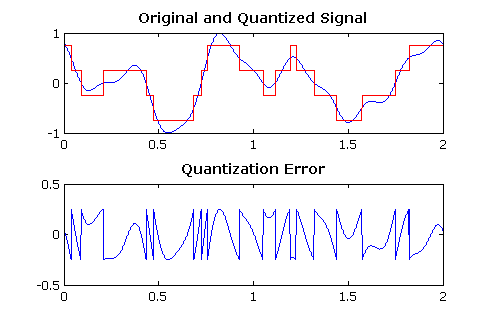
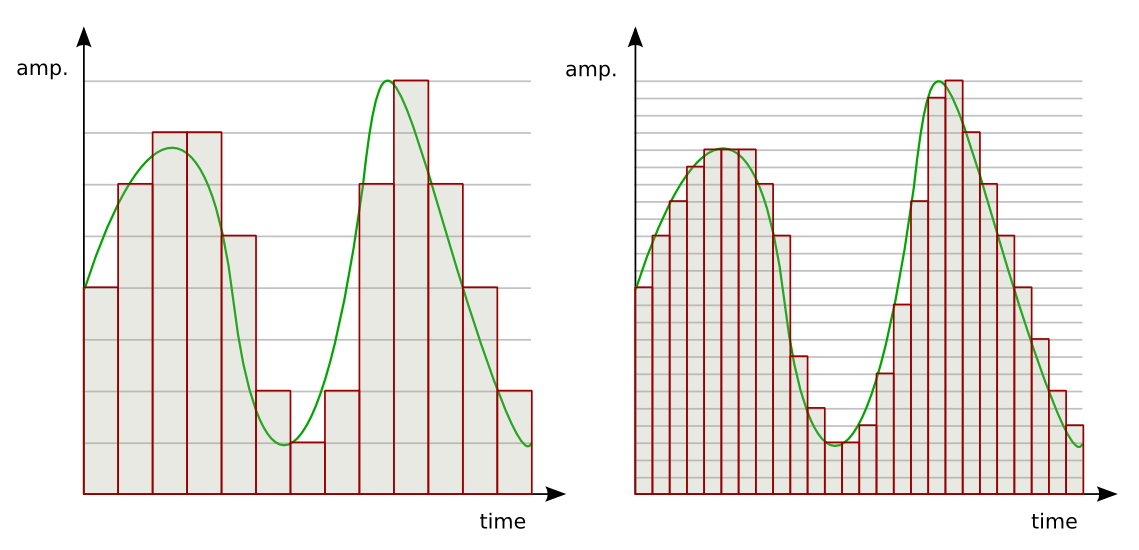
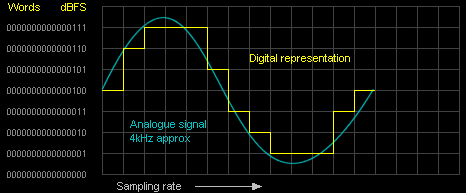
Time sampling is a process in which, during encoding of a continuous audio signal, the sound wave is divided into small separate time sections, and a certain amplitude value is set for each section. The greater the amplitude of the signal, the louder the sound.

sampling frequency

Sound depth (encoding depth): the number of bits per sound encoding.

Volume levels (signal levels): Sound can have different volume levels. The number of different loudness levels is calculated by the formula N = 2 I where I is the depth of the sound.

Sampling rate: the number of measurements of the input signal level per unit of time (for 1 second). The higher the sampling rate, the more accurate the binary encoding procedure will be. Frequency is measured in Hertz (Hz). 1 measurement in 1 second -1 Hz.

1000 measurements in 1 second 1 kHz. Let the sample rate of the letter D. One of three frequencies is selected for encoding: 44.1 KHz, 22.05 KHz, 11.025 KHz.

The range of frequencies a person hears is believed to be 20 Hz to 20 kHz.

The quality of the binary encoding is a value that is determined by the encoding depth and the sample rate.

Audio adapter (sound card) – A device that converts electrical vibrations from an audio frequency to a numeric binary code when inputting sound and vice versa (from a numerical code to electrical vibrations) when playing sound.

Audio adapter characteristics: sampling rate and recording capacity).

The register size is the number of bits in the audio adapter register. The higher the capacity of the digit, the smaller the error of each individual conversion of the value of electric current into a number and vice versa. If the bit width is I, then by measuring the input signal, 2 I = N different values ​​can be obtained.

The size of a digital mono audio file (A) is measured by the formula:

A = D * T * I ​​/ 8, where D is the sampling frequency (Hz), T is the resonance time or the recording of the sound, I register bit (resolution). This formula measures the size in bytes.

The size of a digital stereo audio file (A) is measured by the formula:

A = 2 * D * T * I ​​/ 8, the signal is recorded for two speakers, since the left and right sound channels are encoded separately.


Free Download Mp4Gain
picture


Mp4Gain Main Window
picture


Mp4Gain Features
picture


Free Download Mp4Gain
picture

24-bit and 16-bit audio comparison – audio test results

24-bit and 16-bit audio comparison – audio test results

24-bit audio

What quality of sound can a person determine by ear? In a very recent audio test, respondents are asked to blindly distinguish between sounds with a 24-bit and 16-bit dynamic range. Each of them downloaded several pairs of 24-bit files, one of which underwent a 24-16-24-bit conversion, that is, in practice it was a 16-bit file. They were asked to determine the difference.

The great audio myth: why you don't need that 32-bit DAC

The test involved 140 volunteers (138 men and 2 women – an honest demographic for audiophiles). Average age of respondents: 44 years.

According to the questionnaires, more than 20% of the respondents called themselves musicians and sound engineers, so it is possible to compare the results between “professionals” and amateurs, taking into account the statistical error.

The cost of audio equipment for survey participants typically ranges from $ 1,000 to $ 3,000.

The survey results for the three pairs of files are quite curious. In two of the three compositions, the correct and incorrect answers were distributed exactly in half.

And in the composition of Bozza, 52.85% of users made a mistake by mistaking a 16-bit file for a 24-bit one.

20 respondents answered all questions correctly and 21 people made a mistake in all variants, which also fits the statistical distribution.

It’s even more surprising that musicians perform worse than average, even taking into account statistical error! Vivaldi’s composition was especially confusing.

And here is the result among users whose audio equipment costs expensive: They could not distinguish.
Headphones also don’t help distinguish 16-bit from 24-bit music.

Summarizing. Of course, there are applications where it is necessary to work with 24-bit audio (the same mastering). But the fact is that 16-bit and 24-bit audios are completely indistinguishable from each other by ear. If someone claims to be able to hear the difference, that person is probably wrong.

16-bit vs. 32-bit audio

16-bit vs. 32-bit audio

32-bit DAC

Is it useful to make recordings at 32 bits?

32-bit DAC

No, and nobody can. It’s fun to think that everyone can. Bit depth is all about margin, that’s it. So if you have 24 bit depth you have about 140 dB of headroom. Who Needs It Are we logging jet engines from neutral to finish? Maybe there is someone. But most home musicians and ALL studios that make music never use that kind of margin. Most music has life compressed by someone while being mastered, and only uses the beats on top of the output. So why do people use 24-bit registers? Is it possible to make large files? It does not help the quality of the recording in any way.

The sample rate gives you more frequency response. And that’s it. However, at 44.1 kHz, the records are good down to a whopping 22 kHz, and that’s beyond ANY analog gear of the past. People claim that if you have the ability to turn up the frequency response, then the harmonics go into the audible and “affect the sound.” As far as I know, this has never turned up on double blind hearing tests to make a difference. Again, for the average home studio or these days, music (pop / rock metal tends to be pretty good) is created so badly that any … even possible frequency response gain is destroyed. And furthermore, very few people on Earth can hear beyond 20 kHz and THERE IS NO MUSIC there.

Anything greater than 16 bit 44.1 kHz is a loss of data because the data is simply not used. I think the idea of ​​”more is better” is behind the idea that “higher bit rates and higher sample rates” sound better because they are bigger. It’s bullshit. This is digital data. There are no slipping and slipping. Either there is enough bandwidth to receive the data and play it back (and there is with 16 bit 44.1 kHz) or there is none. Fortunately, if people insist on using higher speeds, no one will die. They are just wasting data space.

Answer 2:
No.

32-bit: choose your taste

Actually, there are two 32-bit types that are used in music. The one you find in a DAC or ADC is basically the same as your 24-bit DAC, with only 8-bit resolution. However, it is primarily “because we can, not because we should.” So I just looked at a 32-bit random DAC, “PCM1795 32-bit 192kHz sampler, extended segment, stereo D / A converter” from Texas Instruments. Scroll down to page 7 of the specification, in the Electrical Specifications section, and you will get the signal to noise ratio. Regardless of the sample rate, it is 123 dB for stereo, 126 dB for mono. That is actually 20.5-21 bits of resolution. So there is absolutely no difference between this DAC in 24-bit and 32-bit mode. In 24-bit mode, you have 20.5-21 bits of true audio, 3.0-3.5 bits of “marketing”. In 32-bit mode, you have 20.5-21 bits of true audio, 11-11.5 bits of marketing.

I’m not even sure why anyone was concerned about 32-bit DACs. When I first went into ADC / DAC with 16-bit stereo audio, it was amazing. Ultimately, my computers will have sound that is “as good as you ever need it”. Well not really, and even then it was pretty clear that you could create an audio system with SNR better than 96dB. I rarely needed it, because before CD no sound reproduction medium offered this level of noise, but it was possible. But nobody makes a system that generates 144 dB in the analog world.

There is another type of 32-bit audio sample that is used in music, this is a 32-bit numeric field, which includes a sign bit, a 23-bit mantissa, and an 8-bit exponent. It’s just a 24-bit audio sample with an added exponent field. Exponential means that the audio can be processed multiple times with virtually no loss of resolution. But if you listen to it, it turns back to a whole number. You cannot hear 32-bit floating point audio; it must be converted to integer format for playback.

But even a 24-bit sample is more than necessary. This is what is now the recording standard. If you could play a 24-bit audio file on an amplified system tuned so that a sample value of 0x0000 0000 0001 only matches the human hearing threshold, the full scale value would exceed the pain threshold and could cause real damage . your audience. This is a digital dynamic range of 144 dB.

I say digital because you can’t think of it as analog. In fact, a really good amp can give you a range of 120dB or so. You won’t be able to fully reproduce your signal

24 bit depth?

How come people start hearing higher quality with some kind of 24 bit DAC instead of the usual 16 bit?

24 bit depth

The answer to this question, like the answer to many other questions, lies in the workings of the human brain. You can easily realize that, in fact, music exists only in our head and consciousness already receives it in a processed form from the subconscious. The subconscious mind, in turn, has an incredible effect on how we see things (literally). And everything that passes through the senses passes through the subconscious without fail.

24 Bit Depth

So the wine for $ 10 seems tastier than the wine for $ 1, although in fact, both there and there the same body is poured. We fully understand that price does not mean high quality, but when we don’t think about it, the brain can very easily fill in the picture in the way it thinks best. And the subconscious mind is capable of operating with very complex structures, much more complex than the price of the product. Marketers know this very well. An old way to sell a pig in a poke, like an expensive DAC, is to compare it to a conventional audio system, but in the case of an expensive DAC, also increase the volume of the audio recording by 0.2 decibels. People do not consciously feel the difference, but the subconscious senses it. At the same time, it’s been known for a long time that people like louder music better. This is how an expensive DAC starts to sound “better” than usual.

The same goes for other components. So people believe that the sound has improved by replacing the USB cable. Or they think that tube sound is better than electronic. In fact, tube amps sound different than electronic ones, but that doesn’t mean that one is better or worse than the other. But without thinking, many, recognizing the “warm tube sound”, immediately prefer it to any other, although it can be emulated in electronic components with equal success.

And to me, in principle, I do not care, but I let them not dirty other people’s brains with these opinions. Better to let them honestly say they like this type of sound and stop saying it’s better.

The most surprising thing to me is that there are even people among audiophiles who pathologically hate digital sound. When digital sound first appeared, everyone from audio engineers to musicians was delighted with its quality. Before its introduction, all analog media were loud and wore out over time. It was impossible to listen to your favorite composition without the crackle or background noise, typical of vinyl records of that time, which was heard many times.

Digital sound on audio discs was perceived as something from another world: for the first time, music could be heard in perfect quality, without any external noise. And this recording could never deteriorate over time and could be transferred to other people via electronic means of communication without loss of quality.

But an extremely low percentage of people perceived this new digital sound with manifest horror. Digital sound sounded so unusual to them, used to analog recordings, that it seemed to them that the melodies with which they were familiar had lost their depth and familiar atmosphere. Just as some people long ago believed that photographs took people’s souls away, early audiophiles believed that digital recording took people’s souls away from music.

This trend continues to this day, although few have seen it in such extreme form. But its main meaning remains, the soul of the music needs to be returned. It doesn’t fit in 16 bits and 44.1 kilohertz, it needs 24 bits and 192 kilohertz. Some also need ritual items like gold wires or server-sized DACs. Some people use ultra-precise watches (oscillators) worth several thousand dollars, which they could not find useful in any professional study. Others diligently determine the processor load during music playback, believing that this affects the quality (in fact, the only thing the processor needs to do is take time to decode the music stream into an uncompressed format and poison it in the DAC before de as it ran out of data to convert and all modern processors cope with this without a problem). The list goes on and on, it would suffice for a series of articles.

Naturally, dozens, if not hundreds, of companies whose activities border on actual fraud benefit from all this. Ordinary people suffer from this too, sometimes spending several thousand dollars on a DAC that has no meaning to them instead of buying high-quality speakers for the same money.

How digital sound works (Part 3)
How digital sound works (Part 3)

Digital Sound

Frequency

DIGITAL SOUND

Having finished with bit depth, it’s time to move on to frequency. It is the frequency that sets the entire range of sounds that can be recorded, while the bit depth only affects the volume and dynamic range. Frequency determines how many of these 16-bit numbers, which we talked about earlier, can be recorded in one second of audio recording (per channel).

Here everything is relatively simple. Humans hear sounds ranging from 20 hertz to 20 kilohertz (20,000 hertz). 1 hertz means that the wave oscillates from maximum to minimum for one second, 20 hertz – 20 vibrations.

Sound with a frequency of less than 20 Hertz is infrasonic and dangerous to health. People do not hear sound above 20 kilohertz, these waves are too fast for the ears to pick up. Of course, many people imagine that they already hear perfectly all frequencies and even above 20 kilohertz, but in fact, most of the people who read this text hardly hear sounds with a frequency of more than 17-19 kilohertz, especially If you abuse MP3 players.

Music is in the midrange, between 25 hertz and 10 kilohertz. The .WAV format, which is used on audio discs, records sound up to 22.05 kilohertz per channel. This is due to the fact that recording equipment does not have ideal sensitivity and decreases as it approaches the upper end of the range. Therefore, this upper limit is taken as a number of 22.05 kilohertz, so that up to 20 kilohertz the sensitivity is maximum.

A typical nonsense that audiophiles spread about frequency is that they claim that the higher the frequency, the more accurate a sinusoid can be built. The more accurate the sine wave, the better the sound, so it is better to listen to music with a frequency of up to 192 kilohertz. This makes sense?

To be honest, here we are faced with a banal ignorance of mathematics. The fact is that if we know the maximum frequency of the wave, ideally we can reproduce its shape using the Nyquist-Shannon theorem, also known as Kotelnikov’s theorem, which states that the verification frequency of a specific value must be twice the wave peak frequency. … That is, for 20 kilohertz we can use a sample rate of 40 kilohertz and we can reproduce the ideal waveform based on this.

You can find the proof of this theorem yourself, if you need it. I will just say that it is tested and that in itself it has nothing to do with sound or any technical aspect of sound recording. It is just a fundamental law of the universe.

For whatever reason, audiophiles don’t perceive this. In his understanding, a sound wave manages to make incomprehensible eddies back and forth or up and down in the shortest period of time between samples and therefore must be constantly captured so as not to lose information. In fact, the waves are purely physically incapable of this.

Since actual audio recordings use 22.05 kHz, .WAV files use an actual sample rate of 44.1 kHz per channel. This is done so that the listener, using their equipment, can accurately construct exactly the waveform that was received during recording. This has nothing to do with sampling errors, you need to recreate the sinusoid and just for this.

The question may arise, what to do if the ADC gave an error during recording and showed the wrong number that corresponds to the actual pressure value at that time. We will talk about this in the next section.

6. ADC, DAC and amplifiers

In general, reading thematic forums and sites, I get the impression that ADCs and DACs are a kind of mystical devices for audiophiles. In fact, in fact, this is just a chain of resistors connected in a special order. As in any electrical device, in ADCs and DACs, the voltage is constantly oscillating back and forth, thanks to quantum mechanics, and it is impossible to do anything with this process. The main question is whether these measurement errors have any meaning.

As we remember, the value given by the ADC is pressure. In turn, a person’s sensitivity to pressure is a difficult subject, especially considering that it changes according to conditions. But overall, it’s pretty obvious that humans don’t have the sensitivity to distinguish all 65,536 possible stops in dynamic range. If we talk about sensitivity in decibels, then people do not consciously feel the difference of 0.2 decibels, but they perceive unconsciously. A difference of 0.1 decibels is considered indistinguishable, neither consciously nor unconsciously.

How digital sound works (Part 2)

How digital sound works (Part 2)

Digital Sound

What is sound?

DIGITAL SOUND

If we talk about sound, then it is actually a wave that is transmitted through a certain physical medium, in our case it is air. This wave is almost impossible to visualize, since it is three-dimensional and propagates in all directions with a fairly complex geometry. To display a wave graphically, a sine wave is usually drawn. It is important to understand here that a sine wave is NOT a wave, it is just a sine wave. It shows the state of a wave at a certain point in space at a certain moment in time and nothing else. We see only part of the wave that passed through this point at any one time. However, this is more than enough to fix the properties of the wave, such as its frequency.

24nnoeb.jpg

The same value that is shown in the sine wave, in the physical sense, is the pressure that the sound wave exerts on a microphone or a person’s ears. This pressure is measured in micropascals, and it is very important to understand that any sound, and also music, are oscillations of a wave with a certain frequency (in the case of music, with a changing frequency), but not a value of separate pressure taken at a given time. It’s just that air pressure is not sound and does not carry any sound information to the human brain. When the pressure fluctuates from one value to another, say with a frequency of 15 kilohertz, it creates a high-pitched, “screeching” sound. The specific pressure value during such fluctuations determines the volume: the higher the pressure, the greater the volume. When the pressure is too high

Therefore, I repeat, the pressure value at a given moment does not contain any information about the sound, and if there is no oscillation, any value corresponds to silence.

3. What are decibels?

After we discover the physical nature of sound (I hope), it’s time to talk about something as mystical as decibels. Decibels are “just” a unit of measurement for something, the same as megabytes and others, to put it simply.

The problem for many people is that decibels are not a constant unit of measurement, and the unit in which each step grows exponentially compared to the previous one. That is, suppose we have 1 decibel of something. Then we got 2 decibels. If you decompose these two decibels and represent them in the form of a ruler measuring centimeters, it turns out that the first decibel occupies only one centimeter, while the second occupies two whole centimeters, so the total value will be 3 centimeters. This is because the second decibel has grown exponentially compared to the first. If you add a third decibel, then it will already take 4 centimeters on this ruler and the total value will be 7 centimeters. (This is just an example to show exponential growth,

If you are far from engineering, then you may be wondering why such a unit of measure is needed. The answer to this question is beyond the scope of this post, and if anyone is interested, I suggest they watch this video:

I’ll keep talking about sound. In our case, we can use decibels for volume and nothing else. That is, 0 decibels for us will correspond to absolute silence (empty), while, let’s say, 140 decibels literally kill; this is such a loud sound. The main thing to remember is that even though we are measuring volume in decibels, this unit continues to grow exponentially. A sound with a volume of 140 decibels is not 140 times louder than a 1 decibel sound, but millions of times (8,912,655 times, to be precise).

Also, some may wonder what negative decibels are, like -40 decibels, etc. So this is the same, it’s just that in many audio devices, engineers take a certain value, say 80 decibels, for the “standard” volume value, and from it they measure a lower volume and a larger one. The default value itself is 0 decibels on the local system of this device. In some cases, 0 decibels is generally the maximum volume and the sound is measured exclusively downwards on such equipment.

We will not use these negative decibels, and for us, absolute silence will always be 0 decibels.

4. Bit depth

Now that we’ve cleared up or remembered all the basics of the basics, it’s time to move on to how digital audio is recorded. Sound is recorded by a microphone, a device that captures the vibrations of a sound wave and converts it into an electric current, the voltage of which fluctuates in proportion to the vibrations of the sound wave, so that its sinusoid is the same.

About audio and USB-C

About audio and USB-C

Usb C

Is the switch to USB-C good or bad? Why is it happening and what does it mean for those who like to listen to music from their mobile device?

The next smartphone you buy may be compatible with USB-C audio, even if it retains the “normal” 3.5mm jack. Which means more USB-C wired headsets are coming soon, because that’s how it works: Add support for something and companies will start making it. However, the use of the new audio jack raises many doubts and questions, how this experience will differ from the one we have had over the years.

The port is new, the details are the same.

Any type of audio content can be played on our smartphones thanks to the well-coordinated work of a number of special details. Going from 3.5mm to USB-C won’t change anything in this regard. However, the details themselves can change dramatically.

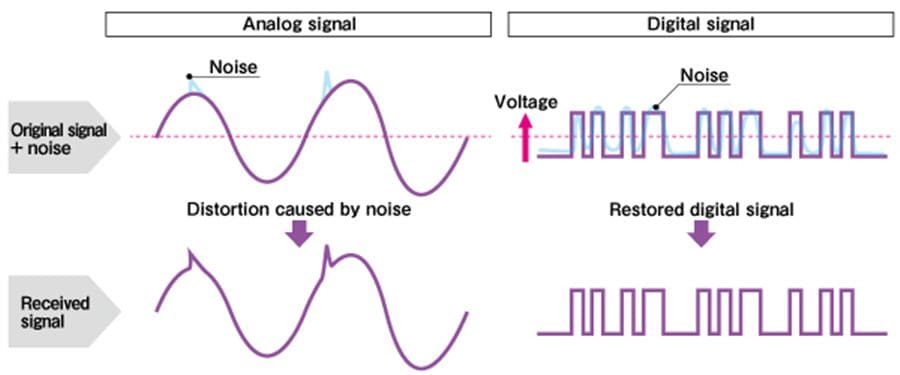
To convert your smartphone files into sound, you need a D / A converter, an amplifier, and speakers. The speakers vibrate to create a wave that affects our eardrums, and the work of their moving parts is possible due to electromagnetism. This wave corresponds to what is called an analog signal, and the varieties of this signal are sounds of different pitches. Then, the wave nature of the signal makes the speaker vibrate, this vibration generates waves that are sent to our eardrums, which, in turn, vibrate in our head, producing sound.

Files on your smartphone or files transferred over the internet are digital in nature. This means it’s just a bunch of ones and zeros put together so the computer can read them and know what to do with them. Digital files, by themselves, do not have any wave nature that allows speakers to produce sound. Therefore, we need something to turn one into another.

Complex algorithms are used to take audio recorded in analog format, convert it to a digital format, such as an .mp3 file, for storage on a computer, and then convert it back to analog for playback. The data has to go to a DAC to convert to the desired waveform and then to an amplifier that makes the wave strong enough to work in headphones. Scientists and engineers use a variety of tricks to “create sound,” but the process described is necessary for all phones, portable audio players, and all speakers.

There are two ways to send audio through the USB port, you guessed it: digital and analog. Analog audio can be converted to your smartphone’s onboard amplifier and DAC and then routed through the port to passive headphones or an adapter. For this to happen, the device must support what is called analog audio operation, in which case the headphones or adapter are just one signal conductor.

If you are using powered headphones or an adapter, the audio signal sent through the USB port is still digital. This means that the DAC and amplifier are inside the headphones or dongle and the conversion is done there and not on the smartphone.

This can cause certain problems. You must ensure that you are using the correct combination of devices. If you have passive headphones or an adapter, your smartphone must support analog audio, and many do not. And the problem is that most dongles, adapters and headphones are not marked in any way for their “activity” or “passivity”, nowhere is it indicated how they are made.

How digital sound works. (Part 1)

How digital sound works. (Part 1)

digital sound

In this post, I’d like to talk about digital sound and, along the way, expose such a popular form of freestyle as audiophilia.

Digital Sound

Unfortunately, lately I see more and more manifestations of this phenomenon, penetrating the minds of even quite reasonable people and causing them to spend money on technological analogues of homeopathic pills. I say “sadly” because everything that I will write in this article should, in principle, be known to all the people who graduated from school. But for some reason that I do not understand, they forget or do not want to apply in practice the knowledge they once acquired. The belief in audiophilia at this point has even penetrated and spread widely among engineers, although that’s really who, and they should understand these things thoroughly.

I originally wanted to write this article in a more aggressive style. But in the end I decided that it would be better for me to do without curses and provocations. On the contrary, I really hope that audiophiles read this article and reflect on what they believe and if they have enough reason to believe. Therefore, I will do so without provocation and will focus solely and exclusively on the facts.

And the most important thing I want to say right now: the audiophile arguments are not arguments related to any technical or engineering aspect. Audifilov’s arguments contradict science, specifically physics and mathematics. They also contradict technical and engineering aspects and audiophiles don’t know how their audio systems work, but this is a small problem compared to how they contradict physical or mathematical laws, showing a complete ignorance of the basics. It is the scientific aspects that I will focus on instead of explaining what the different types of CAD are and other details that are not of fundamental importance.

1. Basics: how sound is reproduced on a computer and any other electronic device

To begin with, an audio file is on a digital medium, such as a hard drive. This audio file has a certain internal format, but they are all a set of zeros and ones (0110010101 …), that is, any file can be represented as a very large number. This number can be easily converted to the usual decimal number system (189208 …).

The direct consequence of this is that the copies of the same file are all exactly the same. It doesn’t matter what medium they are in or how they were transferred or created: if the copies are correct, then they are exactly the same. The difference in playing the same file can only be caused by some other element in this play chain.

And this string is like this:

File -> audio player program -> digital to analog converter (DAC) -> amplifier -> speakers or headphones.

It works like this:

First, the player program loads (or receives from outside) an audio file into memory.

The software then decodes it, if necessary, into an uncompressed digital stream, which is digital audio. We will simply call this uncompressed digital audio .WAV and assume that this is the format in which music is delivered on conventional audio discs (two-channel stereo, 16-bit, 44.1 kilohertz per channel).

After that, this sound enters a digital to analog converter, which takes each number and converts it to an analog value that corresponds to it, most of the time it is a voltage measured in volts (from a certain minimum value that corresponds to a digital number 0 and up to a maximum value that corresponds to the number 65,536 – this is the maximum number that can be written in 16 bits).

After that, the sound, already in the form of electric current, enters the amplifier, the task of which is to raise the voltage to a value that suits the speakers. The amplifier must amplify the signal linearly, that is, each value that reaches it at the input must increase in the same proportion at the output.

In the speakers, the electric current is converted into physical vibrations, which are transmitted to the air and thus the sound we hear is obtained.

This chain, which from now on we will call the audio path, is present in one form or another in any digital audio system. The elements themselves may look very different on different systems (MP3 players, smartphones, computers, etc.), but they are necessarily present. When it comes to a computer, the DAC and amplifier are on the sound card (which is often built into the motherboard). Speakers often have their own built-in amplifier, and some of them may have their own DAC (and connecting to them bypasses the sound card).

HD sound guide

HD sound guide

HD audio

When it comes to HD (high definition) audio, Blu-ray player playback on computer, many people tend to think that the presence of the HDMI interface on the motherboard or video card allows it to automatically play on your TV and home theater system high definition audio formats such as Dolby. Digital Plus, High Resolution DTS-HD, Dolby TrueHD and DTS-HD Master Audio.

hd audio

However, with the exception of some interesting possibilities, in most cases this is not the case at all. Even relatively new high-end HDMI-equipped motherboards, video cards, and sound cards may not be able to handle such large audio streams on their own. Ultimately it all comes down to what kind of input signal they can receive and what kind of signal they can output.

In this review, we’ll take a look at all HD audio formats, their bitrate (streaming), and delivery requirements to the playback medium. In Part 2, we will continue to explore how digital audio streams can (or cannot) be handled in typical PC components. After reading both articles, you will need to understand in depth why so many home theater users use a variety of analog cables (three for 5.1 channel and four for 7.1) instead of HDMI to deliver multi-channel audio where you need it. We’ll also talk about some of the workarounds associated with converting a digital to analog signal on a computer, rather than a receiver or preamplifier – this option is often the most affordable option for optimal HD sound quality. And finally, you can see why buying a Blu-ray player for your home theater is worth waiting a little longer; This will allow you to take advantage of some of the new benefits that should appear before the end of 2008, but are not ready yet (at least they are not ready at the time of writing this article).

In the first part we will cover the following points:

The bit rate (or stream) associated with each format, as well as the number of channels, sample rates (sampling), and bit depths used to encode the formats.
Whether the SPDIF connector can provide the required stream for each format and what types of HDMI interfaces each format works with.

In Part Two, we’ll look at PC software codecs to find out what formats they work with, as well as the types of interfaces that HDMI-equipped motherboards, video cards, and sound cards can support. And since new chipsets and interfaces are available recently (or will be available relatively soon), we’ll also explain how new and future hardware can provide simpler solutions for high-definition audio for PCs that are currently in dire straits.
High Definition Audio Formats (HD Audio)

Blu-ray discs can contain movie soundtracks in one of the following formats:

PCM (linear PCM or LPCM);
Dolby Digital;
DTS;
Dolby Digital Plus;
High resolution DTS-HD;
Dolby TrueHD;
DTS-HD master audio.

Before diving into the above formats in detail, Dolby technologies originated from Dolby Laboratories, a recognized provider of professional, semi-professional and consumer multi-channel surround sound and noise reduction technologies. The DTS format (also called Digital Theater Systems) is in turn derived from DTS, Inc. is also a well-known provider of digital audio technology that competes with Dolby Labs.
PCM (linear PCM or LPCM)

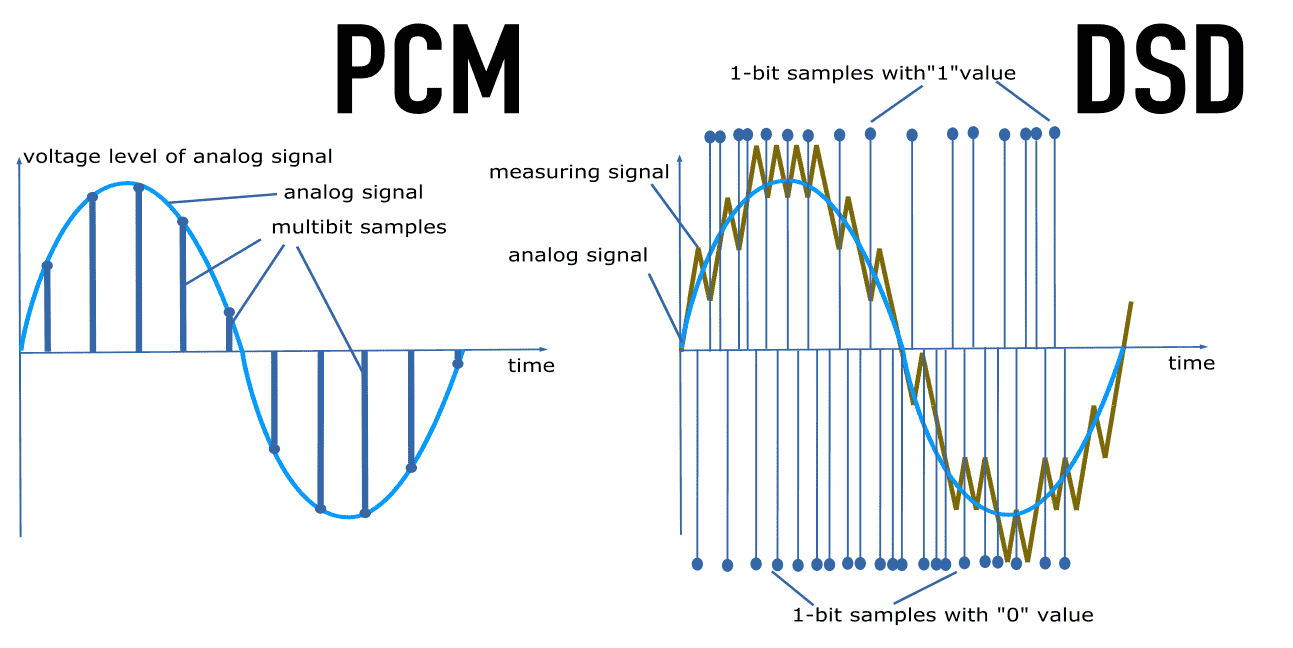
PCM (Pulse Code Modulation) PCM stands for Pulse Code Modulation and provides a digital representation of an analog signal that is sampled (digitized) at regular intervals (with a specified frequency in Hertz) and represented in binary form (with a specified precision – bit width). In addition to using PCM for computer digital audio and audio CDs, it is also used in some digital telephone systems and in various digital video formats. In PCM format, audio width values ​​are represented using different numbers of bits (bit depth); the soundtrack is usually digitized in 12 to 24 bit, but most of the time 16 bit is used in PCM studio encoding for Blu-ray discs.

A PCM audio track can be an exact copy of a studio original encoded on a disc without compression if its bit depth is the same as that of the original. If the bit depth is reduced (as is often the case to save space allocated for storing audio on disk), this can cause a downgrade – for example, using 16-bit instead of 24-bit.

DSD or PCM, which format is really better?

DSD or PCM, which format is really better?

DSD Vs PCM

High definition music exists in two main digital file formats, PCM and DSD. How are they alike, how are they different and which one should I prefer?

DSD PCM

What is PCM
Let’s start with the fact that PCM (Pulse Code Modulation) is initially older, the first mentions of its successful use date back to the middle of the last century and are associated, like many technological advances, with the defense industry, that is, with the Navy radars. As for home use, first of all, it is a well-known CD with a sampling frequency of 44.1 kHz and a 16-bit quantization level.

What is DSD
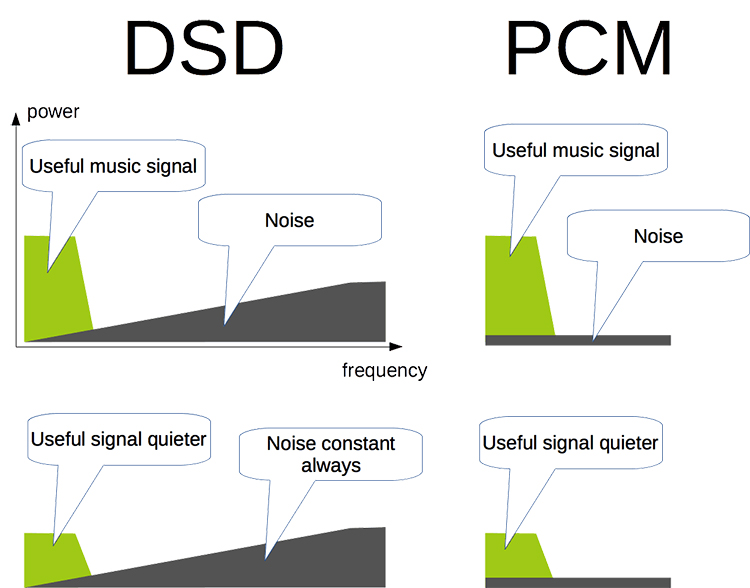
DSD (Pulse Density Modulation) is a format developed by Sony and Philips at the end of the last century and intended for the digital archiving of analog phonograms. The physical medium of this format is SACD. In fact, there is only one similarity between these two formats, both are digital, which for the user means the possibility of making unlimited copies without loss. As for the difference, relative to the field of graphic design, it is roughly the same as raster and vector graphics. And if it is even more artistic, like cross stitch and watercolor. In both cases, an image is obtained, but the method of its creation and, as a result of perception, are completely different.

What is the difference?
PCM, even because of its age, is much more studied, it has much better compatibility with a large number of different devices, it implies the possibility of editing (equalization, division into frequency bands, transformations). DSD is actually a closed format, you can record to it, you can play it, that’s it. However, it is inherently much closer to the original analog signal.

Which is better?
The first and most important conclusion is that from a technical point of view, the formats are far apart in terms of implementation methods, but they are often practically indistinguishable in practical use, that is, in the sound of the final file. We are talking only about minor differences in the nuances of the musical presentation. So, all things being equal, when choosing the next file to download and play, it’s best to focus on the source material. If you are looking to digitize an analog then DSD will probably be preferable and will retain more nuances from the original. If this is a remastering of a digital recording previously made in PCM, then it would make more sense for it to stay in this domain.