Understanding Audio Bit Depth: 8-bit vs. 16-bit vs. 24-bit


Free Download Mp4Gain
picture

Understanding Audio Bit Depth: 8-bit vs. 16-bit vs. 24-bit
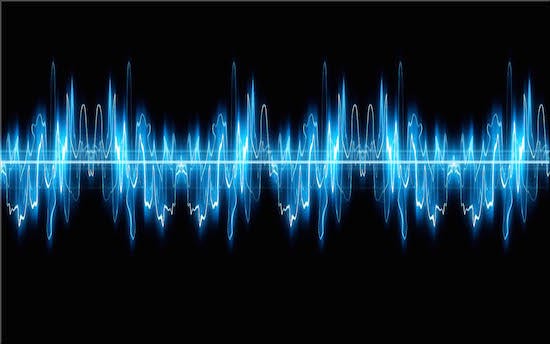
Bit Depth
Bit Depth

When it comes to digital audio, one of the most critical factors in determining the quality of a recording is the audio bit depth. In this article, we’ll delve into the technical details of audio bit depth and explore the differences between 8-bit, 16-bit, and 24-bit audio recordings.
Bit Depth
Bit Depth

What is Audio Bit Depth?

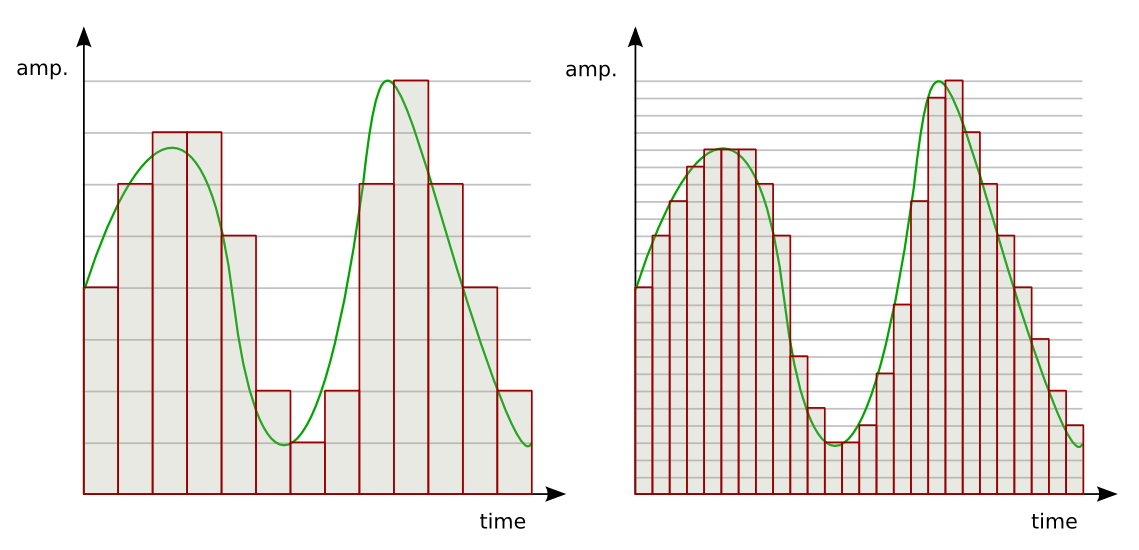
In digital audio, sound waves are converted into a series of numerical values that can be stored and manipulated by computers. Audio bit depth refers to the number of bits of information used to represent each sample in a digital audio recording. Each sample represents the amplitude of the sound wave at a specific point in time.

The bit depth determines the range of possible values for each sample. For example, an 8-bit audio recording has 256 possible values, while a 16-bit recording has 65,536 possible values, and a 24-bit recording has over 16 million possible values. This increase in possible values provides greater resolution and accuracy, resulting in improved sound quality.

Dynamic Range

Another critical aspect of audio bit depth is dynamic range, which refers to the difference between the quietest and loudest sounds that can be recorded. With an increase in bit depth, the dynamic range of a recording also increases. For example, a 16-bit audio recording has a dynamic range of 96 dB, whereas a 24-bit recording has a dynamic range of 144 dB. This difference in dynamic range is quite significant and is one of the reasons why 24-bit audio is preferred for professional applications.

Quantization Noise

Quantization noise is an inherent part of digital audio and is introduced during the process of converting an analog audio signal to a digital representation. Quantization noise is essentially the difference between the actual analog signal and the closest quantized digital value. The more bits used for quantization, the lower the level of quantization noise.

However, as the bit depth increases, the noise introduced becomes less of an issue. At 16 bits, quantization noise is typically not audible, but it can become noticeable when processing audio. At 24 bits, quantization noise is virtually non-existent, even when processing audio.

Conclusion

In conclusion, audio bit depth plays a crucial role in the quality of digital audio recordings. Increasing the bit depth of an audio recording provides greater resolution and accuracy, resulting in improved sound quality. Professionals in the music industry typically prefer 24-bit audio due to its higher dynamic range and lower quantization noise. However, for most consumer applications, 16-bit audio is perfectly adequate and results in high-quality sound.

It is also important to note that bit depth is just one aspect of digital audio quality. Other factors such as sample rate and compression algorithms also play a significant role in determining the overall quality of a digital audio recording. Nonetheless, understanding audio bit depth is a crucial step in the journey to becoming a proficient audio engineer or producer.


Free Download Mp4Gain
picture


Mp4Gain Main Window
picture


Mp4Gain Features
picture


Free Download Mp4Gain
picture

24 bit depth?

How come people start hearing higher quality with some kind of 24 bit DAC instead of the usual 16 bit?

24 bit depth

The answer to this question, like the answer to many other questions, lies in the workings of the human brain. You can easily realize that, in fact, music exists only in our head and consciousness already receives it in a processed form from the subconscious. The subconscious mind, in turn, has an incredible effect on how we see things (literally). And everything that passes through the senses passes through the subconscious without fail.

24 Bit Depth

So the wine for $ 10 seems tastier than the wine for $ 1, although in fact, both there and there the same body is poured. We fully understand that price does not mean high quality, but when we don’t think about it, the brain can very easily fill in the picture in the way it thinks best. And the subconscious mind is capable of operating with very complex structures, much more complex than the price of the product. Marketers know this very well. An old way to sell a pig in a poke, like an expensive DAC, is to compare it to a conventional audio system, but in the case of an expensive DAC, also increase the volume of the audio recording by 0.2 decibels. People do not consciously feel the difference, but the subconscious senses it. At the same time, it’s been known for a long time that people like louder music better. This is how an expensive DAC starts to sound “better” than usual.

The same goes for other components. So people believe that the sound has improved by replacing the USB cable. Or they think that tube sound is better than electronic. In fact, tube amps sound different than electronic ones, but that doesn’t mean that one is better or worse than the other. But without thinking, many, recognizing the “warm tube sound”, immediately prefer it to any other, although it can be emulated in electronic components with equal success.

And to me, in principle, I do not care, but I let them not dirty other people’s brains with these opinions. Better to let them honestly say they like this type of sound and stop saying it’s better.

The most surprising thing to me is that there are even people among audiophiles who pathologically hate digital sound. When digital sound first appeared, everyone from audio engineers to musicians was delighted with its quality. Before its introduction, all analog media were loud and wore out over time. It was impossible to listen to your favorite composition without the crackle or background noise, typical of vinyl records of that time, which was heard many times.

Digital sound on audio discs was perceived as something from another world: for the first time, music could be heard in perfect quality, without any external noise. And this recording could never deteriorate over time and could be transferred to other people via electronic means of communication without loss of quality.

But an extremely low percentage of people perceived this new digital sound with manifest horror. Digital sound sounded so unusual to them, used to analog recordings, that it seemed to them that the melodies with which they were familiar had lost their depth and familiar atmosphere. Just as some people long ago believed that photographs took people’s souls away, early audiophiles believed that digital recording took people’s souls away from music.

This trend continues to this day, although few have seen it in such extreme form. But its main meaning remains, the soul of the music needs to be returned. It doesn’t fit in 16 bits and 44.1 kilohertz, it needs 24 bits and 192 kilohertz. Some also need ritual items like gold wires or server-sized DACs. Some people use ultra-precise watches (oscillators) worth several thousand dollars, which they could not find useful in any professional study. Others diligently determine the processor load during music playback, believing that this affects the quality (in fact, the only thing the processor needs to do is take time to decode the music stream into an uncompressed format and poison it in the DAC before de as it ran out of data to convert and all modern processors cope with this without a problem). The list goes on and on, it would suffice for a series of articles.

Naturally, dozens, if not hundreds, of companies whose activities border on actual fraud benefit from all this. Ordinary people suffer from this too, sometimes spending several thousand dollars on a DAC that has no meaning to them instead of buying high-quality speakers for the same money.