
How digital sound works (Part 3)
Frequency
Having finished with bit depth, it’s time to move on to frequency. It is the frequency that sets the entire range of sounds that can be recorded, while the bit depth only affects the volume and dynamic range. Frequency determines how many of these 16-bit numbers, which we talked about earlier, can be recorded in one second of audio recording (per channel).
Here everything is relatively simple. Humans hear sounds ranging from 20 hertz to 20 kilohertz (20,000 hertz). 1 hertz means that the wave oscillates from maximum to minimum for one second, 20 hertz – 20 vibrations.
Sound with a frequency of less than 20 Hertz is infrasonic and dangerous to health. People do not hear sound above 20 kilohertz, these waves are too fast for the ears to pick up. Of course, many people imagine that they already hear perfectly all frequencies and even above 20 kilohertz, but in fact, most of the people who read this text hardly hear sounds with a frequency of more than 17-19 kilohertz, especially If you abuse MP3 players.
Music is in the midrange, between 25 hertz and 10 kilohertz. The .WAV format, which is used on audio discs, records sound up to 22.05 kilohertz per channel. This is due to the fact that recording equipment does not have ideal sensitivity and decreases as it approaches the upper end of the range. Therefore, this upper limit is taken as a number of 22.05 kilohertz, so that up to 20 kilohertz the sensitivity is maximum.
A typical nonsense that audiophiles spread about frequency is that they claim that the higher the frequency, the more accurate a sinusoid can be built. The more accurate the sine wave, the better the sound, so it is better to listen to music with a frequency of up to 192 kilohertz. This makes sense?
To be honest, here we are faced with a banal ignorance of mathematics. The fact is that if we know the maximum frequency of the wave, ideally we can reproduce its shape using the Nyquist-Shannon theorem, also known as Kotelnikov’s theorem, which states that the verification frequency of a specific value must be twice the wave peak frequency. … That is, for 20 kilohertz we can use a sample rate of 40 kilohertz and we can reproduce the ideal waveform based on this.
You can find the proof of this theorem yourself, if you need it. I will just say that it is tested and that in itself it has nothing to do with sound or any technical aspect of sound recording. It is just a fundamental law of the universe.
For whatever reason, audiophiles don’t perceive this. In his understanding, a sound wave manages to make incomprehensible eddies back and forth or up and down in the shortest period of time between samples and therefore must be constantly captured so as not to lose information. In fact, the waves are purely physically incapable of this.
Since actual audio recordings use 22.05 kHz, .WAV files use an actual sample rate of 44.1 kHz per channel. This is done so that the listener, using their equipment, can accurately construct exactly the waveform that was received during recording. This has nothing to do with sampling errors, you need to recreate the sinusoid and just for this.
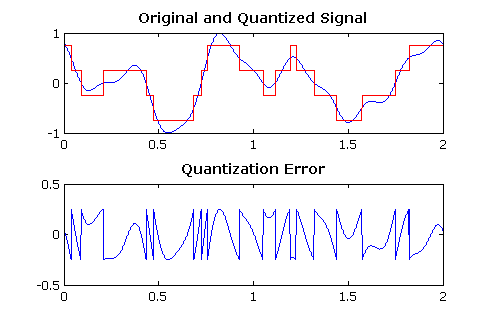
The question may arise, what to do if the ADC gave an error during recording and showed the wrong number that corresponds to the actual pressure value at that time. We will talk about this in the next section.
6. ADC, DAC and amplifiers
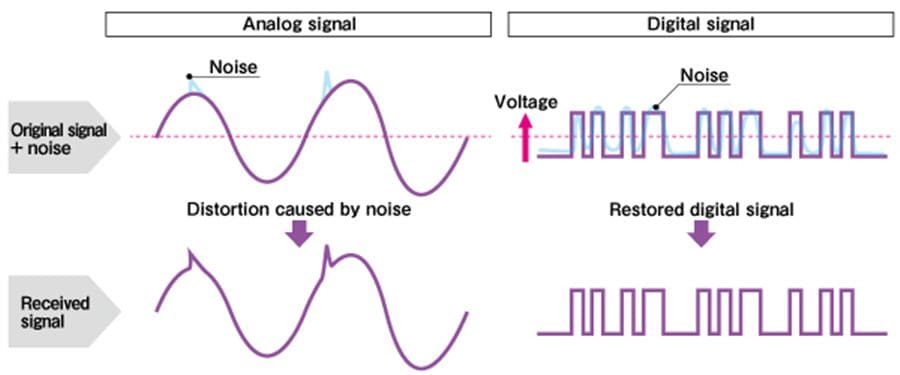
In general, reading thematic forums and sites, I get the impression that ADCs and DACs are a kind of mystical devices for audiophiles. In fact, in fact, this is just a chain of resistors connected in a special order. As in any electrical device, in ADCs and DACs, the voltage is constantly oscillating back and forth, thanks to quantum mechanics, and it is impossible to do anything with this process. The main question is whether these measurement errors have any meaning.
As we remember, the value given by the ADC is pressure. In turn, a person’s sensitivity to pressure is a difficult subject, especially considering that it changes according to conditions. But overall, it’s pretty obvious that humans don’t have the sensitivity to distinguish all 65,536 possible stops in dynamic range. If we talk about sensitivity in decibels, then people do not consciously feel the difference of 0.2 decibels, but they perceive unconsciously. A difference of 0.1 decibels is considered indistinguishable, neither consciously nor unconsciously.


