How digital sound works (Part 3)


Free Download Mp4Gain
picture

How digital sound works (Part 3)
Digital Sound

Frequency

DIGITAL SOUND

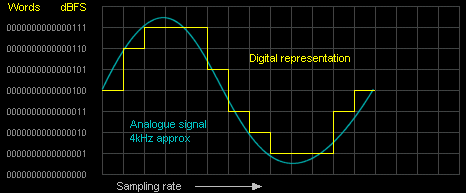
Having finished with bit depth, it’s time to move on to frequency. It is the frequency that sets the entire range of sounds that can be recorded, while the bit depth only affects the volume and dynamic range. Frequency determines how many of these 16-bit numbers, which we talked about earlier, can be recorded in one second of audio recording (per channel).

Here everything is relatively simple. Humans hear sounds ranging from 20 hertz to 20 kilohertz (20,000 hertz). 1 hertz means that the wave oscillates from maximum to minimum for one second, 20 hertz – 20 vibrations.

Sound with a frequency of less than 20 Hertz is infrasonic and dangerous to health. People do not hear sound above 20 kilohertz, these waves are too fast for the ears to pick up. Of course, many people imagine that they already hear perfectly all frequencies and even above 20 kilohertz, but in fact, most of the people who read this text hardly hear sounds with a frequency of more than 17-19 kilohertz, especially If you abuse MP3 players.

Music is in the midrange, between 25 hertz and 10 kilohertz. The .WAV format, which is used on audio discs, records sound up to 22.05 kilohertz per channel. This is due to the fact that recording equipment does not have ideal sensitivity and decreases as it approaches the upper end of the range. Therefore, this upper limit is taken as a number of 22.05 kilohertz, so that up to 20 kilohertz the sensitivity is maximum.

A typical nonsense that audiophiles spread about frequency is that they claim that the higher the frequency, the more accurate a sinusoid can be built. The more accurate the sine wave, the better the sound, so it is better to listen to music with a frequency of up to 192 kilohertz. This makes sense?

To be honest, here we are faced with a banal ignorance of mathematics. The fact is that if we know the maximum frequency of the wave, ideally we can reproduce its shape using the Nyquist-Shannon theorem, also known as Kotelnikov’s theorem, which states that the verification frequency of a specific value must be twice the wave peak frequency. … That is, for 20 kilohertz we can use a sample rate of 40 kilohertz and we can reproduce the ideal waveform based on this.

You can find the proof of this theorem yourself, if you need it. I will just say that it is tested and that in itself it has nothing to do with sound or any technical aspect of sound recording. It is just a fundamental law of the universe.

For whatever reason, audiophiles don’t perceive this. In his understanding, a sound wave manages to make incomprehensible eddies back and forth or up and down in the shortest period of time between samples and therefore must be constantly captured so as not to lose information. In fact, the waves are purely physically incapable of this.

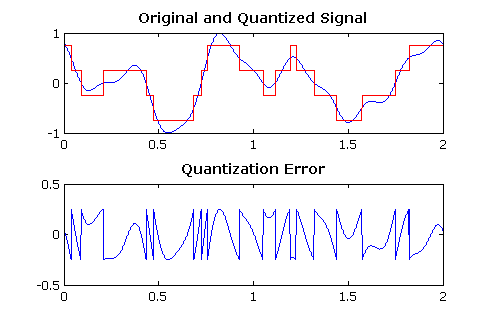
Since actual audio recordings use 22.05 kHz, .WAV files use an actual sample rate of 44.1 kHz per channel. This is done so that the listener, using their equipment, can accurately construct exactly the waveform that was received during recording. This has nothing to do with sampling errors, you need to recreate the sinusoid and just for this.

The question may arise, what to do if the ADC gave an error during recording and showed the wrong number that corresponds to the actual pressure value at that time. We will talk about this in the next section.

6. ADC, DAC and amplifiers

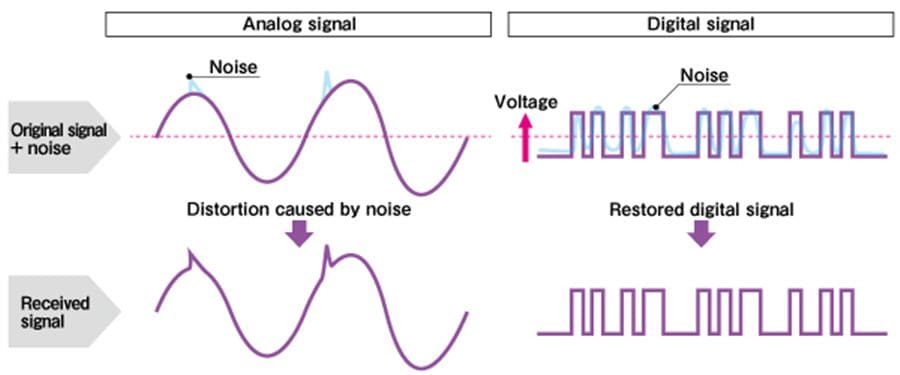
In general, reading thematic forums and sites, I get the impression that ADCs and DACs are a kind of mystical devices for audiophiles. In fact, in fact, this is just a chain of resistors connected in a special order. As in any electrical device, in ADCs and DACs, the voltage is constantly oscillating back and forth, thanks to quantum mechanics, and it is impossible to do anything with this process. The main question is whether these measurement errors have any meaning.

As we remember, the value given by the ADC is pressure. In turn, a person’s sensitivity to pressure is a difficult subject, especially considering that it changes according to conditions. But overall, it’s pretty obvious that humans don’t have the sensitivity to distinguish all 65,536 possible stops in dynamic range. If we talk about sensitivity in decibels, then people do not consciously feel the difference of 0.2 decibels, but they perceive unconsciously. A difference of 0.1 decibels is considered indistinguishable, neither consciously nor unconsciously.


Free Download Mp4Gain
picture


Mp4Gain Main Window
picture


Mp4Gain Features
picture


Free Download Mp4Gain
picture

How digital sound works (Part 2)

How digital sound works (Part 2)

Digital Sound

What is sound?

DIGITAL SOUND

If we talk about sound, then it is actually a wave that is transmitted through a certain physical medium, in our case it is air. This wave is almost impossible to visualize, since it is three-dimensional and propagates in all directions with a fairly complex geometry. To display a wave graphically, a sine wave is usually drawn. It is important to understand here that a sine wave is NOT a wave, it is just a sine wave. It shows the state of a wave at a certain point in space at a certain moment in time and nothing else. We see only part of the wave that passed through this point at any one time. However, this is more than enough to fix the properties of the wave, such as its frequency.

24nnoeb.jpg

The same value that is shown in the sine wave, in the physical sense, is the pressure that the sound wave exerts on a microphone or a person’s ears. This pressure is measured in micropascals, and it is very important to understand that any sound, and also music, are oscillations of a wave with a certain frequency (in the case of music, with a changing frequency), but not a value of separate pressure taken at a given time. It’s just that air pressure is not sound and does not carry any sound information to the human brain. When the pressure fluctuates from one value to another, say with a frequency of 15 kilohertz, it creates a high-pitched, “screeching” sound. The specific pressure value during such fluctuations determines the volume: the higher the pressure, the greater the volume. When the pressure is too high

Therefore, I repeat, the pressure value at a given moment does not contain any information about the sound, and if there is no oscillation, any value corresponds to silence.

3. What are decibels?

After we discover the physical nature of sound (I hope), it’s time to talk about something as mystical as decibels. Decibels are “just” a unit of measurement for something, the same as megabytes and others, to put it simply.

The problem for many people is that decibels are not a constant unit of measurement, and the unit in which each step grows exponentially compared to the previous one. That is, suppose we have 1 decibel of something. Then we got 2 decibels. If you decompose these two decibels and represent them in the form of a ruler measuring centimeters, it turns out that the first decibel occupies only one centimeter, while the second occupies two whole centimeters, so the total value will be 3 centimeters. This is because the second decibel has grown exponentially compared to the first. If you add a third decibel, then it will already take 4 centimeters on this ruler and the total value will be 7 centimeters. (This is just an example to show exponential growth,

If you are far from engineering, then you may be wondering why such a unit of measure is needed. The answer to this question is beyond the scope of this post, and if anyone is interested, I suggest they watch this video:

I’ll keep talking about sound. In our case, we can use decibels for volume and nothing else. That is, 0 decibels for us will correspond to absolute silence (empty), while, let’s say, 140 decibels literally kill; this is such a loud sound. The main thing to remember is that even though we are measuring volume in decibels, this unit continues to grow exponentially. A sound with a volume of 140 decibels is not 140 times louder than a 1 decibel sound, but millions of times (8,912,655 times, to be precise).

Also, some may wonder what negative decibels are, like -40 decibels, etc. So this is the same, it’s just that in many audio devices, engineers take a certain value, say 80 decibels, for the “standard” volume value, and from it they measure a lower volume and a larger one. The default value itself is 0 decibels on the local system of this device. In some cases, 0 decibels is generally the maximum volume and the sound is measured exclusively downwards on such equipment.

We will not use these negative decibels, and for us, absolute silence will always be 0 decibels.

4. Bit depth

Now that we’ve cleared up or remembered all the basics of the basics, it’s time to move on to how digital audio is recorded. Sound is recorded by a microphone, a device that captures the vibrations of a sound wave and converts it into an electric current, the voltage of which fluctuates in proportion to the vibrations of the sound wave, so that its sinusoid is the same.