DSD or PCM, which format is really better?


Free Download Mp4Gain
picture

DSD or PCM, which format is really better?
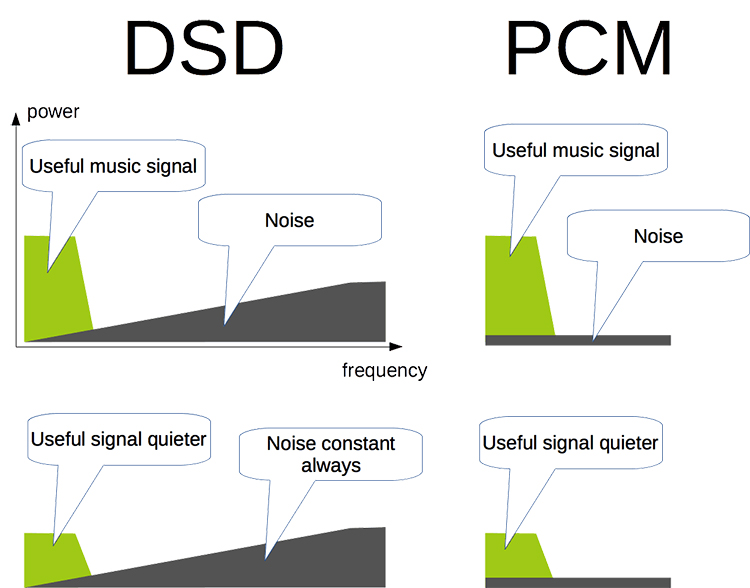
DSD Vs PCM

High definition music exists in two main digital file formats, PCM and DSD. How are they alike, how are they different and which one should I prefer?
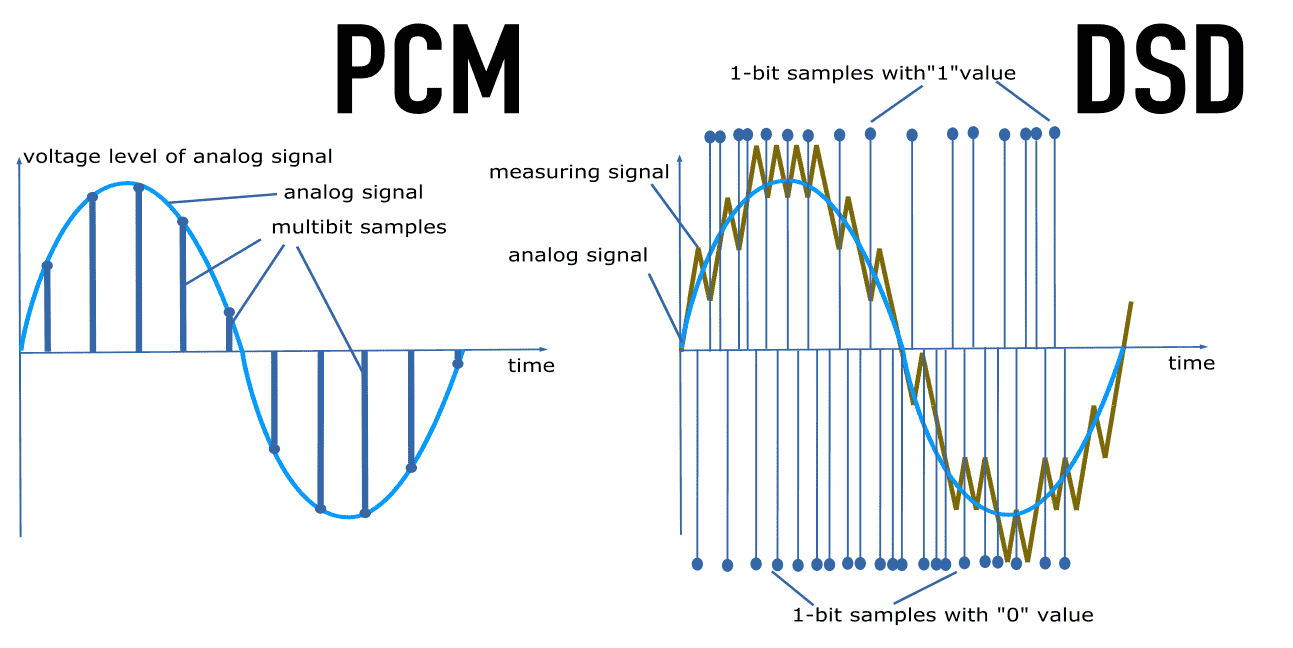
DSD PCM

What is PCM
Let’s start with the fact that PCM (Pulse Code Modulation) is initially older, the first mentions of its successful use date back to the middle of the last century and are associated, like many technological advances, with the defense industry, that is, with the Navy radars. As for home use, first of all, it is a well-known CD with a sampling frequency of 44.1 kHz and a 16-bit quantization level.

What is DSD
DSD (Pulse Density Modulation) is a format developed by Sony and Philips at the end of the last century and intended for the digital archiving of analog phonograms. The physical medium of this format is SACD. In fact, there is only one similarity between these two formats, both are digital, which for the user means the possibility of making unlimited copies without loss. As for the difference, relative to the field of graphic design, it is roughly the same as raster and vector graphics. And if it is even more artistic, like cross stitch and watercolor. In both cases, an image is obtained, but the method of its creation and, as a result of perception, are completely different.

What is the difference?
PCM, even because of its age, is much more studied, it has much better compatibility with a large number of different devices, it implies the possibility of editing (equalization, division into frequency bands, transformations). DSD is actually a closed format, you can record to it, you can play it, that’s it. However, it is inherently much closer to the original analog signal.

Which is better?
The first and most important conclusion is that from a technical point of view, the formats are far apart in terms of implementation methods, but they are often practically indistinguishable in practical use, that is, in the sound of the final file. We are talking only about minor differences in the nuances of the musical presentation. So, all things being equal, when choosing the next file to download and play, it’s best to focus on the source material. If you are looking to digitize an analog then DSD will probably be preferable and will retain more nuances from the original. If this is a remastering of a digital recording previously made in PCM, then it would make more sense for it to stay in this domain.


Free Download Mp4Gain
picture


Mp4Gain Main Window
picture


Mp4Gain Features
picture


Free Download Mp4Gain
picture

Digital sound: DSD vs PCM

Digital sound: DSD vs PCM

DSD vs. PCM: Myth vs. Truth | Audiofiles

Digital sound. How many myths revolve around this phrase. How many disputes have arisen between lovers of comfort and digital quality and supporters of “live airy” vinyl sound multiplied by “warm tube” sound. In addition, there is a lot of controversy among lovers of “numbers”: is 16×44.1 enough or is 24×192 necessary? Which is better: multibit or delta sigma? CDDA or SACD? PCM or DSD? In this article, I will try to explain the basics of digital sound in simple language and will also expand in more detail on comparing two types of encoding of an analog to digital signal: DSD and PCM.

DSD Vs PCM - Real Competitors? | Headfonics Audio Reviews

First, let’s answer the question, what is digital sound? How is it different from analog? In short, in mathematical terms, an analog audio signal is a continuous function, a digital audio signal is a discrete function. What does that mean?

Analog signal

If you draw in your imagination a graph of a sinusoid (this is how a sound wave is most often represented): then no matter how we magnify it, trying to see all the details, we will always see a smooth, smooth line – this is an analog audio signal (Fig. 1).

analog Analog (recording) sound has many parameters that can be used to evaluate its quality. Consider the three most important: frequency range, dynamic range, distortion.

frequency range – a set of frequencies contained in sound. It is generally accepted that the frequency range of human hearing is 20 … 20,000 Hz (sometimes 16 to 22,000 Hz is indicated). The frequency range of the music itself is of no interest in terms of quality assessment (for example, the frequency range of the same plane taking off will be very wide and the tenor’s vocal part will be much narrower). A qualitative parameter, say, of an earphone is the potential frequency range, and it is estimated using the amplitude frequency characteristic (AFC). The ideal frequency response, a straight line across the entire range of hearing frequencies, means that the sound source does not amplify or attenuate any individual frequencies, meaning that the extracted sound matches the original.

Dynamic Range (DD) is the difference between the lowest and highest sound. Loudness is measured in decibels (dB). It is generally accepted that the maximum volume that does not cause injury to a person is 130 dB, the sound of an airplane taking off, and the minimum audible volume, 5 … 10 dB, is at the level of the rustling of the leaves in low wind conditions. Naturally, it will be impossible to distinguish the rustle of leaves against the background of a plane taking off, and listening to music at a level of 130 dB is extremely unpleasant. Therefore, it is generally accepted that a comfortable DD for listening to music is 80 … 100 dB.

The distortion is nothing more than a deviation of the signal from the original.