Bit Depth and Sample Rate PART 2

Fade processing

We now know that digital signal processing is bound to be very buggy. So the approximation of the total will also have a lot of error. These errors not only render the audio unrecoverable, but also introduce an unnatural sound.
To remove these artifacts, we add computed low-amplitude noise to the signal, which we call dithering. The amplitude of the jitter noise is very low, and although some is still heard, it is better than no addition.
Note that jitter noise accumulates. When you add noise to a signal, the signal-to-noise ratio decreases. If the operation is repeated, this ratio will continue to decrease, adding uncertainty to the signal. This is why dithering is often applied as the last step in mastering, and only once.
Dithering has quite an interesting history:
The first dither processing appeared during World War II. Bombers use mechanical computers for navigation and ballistic calculations. Interestingly, these computers are more precise in their processing performance in the air. Engineers realized that vibrations from the plane reduced errors in moving parts. His movements become more continuous, rather than sudden vibrations. Computers have little vibrating motors, and their vibrations are called oscillation, which is derived from the medieval English word “didderen,” meaning “to shake.” Modern dictionaries define dither as a state of high tension, confusion, or anxiety. Dithering brings digital systems closer to analog systems in some way.
– Ken Pohlmann, Digital Audio Rules
Sampling rate
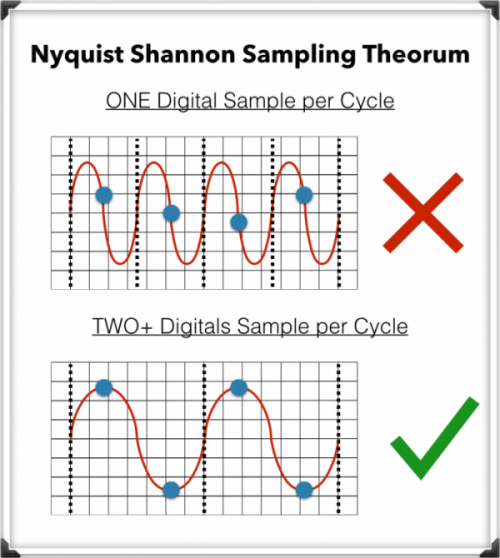
According to theory, the sampling rate of 44.1 K per second is sufficient to cover the hearing range of the human ear. You may have inadvertently learned about Nyquist’s theorem, which states how to avoid aliasing (a type of distortion) and how to reconstruct all frequencies by sampling, which requires sampling at twice the highest frequency of the signal (this theorem also applies to non-audio media, we won’t go into that here).
The human ear has a hearing range of up to 20kHz (most studies show that this number is actually around 17K), so a sample rate of 40K is enough to hear every frequency clearly. 44.1K is the industry standard, which was determined by SONY, which was an oligopoly at the time, for a few reasons.
In a nutshell, the digital audio samples must be above the Nyquist frequency because, in practice, the samples are low-pass filtered during the digital-to-analog conversion process to prevent aliasing. The smoother the slope of the low pass filter, the lower the manufacturing cost. So an audio signal that normally uses a low pass filter will have a smooth slope at 2 kHz. For example, to keep the full spectrum below 20kHz, it should be done at a 44kHz sample rate (20K[highest frequency]+2K[low pass filter slope]x2[Nyquist theory]=44K)
Ultimately, the 44.1K standard was resolved in a battle between Sony and Philips (both had similar end goals). This is also based on the math behind audio sample rate and videotape anatomy. In this way, audio and video can coexist on the same video tape, which has a higher cost performance. However, 48K is the standard for video related to audio. CD audio remains at 44.1K.