“High resolution” basics. What is the difference between DSD, FLAC, MQA, etc.?


Free Download Mp4Gain
picture

“High resolution” basics. What is the difference between DSD, FLAC, MQA, etc.?

High Resolution Audio
There are several formats, even if it says “high resolution”.

High Resolution audio

If the format changes, the amount of sound information and thus the sound quality will change, the file size will also change, and whether the playback device / software will support it or not, it will also change, so choose a format is important. We will explain the main formats incorporating common technologies and unique pieces.

There are several high-resolution formats, but …
What is the sampling frequency?
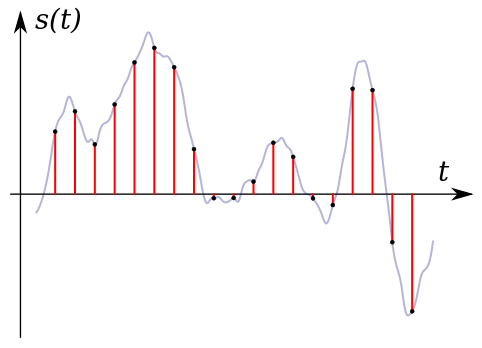
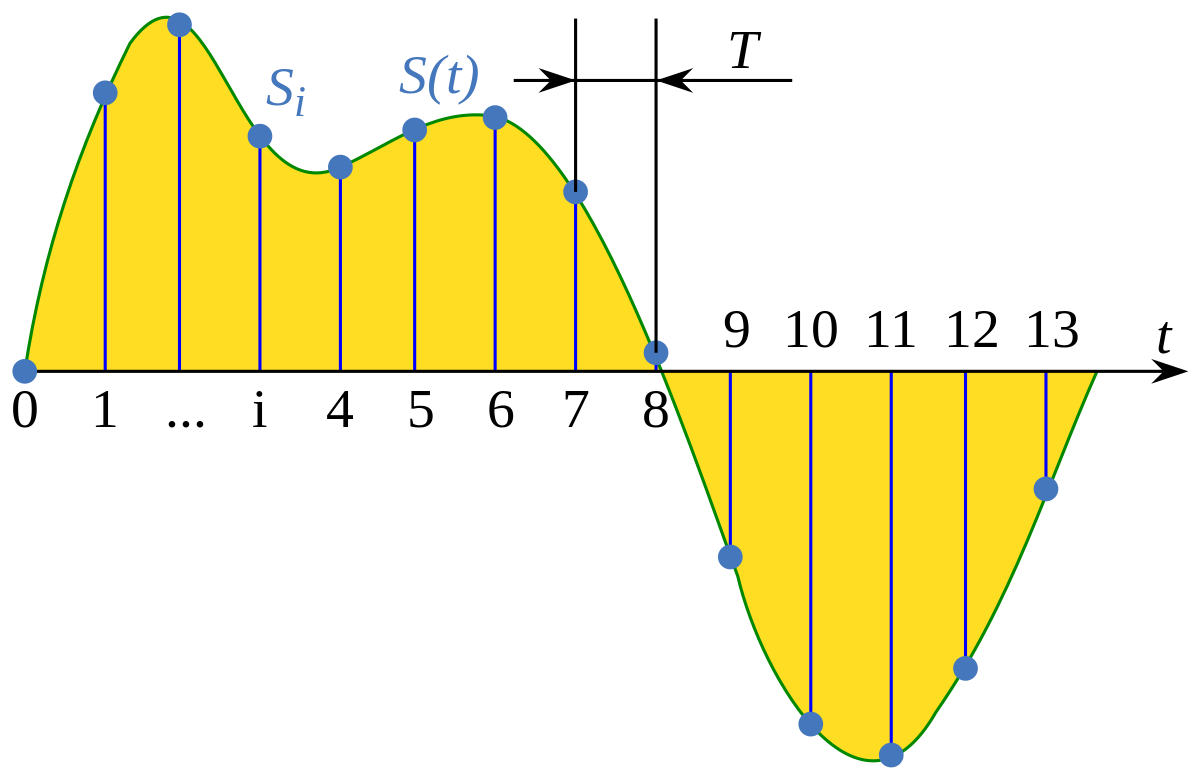
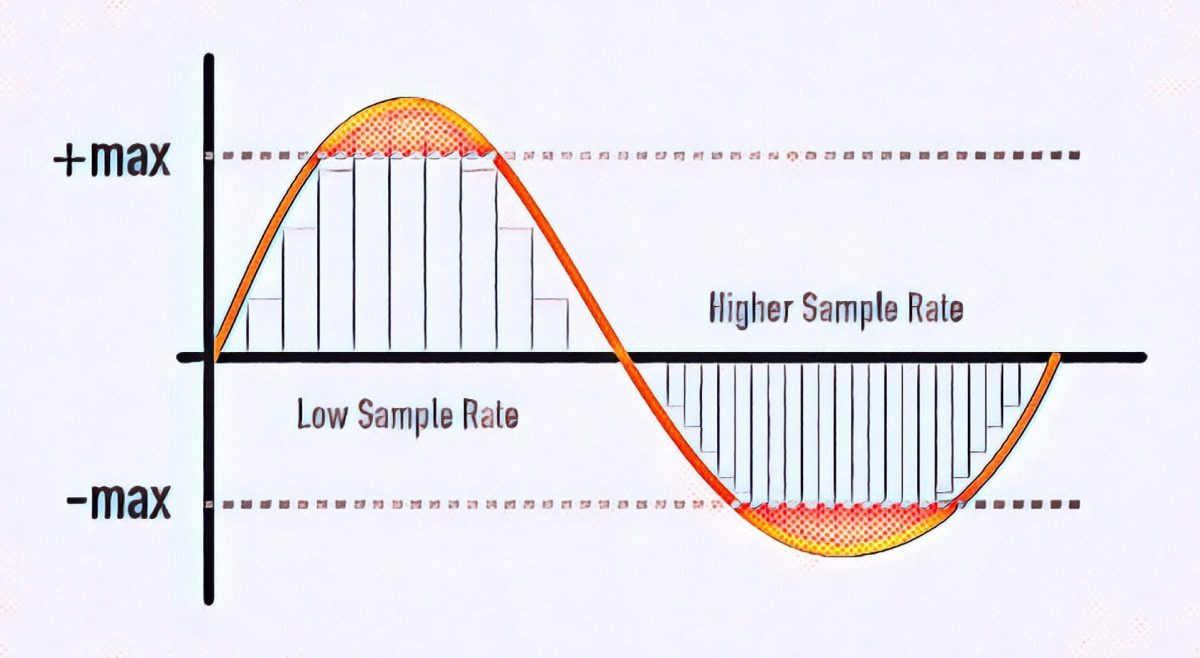
Most digital sound sources are “linear PCM”. This is data obtained by digitizing (sampling) the sound waveform (analog signal) in a canned cycle, and that cycle is called the “sample rate.” If sampling is done every 1/44100 of a second it will be “44.1 kHz”, if it is 1/96000 of a second it will be “96 kHz”, if it is 1/192000 of a second it will be “192kHz”. This means that the implementation cycle of is shorter and the amount of information is greater. In other words, if you look at this number, you can see “how finely the sound was measured with respect to time.”

What is the number of quantization bits?
Value indicating the number of steps in which the amplitude of a signal is expressed when an analog signal is converted to a digital signal (AD conversion) for linear PCM generation. The higher the value, the finer the amplitude of the sound can be captured, and the closer the waveform is to the original sound (analog signal), the more accurately the sound can be reproduced with high resolution.

The large number of quantization bits is directly related to the resolution of the data. For example, when the number of quantization bits is 1 (1 bit), the width of the expression is 2 steps of “0 or 1”, but in 2 bits, there are 4 steps of “00” and “01”, ” 10 “and” 11 “. They can be expressed. Similarly, 4-bit has 16 steps, 8-bit has 256 steps, 16-bit has 65,536 steps, and 24-bit has 16,777,216 steps, allowing for detailed expression.

The “dynamic range” of the maximum / minimum sound ratio that can be handled with the sound waveform data is determined by the number of quantization bits. The dynamic range of human hearing is about 120 dB, but when the number of quantization bits is 16 bits, it reaches 96 dB, but when it is 24 bits, it reaches 144 dB, and when it is 32 bits, reaches 192 dB. (increases by 6 dB for each additional bit) If it is a high resolution sound source, it can handle tiny sounds to powerful sounds with a margin.

Original waveform data. The vertical axis is the sample rate and the horizontal axis is the number of quantization bits.

The higher the sampling frequency (finer the horizontal axis) and the greater the number of quantization bits (finer the vertical axis), the richer in information the “high resolution” sound becomes.
Definition of “high resolution”
High-resolution quality audio sources (hereinafter referred to as high-resolution sound sources) excluding DSD are distinguished by the sample rate and number of quantization bits described above. The term “more than CD specifications” is often used, which means that it is based on the sampling frequency (44.1 kHz) and the number of quantization bits (16 bits) of the CD.

As defined by the Japan Electronics and Information Technology Industries Association (JEITA), high-resolution audio must “either the sampling rate or the number of quantization bits exceed CD specifications”, and sources high resolution sound will follow this.

On the other hand, the Japan Audio Association also defines high resolution, and the recommended high resolution logo is given to audio equipment that guarantees its playability. This standard is divided into analog and digital systems, and the file format is also mentioned, such as setting the standard for high-resolution sound sources to be “96 kHz / 24-bit FLAC and WAV compliant.”


Free Download Mp4Gain
picture


Mp4Gain Main Window
picture


Mp4Gain Features
picture


Free Download Mp4Gain
picture

High resolution sound source

High resolution sound source

Sample Rate

It can be said that “USB-DAC” is a secret weapon for playing music files on a computer with high sound quality.

44100 Hz and 48000 Hz

Just add “USB-DAC” to the audio you use all the time, and you can enjoy very high quality sound! Therefore, this time, Sarah visited Onkyo Co., Ltd., which developed the most advanced “USB-DAC” that supports high-quality sound sources called “high resolution”, which has been released more and more in the last years. We also visited the audition room and asked Mr. Kurosawa, director of the high-quality music distribution site “e-onkyo music”, to teach us how to enjoy high-quality sound!
“Sample rate” and “bit rate”

Sara-chan: Hello! Wow, it’s a nice listening room! I’m excited!

Kurosawa: Hi Sarah! Today, I’m thinking about getting you to experience high-quality sound in a number of ways.

Sara-chan: Thank you! To enjoy music on your PC with high sound quality, “USB-DAC” is definitely important! But there are many “USB-DACs” and I don’t know what to choose.

Mr. Kurosawa: When choosing “USB-DAC”, it is a good idea to check the “sample rate” and the “bit rate”.

Sara-chan: Sa, Samp … Call frequency ?? What the hell is that ??

Kurosawa-san: “USB-DAC” is a device that converts sound from digital signals to analog signals, right? The “sample rate” indicates the number of digital samples of the audio signal acquired per second during the conversion. The “sample rate” determines the frequency range of the audio file. The higher this number, the closer the digital waveform will be to the original analog waveform and the softer the sound will be. On the other hand, “bit rate” indicates the amount of information per second. They are expressed in units of “Hz” and “bit”, respectively. By the way, do you know what the CD standard is?

Sara-chan: Well I’m sure it’s “44.1 kHz / 16 bit”!

Mr. Kurosawa: That’s right! It is said that the sound in the ultra high range above 20 kHz cannot be heard by the human ear, so the CD cuts off the inaudible sound. But even if you think you can’t hear it, you actually feel the vibrations in the air and it affects the sound of the frequencies you hear.
Since the high resolution sound source also records that part, it can be said that it is closer to a more realistic sound. First, at the music-making stage, work is often done at 96 kHz / 24-bit, which is why high-resolution sound sources are sometimes referred to as “studio master quality.” Recently, even more informational sound sources such as “192kHz / 24bit” have appeared. There are “44.1 kHz / 16 bit” and “96 kHz / 24 bit” sound sources here, so let’s compare them using ONKYO’s “DAC-1000 (S)”!

Sara-chan: Wow! You can feel the difference more than you imagined! It feels like a live performance is taking place right in front of you! I feel like the sound is expansive and I feel like I’m surrounded by sound! Anyway, it seems like I’ve never heard it on audio before! Impressed!

Mr. Kurosawa: Fufufu. Can you see the difference! However, even if you have a high resolution sound source such as “96 kHz / 24 bit”, there is no point in using a “USB-DAC” that does not support “96 kHz / 24 bit”. Therefore, when choosing “USB-DAC”, it is important to check the “sample rate” and “bit rate” to see if it is compatible with the sound quality you want to hear. By the way, recently there is even a “USB-DAC” that has a function to change the frequency called “upsampling”.

The difference between 44,100 Hz (music industry) and 48,000 Hz (video industry) part 2

The difference between 44,100 Hz (music industry) and 48,000 Hz (video industry) part 2

sample rate

2) When recording a 48 kHz music video to match the music played at 44.1 kHz on the site. In this case, it can be very difficult to match performance lips to post-production due to the different sample rates of the sound being played. It’s called sink drift.

SAMPLE RATE

3) Another point It seems that this is a problem that occurs at the time of recording, but there is a problem that the sound changes gradually when the sound recorded separately using a cheap recorder is synchronized with the sound recorded in the reference of the video. it seems that there are moments. In this case, it seems that it is necessary to manually and quickly advance the video a bit and match it with the audio file, or extract some frames at the important points of the audio and synchronize it. It seems that this has nothing to do with the sample rate, so I will describe it so as not to cause misunderstandings.

The difference between 44,100 Hz (music industry) and 48,000 Hz (video industry)

The difference between 44,100 Hz (music industry) and 48,000 Hz (video industry)

44100 Hz vs 48000

In video production, record the frame rate for shooting and the sample rate for recording. Remember this is one of the basics for shooting and recording.

44100 48000

First, about the difference in sampling frequency. Generally speaking

44,100Hz (44.1kHz) is the standard in the music industry

48,000Hz (48kHz) is the sound standard in the video industry

The difference between the two sample rates is just that. I spoke of the sample rate as
the frame rate in video in another article, “Sound Principles Required for Video Production,” Sample Rate and Bit Depth. ”
In other words, the higher the sample rate in Hz, the softer the sound will be.

There are several theories about the historical background of 44,100Hz.
I would like to introduce you to one of the most logical.

First, when sampling sound, you need a sample rate that is at least twice the highest frequency you are recording. This is the sample rate required to obtain a minimum of the waveform. This is because it is not possible to record a sound that has the character of a wave if there is only one place to take a sample. Most people say that the audible range is 50 Hz to 16,000 Hz. Double is 32 kHz, but it seems that the harmonic components that make up the tone need to be recorded in order to record the voice correctly. Only when this is taken into account does it appear that up to 44,100Hz is required. Click here for more details.

Sound Processing “I want to hear my voice clearly” (link outside Vook’s site)

What happens when the sample rate is low?
When digitizing analog information, if the sample rate is not high, the high-frequency information will be hidden in the low-frequency information.
Then the high-frequency sound will be recorded as low-frequency sound. Specifically, see the following illustration.
This is called aliasing.

See also: Wikipedia https://en.wikipedia.org/wiki/Aliasing#/media/File:AliasingSines.svg

In any case, by definition, 48,000 Hz has better sound quality than 44,100 Hz. The video industry has introduced 48,000 Hz.

One problem that sometimes occurs is that “I was recording a video at 48 kHz and the separately recorded microphone was set to 44.1 kHz.” At first I thought that different sample rates would be a big deal, but it doesn’t really seem to be the case.

Audio recorded at a small sample rate just has a small number of samples per second, but since there is almost no difference between 44.1 kHz and 48 kHz, I think the difference is barely noticeable when listening to the sound regularly. At 96 kHz, the sound quality is even higher, but the number of samples is so large that ordinary people cannot hear it at all.

In some cases, the sample rate is really important.

1) By writing the audio actually recorded with a different sample number as a video file. This is because the sample rate must be converted to a video sample rate that is different from the conventional 44.1 kHz and 96 kHz sample rates, that is, 48 ​​kHz. Software that specializes in video editing seems to have sound distortion at this point.

About the frequencies used for audio (sample rate, PCM, DSD, etc.)

About the frequencies used for audio (sample rate, PCM, DSD, etc.)

Sample Rate

On this occasion, I would like to explain the frequencies used in digital audio and their meanings.

Audio Sample Rate

Recently, the high-resolution sound source has increased, such as 192KHz Toka, 11.2MHz, as the frequency has been written or will, what frequency?

I would like to explain the frequency used for said audio taking as an example the Combo384 installed in the USB-DAC used in LV2.0.

1. 1. What is the sampling frequency?

Music distribution is becoming mainstream these days, but audio was first digitized on CDs, which are still on the market.

You often hear that the sample rate of a CD is 44.1 KHz. Since digital signals are basically 0 or 1, to reproduce up to the 20 KHz limit that can be heard by the human ear, a resolution of twice that frequency is required. Furthermore, the frequency was decided to be 44.1 KHz taking into account the digital signal processing margin. Since the music signal is a set of sine waves, it is 44.1 KHz that can be shaken at the maximum frequency of 20 KHz.

2. What are 16 bits and 24 bits?

As you often hear, CDs are sometimes described as 44.1KHz / 16bit. This 16 bit is the volume of the sound. Since 16 bits can express the size of 2 raised to 16, there are 65536 different sizes.

If this is converted to dB at 20LOG (65536), it will be approximately 96dB. The dynamic range of a CD (the difference between low and loud sounds) is 96 dB.

For DVD and Hi-Res, it can be 24-bit, but in this case, it’s 144 dB in 16.77 million steps.

3. 3. PCM format

So what is the actual signal? In the case of the PCM format, the standard called I2S, which can support up to 32 bits in sample rate, is common. In the case of a CD, being stereo, the data has a frequency of 44.1 KHz with 32 bits of 2 channels (L, R) alternately (although in reality 16 bits are used).

Therefore, to process this digitally, a processing capacity of 44.1KHz x 2CH x 32bit = 2.8224MHz is required.

Sample rate and bit rate Part 2

Sample rate and bit rate Part 2

sample rate and bit rate

Sampling theorem

Sample Rate & Bit Rate

It is a very simple explanation, but it can express up to half the sample rate. When sampling a signal, if the interval is small, it can be restored close to the original signal, but if it is too thick, it cannot be restored (I would like to write a little more detail when talking about signal processing or other timing) .

44.1 kHz

Why is there a poorly separated rate of 44.1? .. ..

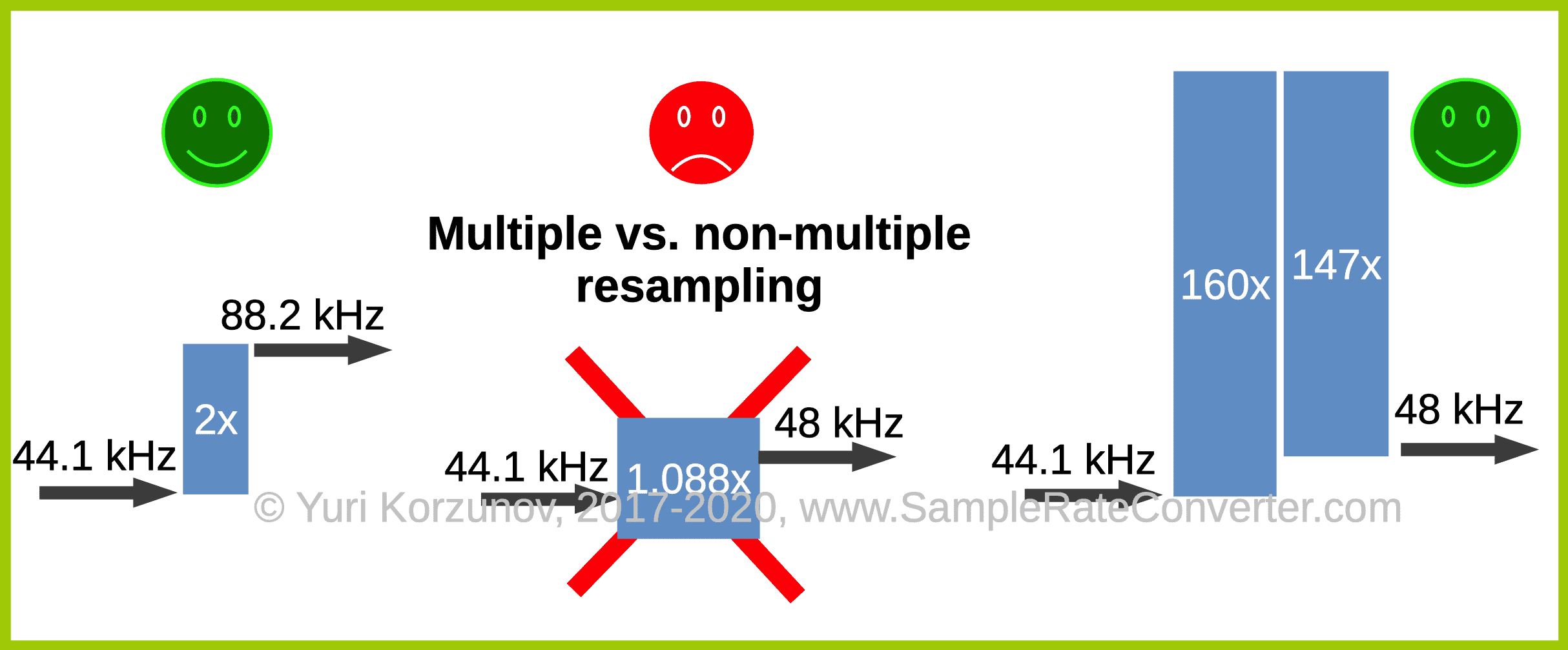
Didn’t technicians deliberately make cumbersome clocks to prevent music CDs from being easily copied? I heard something like that. When I searched, it seems this happened (?) Due to the convenience of an old PCM recorder. In this age, it is difficult to know what 44.1 kHz is in development. The 44.1 kHz ↔ 48 kHz sampling conversion is a headache. For example, USB audio (USB audio device class) exchanges data at 1 ms intervals. In the case of 48kHz, the data is 48 samples, but when considering 44.1kHz, it will be 44 samples (x9) and 45 samples (x1) in 10ms. If you cheat on a sample when there are 45 samples (tentatively), it will be 44.0kHz. I think it’s more like that with voice and music, and the human ear usually cheats (it’s just my personal opinion).
However, the objective evaluation method will soon come to an end. For example, you can clearly see that you were fooled by a sine wave (sine wave) (maybe you are unexpectedly on the market).

Number of quantization bits

The sampling had to take a value in the direction of time (discretization), but the quantization had to take a value in the direction of amplitude. The range that it is possible to display the volume of the sound, which is often heard, “96 dB dynamic range” means that the number of quantization bits is 16 bits, and the musical signal is reproduced in the range of 0 to 65535. dog. The number of quantization bits is also called the bit depth or bit depth.

Bitrate

In communication, it indicates how many bits of data are transferred per hour and is generally expressed in bps (bit / s) of how many bits are transferred (processed) per second. If it is low, the size when saving as a file is small and there is space on the transmission line for communication. For example, when an audio (1 channel) is compressed to 1/3, the 3 channel audio can be sent at the same bit rate. Excuse the old story, but considering from the age of analog communication (analog mobile phone), digitization + compression will be able to support multiple calls with the same radio wave.

Finally

I often hear what is called Hi-Res Audio. The sampling frequency is said to be 96 kHz or 192 kHz, which is over 48 kHz, the number of quantization bits is 24 bits, and the limit (high range) of human hearing is about 20 kHz, but it expresses frequencies higher than that. It will be. It is the same bit rate as the image from a long time ago. .. ..
By the way, it seems that dogs can hear up to 60 kHz and cats up to about 64 kHz.

Hi-res audio example
Sampling frequency Number of quantization bits Number of channels bit rate Frequency that can be expressed
192 kHz 24 2 9,216 kbps 96 kHz
192 kHz 16 2 6,144 kbps 96 kHz
96 kHz twenty-four 2 4.608 kbps 48 kHz
96 kHz 16 2 3,072 kbps 48 kHz
48 kHz twenty-four 2 2,304 kbps 24 kHz
Considering the limit of human hearing (about 20 kHz), according to the sampling theorem, 48 kHz or 44.1 kHz is a sufficient frequency, but what about all of them? .. ..
In my case, I cannot distinguish the high resolution range, but it should be able to reproduce the discarded frequency at 48 kHz to 96 kHz, and when the number of quantization bits is in the 24-bit range, the sound pressure (dB) is a little. Feels like it’s going up (?) (It’s just a story from my ears).
I’d like to make a comparison if I get the chance, but I don’t think I can tell by ear without a proper regenerator (like an expensive analog amp).

Is it time for cats and dogs to get verified in the acoustic industry? .. ..

Sample rate and bit rate

Sample rate and bit rate

Sample Rate and Bit rate

If the file size is reduced (code at a lower bit rate), the sound quality tends to deteriorate. How much should it really be? .. ..

sample rate bit rate

When compressing using audio encoding (AAC, MP3, etc.), the compression rate is determined by the bit rate at the time of encoding. Specifically, if you set a low bitrate, the compression rate will be high and the file size when saved will be small, but what is the bitrate for the original sound source (PCM) without compression in the first place?

If you save it as PCM, the sound quality of the original sound will be obtained, but it can be a little inconvenient to save it without worrying about the file size. Also, depending on the application, I think the original sound size has enough memory capacity and the communication speed is correct. Therefore, I would like to write about the sample rate and bit rate that are often heard in digital audio.

The bit rate of digital audio is determined by the sampling frequency, the number of bits assigned to a sample (number of quantization bits), and the number of channels (stereo, monaural, etc.).

PCM bit rate (uncompressed) = sample rate x number of quantization bits x number of channels
As I wrote a bit last time, in file containers like wav and mp4 format, this information is attached as a header, so that the application can see the header and play it back. The compression rate of the encoding is determined by the bit rate specified at the time of encoding for this PCM (uncompressed) bit rate.
For example, as many of you know about music CDs, with 44.1 kHz stereo, this is the next bit rate.

Music CD bit rate: 44100Hz x 16bit x 2ch (stereo) = 1411.2kbps
When encoding this with MP3, AAC, etc., you will naturally need to specify a bitrate less than 1,411.2 kbps. For example, when encoding at 256 kbps, the compression rate is approximately 18% and the file size is 1/5 or less when the original sound is 100%.

Encode Music CDs at 256 kbps: 256 kbps / 1,411.2 kbps = approximately 18%
Generally, the sample rates of audio devices actually connected to a PC are 48 kHz and 44.1 kHz for music, 16 kHz and 8 kHz for audio such as microphones and headphones, and 32 kHz, 24 kHz, 22.05 kHz. , etc.

The bit rate of PCM (uncompressed sound source) with 16-bit quantization bits is as follows.

Stereo (for music) PCM 16-bit bit rate (example)
Sampling frequency Number of quantization bits Number of channels Bit rate Comments
48 kHz 16 2 1,536 kbps
44.1 kHz 16 2 1,411.2 kbps Music CD
32 kHz 16 2 1,024 kbps
24 kHz 16 2 768 kbps
22.05 kHz 16 2 705.6 kbps
16-bit monaural PCM bit rate (for audio) (example)
Sampling frequency Number of quantization bits Number of channels Bit rate Comments
32 kHz 16 1 512 kbps Super Wide Band
24 kHz 16 1 384 kbps
16 kHz 16 1 256 kbps Broadband
8 kHz 16 1 128 kbps Narrowband

Sampling rate

If you check the web, there are explanations such as the sampling required to convert analog waveforms to digital conversion. For example, it shows how many samples of an audio signal input from a microphone are taken per second and digitized. The larger the sample, the greater the range that can be recorded. When an analog waveform is digitized, the frequency that can be expressed is half the sampling frequency (sampling theorem). For example, with a sampling frequency of 48 kHz, it can be expressed up to 24 kHz. At 8 kHz (narrow band) and 16 kHz (wide band), which are often used for audio, you can only hear up to 4 kHz and 8 kHz, respectively. The higher the sample rate, the higher the bit rate.

Sample rate and bit depth

Sample rate and bit depth

uno2

When describing digital recording devices, two fundamental concepts are used: sample rate and bit depth. In this article, we will see what it is.

Sampling rate
The sample rate is the rate at which the logger captures samples of the input signal. When recording sound in digital form, in fact, individual samples or, in other words, values ​​of sound intensity are recorded at separate points in time.

The sample rate for recording devices is usually the following standard values: 44.1 kHz; 48 kHz and 96 kHz. The higher the sample rate, the more samples will be taken in 1 second and the better the digital sound quality we will get as a result.

What is the meaning of these numbers? They mean the number of times the recorder reads the sound intensity value from the input signal per second. The sample rate is measured in kilohertz (kHz), 1 kHz = 1000 samples per second.

For example, if the recording is made with a sampling frequency of 48 kHz, this means that the sound recorder measures and records the sound intensity value 48,000 times per second.

This number may seem unimaginably huge, but here the phenomenon called Nyquist frequency is worth remembering. The Nyquist frequency is named after the person who first discovered it. Defines the highest sound frequency that can be recorded at a given sample rate.

In short, the maximum tone that can be digitally fed is about half the sample rate.

Therefore, when recording at a sampling frequency of 48 kHz, the maximum audio frequency that can be recorded is 24 kHz. This is sufficient, considering that the human ear hears frequencies on average from 20 Hz to 20 kHz.

Bit depth
When talking about digital recording devices, you can often hear the words “16-bit”, “24-bit”, and so on. Some mean the number of information units with which the value of each sample obtained from the digital recording can be represented.

The higher the value of this number, the more accurately you can record the value of each sample and the higher the sound quality you will get as a result.

Do not think that the greater the number of bits, that is, the greater the bit depth, the greater the intensity value that can be set. Here is meant representation precision.

Modern recorders are usually 24 bits wide. It should be noted that recording with a large bit depth takes up a lot of space on the storage device, but this is not so important, because modern media has a huge volume and is becoming more and more affordable.

Why can the difference in bitrate make it sound great (high, medium, low)?

Why can the difference in bitrate make it sound great (high, medium, low)?

Bit Depth vs. Bit Rate

Reply:
Just to make sure this is clear, let’s differentiate

BIT RATE BIT DEPTH

sample rate vs bit depth

as much as

Bit rate

how they relate to audio in the digital domain …

Sampling frequency:

The sample rate is specified as a frequency (samples per second), for example, 44.1 kHz for CD. Other common values ​​are 48, 88.2, 96, 176.4, and 196 kHz, although some formats (such as DSD) have sample rates greater than 2.8 MHz. The sample rate indicates

how often the audio signal is measured

While some people view lower readings as a tiered bar graph, I prefer to view them as a child bitmap. If you take the outline of a horse and simplify it to 20 points so the child can connect, it’s not so much that you end up with steps (using straight and curved lines to connect 20 correctly spaced points can lead to a decent figure), but there won’t be without subtlety. Whereas with 200 (or 2000) points, you could approximate the wavy strands along the horse’s mane.

In audio, a lower sample rate does not make the sound “bad” (eg, fuzzy, fuzzy, or distorted), but rather limits the maximum frequency (pitch) that can be recorded / played back as intended.

Nyquist theorem formula

, The 44.1 kHz sampling rate was chosen for CD because it can record and play back frequencies up to 20 kHz. To record a spoken word (such as a speech, a sermon, or an audiobook), it would be difficult to detect a much lower sample rate, as the human voice has less and less harmonic information above 10 kHz.

Depth bits:

Considering that the sampling frequency determines how

often

audio signal is measured, bit depth indicates

scale accuracy

Since we are talking about digital audio, we describe this measurement scale in bits, where each bit is 0 or 1, and we concatenate a certain number of them to represent the value. When we have 8 bits, there are 256 possible numerical values, including zero. With 16 bits, there are 65,536 possible values. A 24-bit register can use 16,777,216 values.

When we convert analog audio to digital representation (A-to-D) and vice versa (D-to-A), we find interesting mathematical relationships. Each bit (digital) doubles the number of possible values ​​… And doubling the amplitude (approximately 4 times the power) of the sound wave (analog) corresponds to + 6 dB of loudness. Therefore, we can estimate the maximum dynamic range * of a digital recording at 6 dB / bit. Therefore, 8-bit recording has ~ 48 dB of dynamic range, 16-bit recording (such as a CD) has ~ 96 dB, and 24-bit recording has ~ 144 dB.

* For those of you unfamiliar with this term, dynamic range basically describes the difference between the quietest and loudest sound waves that can be recorded / played back. The CD has a difference of approximately 96 dB, which can be used to represent the most subtle pause compared to the incredibly loud burst of the cannon at Tchaikovsky’s climax.

1812 Overture

,

Three quick notes for those interested in delving into the rhythm …

There is a formula for the actual dynamic range of a digital recording that may differ slightly from the previous estimate, but it is a fairly minimal deviation, so an estimate of 6 dB / bit is what you normally see in quotes.
The latest 32-bit floating point representations combine a 24-bit number and an 8-bit exponent to represent many more possible values ​​than 24-bit registers. The dynamic range estimate is getting a bit dubious, but suffice it to say it’s well above 144 dB.
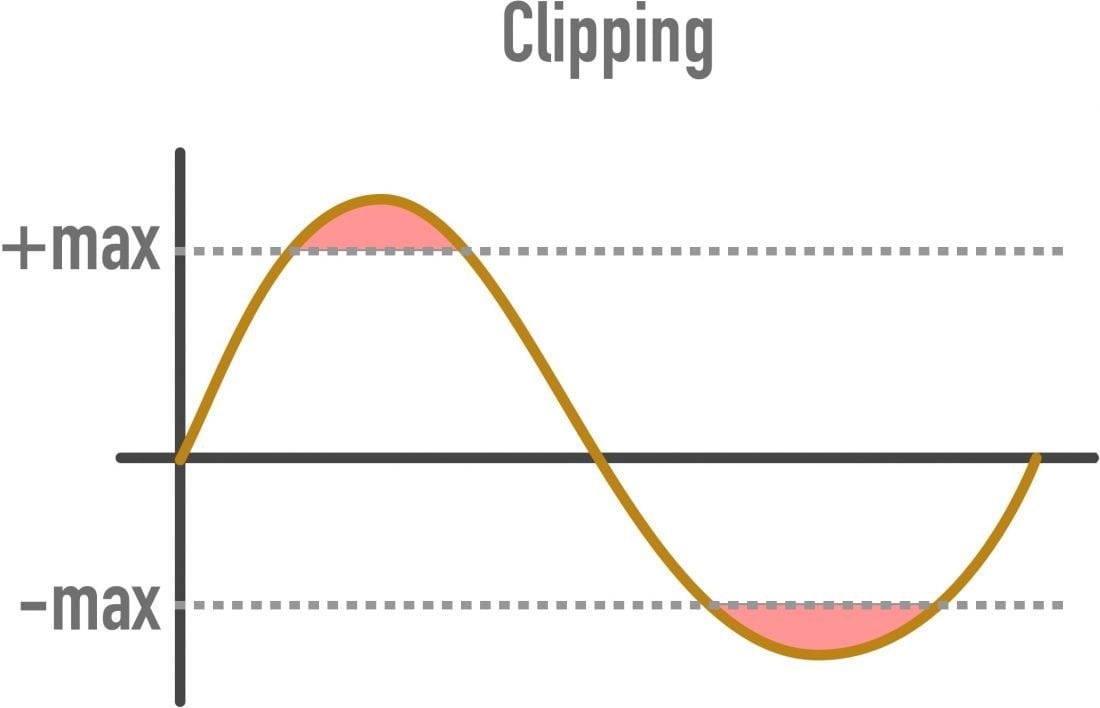
Using a lower bit depth, while you might think in terms of warp plugins with names like “bit-grinder”, doesn’t have to sound “bad” (eg fuzzy, fuzzy, or distorted), but just represents a reduced dynamic range. But since a 16-bit recording with a dynamic range of 96 dB (65,536 numerical values) cannot be represented in 8 bits (48 dB and 256 numerical values), to reduce the bit depth of the already digitized audio, a mathematical correction of the numbers down. (for example, 65535 becomes 255) using a compressor or limiter, which can cause the quietest recording bits to be lost so that the difference between soft and loud parts is <48 dB. Without such scheme, the transformation will cause clipping (numerical values ​​above the maximum),
Bit rate:

In digital audio, the bit rate is a measure of

how many bits are transmitted / processed per second

Sample rate and bit depth

Sample rate and bit depth

Sample Rate Bit Depth

When describing digital recording devices, two fundamental concepts are used: sample rate and bit depth. In this article, we will see what it is.

Sample Rate, Bit Depth

Sampling rate
The sample rate is the rate at which the logger captures samples of the input signal. When recording sound in digital form, in fact, individual samples or, in other words, the sound intensity values ​​are recorded at separate points in time.

The sample rate for recording devices is usually the following standard values: 44.1 kHz; 48 kHz and 96 kHz. The higher the sample rate, the more samples will be taken in 1 second and the better the digital sound quality we will get as a result.

What is the meaning of these numbers? They mean the number of times the recorder reads the sound intensity of the input signal per second. The sample rate is measured in kilohertz (kHz), 1 kHz = 1000 samples per second.

For example, if the recording is carried out at a sampling frequency of 48 kHz, this means that the sound recorder measures and records the sound intensity value 48,000 times per second.

This amount may seem unimaginably huge, but a phenomenon called the Nyquist frequency is worth remembering here. The Nyquist frequency is named after the person who first discovered it. Defines the highest sound frequency that can be recorded at a given sample rate.

In short, the maximum tone that can be digitally fed is about half the sample rate.

Therefore, when recording at a sampling frequency of 48 kHz, the maximum audio frequency that can be recorded is 24 kHz. This is sufficient, considering that the human ear hears frequencies on average from 20 Hz to 20 kHz.

Bit depth
When talking about digital recording devices, you can often hear the words “16-bit”, “24-bit”, and so on. Some mean the number of information units with which the value of each sample obtained from the digital recording can be represented.

The higher the value of this number, the more accurately you can record the value of each sample and the higher the sound quality you will get as a result.

Do not think that the greater the number of bits, that is, the greater the bit depth, the greater the intensity value that can be set. Here is meant representation precision.

Modern recorders are typically 24-bit wide. It should be noted that recording with a large bit depth takes up a lot of space on the storage device, but this is not so important, because modern media has a huge volume and is becoming more and more affordable.