Psychoacoustic Threshold Estimation in MP3


Free Download Mp4Gain
picture

Psychoacoustic Threshold Estimation in MP3

Psychoacoustic Threshold Estimation in MP3

Let’s talk about Psychoacoustic Threshold Estimation in MP3

Psychoacoustic threshold estimation in MP3 encoding is a crucial element for efficient compression. In my experience, this process plays a significant role in how audio is perceived by listeners after compression. It’s based on the principles of psychoacoustics, which examine how humans perceive sound. Essentially, psychoacoustic models allow MP3 encoding to remove parts of the audio that are inaudible to the human ear, making the file size smaller without compromising perceived quality. To understand it better, think of how you might ignore background noise when focusing on a conversation in a crowded room. Similarly, MP3 compression removes sounds that would not be heard by a listener under normal conditions.

In MP3 encoding, threshold estimation is done by analyzing the signal’s frequency spectrum. The human ear is more sensitive to certain frequencies and less sensitive to others. By determining which parts of the audio are inaudible based on these sensitivities, MP3 compression algorithms can selectively remove these frequencies. The result is a compressed file that maintains the most important parts of the sound while discarding unnecessary details.

The Role of Psychoacoustics in MP3 Compression

When discussing MP3 compression, psychoacoustics comes into play to ensure the best balance between sound quality and file size. It’s as though I’m packing a suitcase for a trip—choosing the essentials and leaving behind the non-essentials. In MP3 encoding, psychoacoustic models aim to identify which audio frequencies are masked by others, allowing them to be discarded without a noticeable loss in quality.

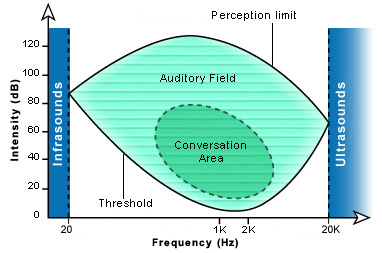
These psychoacoustic models use data about human hearing perception. For instance, our ears are more sensitive to mid-range frequencies than to low or high frequencies. When encoding an MP3, the algorithm uses this knowledge to reduce the representation of low and high frequencies, especially if they are masked by louder sounds in the mid-range. This approach reduces the file size, making it more efficient while maintaining an acceptable sound quality.

Psychoacoustic Models: Key Techniques for Estimation

Psychoacoustic models are essential for estimating thresholds in MP3 encoding. The two main models used in MP3 compression are the MPEG-1 Layer III and the more complex MPEG-2 Layer III. These models implement specific techniques to determine which parts of the audio signal can be discarded without affecting the perceived quality.

  • Critical Bands: The human ear perceives sounds in frequency groups called critical bands. Each critical band includes frequencies that are close enough together that they affect each other’s perception. When encoding, psychoacoustic models assess these bands and eliminate those that won’t affect the listener’s experience.
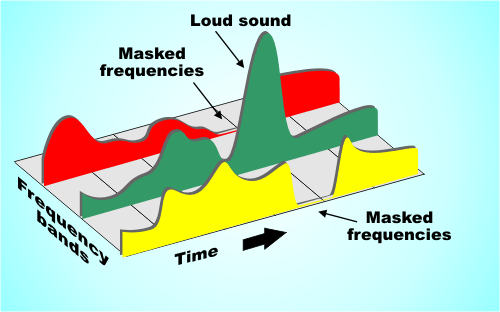
  • Masking Effect: This is a phenomenon where a louder sound makes it difficult to hear a quieter sound. The MP3 encoder uses this principle to discard sounds masked by others, reducing the file size.
  • Threshold of Hearing: The threshold of hearing refers to the quietest sound that the average human ear can detect. Sounds below this threshold are effectively inaudible and can be removed during encoding.

Practical Example: How Psychoacoustic Threshold Estimation Works

Imagine you’re listening to your favorite song on your smartphone. The song is compressed into an MP3 file, but somehow it still sounds amazing. What’s happening behind the scenes is the psychoacoustic threshold estimation. For example, if you’re listening to a powerful guitar solo, the MP3 algorithm may eliminate some of the higher frequencies from the background sounds like drums or cymbals that are masked by the louder guitar notes.

From my experience, it’s much like watching a movie with a powerful soundtrack. When the action is intense, the quieter background sounds fade into the background. The MP3 encoder mimics this behavior, focusing on what’s essential to the listener’s perception of the music and discarding less important details. It’s a brilliant way to optimize audio files while preserving the listening experience.

The Benefits of Psychoacoustic Threshold Estimation in MP3

The main benefit of psychoacoustic threshold estimation is the reduction in file size. The more efficient the compression, the smaller the file size, which makes it easier to store and stream audio. This is particularly crucial in a world where bandwidth is often limited, and storage space can be at a premium.

Another benefit is the preservation of sound quality. As an audio professional, I’ve found that effective psychoacoustic modeling ensures that what’s important to the listener remains intact. The algorithm removes what isn’t necessary, but it does so without compromising the overall experience. For example, it’s as if you’re cleaning up a painting by removing minor smudges that no one would notice anyway. The final image (or audio) still looks great but is lighter.

Latest Words on Psychoacoustic Threshold Estimation in MP3

Psychoacoustic threshold estimation is an essential process for MP3 compression. It ensures that audio files are as small as possible while maintaining the best possible quality. From my expertise, understanding psychoacoustics is key to understanding how modern audio compression works. These methods allow for the efficient storage of high-quality sound without sacrificing too much bandwidth or space.

At the end of the day, MP3 encoding wouldn’t be nearly as efficient or effective without psychoacoustic threshold estimation. It’s a fascinating blend of human perception and technology that allows us to enjoy high-quality audio in a convenient format. In cases where precise audio management is critical, using specialized software can further enhance the quality of the compressed file, and Mp4Gain offers a reliable option in this area.

What is psychoacoustic threshold estimation in MP3 encoding?

Psychoacoustic threshold estimation in MP3 encoding is the process of determining which parts of an audio signal are inaudible to the human ear and can be discarded to reduce file size without affecting perceived sound quality.

How does psychoacoustic modeling affect MP3 compression?

Psychoacoustic modeling reduces MP3 file sizes by removing audio frequencies that are masked by louder sounds, ensuring only the most essential elements of the sound are preserved for optimal listening quality.

What is the masking effect in psychoacoustics?

The masking effect is when louder sounds make it difficult to hear quieter ones. MP3 encoders exploit this effect to remove inaudible sounds, making the file more efficient without sacrificing quality.

Why are some frequencies removed in MP3 compression?

Some frequencies are removed in MP3 compression because they are outside the human ear’s sensitivity range or are masked by louder sounds, making them unnecessary for a high-quality listening experience.

How do critical bands influence MP3 encoding?

Critical bands are frequency ranges that the human ear perceives as a group. MP3 encoders use this information to determine which sounds in a frequency band are crucial and which can be discarded without affecting quality.

What are the benefits of psychoacoustic threshold estimation for MP3 files?

The main benefit of psychoacoustic threshold estimation is reduced file size while maintaining sound quality. This is particularly important for efficient storage and streaming of audio files.

How does psychoacoustic modeling enhance listening experience?

Psychoacoustic modeling enhances the listening experience by focusing on the most important frequencies and discarding unnecessary ones, resulting in a clear, high-quality sound that doesn’t take up much storage space.

What is the threshold of hearing in psychoacoustics?

The threshold of hearing refers to the faintest sound that can be perceived by the average human ear. Sounds below this threshold are removed during MP3 encoding because they are inaudible.

How does psychoacoustic threshold estimation improve MP3 file size efficiency?

Psychoacoustic threshold estimation improves MP3 file size efficiency by removing audio frequencies that would go unnoticed by the listener, making the file smaller without sacrificing quality.

Comments:

I’ve always been amazed by how much smaller MP3 files are compared to other formats. This article really breaks down why that is so clearly! The psychoacoustic principles are fascinating.

– AudioFan99

Really interesting read! I never realized that so much of the sound is actually removed when encoding an MP3. This helps explain why high-quality audio formats like FLAC sound so much better.

– MusicLover123

I had no idea that psychoacoustic models played such a big role in MP3 quality. I wonder how much it varies across different types of audio, like classical versus rock music.

– CuriousJoe

Great explanation! Would love to know more about how these models evolve over time and how they’ve impacted newer audio formats.

– SoundGeek2024

I’ve been looking for a deeper dive into how MP3 compression works, and this article really filled in the gaps. So cool to see the science behind it!

– TechieGuy


Free Download Mp4Gain
picture


Mp4Gain Main Window
picture


Mp4Gain Features
picture


Free Download Mp4Gain
picture

Psychoacoustic Modeling in MP3 Encoding

Psychoacoustic Modeling in MP3 Encoding

Psychoacoustic Modeling in MP3 Encoding

Let’s talk about Psychoacoustic Modeling in MP3 Encoding

Psychoacoustic modeling is at the heart of how MP3 encoding achieves its impressive compression without compromising the sound quality listeners expect. As a specialist in audio processing, I often dive into the fascinating relationship between human hearing and digital encoding methods. At its core, psychoacoustic modeling is a technique that removes sounds that listeners likely won’t hear, freeing up space without noticeable loss. Picture it like filtering out background noise in a crowded room; you retain what matters, discarding the rest. Let’s break down how psychoacoustic modeling enables MP3 encoding to reduce file sizes while keeping the music enjoyable and clear.

What is Psychoacoustic Modeling in Audio Encoding?

Psychoacoustic modeling, simply put, utilizes principles of human auditory perception to create efficient digital audio files. Rather than storing every tiny sound detail, it stores only what our ears can reasonably detect. It’s like reducing a high-definition image down to a manageable size without losing the essential picture quality. This process allows MP3 files to capture and convey musical elements that matter most to our ears, without holding onto excess sound data. As someone who frequently works with audio processing, I appreciate the balance of quality and file size that psychoacoustic modeling provides in MP3 encoding.

How Human Hearing Influences MP3 Encoding

When we look at how MP3 encoding handles audio, it’s all about the way human hearing works. The ear doesn’t perceive all sounds equally; some frequencies and volumes dominate our perception, while others slip by almost unnoticed. Psychoacoustic modeling cleverly eliminates or reduces these less perceptible sounds. For example, sounds above 16,000 Hz are often inaudible to most people, especially in the presence of louder, lower frequencies. It’s much like focusing on a favorite melody while ignoring background noise at a concert.

The Role of Frequency Masking in Psychoacoustic Models

One of the main principles in psychoacoustic modeling is frequency masking, where stronger sounds can mask weaker ones, making them harder to hear. Imagine standing beside a roaring waterfall; you’re unlikely to hear someone whispering nearby. MP3 encoding leverages this concept by reducing the data assigned to “masked” sounds, which won’t be missed by the human ear. This smart approach allows MP3 files to cut down on unnecessary audio information, achieving efficient compression.

Temporal Masking and Its Impact on MP3 Quality

Temporal masking is another vital part of psychoacoustic modeling, involving how sounds can mask other sounds that occur closely in time. For instance, if a loud drum beat is immediately followed by a quieter note, the latter may go unnoticed. MP3 encoding uses this to selectively reduce details around louder, more prominent sounds, ensuring that the auditory experience remains rich without holding onto insignificant data. I find this process mirrors how we naturally overlook brief, quiet noises in a bustling environment.

Quantization and Bit Allocation in MP3 Encoding

Quantization refers to rounding off sound values to fit within a manageable range, a process that directly affects file size. In MP3 encoding, bit allocation determines how many bits are given to various sound details based on psychoacoustic analysis. High-priority sounds receive more bits for clarity, while lower-priority ones are stored with less. Think of it like budgeting for a party: spend most on the essentials, while the little things take up less. This efficient allocation keeps MP3 files both compact and high-quality.

How Psychoacoustic Models Balance Compression and Sound Quality

Achieving the right balance between compression and sound quality is a core aim of psychoacoustic models. As someone who’s seen various encoding approaches over the years, I know this balance is key to a good MP3. By retaining perceptually significant sounds and discarding what won’t be missed, MP3 encoding hits a sweet spot of clarity and efficiency. Imagine reducing the weight of a suitcase by only packing the essentials, leaving out items that don’t add real value. This is how MP3 encoding achieves such remarkable compression.

Examples of Psychoacoustic Models in Action

There are several prominent psychoacoustic models used in MP3 encoding. The most widely known is the Model I from MPEG-1 Layer III, which focuses on frequency and temporal masking. For instance, think of an orchestra: MP3 encoding gives priority to the lead violin while reducing data for background noise that listeners won’t notice. Each model is tuned to prioritize sounds based on human auditory characteristics, making MP3 an optimal format for casual listening.

Why MP3 Encoding Uses Psychoacoustic Models

MP3 encoding heavily relies on psychoacoustic models because they offer a realistic way to reduce file sizes without making music sound low-quality. Think about an artist painting a detailed portrait; they use their skills to add meaningful details while avoiding unnecessary strokes. Likewise, psychoacoustic models filter out audio “noise” we wouldn’t miss, creating manageable, shareable files that still deliver great listening experiences.

Comparing Psychoacoustic Models Across Audio Formats

MP3 isn’t the only format that uses psychoacoustic modeling; AAC and OGG also incorporate similar principles, each with its nuances. While MP3 prioritizes compatibility, AAC provides higher fidelity at similar bit rates, and OGG offers an open-source alternative. It’s like comparing various types of camera lenses, where each is suited for a particular scenario. Understanding these models helps us choose the right format for different audio needs, from streaming to high-quality recordings.

Advantages of Psychoacoustic Modeling in MP3 Files

Psychoacoustic modeling has several advantages for MP3 files. It enables significant compression without noticeable loss, makes sharing and streaming efficient, and preserves key elements of audio that listeners enjoy. For instance, it’s like packing a travel bag with only the essentials but keeping items that create a great travel experience. This streamlined, effective approach is why MP3 remains popular for digital music.

Limitations of Psychoacoustic Models in MP3 Encoding

Despite its strengths, psychoacoustic modeling in MP3 has limitations. When audio files are compressed too much, some details are inevitably lost, which audiophiles might notice. It’s similar to shrinking an image too far and losing clarity. While MP3 is excellent for everyday use, those seeking higher audio fidelity may notice subtle differences compared to lossless formats like FLAC. These limitations remind us that psychoacoustic modeling is powerful, but not perfect.

Real-World Applications of Psychoacoustic Models

From streaming music to sharing files online, psychoacoustic models make MP3 an excellent choice for many real-world uses. For instance, music streaming services rely on these models to provide clear audio without overwhelming data demands. Imagine listening to your favorite playlist on a road trip—psychoacoustic models ensure the songs sound great without consuming excessive storage or bandwidth. These models are why MP3 remains a go-to for versatile audio use.

Choosing the Right Bitrate for MP3 Compression

Selecting the right bitrate is crucial to balancing quality and file size in MP3 encoding. Higher bitrates retain more detail, but increase file size, while lower bitrates save space but may reduce quality. It’s like choosing resolution for a video; higher quality takes more data. Finding a balance, often around 128-320 kbps, ensures an optimal experience without excessive file size, especially with the efficiency of psychoacoustic modeling.

Latest Words on Psychoacoustic Modeling in MP3 Encoding

Psychoacoustic modeling plays a transformative role in MP3 encoding, allowing for efficient file compression without sacrificing the sound quality that listeners cherish. By understanding human hearing, MP3 encoding eliminates non-essential sounds, ensuring that the audio remains clear, enjoyable, and compact. This approach, with its reliance on frequency and temporal masking, bit allocation, and quantization, revolutionizes how digital audio files are shared and enjoyed. For anyone looking to manage their audio files without compromising on sound, an app like Mp4Gain can be a reliable tool to further optimize and normalize audio quality in various formats, including MP3.

Comments:

This was super helpful! I always wondered how MP3s keep the quality but shrink the file size so much.

Wish there were even more examples on bitrates. But still, great info here!

I didn’t realize that MP3 used human hearing principles to save space. Pretty cool concept!

This article is a gem. Finally, someone explains psychoacoustics in plain English. Thanks!

Could you do a similar article on FLAC? I’m curious about lossless formats too.

I use MP3s a lot and never knew about psychoacoustics. Makes me appreciate the format more.

This is the best breakdown I’ve found so far. Got a better understanding of MP3 encoding now.

I’m a bit confused about temporal masking. Would love more detail there!

Glad to finally understand why higher bitrates matter. Helpful read!

Any tips on choosing the right bitrate? I’d love a guide for that specifically.

Pretty amazing how they compress sound. Learned something new here today.

This was a solid article. Appreciate the straightforward language.

Would have liked more about psychoacoustic models in other formats like OGG, but still a great read.

Best KBPS for MP3

Best KBPS for MP3

Best KBPS for MP3
Best KBPS for MP3
Best KBPS for MP3
Best KBPS for MP3

Let’s Talk about MP3 Bitrates

Best KBPS for MP3
Best KBPS for MP3

Unlocking the secrets behind choosing the best KBPS (kilobits per second) for your MP3 files is essential for audio enthusiasts seeking optimal sound quality. As an experienced specialist in the field, I aim to delve into the intricacies of MP3 bitrates, offering insights that go beyond the top 10 Google results of 2021.

Deciphering MP3 Bitrates: The Basics

Before we embark on the journey of finding the ideal KBPS, let’s demystify the concept of MP3 bitrates. Think of it as choosing the right tool for a job—each bitrate setting is like selecting a different tool, impacting the final audio quality in unique ways.

Understanding Bitrate Levels

  • Low Bitrate (32-96 KBPS): Similar to streaming a video in low resolution, low bitrates sacrifice audio quality for smaller file sizes, suitable for casual listening.
  • Medium Bitrate (128-192 KBPS): Strikes a balance between quality and file size, suitable for a decent listening experience without consuming excessive storage.
  • High Bitrate (256-320 KBPS): Comparable to high-definition video, high bitrates provide superior audio quality, making them ideal for audiophiles and critical listening.

Choosing the Right KBPS: Tailoring to Your Preferences

Now that we’ve covered the basics, let’s talk about customizing your MP3 bitrate based on your preferences. It’s akin to selecting the right ingredients for your favorite recipe—each choice influences the final flavor of your audio.

Personalizing Bitrates for Different Devices

  • Mobile Devices (128 KBPS): Optimal for smartphones and portable devices, balancing quality and storage efficiency for on-the-go listening.
  • Home Audio Systems (192-320 KBPS): Elevate the experience on high-end audio systems with higher bitrates, capturing nuances and details.
  • Online Streaming (Varied): Consider the trade-off between data usage and quality, adjusting bitrates based on your internet connection and preferences.

The Science Behind Bitrate Impact on Audio Quality

Let’s dive deeper into the science of how bitrates impact audio quality. Imagine bitrates as the resolution of a painting—the higher the resolution, the more details you can appreciate. Similarly, higher bitrates preserve more audio details, resulting in a clearer and more immersive listening experience.

Psychoacoustic Principles

  • Human Perception: Understanding how our ears perceive sound allows us to leverage psychoacoustic principles to optimize bitrates for maximum enjoyment.
  • Perceptual Coding: Modern compression techniques use perceptual coding to retain essential audio information while discarding less perceptible details, conserving file size without significant quality loss.

Latest Words on MP3 Bitrates

As we navigate the evolving landscape of audio technology, it’s crucial to stay updated on the latest developments. Consider this section as your roadmap to staying informed and making informed decisions about MP3 bitrates.

Emerging Trends in Audio Compression

  • Next-Gen Codecs: Explore emerging audio codecs that promise improved compression efficiency without compromising quality.
  • Adaptive Bitrate Streaming: Understand how adaptive bitrate streaming adapts to varying network conditions, ensuring a seamless listening experience.

Let’s Talk About Bitrate Myths

Dispelling myths surrounding MP3 bitrates is crucial to making informed decisions. Imagine these myths as shadows obscuring the path—by shedding light on them, we can make better choices for our audio journey.

Myth: Higher Bitrate Always Means Better Quality

Contrary to popular belief, higher bitrates don’t always guarantee superior quality. Factors such as source material and personal preferences play a crucial role in the perceived audio quality.

Myth: Low Bitrates Are Always Inadequate

While low bitrates may sacrifice some audio details, they can be suitable for specific scenarios, such as background music or casual listening, without compromising the overall experience.

The Future of MP3 Bitrates: What Lies Ahead

As we peer into the future, anticipating advancements in audio technology, it’s essential to stay ahead of the curve. Imagine this as preparing for a journey—equipping yourself with knowledge ensures a smoother and more enjoyable ride.

Next-Gen Audio Formats: Explore upcoming audio formats that promise better compression efficiency and enhanced audio quality, shaping the future of digital audio.

The Game-Changer: Mp4Gain

Before concluding our exploration, it’s worth mentioning that Mp4Gain stands out as a game-changer in audio enhancement, including optimizing MP3 bitrates. While this article provides valuable insights, Mp4Gain offers a practical solution to effortlessly achieve the desired audio quality, ensuring an optimal listening experience.

Comments:

Comment: This article was a game-changer for me! Finally, I understand the science behind MP3 bitrates. Kudos!

Comment: I’d love more info on adaptive bitrate streaming. It sounds like the future of audio!

Comment: The myths section cleared up so much confusion for me. Thanks for debunking!

Comment: Anyone else excited about the future of audio formats? Can’t wait to see what’s next!

Comment: This article made me rethink my approach to MP3 bitrates. Time for some adjustments!

Comment: I’ve been using Mp4Gain, and it’s a game-changer indeed. Thumbs up for the recommendation!

Comment: Adaptive bitrate streaming sounds fascinating. Can’t wait to explore further!

Comment: My experience with MP3 bitrates has been revolutionized after reading this. Great insights!

The Science of MP3 Compression and Psychoacoustics: A Comprehensive Guide

The Science of MP3 Compression and Psychoacoustics: A Comprehensive Guide

Mp3 Psychoacoustics
Mp3 Psychoacoustics

Introduction

Mp3 Psychoacoustics
Mp3 Psychoacoustics

When we listen to music, we want the best possible quality. However, in today’s digital age, most music is streamed or downloaded in the MP3 format, which is a compressed file format that significantly reduces the file size. This compression is achieved by removing parts of the audio that are deemed to be less important or less noticeable to the human ear. The science behind this process is called psychoacoustics, which is the study of how the human brain perceives and processes sound.

Unraveling the Mysteries of MP3 Compression

MP3 compression is a complex process that involves a number of different factors. One of the key factors is the bit rate, which is the amount of data used to represent each second of audio. The lower the bit rate, the more compression is applied, and the lower the quality of the resulting audio. However, research has shown that the human ear is less sensitive to certain types of sounds, such as high frequencies, and that these sounds can be removed without significantly affecting the perceived quality of the audio. This is why MP3 compression is able to achieve such a high degree of compression while still maintaining a relatively high level of audio quality.

Another factor that plays a role in MP3 compression is the use of perceptual coding. This involves analyzing the audio signal and removing parts that are deemed to be less important or less noticeable to the human ear. This can include sounds that are masked by other sounds or sounds that are outside the range of human hearing. By removing these sounds, the file size can be reduced without significantly affecting the perceived quality of the audio.

The Impact of MP3 Compression on Human Hearing Perception

While MP3 compression can significantly reduce the file size of audio files, it can also have an impact on the way we perceive sound. The removal of certain sounds can result in a loss of detail and clarity, and can also introduce artifacts such as distortion and noise. Additionally, because the compression process involves removing sounds that are less noticeable to the human ear, it can sometimes result in a loss of depth and richness in the audio.

However, the impact of MP3 compression on human hearing perception is still a subject of debate. Some studies have found that listeners are unable to distinguish between compressed and uncompressed audio files in blind listening tests, while others have found that the compression process can have a significant impact on the perceived quality of the audio.

Perception of Sound in MP3 Compression: Insights from Psychoacoustic Research

Psychoacoustic research has provided insights into how the human brain perceives sound, and has helped to inform the development of MP3 compression algorithms. One of the key findings of this research is that the human ear is less sensitive to sounds that are outside the range of human hearing, and to sounds that are masked by other sounds. This has allowed developers to remove these sounds from audio files without significantly affecting the perceived quality of the
audio.

Another important finding from psychoacoustic research is that the human brain is able to fill in missing sounds based on contextual cues. This means that if a sound is missing from an audio file due to compression, the brain can still perceive the missing sound based on the surrounding sounds and the context of the audio. This has helped to inform the development of compression algorithms that are able to remove certain sounds without significantly affecting the perceived quality of the audio.

Maximizing the Quality of MP3 Audio Files

While MP3 compression is able to achieve a high degree of compression while maintaining a relatively high level of audio quality, there are still ways to maximize the quality of MP3 audio files. One of the most important factors is the bit rate, which should be set as high as possible to maximize the quality of the audio. Additionally, it is important to use a high-quality encoder that is able to accurately analyze the audio signal and remove sounds that are less noticeable to the human ear.

Another important factor is the use of high-quality playback equipment, such as headphones or speakers. Low-quality equipment can introduce artifacts and distortions that can negatively impact the perceived quality of the audio. Additionally, it is important to ensure that the audio file is stored and transmitted in a lossless format, such as WAV or FLAC, to prevent further degradation of the audio quality.


Overall, the science of MP3 compression and psychoacoustics is a complex and fascinating field that has helped to revolutionize the way we listen to and consume music. By understanding the factors that impact the perceived quality of audio, we can make informed decisions about how to optimize the quality of our MP3 audio files, and ensure that we are getting the best possible listening experience.

For more information on this topic, we recommend checking out this comprehensive guide on MP3 compression and psychoacoustics from Sound on Sound.

The Impact of Advancing Audio Technology on MP3 Compression and Psychoacoustics

The advancement of audio technology has led to an increasing demand for high-quality audio, and as a result, many audio formats have been developed that offer superior sound quality compared to MP3s. However, MP3s remain popular due to their portability, low file size, and wide compatibility with a range of devices and software. Despite the advent of new audio formats, MP3s still have a place in the digital music landscape.

Modern audio equipment, such as high-quality headphones, speakers, and digital-to-analog converters, have the ability to reproduce sound with an incredibly high level of accuracy and detail. This can reveal flaws and imperfections in audio files that were previously undetectable. While MP3 compression algorithms have come a long way in reducing the impact of compression on perceived audio quality, the increased accuracy and detail of modern audio equipment means that even small artifacts in the audio can be more noticeable.

However, as audio technology continues to improve, it is possible that MP3 compression may become less relevant. Newer compression formats, such as AAC and FLAC, offer higher levels of compression while maintaining higher levels of audio quality. These formats are becoming increasingly popular, and as they become more widely adopted, it is possible that MP3 compression will become less common.

Ultimately, the future of audio compression and psychoacoustics is uncertain, but it is clear that advances in technology will continue to shape the way we listen to and consume music. As technology continues to evolve, it is important for audio formats to adapt and improve to meet the growing demand for high-quality audio.

How to make a machine listen to sound like a human? Part 2

How to make a machine listen to sound like a human? Part 2

Human perception
Human perception

Neural networks (NNs) are very good at extracting abstract representations of data and are therefore ideal for detecting cognitive properties in sound. To build a system for this purpose, let us first investigate how sound is represented in the human hearing organ, which we can use to motivate neural networks to process representations of sound meaning.

Human perception
Human perception

cochlear representation
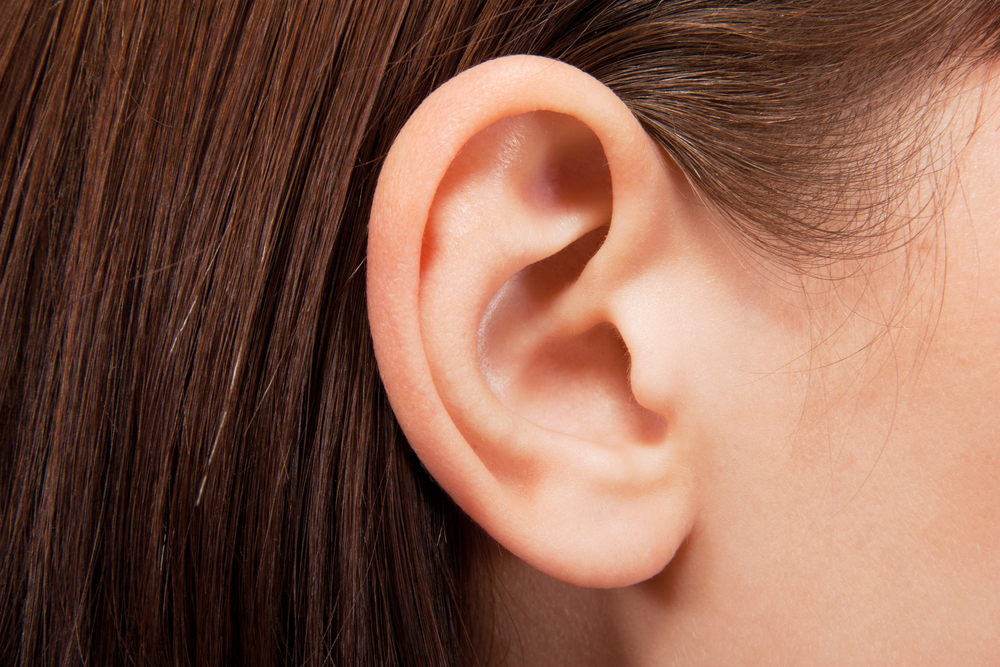
Human hearing begins with the external ear, which first consists of the atrium. The earpiece acts as a form of sound spectral preprocessing, where the input sound is modified based on its orientation relative to the listener. The sound then enters the ear canal through an opening in the atrium and subsequently modifies the spectral characteristics of the incoming sound by resonating this amplified frequency (ranging from ~1-6 kHz) [1].

How to make a machine listen like a human

Illustration of the human auditory system

When the sound waves reach the end of the ear canal, they excite the eardrum, to which the ossicles (the smallest bones in the human body) are attached. These bones transmit pressure from the ear canal to the fluid-filled cochlea of ​​the inner ear [1]. The cochlea plays an important role in guiding the representation of sound meaning for neural networks (NN), as this is the organ responsible for translating acoustic vibrations into human neural activity.

It is a coiled tube that is separated along its length by two membranes, Reisner’s membrane and the basement membrane. Throughout the cochlea, there is a row of about 3,500 inner hair cells [1]. When pressure enters the cochlea, its two membranes depress. The basement membrane is narrower and stiffer at the base, but wider and looser at its apex, making the response at a particular frequency stronger at each place along its length.

In simple terms, the basilar membrane can be thought of as a set of continuous membrane-length bandpass filters that separate sounds into their spectral components.

How to make a machine listen like a human

Illustration of the human cochlea

This is the most fundamental mechanism by which humans convert sound pressure into neural activity. Therefore, it is reasonable to assume that the spectral representation of sound is advantageous when building models of sound perception with artificial intelligence. Because the frequency response in the basilar membrane varies exponentially, a logarithmic representation of the frequency is probably the most efficient. Such a frequency representation can be generated using a filter bank of gamma tones. These filters are commonly used in spectral filtering modeling of the auditory system because they can estimate the impulse response of human auditory filters arising from auditory nerve fibers in response to a type of white noise called the “revcor” function.

How to make a machine listen like a human

Comparison of simplified human profile transduction and digitized profile transduction

The cochlea has about 3,500 inner hair cells, and humans can detect gaps in sounds 2 to 5 ms long, so spectral decomposition using 3,500 gamma tone filters divided into 2 ms windows seems like a machine to achieve. a spectrum similar to the human, the best parameter to represent. However, in real-world scenarios, I believe that less spectral decomposition also achieves desirable results in most analysis and processing tasks, while being computationally more feasible.

Various software libraries for auditory analysis are available online. An important example is Jason Heeris’ Gammatone Filterbank Toolkit, which not only provides tunable filters, but also provides tools for spectral analysis of sound signals using gammatone filters.

neural coding
As neural activity moves from the cochlea to the auditory nerve and ascending auditory pathways, several processes take place in brainstem nuclei before it reaches the auditory cortex.

These procedures build a neural code that represents the interaction between the stimulus and the perception. Much more about the specific jobs within these kernels are still conjecture or unknown, so I’ll cover how they work at a high level.

How to make a machine listen to sound like a human?

How to make a machine listen to sound like a human?

Human Ears
Human Ears

A great advance in artificial intelligence technology has been achieved by modeling human systems.

Human Perception


Although artificial neural networks are mathematical models that can only roughly simulate how human neurons actually work, their application to solving complex and ambiguous real-world problems is far-reaching. Furthermore, modeling the structural depth of the human brain in a neural network opens up a wide range of possibilities for learning more meaningful meaning behind the data.


In image recognition and processing, inspiration from the complex and spatially invariant neurons in the convolutional neural networks (CNNs) of the visual system has also resulted in substantial improvements in our technique. If you’re interested in applying image recognition techniques to audio spectrograms, check out my article “What’s wrong with convolutional neural networks (CNN) and spectrograms for audio processing?”

As long as human perception surpasses that of machines, we can learn to benefit from understanding the principles of human systems. Humans are highly adept at perceptual tasks, and in the field of machine hearing, the contrast between human understanding and current AI technologies is particularly stark. Considering the benefits of taking inspiration from human systems in the field of vision processing, I suggest that we can apply neural networks to similar processes in the field of vision, and there will be benefits in the field of machine hearing.

How to make a machine listen like a human

The process framework of this article

In this series of articles, I will detail a framework for real-time audio signal processing using AI developed in collaboration between Aarhus University and smart speaker manufacturer Dynaudio A/S. It draws heavily from cognitive science, which attempts to combine perspectives from biology, neuroscience, psychology, and philosophy to better understand our cognitive abilities.

Cognitive properties of sound.
Perhaps the most abstract way to think about sound is how we humans understand it. While solutions to signal processing problems must work within the confines of low-level property parameters such as intensity, spectrum, and time, the end goal is often recognizable: to transform the signal in a certain way. that is cognitively meaningful to us about the meaning contained in The Sound.

For example, if one wishes to programmatically change the gender of the speaker of a discourse, the problem must be described in more meaningful terms before defining its lower-level characteristics. A speaker’s gender can be thought of as a cognitive attribute made up of many factors: the tone and timbre of speech, differences in pronunciation, differences in word and language choices, and understanding of how these attributes relate to each other. relate to gender.

These parameters can be described by lower-level features, such as intensity, spectral, and temporal properties, but only in more complex combinations can they form higher-level representations of meaning. This forms a hierarchy of audio features from which the “meaning” of the sound can be inferred. The cognitive properties of human voices can be thought of as being represented by the combined time series patterns of intensity, spectrum, and statistical properties of sound.