
Psychoacoustic Threshold Estimation in MP3

Let’s talk about Psychoacoustic Threshold Estimation in MP3
Psychoacoustic threshold estimation in MP3 encoding is a crucial element for efficient compression. In my experience, this process plays a significant role in how audio is perceived by listeners after compression. It’s based on the principles of psychoacoustics, which examine how humans perceive sound. Essentially, psychoacoustic models allow MP3 encoding to remove parts of the audio that are inaudible to the human ear, making the file size smaller without compromising perceived quality. To understand it better, think of how you might ignore background noise when focusing on a conversation in a crowded room. Similarly, MP3 compression removes sounds that would not be heard by a listener under normal conditions.
In MP3 encoding, threshold estimation is done by analyzing the signal’s frequency spectrum. The human ear is more sensitive to certain frequencies and less sensitive to others. By determining which parts of the audio are inaudible based on these sensitivities, MP3 compression algorithms can selectively remove these frequencies. The result is a compressed file that maintains the most important parts of the sound while discarding unnecessary details.
The Role of Psychoacoustics in MP3 Compression
When discussing MP3 compression, psychoacoustics comes into play to ensure the best balance between sound quality and file size. It’s as though I’m packing a suitcase for a trip—choosing the essentials and leaving behind the non-essentials. In MP3 encoding, psychoacoustic models aim to identify which audio frequencies are masked by others, allowing them to be discarded without a noticeable loss in quality.
These psychoacoustic models use data about human hearing perception. For instance, our ears are more sensitive to mid-range frequencies than to low or high frequencies. When encoding an MP3, the algorithm uses this knowledge to reduce the representation of low and high frequencies, especially if they are masked by louder sounds in the mid-range. This approach reduces the file size, making it more efficient while maintaining an acceptable sound quality.
Psychoacoustic Models: Key Techniques for Estimation
Psychoacoustic models are essential for estimating thresholds in MP3 encoding. The two main models used in MP3 compression are the MPEG-1 Layer III and the more complex MPEG-2 Layer III. These models implement specific techniques to determine which parts of the audio signal can be discarded without affecting the perceived quality.
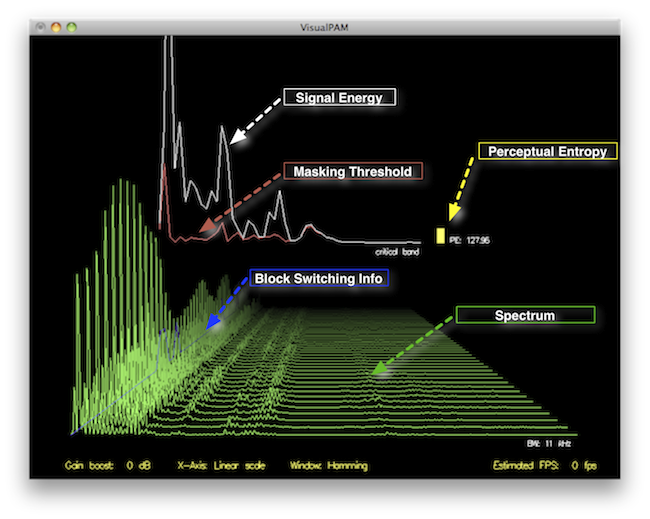
- Critical Bands: The human ear perceives sounds in frequency groups called critical bands. Each critical band includes frequencies that are close enough together that they affect each other’s perception. When encoding, psychoacoustic models assess these bands and eliminate those that won’t affect the listener’s experience.
- Masking Effect: This is a phenomenon where a louder sound makes it difficult to hear a quieter sound. The MP3 encoder uses this principle to discard sounds masked by others, reducing the file size.
- Threshold of Hearing: The threshold of hearing refers to the quietest sound that the average human ear can detect. Sounds below this threshold are effectively inaudible and can be removed during encoding.
Practical Example: How Psychoacoustic Threshold Estimation Works
Imagine you’re listening to your favorite song on your smartphone. The song is compressed into an MP3 file, but somehow it still sounds amazing. What’s happening behind the scenes is the psychoacoustic threshold estimation. For example, if you’re listening to a powerful guitar solo, the MP3 algorithm may eliminate some of the higher frequencies from the background sounds like drums or cymbals that are masked by the louder guitar notes.
From my experience, it’s much like watching a movie with a powerful soundtrack. When the action is intense, the quieter background sounds fade into the background. The MP3 encoder mimics this behavior, focusing on what’s essential to the listener’s perception of the music and discarding less important details. It’s a brilliant way to optimize audio files while preserving the listening experience.
The Benefits of Psychoacoustic Threshold Estimation in MP3
The main benefit of psychoacoustic threshold estimation is the reduction in file size. The more efficient the compression, the smaller the file size, which makes it easier to store and stream audio. This is particularly crucial in a world where bandwidth is often limited, and storage space can be at a premium.
Another benefit is the preservation of sound quality. As an audio professional, I’ve found that effective psychoacoustic modeling ensures that what’s important to the listener remains intact. The algorithm removes what isn’t necessary, but it does so without compromising the overall experience. For example, it’s as if you’re cleaning up a painting by removing minor smudges that no one would notice anyway. The final image (or audio) still looks great but is lighter.
Latest Words on Psychoacoustic Threshold Estimation in MP3
Psychoacoustic threshold estimation is an essential process for MP3 compression. It ensures that audio files are as small as possible while maintaining the best possible quality. From my expertise, understanding psychoacoustics is key to understanding how modern audio compression works. These methods allow for the efficient storage of high-quality sound without sacrificing too much bandwidth or space.
At the end of the day, MP3 encoding wouldn’t be nearly as efficient or effective without psychoacoustic threshold estimation. It’s a fascinating blend of human perception and technology that allows us to enjoy high-quality audio in a convenient format. In cases where precise audio management is critical, using specialized software can further enhance the quality of the compressed file, and Mp4Gain offers a reliable option in this area.
What is psychoacoustic threshold estimation in MP3 encoding?
Psychoacoustic threshold estimation in MP3 encoding is the process of determining which parts of an audio signal are inaudible to the human ear and can be discarded to reduce file size without affecting perceived sound quality.
How does psychoacoustic modeling affect MP3 compression?
Psychoacoustic modeling reduces MP3 file sizes by removing audio frequencies that are masked by louder sounds, ensuring only the most essential elements of the sound are preserved for optimal listening quality.
What is the masking effect in psychoacoustics?
The masking effect is when louder sounds make it difficult to hear quieter ones. MP3 encoders exploit this effect to remove inaudible sounds, making the file more efficient without sacrificing quality.
Why are some frequencies removed in MP3 compression?
Some frequencies are removed in MP3 compression because they are outside the human ear’s sensitivity range or are masked by louder sounds, making them unnecessary for a high-quality listening experience.
How do critical bands influence MP3 encoding?
Critical bands are frequency ranges that the human ear perceives as a group. MP3 encoders use this information to determine which sounds in a frequency band are crucial and which can be discarded without affecting quality.
What are the benefits of psychoacoustic threshold estimation for MP3 files?
The main benefit of psychoacoustic threshold estimation is reduced file size while maintaining sound quality. This is particularly important for efficient storage and streaming of audio files.
How does psychoacoustic modeling enhance listening experience?
Psychoacoustic modeling enhances the listening experience by focusing on the most important frequencies and discarding unnecessary ones, resulting in a clear, high-quality sound that doesn’t take up much storage space.
What is the threshold of hearing in psychoacoustics?
The threshold of hearing refers to the faintest sound that can be perceived by the average human ear. Sounds below this threshold are removed during MP3 encoding because they are inaudible.
How does psychoacoustic threshold estimation improve MP3 file size efficiency?
Psychoacoustic threshold estimation improves MP3 file size efficiency by removing audio frequencies that would go unnoticed by the listener, making the file smaller without sacrificing quality.


Comments:
I’ve always been amazed by how much smaller MP3 files are compared to other formats. This article really breaks down why that is so clearly! The psychoacoustic principles are fascinating.
– AudioFan99
Really interesting read! I never realized that so much of the sound is actually removed when encoding an MP3. This helps explain why high-quality audio formats like FLAC sound so much better.
– MusicLover123
I had no idea that psychoacoustic models played such a big role in MP3 quality. I wonder how much it varies across different types of audio, like classical versus rock music.
– CuriousJoe
Great explanation! Would love to know more about how these models evolve over time and how they’ve impacted newer audio formats.
– SoundGeek2024
I’ve been looking for a deeper dive into how MP3 compression works, and this article really filled in the gaps. So cool to see the science behind it!
– TechieGuy