How to make a machine listen to sound like a human? Part 2


Free Download Mp4Gain
picture

How to make a machine listen to sound like a human? Part 2
Human perception
Human perception

Neural networks (NNs) are very good at extracting abstract representations of data and are therefore ideal for detecting cognitive properties in sound. To build a system for this purpose, let us first investigate how sound is represented in the human hearing organ, which we can use to motivate neural networks to process representations of sound meaning.

Human perception
Human perception

cochlear representation
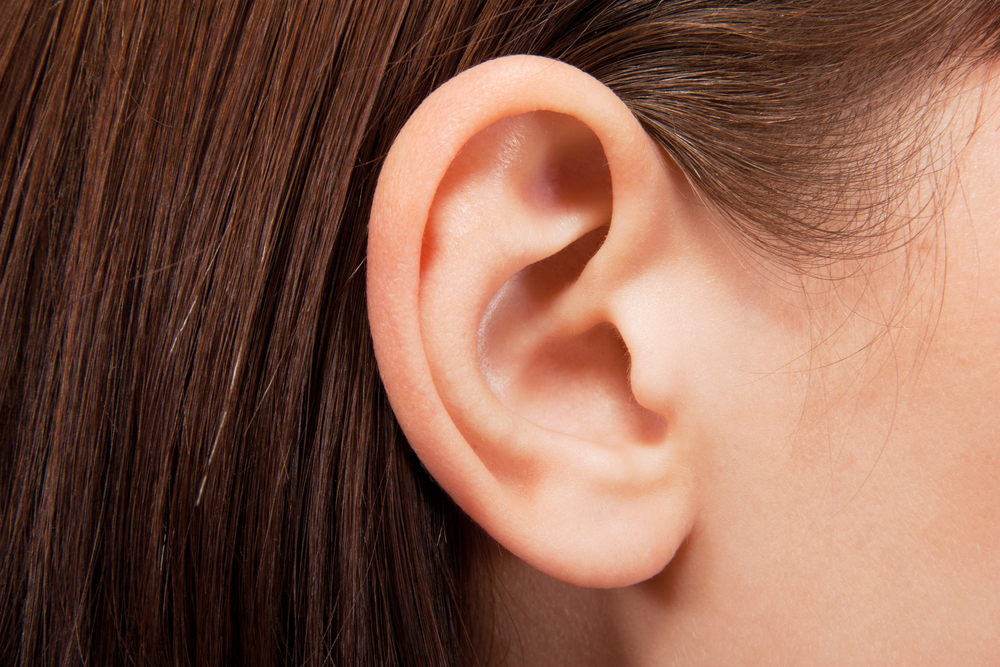
Human hearing begins with the external ear, which first consists of the atrium. The earpiece acts as a form of sound spectral preprocessing, where the input sound is modified based on its orientation relative to the listener. The sound then enters the ear canal through an opening in the atrium and subsequently modifies the spectral characteristics of the incoming sound by resonating this amplified frequency (ranging from ~1-6 kHz) [1].

How to make a machine listen like a human

Illustration of the human auditory system

When the sound waves reach the end of the ear canal, they excite the eardrum, to which the ossicles (the smallest bones in the human body) are attached. These bones transmit pressure from the ear canal to the fluid-filled cochlea of ​​the inner ear [1]. The cochlea plays an important role in guiding the representation of sound meaning for neural networks (NN), as this is the organ responsible for translating acoustic vibrations into human neural activity.

It is a coiled tube that is separated along its length by two membranes, Reisner’s membrane and the basement membrane. Throughout the cochlea, there is a row of about 3,500 inner hair cells [1]. When pressure enters the cochlea, its two membranes depress. The basement membrane is narrower and stiffer at the base, but wider and looser at its apex, making the response at a particular frequency stronger at each place along its length.

In simple terms, the basilar membrane can be thought of as a set of continuous membrane-length bandpass filters that separate sounds into their spectral components.

How to make a machine listen like a human

Illustration of the human cochlea

This is the most fundamental mechanism by which humans convert sound pressure into neural activity. Therefore, it is reasonable to assume that the spectral representation of sound is advantageous when building models of sound perception with artificial intelligence. Because the frequency response in the basilar membrane varies exponentially, a logarithmic representation of the frequency is probably the most efficient. Such a frequency representation can be generated using a filter bank of gamma tones. These filters are commonly used in spectral filtering modeling of the auditory system because they can estimate the impulse response of human auditory filters arising from auditory nerve fibers in response to a type of white noise called the “revcor” function.

How to make a machine listen like a human

Comparison of simplified human profile transduction and digitized profile transduction

The cochlea has about 3,500 inner hair cells, and humans can detect gaps in sounds 2 to 5 ms long, so spectral decomposition using 3,500 gamma tone filters divided into 2 ms windows seems like a machine to achieve. a spectrum similar to the human, the best parameter to represent. However, in real-world scenarios, I believe that less spectral decomposition also achieves desirable results in most analysis and processing tasks, while being computationally more feasible.

Various software libraries for auditory analysis are available online. An important example is Jason Heeris’ Gammatone Filterbank Toolkit, which not only provides tunable filters, but also provides tools for spectral analysis of sound signals using gammatone filters.

neural coding
As neural activity moves from the cochlea to the auditory nerve and ascending auditory pathways, several processes take place in brainstem nuclei before it reaches the auditory cortex.

These procedures build a neural code that represents the interaction between the stimulus and the perception. Much more about the specific jobs within these kernels are still conjecture or unknown, so I’ll cover how they work at a high level.


Free Download Mp4Gain
picture


Mp4Gain Main Window
picture


Mp4Gain Features
picture


Free Download Mp4Gain
picture

How to make a machine listen to sound like a human?

How to make a machine listen to sound like a human?

Human Ears
Human Ears

A great advance in artificial intelligence technology has been achieved by modeling human systems.

Human Perception


Although artificial neural networks are mathematical models that can only roughly simulate how human neurons actually work, their application to solving complex and ambiguous real-world problems is far-reaching. Furthermore, modeling the structural depth of the human brain in a neural network opens up a wide range of possibilities for learning more meaningful meaning behind the data.


In image recognition and processing, inspiration from the complex and spatially invariant neurons in the convolutional neural networks (CNNs) of the visual system has also resulted in substantial improvements in our technique. If you’re interested in applying image recognition techniques to audio spectrograms, check out my article “What’s wrong with convolutional neural networks (CNN) and spectrograms for audio processing?”

As long as human perception surpasses that of machines, we can learn to benefit from understanding the principles of human systems. Humans are highly adept at perceptual tasks, and in the field of machine hearing, the contrast between human understanding and current AI technologies is particularly stark. Considering the benefits of taking inspiration from human systems in the field of vision processing, I suggest that we can apply neural networks to similar processes in the field of vision, and there will be benefits in the field of machine hearing.

How to make a machine listen like a human

The process framework of this article

In this series of articles, I will detail a framework for real-time audio signal processing using AI developed in collaboration between Aarhus University and smart speaker manufacturer Dynaudio A/S. It draws heavily from cognitive science, which attempts to combine perspectives from biology, neuroscience, psychology, and philosophy to better understand our cognitive abilities.

Cognitive properties of sound.
Perhaps the most abstract way to think about sound is how we humans understand it. While solutions to signal processing problems must work within the confines of low-level property parameters such as intensity, spectrum, and time, the end goal is often recognizable: to transform the signal in a certain way. that is cognitively meaningful to us about the meaning contained in The Sound.

For example, if one wishes to programmatically change the gender of the speaker of a discourse, the problem must be described in more meaningful terms before defining its lower-level characteristics. A speaker’s gender can be thought of as a cognitive attribute made up of many factors: the tone and timbre of speech, differences in pronunciation, differences in word and language choices, and understanding of how these attributes relate to each other. relate to gender.

These parameters can be described by lower-level features, such as intensity, spectral, and temporal properties, but only in more complex combinations can they form higher-level representations of meaning. This forms a hierarchy of audio features from which the “meaning” of the sound can be inferred. The cognitive properties of human voices can be thought of as being represented by the combined time series patterns of intensity, spectrum, and statistical properties of sound.

Perceptual encoding of audio volume

Human acoustic perception takes place in two dimensions:
frequency
and
intensity
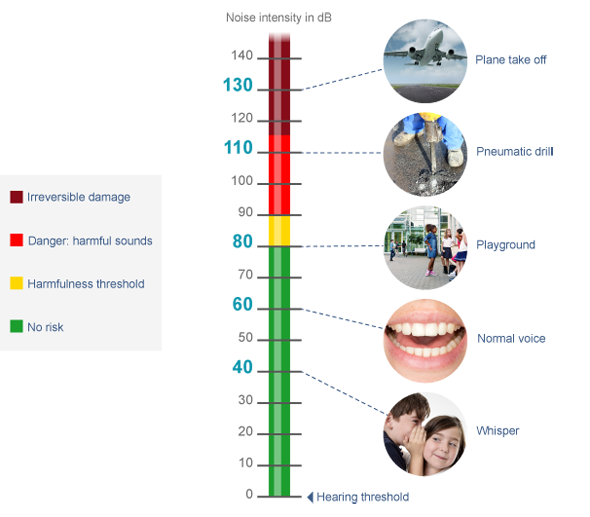
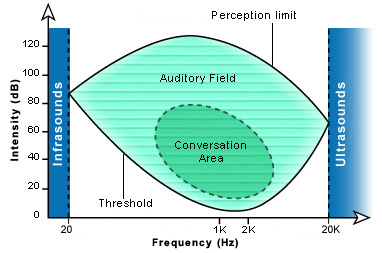
. In the frequency domain, the human ear is able to perceive frequencies in the range of 20 to 20,000 Hz. In terms of intensity, humans perceive a dynamic range around 120 dB. Sounds of intensity greater than 90 dB. They can cause irreversible damage.

Sound is produced by the interaction of a vibrating object, a transmission medium and a receiver. In order for the sound to be perceived by the human being, the object must vibrate with a frequency between 20 Hz and 20 KHz. The vibration produces an alternative compression and rarefaction of the air that is transmitted in the form of sound waves. These waves reach the ear, where electrical stimuli are produced that the brain interprets as sounds. The sound waves are attenuated with distance and can be absorbed or reflected by the obstacles they encounter.

Sound characteristics

A sound can be described by sutone
, bell, intensity and duration
. The
tone
of a sound is directly related to frequency, although they are not synonyms. Frequency is a physical magnitude associated with any sound, while tone (high or low) is a perceptual characteristic that we only capture in periodic sounds: those with a more or less constant frequency.

From the musical point of view, when doubling the frequency of a sound, it goes to the next octave. For example, the La of the central octave of the piano has a frequency of 440 Hz., And the La of the next octave (higher), 880 Hz. In Western music, the octave is divided into 12 semitones (the twelve keys that is in every octave of a piano). To obtain the frequency of a semitone from the frequency of the previous one, one must multiply by twelfth root of 2, or what is the same: 1,05946.

The
doorbell

it is the “personality” of a sound and allows
distinguish, for example, the sound of a piano and a trumpet with equal duration, intensity and tone. Graphically, the timbre is characterized by the shape of the wave. Pure sine waves are only obtained electronically, but in nature, the sounds are more complex. The most severe vibration frequency (base frequency) is what determines the period and amplitude. The remaining frequencies, which are usually multiples of the base frequency, are the harmonics

Related to intensity is the concept of
Dynamic range
, which is the difference in decibels between the loudest and weakest sound a system can produce. In a sound device, this value indicates the difference between the maximum volume and the background noise that is emitted when there is no signal. In sound equipment of a certain quality the dynamic range ranges from 80 dB to 95 dB

File Format

AU
. Sun standard audio format. Poor quality but they are very common on the Internet.

AIFF
(Audio Interchange File Format), common on Mac. There is a version with compressed samples, AIFF-C.

Quicktime
It also has audio format, synchronizable and integrable with other media.

WAV
(Waveform) is the Windows format.

MP3