Human acoustic perception takes place in two dimensions:
frequency
and
intensity
. In the frequency domain, the human ear is able to perceive frequencies in the range of 20 to 20,000 Hz. In terms of intensity, humans perceive a dynamic range around 120 dB. Sounds of intensity greater than 90 dB. They can cause irreversible damage.
Sound is produced by the interaction of a vibrating object, a transmission medium and a receiver. In order for the sound to be perceived by the human being, the object must vibrate with a frequency between 20 Hz and 20 KHz. The vibration produces an alternative compression and rarefaction of the air that is transmitted in the form of sound waves. These waves reach the ear, where electrical stimuli are produced that the brain interprets as sounds. The sound waves are attenuated with distance and can be absorbed or reflected by the obstacles they encounter.
Sound characteristics
A sound can be described by sutone
, bell, intensity and duration
. The
tone
of a sound is directly related to frequency, although they are not synonyms. Frequency is a physical magnitude associated with any sound, while tone (high or low) is a perceptual characteristic that we only capture in periodic sounds: those with a more or less constant frequency.
From the musical point of view, when doubling the frequency of a sound, it goes to the next octave. For example, the La of the central octave of the piano has a frequency of 440 Hz., And the La of the next octave (higher), 880 Hz. In Western music, the octave is divided into 12 semitones (the twelve keys that is in every octave of a piano). To obtain the frequency of a semitone from the frequency of the previous one, one must multiply by twelfth root of 2, or what is the same: 1,05946.
The
doorbell

it is the “personality” of a sound and allows
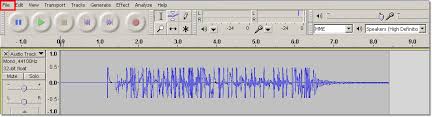
distinguish, for example, the sound of a piano and a trumpet with equal duration, intensity and tone. Graphically, the timbre is characterized by the shape of the wave. Pure sine waves are only obtained electronically, but in nature, the sounds are more complex. The most severe vibration frequency (base frequency) is what determines the period and amplitude. The remaining frequencies, which are usually multiples of the base frequency, are the harmonics
Related to intensity is the concept of
Dynamic range
, which is the difference in decibels between the loudest and weakest sound a system can produce. In a sound device, this value indicates the difference between the maximum volume and the background noise that is emitted when there is no signal. In sound equipment of a certain quality the dynamic range ranges from 80 dB to 95 dB
File Format
•
AU
. Sun standard audio format. Poor quality but they are very common on the Internet.
•
AIFF
(Audio Interchange File Format), common on Mac. There is a version with compressed samples, AIFF-C.
•
Quicktime
It also has audio format, synchronizable and integrable with other media.
•
WAV
(Waveform) is the Windows format.
•
MP3