How to make a machine listen to sound like a human? Part 2


Free Download Mp4Gain
picture

How to make a machine listen to sound like a human? Part 2
Human perception
Human perception

Neural networks (NNs) are very good at extracting abstract representations of data and are therefore ideal for detecting cognitive properties in sound. To build a system for this purpose, let us first investigate how sound is represented in the human hearing organ, which we can use to motivate neural networks to process representations of sound meaning.

Human perception
Human perception

cochlear representation
Human hearing begins with the external ear, which first consists of the atrium. The earpiece acts as a form of sound spectral preprocessing, where the input sound is modified based on its orientation relative to the listener. The sound then enters the ear canal through an opening in the atrium and subsequently modifies the spectral characteristics of the incoming sound by resonating this amplified frequency (ranging from ~1-6 kHz) [1].

How to make a machine listen like a human

Illustration of the human auditory system

When the sound waves reach the end of the ear canal, they excite the eardrum, to which the ossicles (the smallest bones in the human body) are attached. These bones transmit pressure from the ear canal to the fluid-filled cochlea of ​​the inner ear [1]. The cochlea plays an important role in guiding the representation of sound meaning for neural networks (NN), as this is the organ responsible for translating acoustic vibrations into human neural activity.

It is a coiled tube that is separated along its length by two membranes, Reisner’s membrane and the basement membrane. Throughout the cochlea, there is a row of about 3,500 inner hair cells [1]. When pressure enters the cochlea, its two membranes depress. The basement membrane is narrower and stiffer at the base, but wider and looser at its apex, making the response at a particular frequency stronger at each place along its length.

In simple terms, the basilar membrane can be thought of as a set of continuous membrane-length bandpass filters that separate sounds into their spectral components.

How to make a machine listen like a human

Illustration of the human cochlea

This is the most fundamental mechanism by which humans convert sound pressure into neural activity. Therefore, it is reasonable to assume that the spectral representation of sound is advantageous when building models of sound perception with artificial intelligence. Because the frequency response in the basilar membrane varies exponentially, a logarithmic representation of the frequency is probably the most efficient. Such a frequency representation can be generated using a filter bank of gamma tones. These filters are commonly used in spectral filtering modeling of the auditory system because they can estimate the impulse response of human auditory filters arising from auditory nerve fibers in response to a type of white noise called the “revcor” function.

How to make a machine listen like a human

Comparison of simplified human profile transduction and digitized profile transduction

The cochlea has about 3,500 inner hair cells, and humans can detect gaps in sounds 2 to 5 ms long, so spectral decomposition using 3,500 gamma tone filters divided into 2 ms windows seems like a machine to achieve. a spectrum similar to the human, the best parameter to represent. However, in real-world scenarios, I believe that less spectral decomposition also achieves desirable results in most analysis and processing tasks, while being computationally more feasible.

Various software libraries for auditory analysis are available online. An important example is Jason Heeris’ Gammatone Filterbank Toolkit, which not only provides tunable filters, but also provides tools for spectral analysis of sound signals using gammatone filters.

neural coding
As neural activity moves from the cochlea to the auditory nerve and ascending auditory pathways, several processes take place in brainstem nuclei before it reaches the auditory cortex.

These procedures build a neural code that represents the interaction between the stimulus and the perception. Much more about the specific jobs within these kernels are still conjecture or unknown, so I’ll cover how they work at a high level.


Free Download Mp4Gain
picture


Mp4Gain Main Window
picture


Mp4Gain Features
picture


Free Download Mp4Gain
picture

How to make a machine listen to sound like a human?

How to make a machine listen to sound like a human?

Human Ears
Human Ears

A great advance in artificial intelligence technology has been achieved by modeling human systems.

Human Perception


Although artificial neural networks are mathematical models that can only roughly simulate how human neurons actually work, their application to solving complex and ambiguous real-world problems is far-reaching. Furthermore, modeling the structural depth of the human brain in a neural network opens up a wide range of possibilities for learning more meaningful meaning behind the data.


In image recognition and processing, inspiration from the complex and spatially invariant neurons in the convolutional neural networks (CNNs) of the visual system has also resulted in substantial improvements in our technique. If you’re interested in applying image recognition techniques to audio spectrograms, check out my article “What’s wrong with convolutional neural networks (CNN) and spectrograms for audio processing?”

As long as human perception surpasses that of machines, we can learn to benefit from understanding the principles of human systems. Humans are highly adept at perceptual tasks, and in the field of machine hearing, the contrast between human understanding and current AI technologies is particularly stark. Considering the benefits of taking inspiration from human systems in the field of vision processing, I suggest that we can apply neural networks to similar processes in the field of vision, and there will be benefits in the field of machine hearing.

How to make a machine listen like a human

The process framework of this article

In this series of articles, I will detail a framework for real-time audio signal processing using AI developed in collaboration between Aarhus University and smart speaker manufacturer Dynaudio A/S. It draws heavily from cognitive science, which attempts to combine perspectives from biology, neuroscience, psychology, and philosophy to better understand our cognitive abilities.

Cognitive properties of sound.
Perhaps the most abstract way to think about sound is how we humans understand it. While solutions to signal processing problems must work within the confines of low-level property parameters such as intensity, spectrum, and time, the end goal is often recognizable: to transform the signal in a certain way. that is cognitively meaningful to us about the meaning contained in The Sound.

For example, if one wishes to programmatically change the gender of the speaker of a discourse, the problem must be described in more meaningful terms before defining its lower-level characteristics. A speaker’s gender can be thought of as a cognitive attribute made up of many factors: the tone and timbre of speech, differences in pronunciation, differences in word and language choices, and understanding of how these attributes relate to each other. relate to gender.

These parameters can be described by lower-level features, such as intensity, spectral, and temporal properties, but only in more complex combinations can they form higher-level representations of meaning. This forms a hierarchy of audio features from which the “meaning” of the sound can be inferred. The cognitive properties of human voices can be thought of as being represented by the combined time series patterns of intensity, spectrum, and statistical properties of sound.

Sound digitization

Sound digitization

Sound

Recently, the capabilities of multimedia equipment have grown significantly, but for some reason this area has not received enough attention.

Sound Perception

The average user suffers from a lack of information and is forced to learn only from his own experience and mistakes. With this article we will try to eliminate this annoying misunderstanding. This article is aimed at a common user and aims to help you understand the theoretical and practical foundations of digital sound, to identify the basic possibilities and techniques of its use.

What exactly do we know about the sound capabilities of a computer, other than the fact that our home computer has a sound card and two speakers? Unfortunately, probably due to insufficient literature or for some other reason, but the user is, in most cases, unfamiliar with anything other than Windows’ built-in audio input / output mixer and recorder. The only use of a sound card that a common user encounters is to play sound in games and listen to a collection of audio. And after all, even the simplest sound card installed in almost every computer can do much more: it opens up wide possibilities for everyone who loves and is interested in music and sound, and for those who want to create your own music, a sound. The card can become an omnipotent tool. To find out what the computer can do in the field of sound, you just need to take an interest and you will be presented with opportunities that, perhaps, you did not even know about. And all this is not as difficult as it might seem at first glance.

Some facts and concepts that are difficult to do without:

According to the theory of the Fourier mathematician, a sound wave can be represented as a spectrum of frequencies included in it.

The frequency components of the spectrum are sinusoidal oscillations (so-called pure tones), each of which has its own amplitude and frequency. Therefore, any vibration, even the most complex shape (for example, a human voice), can be represented as the sum of the simplest sinusoidal vibrations of certain frequencies and amplitudes. On the contrary, by generating different vibrations and superimposing them on each other (mixing, mixing), you can get different sounds.
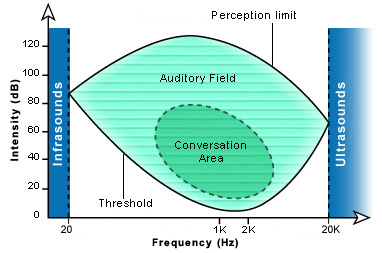
Note: The hearing aid / human brain is capable of distinguishing between 20 Hz and ~ 20 kHz frequency components (upper limit may vary based on age and other factors). Also, the lower limit fluctuates a lot depending on the intensity of the sound.

Digitize sound and store it on digital media
“Normal” analog sound is represented on analog equipment as a continuous electrical signal. The computer operates with data in digital form. This means that the sound on the computer is also represented in digital form. How does the conversion of an analog signal to digital occur?
Digital sound is a way of representing an electrical signal using discrete numerical values ​​of its amplitude. Let’s say we have a good quality analog audio track (by saying “good quality” we will assume a silent recording that contains spectral components from the entire audible frequency range, roughly 20 Hz to 20 KHz) and we want to “input” into a computer (ie digitize) without loss of quality. How to achieve this and how is digitization carried out? A sound wave is a kind of complex function, the dependence of the amplitude of a sound wave on time. It would seem that since it is a function, you can write it to a computer “as is,” that is, describe the mathematical form of the function and store it in the computer’s memory. However, this is practically impossible, since sound vibrations cannot be represented by an analytical formula (like y = x2, for example). There is only one way left: to describe the function by storing its discrete values ​​at certain points. In other words, at each moment, you can measure the value of the amplitude of the signal and write it as numbers. However, this method also has its drawbacks, as we cannot record the amplitude values ​​of the signal with infinite precision and we are forced to round them. In other words, we will approximate this function along two coordinate axes: amplitude and time (approximate in points means, in simple terms, taking the values ​​of the function in points and writing them with finite precision). Therefore, signal digitization involves two processes: a sampling process (sampling) and a quantization process. Sampling process is the process of obtaining the values ​​of the converted signal at certain intervals.

Quantization is the process of replacing the actual values ​​of the signal

Sound – Part 3

Sound – Part 3

Sound

The phenomenon of resonance plays an important role in the conduction of sound, in which the sound wave of a vibrating object causes the vibratory movements of another (resonator).

sound perception

The resonance can be sharp, if the natural oscillation period of the resonator coincides with the period of the acting force, and muffled, if the oscillation periods do not coincide. With a sharp resonance, the oscillations decay slowly, dull, quickly. It is important to note that the vibrations of the structures of the ear that conduct the sounds decay rapidly; This eliminates external sound distortion, so that a person can receive more and more sound signals quickly and steadily. Some structures of the cochlea have a sharp resonance, which helps to distinguish between two closely spaced frequencies. The main properties of the hearing analyzer. The main properties of the hearing analyzer include its ability to distinguish between the pitch (frequency concept) of sound, its volume (intensity concept) and the timbre, which includes the main tone and harmonics. As is common in classical physiological acoustics, the human ear perceives a band of sound frequencies from 16 to 20,000 Hz (12-24 to 18,000-24,000 Hz). The greater the amplitude of the sound, the better the audibility. However, up to a known limit, beyond which sound overload begins. Vibrations with a frequency of less than 16 Hz are called infrasound and above the upper limit of auditory perception (that is, more than 20,000 Hz) – ultrasound. Under normal conditions, the human ear does not pick up infrared and ultrasound, but with a special study these frequencies are also perceived, hearing gradually deteriorates with age. it moves towards the perception of low frequencies and the area of ​​greatest sensitivity. So if at age 20-40 it is in the 3000 Hz region, then at age 60 and older it shifts to the 1000 Hz region. The upper and lower limits of hearing can change with disease. of the auditory organ, as a result of which the area of ​​auditory perception is reduced. In children, the upper limit of sound perception reaches 22,000 Hz, in older people it is lower and usually does not exceed 10,000-15,000 Hz. In all mammals, the upper limit is higher than in humans: for For example, in dogs it reaches 38,000 Hz, in cats – 70,000 Hz, in bats – 200,000 Hz or more. As studies carried out in our country have shown, a person is capable of perceiving ultrasounds with a frequency of up to 200-225 kHz, but only with bone conduction.

+ The entire range of frequencies perceived by the human ear is divided into several parts: tones up to 500 Hz are called low frequency, 500 to 3000 Hz – medium frequency, 3000 to 8000 Hz – high frequency. Different parts of the range are perceived by the ear differently. It is most sensitive to sounds in the 1000-4000 Hz range, which is important for the perception of the human voice. The sensitivity (excitability) of the ear at frequencies below 1000 and above 4000 Hz is significantly reduced. Therefore, for a frequency of 10,000 Hz, the threshold sound intensity is 1000 times greater than for the optimal sensitivity zone of 1000-4000 Hz. The different sensitivity to low and high frequency sounds is largely due to to the resonant properties of the external auditory canal. The corresponding properties of the sensitive cells of the individual snail curls also play a role.

Sound – Part 2

Sound – Part 2

Sound perception

Physiological characteristics of sound perception

The identical states of a sound wave (areas of thickening or rarefaction) are called phases. The distance between the same phases is called the wavelength. Low sounds, in which the phases are far from each other, are characterized by a long wavelength, high sounds with a close phase position – small (short).

Phase and wavelength are important in the physiology of hearing. Thus, one of the conditions for optimal hearing is the arrival of a sound wave at the windows of the vestibule and cochlea in different phases (anatomically, this is provided by the sound conduction system of the middle ear). High sounds with a short wavelength cause vibrations of a low column of labyrinthine fluid (perilymph) at the base of the cochlea, low, with a longer wavelength, propagating to its apex. This circumstance is important for understanding modern theories of hearing.

The physical characteristics of sound also include the frequency and amplitude of sound vibrations. The unit of measurement for vibration frequency is 1 hertz (Hz), which is the number of vibrations per second. Amplitude of vibrations: the distance between the middle and extreme positions of the vibrating body. The amplitude of the vibrations (intensity) of the sound body largely determines the perception of sound. By the nature of vibratory movements, sounds are divided into three groups: pure tones, complex tones, and noise. Harmonic (rhythmic) sinusoidal vibrations create a clean and simple sound tone (that is, a tone of the same frequency sounds), like the sound of a tuning fork. An inharmonious sound that differs from simple tonal sounds in a complex structure is called noise. The noise spectrum consists of a variety of vibrations, the frequencies of which are chaotically related to the pitch frequency, like different fractional numbers. The perception of noise is often accompanied by unpleasant subjective sensations. Complex tones are characterized by an orderly relationship of their frequencies to the frequency of the main tone, and the ear has the ability to analyze complex sounds. In general, the ear decomposes each complex sound into simple sinusoidal components (Ohm’s law), that is, what happens in physics is called “Fourier’s theorem (series)”.

The ability of a sound wave to bend around obstacles is called diffraction. Low-frequency sounds with a long wavelength have better diffraction than high-pitched sounds with a short wavelength. The phenomenon of reflection of a sound wave from obstacles in its path is called an echo. The multiple reflection of sound in closed rooms from various objects is called “reverberation”. With good sound insulation of rooms, the reverberation is weak, for example, in a theater, cinema, etc., with poor sound insulation, it is strong. The phenomenon of superposition of the reflected sound wave on the primary sound wave is called “interference”. With this phenomenon, an increase or decrease in sound waves can be observed. When sound passes through the external auditory canal, its interference takes place and the sound wave is amplified.

Sound perception mechanism

Sound perception mechanism

The perception of sound

The sound vibrations of the air, passing through the external auditory canal, cause vibrations of the tympanic membrane and, through the auditory ossicles, are transmitted in an enhanced form to the membrane of the oval window leading to the vestibule of the cochlea.

SOUND PERCEPTION

The resulting vibration sets the perilymph and endolymph of the inner ear in motion and is sensed by the fibers of the main membrane, which carries the cells of the organ of Corti. The vibration of the hair cells of the organ of Corti causes the hairs to come into contact with the integumentary membrane. The hairs bend, causing a change in the membrane potential of these cells and the appearance of excitation in the nerve fibers that braid the hair cells. Through the nerve fibers of the auditory nerve, the excitation is transmitted to the auditory analyzer of the cerebral cortex.

The human ear can perceive sounds with a frequency of 20 to 20,000 Hz. Physically, sounds are characterized by frequency (number of periodic vibrations per second) and force (amplitude of vibrations). Physiologically, this corresponds to tone and volume. The third important characteristic is the sound spectrum, that is, a composition of additional periodic oscillations (harmonics) that arise together with the fundamental frequency and exceed it. The sound spectrum is expressed by the timbre of the sound. This is how the sounds of different musical instruments and the human voice are distinguished.

The distinction between sounds is based on the phenomenon of resonance that occurs in the fibers of the main membrane.

The width of the main membrane, that is, the length of its fibers is not the same: the fibers are longer at the apex of the cochlea and shorter at its base, although the cochlear canal is wider here. Its natural vibration frequency depends on the length of the fibers: the shorter the fiber, the more sound it resonates. When a high-frequency sound enters the ear, the short fibers of the main membrane located at the base of the cochlea resonate in it and the sensitive cells located in them are excited. In this case, not all cells are excited, but only those that are in fibers of a certain length. Low sounds are heard by the sensitive cells of the organ of Corti, located in the long fibers of the main membrane at the apex of the cochlea.

+ At the same time, the speed of the signal’s passage through the structures of the auditory organ and its entry into the cortex requires some reserves. Therefore, it is known that initially the hearing organ simply assesses the arrival of the signal and then adjusts to the level of best audibility. This means that the first stage takes between 35 and 175 milliseconds and the second between 180 and 500. At the same time, the maximum number of distinguishable sounds depends on the frequency of vibration and the functional state of the organ, and is set at 3 – 4 thousand shades.

Therefore, the primary analysis of sound signals begins already in the organ of Corti, from where the excitation is transmitted along the fibers of the auditory nerve to the auditory center of the cerebral cortex in the temporal lobe, where they are evaluated. qualitatively.

Mp3, how it compresses the sound and why it needs to be normalized

The mp3 bases its effectiveness on that it is based on human hearing. That is, from knowing the limitations and behaviors of the human ear, it is that they have managed to eliminate information without this fact affecting the quality, if other values, such as bitrate and sample rate, are kept at adequate levels.

Sound perception
Characteristics of human hearing

Human hearing is not perfect. In addition to the physical limitations of the ear, sound has to travel through the nerves to the auditory cortex of the brain, where it is transformed into different perceptions of which we are aware.

sound perception mp3
Volume:

Two sounds with the same amplitude can be perceived with different intensity depending on the frequencies they have. The perception of the intensity of a sound is not constant with frequency. The human ear has a greater sensitivity to sound between 1000 and 5000 Hz. All the points of the curve are perceived with the same volume (volume), but the necessary sound pressure is not the same.


Frequency range

Human beings can perceive sounds in the frequency range of 20 Hz to 20 kHz due to the physical limitations of the ear. The frequency range changes with age, we lose the ability to hear the higher frequencies as we age.


Dynamic range

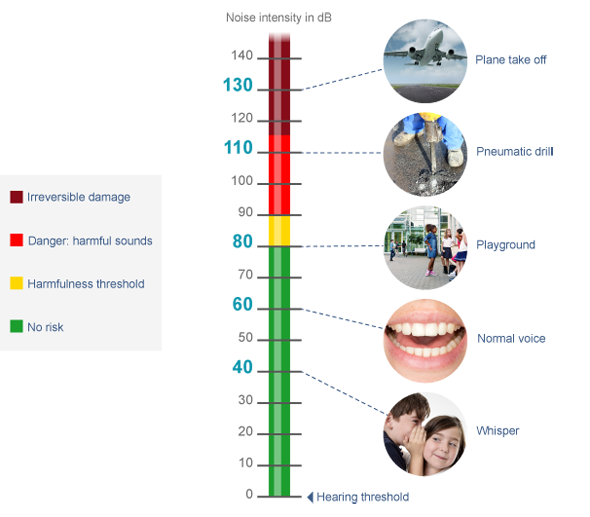
The smallest variation in air pressure that a human can detect (20 micropascals) measured at the frequencies where we are most sensitive, is used as a reference (0 dB) to measure the intensity of other sounds.

Power in dB (decibels) =, where P is the power considered and is the power corresponding to 20 micropascals.

A normal conversation is between 50-60 dB and the sound of car traffic is approximately 80 dB. The maximum sound that the ear can tolerate is 130 dB, which provides a dynamic range of 0 to 130 dB.


Auditory masking

Hearing masking is defined as the “decreased audibility of one sound due to the presence of another.” Auditory masking consists of frequency masking and temporal masking:


Frequency masking:

Also called simultaneous masking, it is best explained with an example. If you have a loud sound with a frequency of 1000 Hz, and also a sound at the 1100 Hz frequency that is 18 dB below the above, the 1100 Hz sound cannot be heard because it is being masked by the louder sound of 1000 Hz. This is because the 1000 Hz sound is louder and has a close frequency. The closer they are in frequency, the louder the sounds that can be masked by the louder sound. (Figure 2)

Temporary masking: occurs before and after a loud sound. If a sound is masked after a louder sound, it is called post-masking, and if it is masked in advance it is called pre-masking. Previous masking only exists for a brief moment (20 ms). Subsequent masking takes effect up to 200 ms. (Figure 3).

By exploring both masks (in frequency and time) it is possible to substantially reduce the audio information, without an audible change.

That is, there are at least four facts that allow the information to be reduced without the ear detecting it.

1.- The human ear does not detect the stereo in the low frequencies.

2.- If two or more sounds occur at nearby frequencies, the human ear will only listen to the loudest sound.

3.- The sounds before and especially after a loud sound are also masked or “covered” by the loudest sound.

4.- The ear does not receive the same volume at all frequencies.

All this allows the mp3 to discard information, a lot of information, that the human ear will not detect, if a suitable bitrate and samplerate are used.

Waveform and perceptual encoders

There are two types of audio encoders. First we have the waveform encoders, which try to reconstruct the signal as exactly as possible after encoding and decoding.

Perceptual encoders do not attempt to keep the signal exactly as it was before the encoding and decoding step. They seek to ensure that the human ear perceives the output as the original. Taking advantage of knowledge about the properties of hearing and the limitations of human hearing, the perceptual encoder removes part of the signal that we cannot perceive.

Almost all perceptual encoders transform the sound from the time domain to the frequency domain, and they soon separated the different frequencies into subbands. Then he uses his knowledge of how the ear works to remove unnecessary information. The chewing effect is the most commonly explored hearing phenomenon.

Sound perception

Up to 20 years if you have not abused headphones and concerts, the ability to perceive frequencies is maximum. Or approximately 20Hz to 20,000Hz. 1 Hertz is written Hz, = one oscillation per second.

The louder the sound, the more directional it is in space like a laser beam. That is why it is advisable to have tweeters at ear level, but treble stops quickly due to obstacles.

The lower the sound, the more it radiates in all directions and crosses many obstacles such as walls and ceilings.

A church organ can drop to 16Hz. The bass of a 26.7Hz grand piano, the electric basses are between 40 and 50Hz. The lowest frequencies are vibrations that we can pick up. Higher frequencies, if not directly audible, can influence the audible frequencies through the harmonic set. These harmonics are multiples or submultiples of the fundamental frequencies. They characterize the timbre of a voice or an instrument or a microphone.

The most common audio formats.

.MP3 called MPEG 1 and 2 layer 3 (since 1992)
The evolution of the format recently stopped, it is a compressed format. There are 56 different 56Khz qualities, enough to listen to a dictated text. 128kilo bits per second is fine for electric music or 320KBPS, the highest quality in MP3. It exists in medium quality with a variable bit rate VBR = variable bit rate. The quality of the transmission varies in real time according to the variations of the audio file.

.WMA Windows Media Audio (since 1999)
Compressed format used by Microsoft Windows software with variable quality, in some cases lower or higher than MP3. In 8 or 16 bits, sampled from 8Hz to 48KHz, mono or stereo with a data stream of 5 to 192KHz. With a quality roughly equal to MP3 128KPPS, the 96KHz WMA file takes 25% less space than MP3.

.OGG Vorbis (since 1993)
Less common format. It is a compressed audio format that comes from the free Linux environment. Slightly higher than MP3 and WMA format suitable for 8 to 48KHz 16-24 bit surround sound and transmission, with an audio data stream of 16 to 512KBPS, often 128 to 320KBPS. It exists in medium quality with a variable bit rate VBR = variable bit rate. The quality of the transmission varies in real time according to the variations of the audio file.

AAC Advanced Audio Coding (since 1997)
The compressed format allows better quality than MP3. An upgraded version HE-AAC or eAAC + (MPEG 4) is used for DAB (Digital Audio Broadcasting) digital radio transmission.

.M4a (audio) and .MP4 (audio or video)
Compressed formats. They are used for APPLE products and are of very good quality.

.WAV
It is a very good quality uncompressed format. By default, high-quality recording in dictaphone. For an audio CD (700Mo), these are 16-bit packets extracted or read 44100 times per second = 44.1KHz with a flow of 1411KBPS = Kilo bits per second. Which is much higher than the MP3 which has a 320KBPS limit.

Perceptual encoding of audio volume

Human acoustic perception takes place in two dimensions:
frequency
and
intensity
. In the frequency domain, the human ear is able to perceive frequencies in the range of 20 to 20,000 Hz. In terms of intensity, humans perceive a dynamic range around 120 dB. Sounds of intensity greater than 90 dB. They can cause irreversible damage.

Sound is produced by the interaction of a vibrating object, a transmission medium and a receiver. In order for the sound to be perceived by the human being, the object must vibrate with a frequency between 20 Hz and 20 KHz. The vibration produces an alternative compression and rarefaction of the air that is transmitted in the form of sound waves. These waves reach the ear, where electrical stimuli are produced that the brain interprets as sounds. The sound waves are attenuated with distance and can be absorbed or reflected by the obstacles they encounter.

Sound characteristics

A sound can be described by sutone
, bell, intensity and duration
. The
tone
of a sound is directly related to frequency, although they are not synonyms. Frequency is a physical magnitude associated with any sound, while tone (high or low) is a perceptual characteristic that we only capture in periodic sounds: those with a more or less constant frequency.

From the musical point of view, when doubling the frequency of a sound, it goes to the next octave. For example, the La of the central octave of the piano has a frequency of 440 Hz., And the La of the next octave (higher), 880 Hz. In Western music, the octave is divided into 12 semitones (the twelve keys that is in every octave of a piano). To obtain the frequency of a semitone from the frequency of the previous one, one must multiply by twelfth root of 2, or what is the same: 1,05946.

The
doorbell

it is the “personality” of a sound and allows
distinguish, for example, the sound of a piano and a trumpet with equal duration, intensity and tone. Graphically, the timbre is characterized by the shape of the wave. Pure sine waves are only obtained electronically, but in nature, the sounds are more complex. The most severe vibration frequency (base frequency) is what determines the period and amplitude. The remaining frequencies, which are usually multiples of the base frequency, are the harmonics

Related to intensity is the concept of
Dynamic range
, which is the difference in decibels between the loudest and weakest sound a system can produce. In a sound device, this value indicates the difference between the maximum volume and the background noise that is emitted when there is no signal. In sound equipment of a certain quality the dynamic range ranges from 80 dB to 95 dB

File Format

AU
. Sun standard audio format. Poor quality but they are very common on the Internet.

AIFF
(Audio Interchange File Format), common on Mac. There is a version with compressed samples, AIFF-C.

Quicktime
It also has audio format, synchronizable and integrable with other media.

WAV
(Waveform) is the Windows format.

MP3